
Title inspired by Chrissy’s immaculate: “Why are Non-Binary People Like That?”
If you clicked on this article, you probably already know what I mean. Polyamory people are like that. But what is that?
There’s a certain ick factor I get from a certain type of polyamorous person (#NotAllPolyamorousPeople). I have a leg to stand on here because I have been in one long-term open relationship, and have been partnered with people who were polyamorously married. I’m in “the scene” or whatever the fuck. But much like Chrissy writing about being non-binary, I have to ask—as an occasionally non-monogamous person—why do y’all have to make it so embarrassing?
I am not entirely pro-monogamy or anti-polyamory. I’m down to have a bohemian open kind of thing in my relationships. Mainly, I’m really just open to what the relationship calls for, what the dynamic beckons.
What I am exploring here is why I get a particular ick from a particular style of polyamory.
Human beings get the ick from anyone missionizing. It’s cool to believe in something, but when someone pushes that belief onto you, it gets creepy; connecting with a belief system (whether it’s Jehovah’s Witnesses or ethical non-monogamy) is a deeply personal thing, so it’s odd when a person believes they can universalize this singular, individualized thing. Like, you don’t know me. Do you think this particular divinity is going to improve my life? That this style of dating would work best for me?
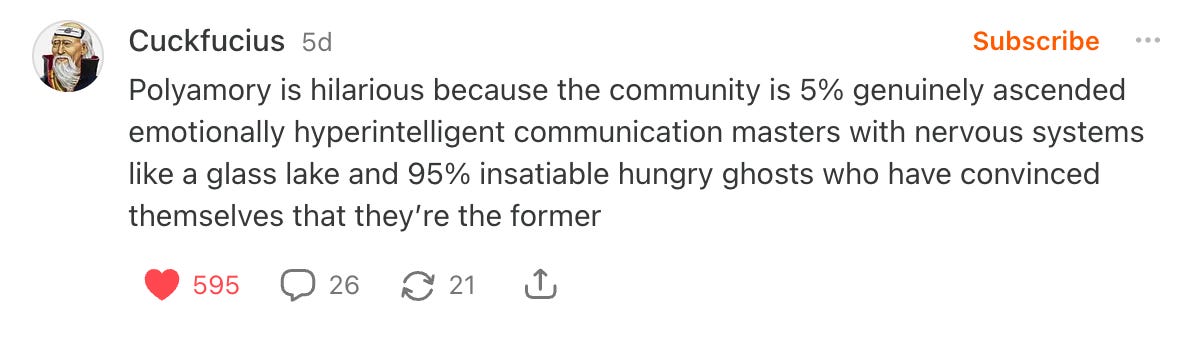
In my dating and social life, I’ve noticed that the people most committed to polyamory were also raised religiously Christian. It’s interesting how these former believers think that by banging half the city, they have overcome their strict, judgmental, exclusionary, morally self-righteous upbringing. Instead, they traded the Bible for Polysecure, the congregation for the polycule, and church for the dispensary.
They still have the same evangelical cadence, the same conviction that they’ve discovered not just a lifestyle that works for them, but the lifestyle that would liberate everyone else if only we’d stop being so repressed and provincial.
Finally, the logics of “acceptance” and “community” in polyamory and Christianity are very similar. In Meghan Daum’s early-2000s essay “According to the Women I’m Fairly Pretty,” she spends a week with a polycule house which is also, not surprisingly, obsessed with different sci-fi and fantasy media. They call their familycule the Ravenhearts; one of their members is famously credited with coining the term polyamory.
They have a calendar for who sleeps with who, meetings about who has committed which grievance. Daum endeavored to figure out what I want to know: why does this leave an icky taste in our mouths? That’s when she lands on it: There’s no hate like Christian love, and there’s no exclusion like polyamorous acceptance. Both groups say that they are truly open, that they love and accept everyone–just so long as you join their ranks. Daum concludes:
“This is where the Ravenhearts lose me. It’s not their polyamory I have a problem with. It’s their forced iconoclasm. It’s their paraphernalia. It’s the fact that they don’t seem to sleep with anyone who isn’t just like them. The result is that too often ‘deeply connecting’ seems more a matter of shared membership in a subculture–a subculture that is based around the premise of ‘not fitting in’ and has an entire system of toys and tchotchkes and T-shirts to consumerize the idea of not fitting in–than it does with actually connecting” (112).
I LIKE BEING JEALOUS! I LIKE IT WHEN MY PARTNER IS JEALOUS! Like, in small doses and mostly playfully and in a healthy way. It’s hot. But, yeah, I fucking like that.
The main way poly people therapize you is by saying that jealousy is “always about something else,” that it’s “information.” Yes–the information is that I am jealous. If I had a dollar for every time a polyamorous person told me, with the tone of a kindergarten teacher speaking to a child incapable of sharing, that my jealousy is “actually about personal insecurity” or “a different issue in the relationship,” I would be able to build a city that does not accept polyamorous people.
Aside from the fact that I do not want straight men with poorly-painted nails to explain my emotional interiority to me, I generally dislike this desire to annihilate and abolish jealousy in romantic relations.
We are overly-therapized. We are trying to do away with all the scary, negative, bad, “toxic” human experiences. But fuck that. Jealousy is fun as hell. I don’t want to “unlearn” my jealous inclinations.
One time I dated a woman who very obviously was getting the eyes from a lot of other women at a party we went to together.
When we got home, I told her that it sparked a bit of jealous anxiety in me. I pinned her down and told her, “you’re mine, do not ever fuck anyone else.” We verbalized a fantasy to one another about my tying her to my bed frame, never letting her be seen by anyone else.
Then she flipped me over onto my stomach and said she’d show me “just how much” she “doesn’t want anyone else,” that I would come to know how much she wanted me and only me–a want so profound I would come to regret its physical impact. As I felt her fourth finger enter me, I only regretted not telling her earlier that I often felt jealous.
It was hot. The reassurance, the admission of jealousy, the mutual sense of ownership and possession thereafter. This is what poly people want to get rid of and you’re laughing; someone who still has the Buzzfeed app on their phone is trying to take away hot, semi-toxic sex and you’re laughing.
Put simply: I want to feel jealous. I want my partner to occasionally get jealous. I want to have the kind of sex produced from that jealousy. I love when I catch that envious glint in my partner’s eye, that worry that I might leave, and they come up to me at the function to put their arm around me.
Everything in moderation. Ice cream for one breakfast a month, TV binges every other week, MDMA twice a year in Europe. A bad thing once in a blue moon makes the bad thing a good thing—a way for human beings to prove that they can engage with something toxic, without being ruined by it. It is actually better to do the bad thing once in a while, do it well, than to not do it at all. What else is free will for?
Jealousy is closely linked with arousal, a sensation poly people do not exactly inspire or aspire toward. I can only imagine what disgusting, overly sincere, sappy conversation would ensue with a poly if I told them I felt jealous.
“Well, what is this really about?” they would say, eyebrow furrowed like a therapist trying to unlock some Freudian desire to fuck a flower vase and not a perfectly normal part of the human condition.
Sure, it could be a sign of insecurity, but it could also just be a sign of desire and possessiveness for my partner. Oh yeah right, I’m not supposed to want to “possess” my partner because this has “connotations of private property ownership and capitalism.”
I hope my love for my spouse and the love they have for me is exactly like private property ownership: protected with a shotgun, single-mindedly labored at and saved up for, profoundly cherished.
My main issue (as someone who fucks and dates proliferously) with the poly community is the way in which a centuries-old practice has become commodified by publishing and Millennial therapists with TikTok accounts.
I’m not polyphobic because I am pro-monogamy. I date in a way that has often had me fighting the p-word accusation.1 “But Your Honor, I did not maintain a manipulative emotional monopoly over multiple women at once.”
I’m not the first person to write this, but the issue is the strange moral bureaucracy that now accompanies dating.
Polyamory, at least in its contemporary urban-professional form, feels like HR-managed desire. Every impulse must be processed, named, workshopped, disclosed in a Google Calendar invite with pastel color coding. Nobody can simply lust; they have to “navigate attachment structures” and “honor everyone’s boundaries” and “hold space.”
What if I told you that my attachment style is my mouth to your clit/dick?
Instead, the language is antiseptic. Sometimes, the greatest sign of emotional intelligence is the ability to do something with minimal verbal communication, to feel the emotional tone of the moment, to pursue it without adjudicating on it.
I think back to that hot, jealousy-ridden sex with my then girlfriend. Wasn’t turning it into a fun sex game a way of communicating that rose above the rote, brute force therapy circle thing? We locked eyes and without saying it aloud, acknowledged the insecurity and newfound security in our relationship. And then we both came.
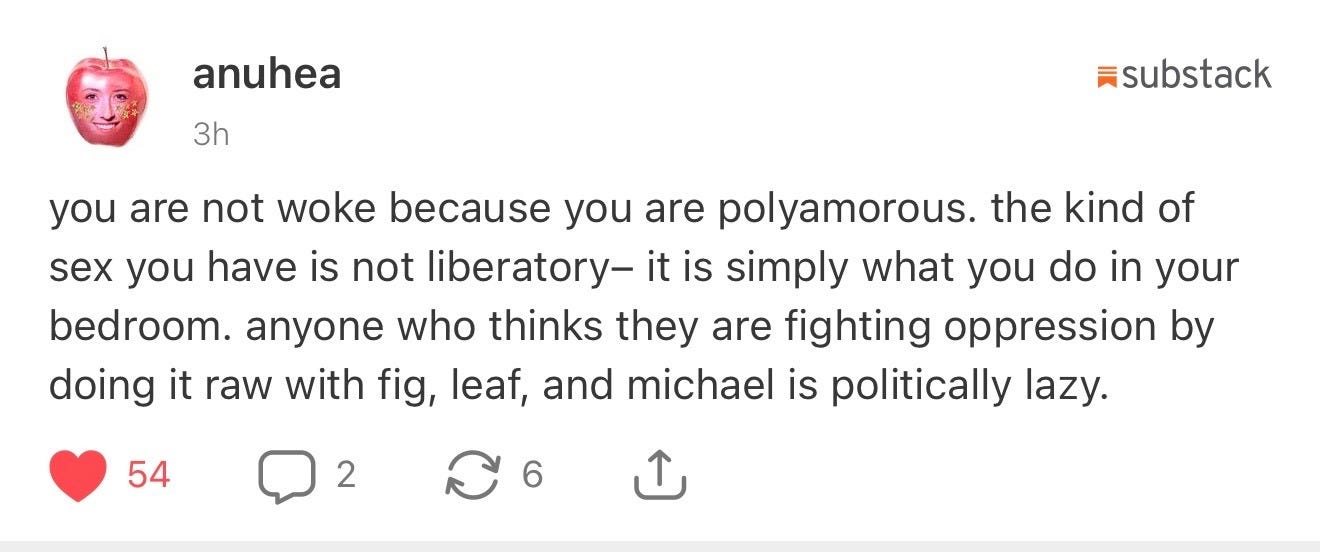
I just don’t think people should turn their sexual and romantic activity into a political ideology. I don’t want some guy with a gage to virtue signal to me because he has three fuck buddies. I don’t want people who look like they worked at GameStop and Hot Topic from 2013-2016 to think they deserve to recommend books to me.
Every time I ask a polyamorous person what it practically means to be poly, they tell me something like, “Well, I’m seeing a few people, and I’m sleeping with all of them. They vaguely know about each other, I have stronger feelings for some and weaker feelings for others.” Isn’t that just dating in a big city? What are you doing differently than Charlotte York?
There’s also the heterosexuality of it all. Straight people dating like gay men call themselves polyamorous. Straight people realized they could fuck more than one person at once and started dedicating blogs and political thought to this practice, when gay dudes have been doing this without a second thought since forever. And it’s not just the gays, it’s really lots of artists and members of the avant-garde who had open marriages, different kinds of arrangements, etc.
Kathy Acker, a true experimental postmodern writer of the late-20th century, was married twice and seriously partnered more times than that. None of these relationships (which often overlapped) were monogamous, but they weren’t polyamorous either. They just did what they wanted.
In Memoirs of a Beatnik by Diane di Prima (1 of the best memoirs ever, and 1 of the only female-written things from the Beat generation) she describes her dating life, which largely consisted of sleeping with multiple women or men at once who not only knew about each other, but knew each other very closely from being in the same friend group or even family. She lives and fucks and loves as she pleases, following the natural dynamic that arises within herself and between others. Oh and guess what, they never called this a fucking polycule.
The first gay English language erotica, Teleny (1893) doesn’t even consciously approach the question of whether or not to put a label on the two male love interests. They experience jealousy; they have their first kiss then fuck other people, then have a weekend-long fuck fest, before discussing exclusivity, at which point they go to a sex party where they decide to not fuck anyone else, for now.
Polyamory is hardly new, and the old way did something better. It flows naturally, decided purely by the dynamic of the actual couple rather than the impositions of some totalizing belief system or theory. They follow the stream of their relationships, their body, the vibe.
There are no unwavering rules, no ten commandments of ethical non-monogamy. And what’s more, they don’t need them. Things are not always perfect, but people are clear-eyed, respectful, and self-aware enough to know when a new partner would be the right thing, when to stay and when to go. Not everything needs to be discussed, labeled, adjudicated.
There was “open communication” and “boundaries” and consideration for the “comfort of the other person.” But they don’t label any of it. They do what feels right, and none of it feels moralistic or ethical. It’s not immoral or unethical either.
Asking if my sex life is moral or ethical feels a lot like asking if a table is feminist; this is not the purpose of a table. A table cannot be feminist or anti-feminist. And I’d wager that the second you start trying to will a feminist table into existence, you’ll get some schlocky, hot pink, bizarrely shaped countertop which is actually an insult to feminism. Likewise, the second you start trying to force “ethical” onto “non-monogamy,” you get the relational and philosophical equivalents of a mass-produced fuschia desk labeled “feminist table,” like something in the props department for Portlandia.
And if you have to clarify that your movement is ethical in the title, maybe it isn’t?
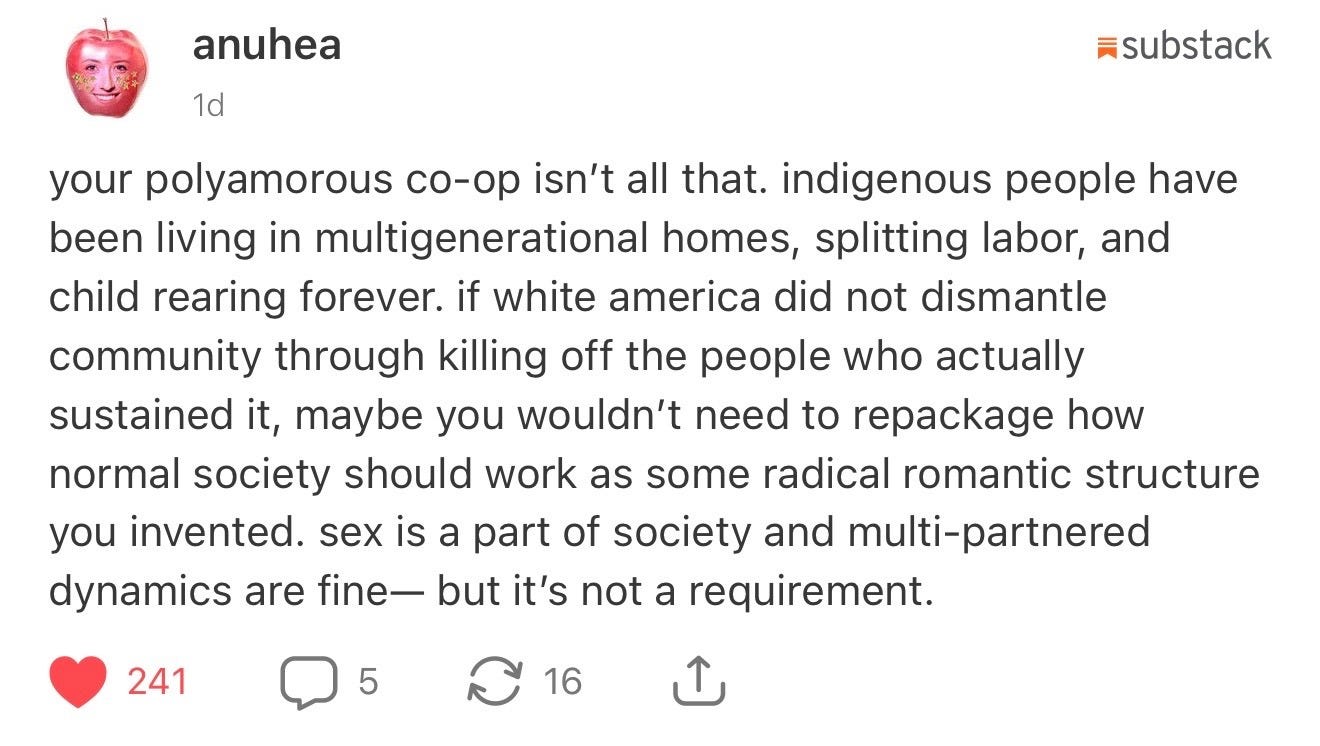
Critical Intimacies by Erin Williams, one of my favorite blogs on here, has written a lot and very well about the rise of “hetero ‘ethical non-monogamy’” as a “new intimacy purity regime.” She draws upon Foucault, who famously reversed the idea that 19th-century Victorians were prudish puritanicals, whose greatest sin was being fearful and repressive toward sexual speech. Quite the opposite, he tells us. They talked about sex constantly, and were responsible for many of the sexual typologies, pathologies, stereotypes, and ideas we still have today. And so, when the 1960s left said that to liberate ourselves we must talk about sex, Foucault intervened.
Williams writes, “His argument was that the modern injunction to speak truthfully about desire (to confess it, analyze it, and produce it as knowledge) was power’s most sophisticated operation. Repression was the crude version. The incitement to discourse was the refined one. Speaking your desire doesn’t free you. You are produced as a subject by the requirement to speak it, to make it legible, to submit it to examination and management.”
In Tomorrow Sex Will Be Good Again, the theorist Katherine Angel also invokes Foucault to tell us that talking about sex is not giving up power. Saying yes to sex does not mean saying no to power.
To be clear, I think that talking is better than not being able to speak at all. As someone who spends time with repressed people, I’ve always found Foucault’s argument a little too strong. Certainly, for many people, being able to talk about sex and romance is very liberating. The question is how.
xoxo,
femcel
to clarify, i date polyamorously/openly when it is called for, but i am not living and dying by being polyamorous as an identity
No posts
Comments
Nothing yet. Say the first thing.
Sign in to join the conversation.