
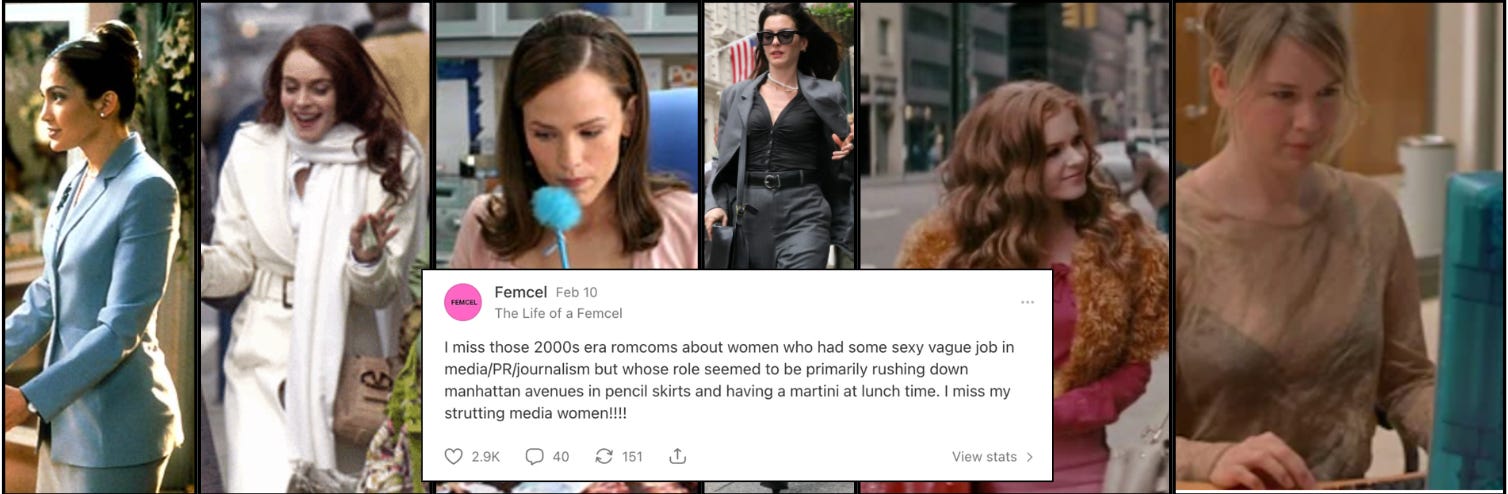
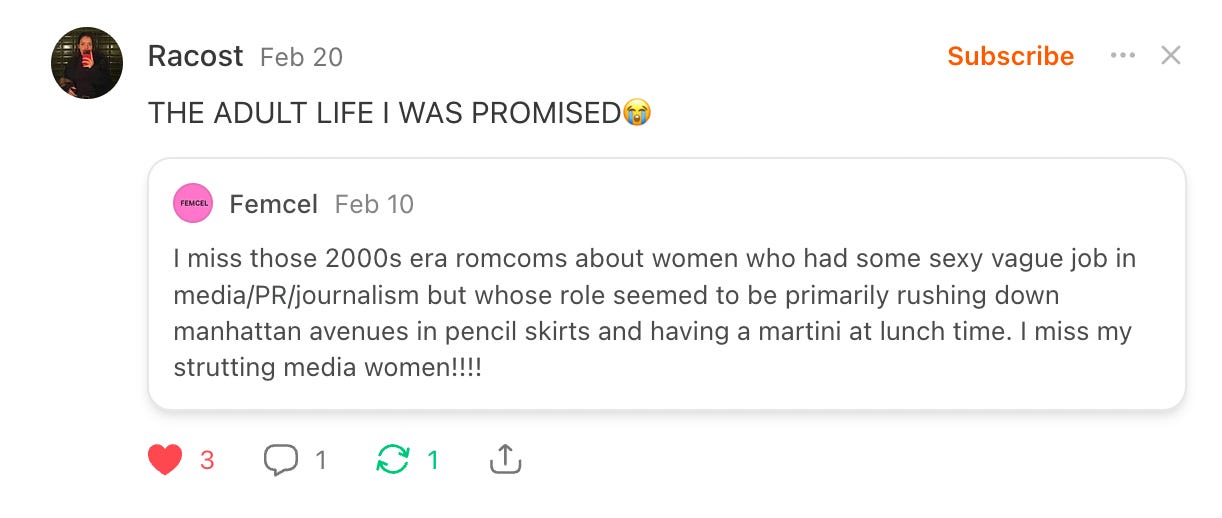
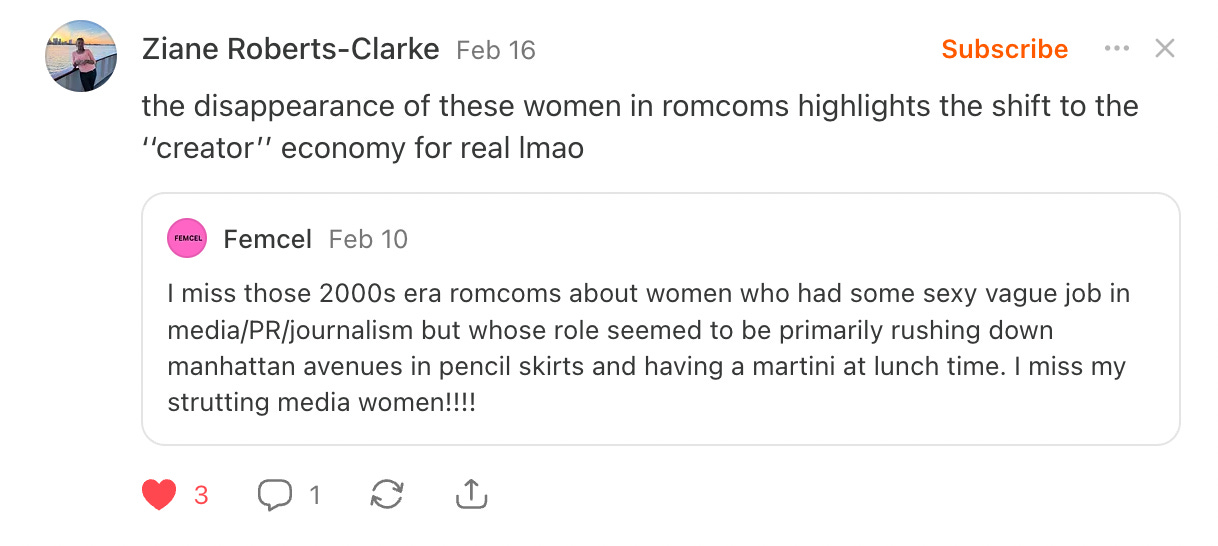
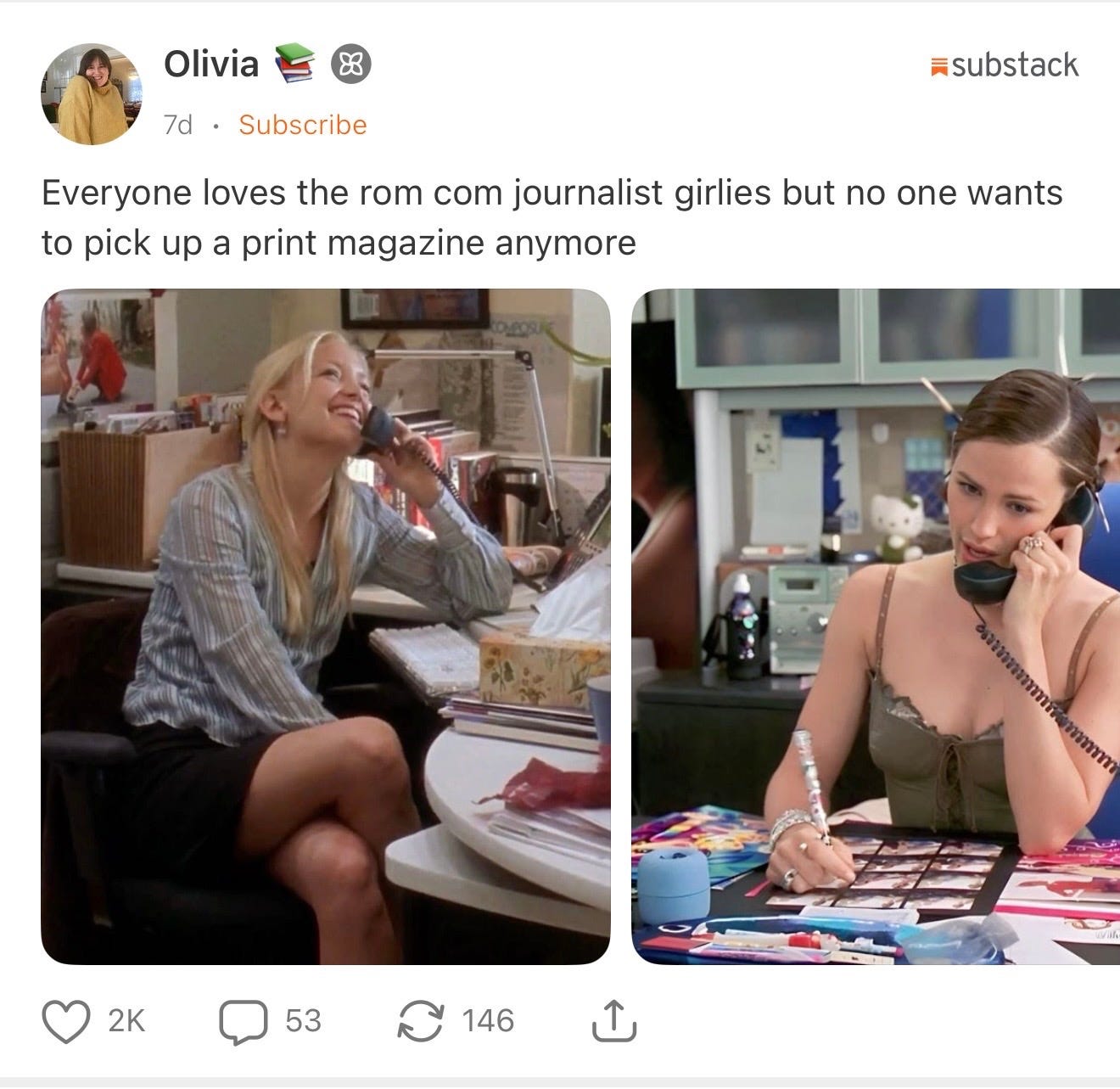
The original note: I miss those 2000s era romcoms about women who had some sexy vague job in media/PR/journalism but whose role seemed to be primarily rushing down Manhattan avenues in pencil skirts and having a martini at lunch time. I miss my strutting media women!!!!
Born in 2001, I grew up under the distant guidance of movies made just before and after I arrived in a Los Angeles maternity ward—films that would quietly shape my expectations years later, streaming on my middle school laptop.
How to Lose a Guy in 10 Days (advice columnist). Bridget Jones’s Diary (publishing/broadcast). 13 Going on 30 (magazine editor). Never Been Kissed (newspaper reporter). The Wedding Planner (wedding planner). Just My Luck (Public Relations executive). The Devil Wears Prada (fashion magazine assistant). Confessions of a Shopaholic (financial journalist…technically). 27 Dresses (features writer). The Proposal (book editor-in-chief). Morning Glory (TV producer). What Women Want (advertising executive). Two Weeks Notice (environmental lawyer, but aesthetically still in that “frazzled big-city professional woman” canon). Picture Perfect (advertising executive).
And of course, Sex and the City (sex and dating columnist).
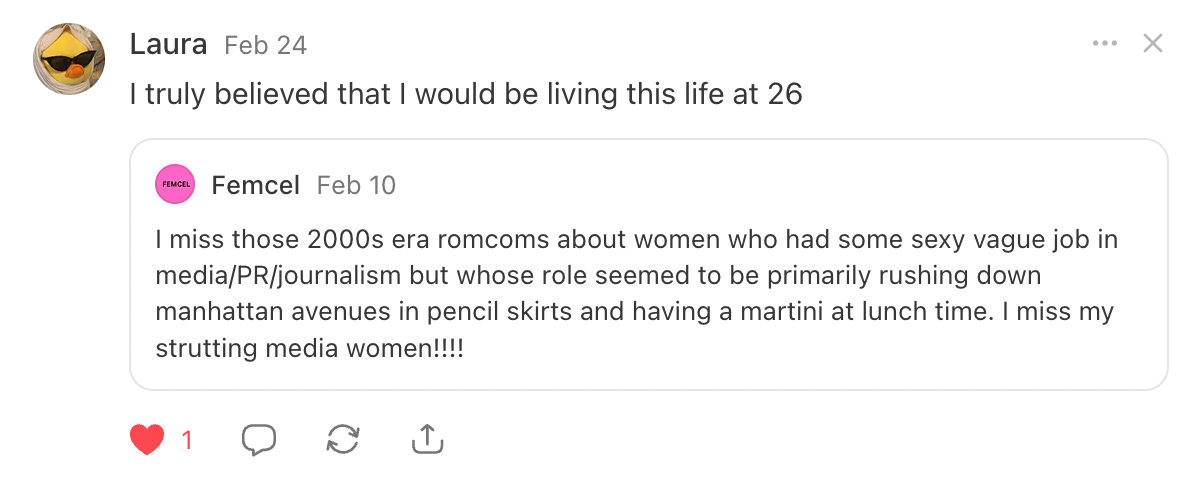
It was these movies that made me want to be a journalist. Or work in marketing. Or copywriting. Or really, any vague media job that involved writing, but mostly meant strutting down a busy Manhattan avenue in a Chanel suit and Manolo Blahnik heels, gossiping while rapidly downing a latte, sipping martinis at fabulous work events, and sleeping around with Matthew McConaughey / Hugh Grant / Mark Ruffalo / Michael Vartan / Dermot Mulroney / Chris Pine.
There were, however, inklings of disillusionment with this dream. The first came in elementary school, when I overheard my mom gossiping about a stay-at-home mom in our neighborhood community.
“Yeah, her parents are pissed because they paid a shit ton of money for her to go to NYU law school. She thought being a lawyer was all about wearing Gucci blazers and designer handbags, then she found out all the fashion is mostly wasted on being trapped in an ugly corporate office for ten hours a day with heinous middle-aged men. So now she just tailors children’s clothes from home.”
All to say–do not let my mom get a hold of your life story and its failures.
But also to say, this was the first moment of disconnect between what I torrented on my shitty $250 PC in the early 2010s and the cold, corporate reality.
Those movies released during my childhood worked on me like cultural osmosis anyway.
But then, the shows that continued to raise me said something else about being a young woman in a big city.
Girls, Orange is the New Black, Broad City, Insecure, Breaking Bad–all the 2010s shows that told you over and over again: the economy is terrible. There is rampant inequality. You will either work a terrible, low-paying job or make meth. Broad City’s Ilana is a parody of the idea that working in advertising could be glamorous. And I can’t even get into the Girls of it all (stay for section 3 on that).
But still, I had this barely conscious delusion that I would work as a journalist, which would entail writing big, muckraking pieces every week, going out constantly to conduct exciting interviews, using my opportunity to be out of the office to have a bagel and black coffee with a cigarette for dessert. Then I’d rush back to the office, and a thirty-second montage would enable me to finish writing the next big, front page article before dashing off to put on some mascara in the back of a taxi before meeting my girl-and-gay friends.
I was 15, okay?
Unfortunately for me, my two high school internships (at local newspapers) were kind of like this. I wasn’t interviewing congress people or famous actresses, but I was writing really great Arts & Culture profiles, going to City Hall meetings, and since I was paid a very low stipend, could pretty much come in and out as I pleased. I came to work late and left early, and without any real responsibilities, did in fact spend all of my evenings after work doing fabulous shit with fabulous friends in my hometown of LA, which felt at the time like pre-Manhattanite training. My friends and I got our fake IDs by MacArthur park and used them every other night, partying and drinking and smoking like the protagonists in an early-2000s romcom.
At 16 and 17, in the summers after 10th and 11th grade, I lived that dream. Of course, I could live it because I was expendable, a little summery frill for these tiny papers with a small team of actual, over-worked staff journalists. I could take three-hour-long lunch breaks. I could pitch whatever the hell I wanted, write the story, and then go home.
My rude awakening came the summer after high school. I got a much more real internship–this time the stipend was enough to live off of. Because of that, I really had to be there from 9-5.
And that’s when I realized: work is not glamorous. I was just 18 and three months old. What a perfect time to learn that the movies were a total lie.
At this full-time internship, my stories were largely assigned and lackluster. The majority of them did not involve leaving the office. I took a lot of phone interviews, which was a terrible thing to have to do in an open office of 30 other people when you’re freshly 18 and super self-conscious. I was also under-assigned work, which meant many days where I was done by 2 p.m., or could have waltzed in at 11:30 a.m.
So I experienced one of the real tasks of work: pretending to work. I would read articles that were in the wheelhouse of what our paper and accompanying magazine covered, to make it look like I was doing research and not bored out of my mind while arbitrarily staying until 5 p.m. It took me 50 minutes to get home via train, by which point I was too exhausted to do anything fun. I was new to this city, and so I didn’t even have friends to text for weekend plans. I had one fling, with a Google employee 15 years my senior. I guess I missed my parents.
I fucking panicked. What would I do now? I was about to major in History or English and join my college’s student newspaper and apply for internships with local papers. But I wasn’t doing it because I wanted another basic-bitch office job; I wanted to write. I didn’t want to be sitting on my young hot ass nine hours per day, bored, face glued to a screen and surrounded by non-movie-star-looking people, arriving home with just enough time and energy to reheat leftovers and pass out while watching something bad on Hulu.
I did not only want to write, but to write fun, sexy, exciting stuff. I wanted to have creative expression. And most of all, I wanted to have a glamorous fucking life.
What these movies did successfully was not only tell us that a glamorous life would require a glamorous job, but more importantly, that work could ever be glamorous. I want to (1) explore these movies as a cohesive genre beyond their typical label of “romcom,” (2) what has shifted with The Devil Wears Prada 2, and (3) the intermediary period of 2010s Millennial media which challenged the narrative of the early-2000s career-woman romcoms.

I will call this genre–because it is a genre in its own right–Capitalist Glamourism.
Unlike Fredric Jameson and Mark Fisher’s Capitalist Realism (“It is easier to imagine the end of the world than the end of capitalism”), Capitalist Glamourism glamorizes work and brings other aspects of an enviable life—friends, fashion, true love—into such close proximity with work that it becomes difficult to tell whether they are separable at all.
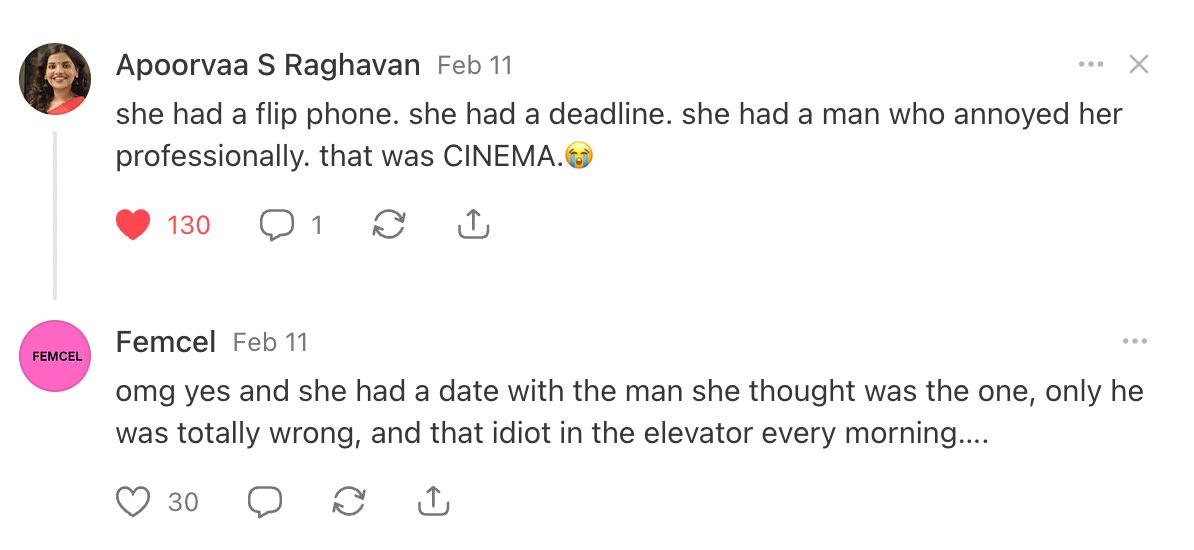
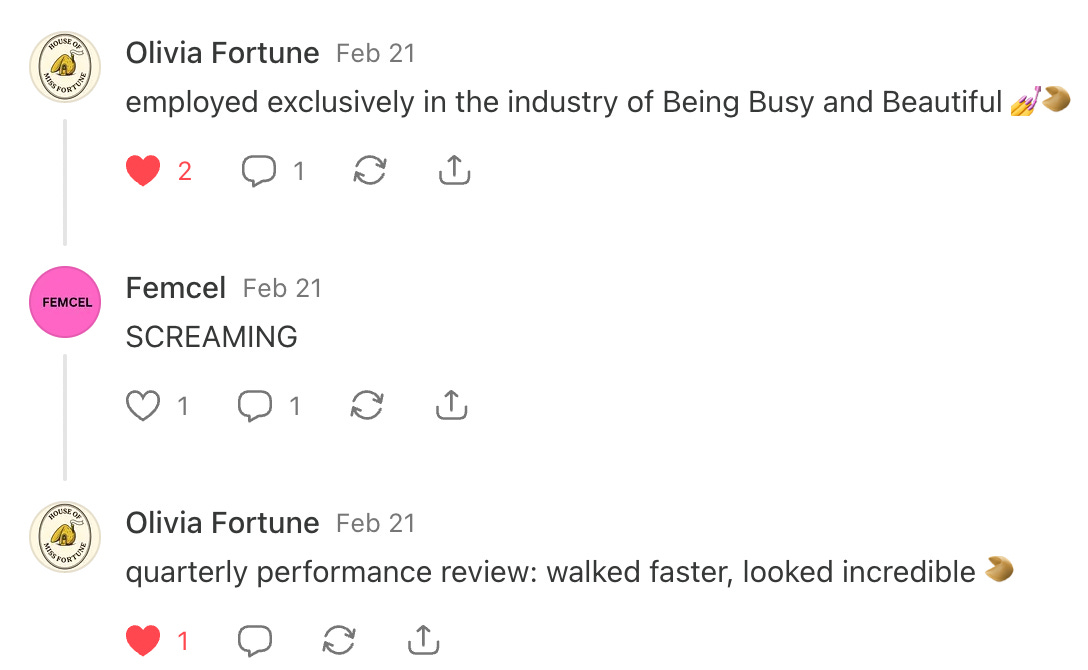
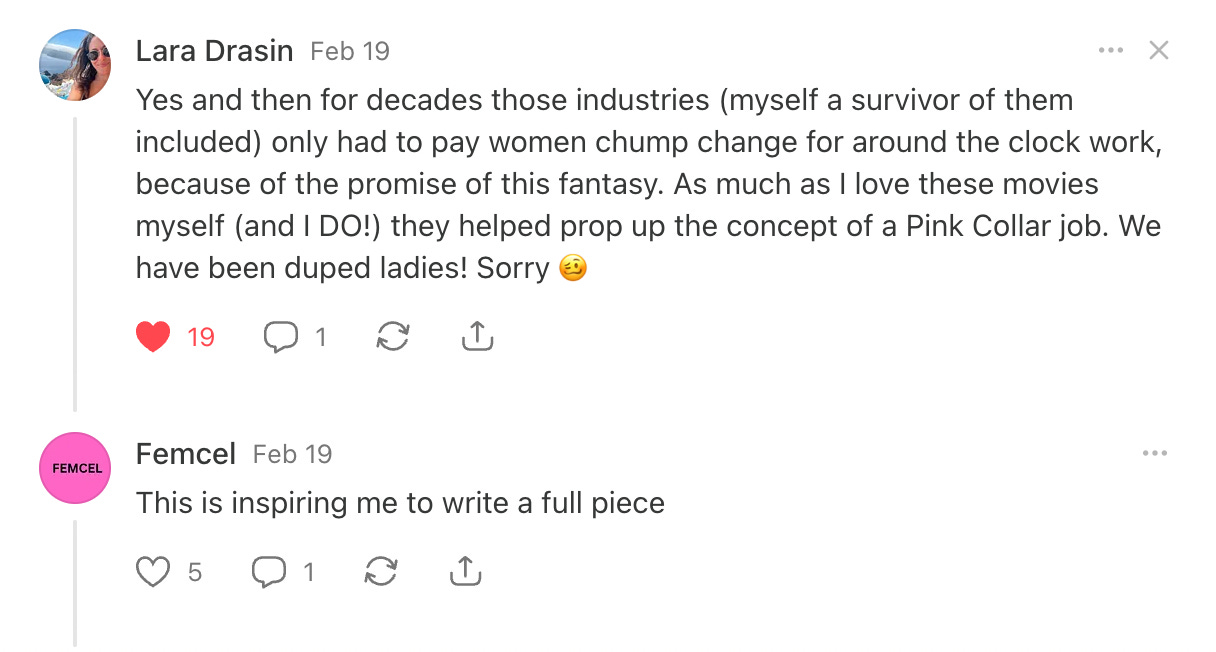
I was inspired to write a longer, full piece based on my note because it clearly struck such a chord–3,000+ likes! Tons of comments were left by you: that this was the life you were promised, that these movies made you want to go into journalism, that these movies made you want to move to New York.
And it’s no wonder. Capitalism Glamourism made it seem like without the right career, you won’t have the friends, the guy–the life in general.
Early 2000s romcoms are a case study in hypnotic conditioning; you know that trick where a hypnotist shows you broccoli, then chocolate, then broccoli, then chocolate–all in rapid succession, such that you might really think that broccoli tastes like chocolate?
Well, Capitalist Glamourism shows you the work, then the romance, then the work, then the romance. The work, then the glamorous outfit, the work, then the glamorous outfit. These movies hypnotize you into thinking that working tastes like romance, that having a 9-5 means having a perfect outfit and a perfect strut.
I got tricked into think that having a job means falling in love with Matthew McConaughey, that working at a magazine is endless model-walking down a Manhattan sidewalk to get a quick coffee from a stand, rushing into an office where you enter into three minutes of the most clever banter a writer’s room could summon–with a bitchy gay guy, your pretty assistant, or spunky bestie-cum-co-worker.
If only. The camera shuts off when there is the real drudgery of work: sitting for eight hours straight, completing meaningless tasks, or worse–pretending to be busy when you have no tasks at all but can’t go home, dealing with condescending or rude co-workers or supervisors, and so on and so forth.

The hallmarks of this genre are clear:
A career in media. This could be PR, TV, magazines, journalism, copy editing, advertising.
Having a fabulous apartment. This is really important.
Falling in love through a meet-cute with a perfect, handsome man.
A gaggle of supportive, loyal friends who are there for witty banter and saving the day.
The conflict of the plot hinges and turns upon the woman keeping her job, which is tied to keeping her friends, lover, and apartment. But it is really about the glamourousness of the job.
Actual work is never shown, but what I call “glamour labor” is shown constantly: fun pitch meetings, event planning, fun work event attendance.
Its plot arc is fundamentally this: Jane, a professionally ambitious 24-year-old in New York City, faces [XYZ calamity which threatens, simultaneously, her love life and professional life]. To fix the situation, she must [do something which brings her back both to her job, and her love interest]. By the end of the movie, she now has the career, an even bigger apartment, and the guy.
(There is probably a gender-specific feminist analysis one could do of these movies–the way in which their goal is to humble independent career women and remind them that at the end of the day, they still need to marry a man. The Wedding Planner and The Devil Wears Prada are the clearest example of this, whereby women are at first lauded for their careerism and independence, but then ultimately knocked down a few professional ego pegs by the reminder that other things come before their jobs; this thing that comes first is always heterosexual love/a man, never their mental or physical well-being, relationship with friends or family. If these movies are good propaganda for taking a media job that will never pay more than $55k, they’re perhaps even better propaganda that your sappy boyfriend is more important).
Let’s use Just My Luck as a case study. In Just My Luck, Lindsay Lohan’s character is literally born lucky. Her luck is introduced to us in the three intertwined ways in which a woman’s life could be fabulous: a fabulous apartment, a meet-cute with a hot rich guy on the way to her glamorous career at a PR firm.
The first serious scene is a pitch meeting to a record label CEO (the pitch meeting is the only time you ever see these women work). Her pitch is so terrific she gets the account, a company credit card, and a huge promotion.
When she loses her luck, the first major blow to her life comes in the loss of her career, then the loss of the guy, then her apartment. While there are other little signifiers of bad luck–the weather turning on her, her newfound clumsiness, the main ways the movie lets us know that she is now an unlucky woman is that she has lost her glamorous PR job, her tall trust fund baby, and her insane apartment.
Her bad luck is introduced through painstaking scenes of actual labor—her new, horrible job as a janitor.
These scenes matter because they break the core rule of Capitalist Glamourism: you are not supposed to see women working. For an ostensible film(s) about an ambitious career woman, we see a lot more clips of her at dinner with friends, going out on dates, and taking latte-sipping breaks on Park Ave. The apotheosis of this, of course, is Sex and the City. We basically never see these women working, all of whom work some Capitalist Glamourism career: columnist, art gallery director, PR executive, attorney. Sometimes, we see Samantha or Charlotte working, but of course only when it’s glamorous–a party, usually.
Once again, Capitalism Glamourism will make you think that working is an endless stream of launch parties, event planning, exciting pitch meetings, and lattes. It does this by only showcasing those elements, never showing you the real work.
By contrast, when Lohan’s character loses her luck, we get long, long clips of her real material labor. We see many scenes of her new, horrible job of working at a bowling alley. Shots linger over her shitty outfit–sneakers, plain jeans, flannel. (Today this outfit would be considered cool and y2k grunge, but I digress).
The message is clear: a fabulous job means no job at all. It just means strutting in a fab outfit.
Just My Luck is a perfect case study because she is able to reverse her luck by kissing the right guy. Here, in a perfectly distilled plot point, is the point: the luck is the career which is the guy. They are all inseparable. This is the promise of Capitalist Glamourism.
In these movies, the good life is all about nailing a pitch meeting for some sexy, big-budget PR event, then taking a four-hour long lunch break to have rapid fire, witty banter with a girlfriend or gay co-worker, strutting effortlessly down a Manhattan avenue–latte in hand, cashmere scarf dangling in the wind, Chanel heels clacking against the pavement.
Jump cut to said PR event, where the protagonist rushes around with a headset, clipboard, and a gorgeous man mysteriously following her. Everything goes perfectly, and after her 20 minutes of “work” before she falls into a gossip session with her endlessly supportive, loyal, great listener friends.
What’s fascinating is the meta layer. These actresses are actually working—as actresses. We are watching them work to perform work. Laboring to simulate labor—while actually laboring.
These movies doubly conceal reality. The actress playing a PR executive makes the job look breezy, while the film itself conceals the labor of acting. We don’t see her agent pressuring her, her boyfriend cheating publicly, the director harassing her, or the million other indignities actresses faced in the 2000s (and likely still do). The illusion compounds itself.
Lindsay Lohan, Jennifer Lopez, Jennifer Garner, Jennifer Aniston–they all doubly concealed the act of labor. We don’t see what happens after the pitch meeting and you’re stuck at a desk until 5, and we don’t see what happens after the director yells cut and the actress has a mental breakdown. It is a hall of illusory mirrors of fabulousness.
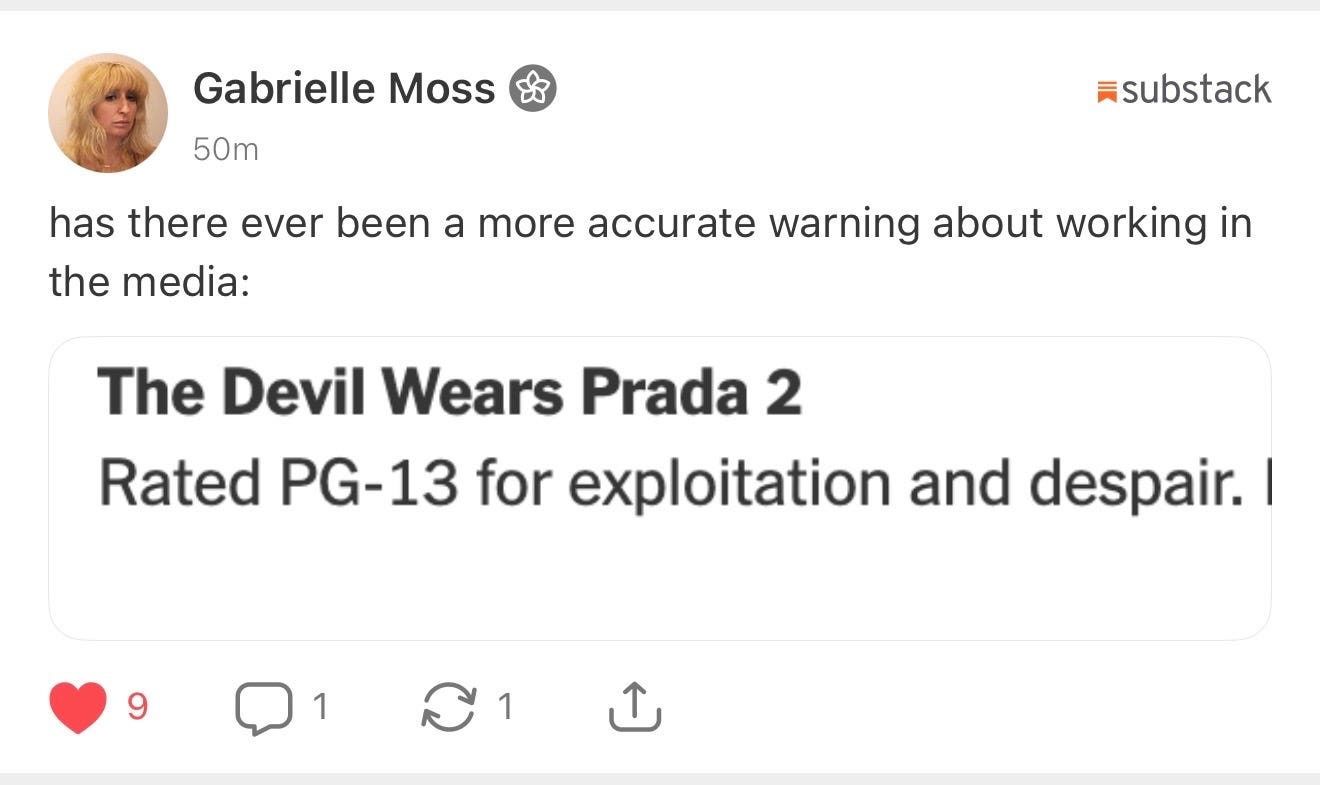
The Devil Wears Prada 2
First of all, this movie was fucking genius. Thank you to screenwriter Aline Brosh McKenna (who wrote the original TDWP) for understanding the fucking assignment.
When we heard there was a new Devil Wears Prada coming out, I think a lot of us asked the same question: Have you lost your minds? How the fuck are you going to reboot a movie which was based implicitly upon the infallibility, financial stability, and cultural prestige of a print magazine? You’re going to make a movie, in the year of our lord and savior 2026, about a woman who works at a print magazine? What will you do next? Revamp the horse and buggy? Give us a gritty prestige drama about a door-to-door saleswoman who sells vitamin C serum on the Lowest West Side?
Working at a print magazine in the way one did in 2005 feels almost artisanal, like we’re all about to pay AMC $21.95 to watch a movie about a woman churning butter.
Brosh McKenna felt the collective, doubtful, almost incredulous hive mind and delivered us this (as a brief summary, feel free to skip if you saw the movie): Andy Sachs, now at the height of a prestigious and meaningful print journalism career, is suddenly fired via text message. When Runway is faced with criticism for sloppy journalism about a fast fashion brand, the old geezer who owns the media conglomerate which owns Runway asks Andy if she could return to Runway as Features editor, to give the magazine more gravitas and serious journalistic integrity. Miranda, who does not remember the “smart fat girl,” isn’t pleased.
But now, Miranda knows her vintage Chanel heels are clacking on very thin ice. She lets the corporate overlord do whatever he wants. When he suddenly dies, his son brings in six of the most homely looking people I’ve ever seen (consultants, duh) to drastically downsize, cut, and gut Runway. Cut to Miranda having to fly (gasp) coach to Milan Fashion Week.
At this point, the movie is less so about how to save the magazine, but more so about how to save the movie/the genre itself. The collective anxiety over a Devil Wears Prada 2 is less so about the fact that magazines have died, but in a more meta sense the fact that with the death of print, comes the death of this particular genre. Women like Brosh McKenna then have the same issue as women who once made a terrific living with their journalism degrees. It’s not that the character Andy has to save her career in media, it’s that she must find a way to save herself as a media entity, as a figure of a particular genre, as an avatar of a supposed reality. If we cannot reboot magazines, we cannot reboot Capitalism Glamourism.

Andy finds a buyer for not only the magazine, but the entire media conglomerate which houses it and other publications. Miranda congratulates her on saving herself–on finding the wooden plank floating by the Titanic. They all live happily ever after.
(As an aside, Caleb Hearon acts as assistant #2 to Miranda and is CRIMINALLY UNDER USED. They gave him lines that could have been read by my brother, dad, or any random guy off the street, and not an incredibly funny, irreverent homosexual comedian.)
The film’s self-aware anxieties about private equity firms gutting businesses for short-term profit, the loss of old guard media CEOs who saw value in patronizing the arts, and the loss of their patronage in a world of ugly management consultants, begin to expose just how contingent—and fragile—that glossy fantasy of media work always was.
One of the best deliveries of this anxiety comes in the form of Leonardo da Vinci’s The Last Supper. Runway staff have a big, pre-Milan Fashion Week dinner in front of the famous mural painting, housed in the Convent of Santa Maria delle Grazie in Milan, Italy.
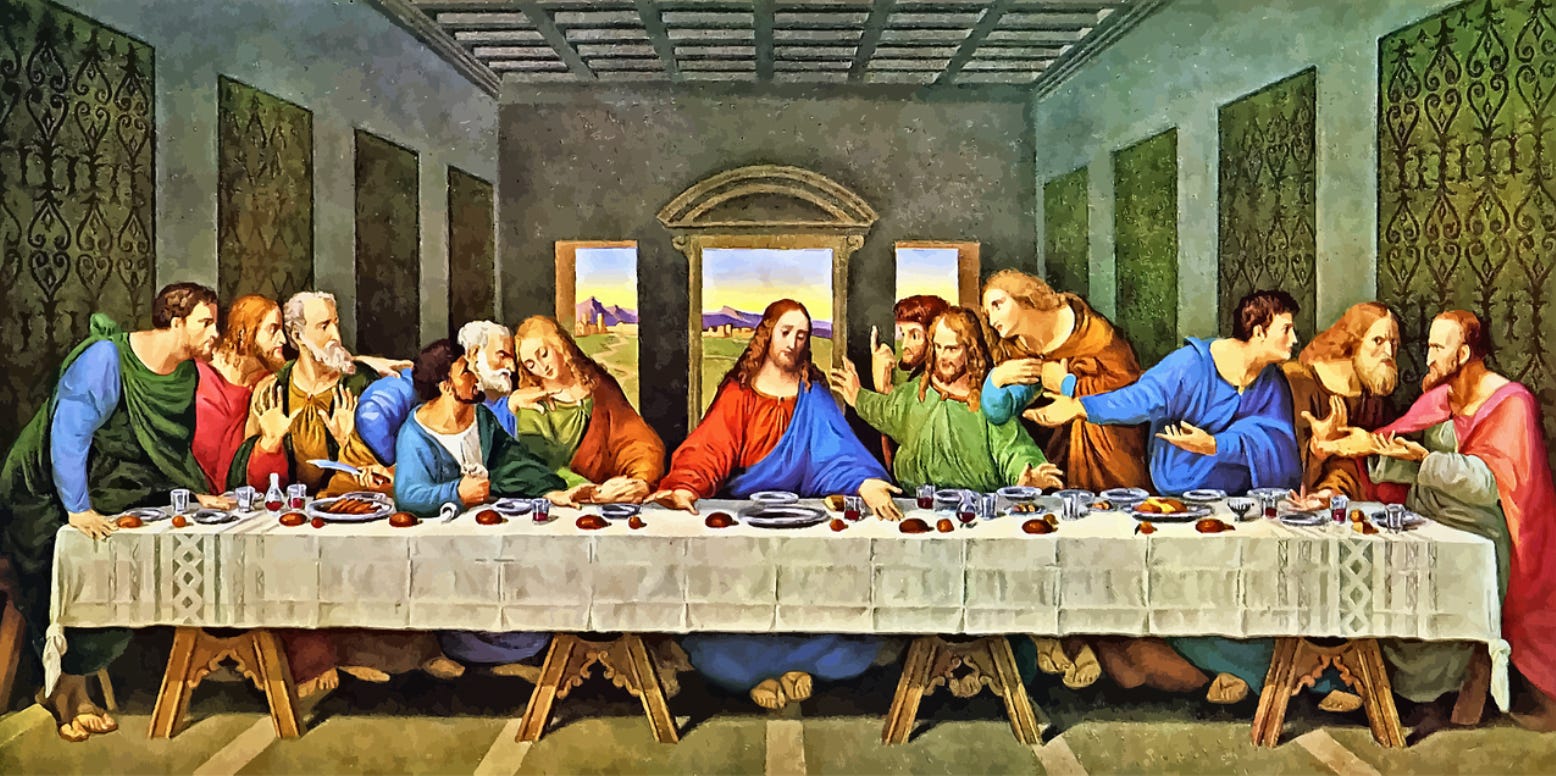
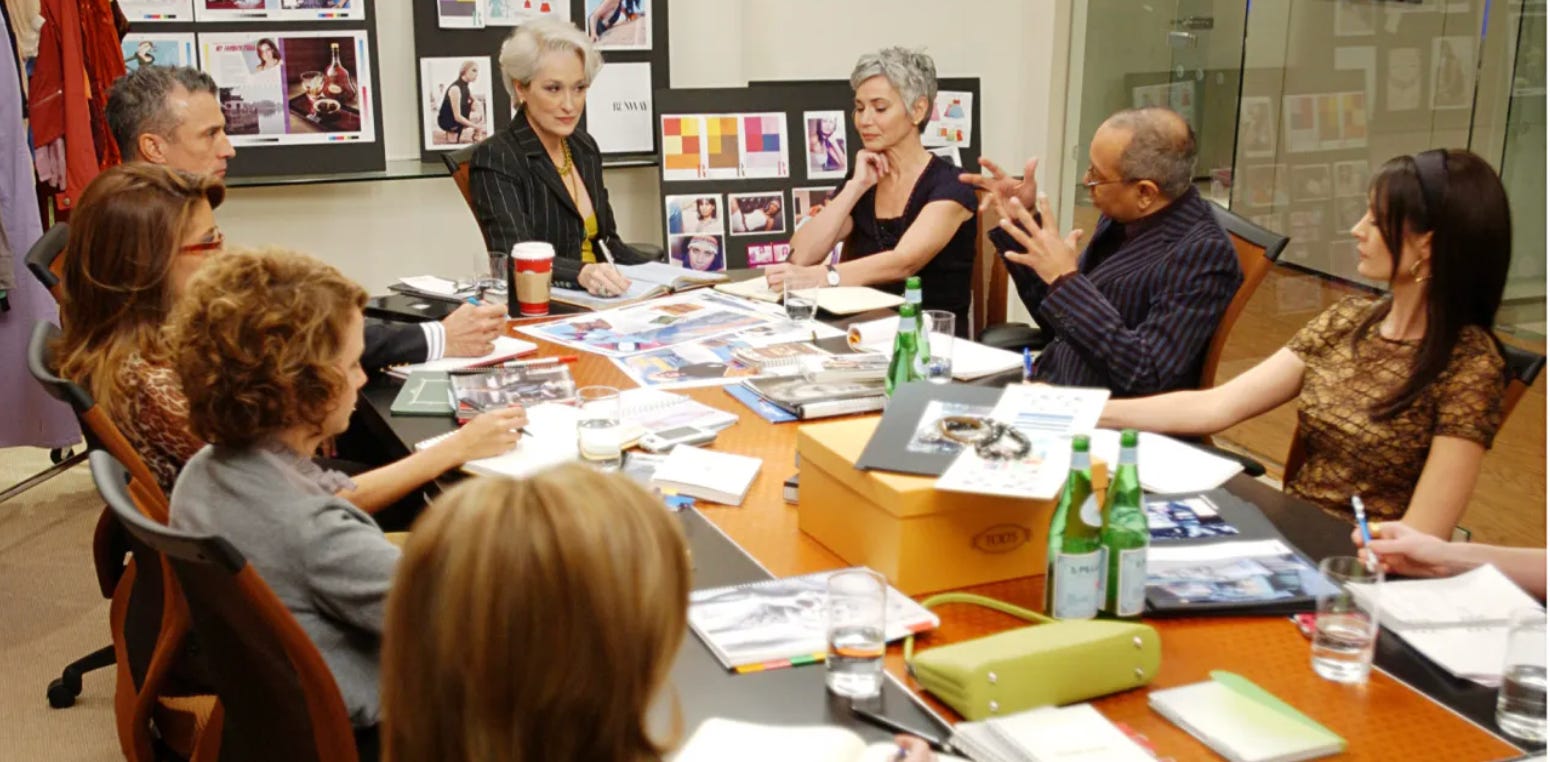
The movie unsubtly interprets the symbolic role of this painting in two ways:
Miranda, believing that Andy is about to royally fuck her over, says the painting is all about the ultimate fallibility of man, his selfishness, his evil nature.
A frightening Musk-Bezos-Zuckerberg parody character, Benji Barnes, is about to buy out Runway and replace Miranda as EIC with his girlfriend, Emily Blunt (DUN DUN DUN). Miranda begins saying something to him about the sentimental value of tradition, of maintaining things as they always have been. After all, surrounded by all of this beautiful, old art and history, wouldn’t he agree? No–in fact, he says that to him, these paintings and churches and old ass buildings represent just that–a trace of a forgotten empire, the way in which society moves on, keeps what is convenient to keep, but ultimately discards with unprofitable, outmoded ways of life.
But I believe these analyses, offered didactically within the script’s diegesis, are red herrings for the true meaning of the painting.
This painting represents the loss of patronage, and the loss of a world which appreciates and values art for art’s sake. Without these things, there is no art. Not only is there no art–there are no such things as fashion magazines, and no such things as frilly fun movies about glamorous career girls who work at fashion magazines.
Leonardo da Vinci, like hundreds of other artists in his generation and beyond, was well-patronized. Da Vinci in particular received patronage for The Last Supper by the Duke of Milan, Ludovico Maria Sforza (1452-1508). The Italian historian Francesco Guicciardini (1483-1540) called Sforza the “arbiter of Italy” due to his patronage and taste for art. Are there any wealthy politicians or businessmen today who would be considers “arbiters” of anything other than AI investment and private equity enterprises?
The concept of a patron to the arts now feels as quaint as a movie about a woman trying earnestly to make a sustainable life and career at a print magazine, or any other old-timey shit like baking pies from scratch or believing that art might be sustained by taste rather than metrics.
These old world patrons did not benefit financially from patronage. They got prestige. In the case of the Church or political figures, it would cement their power. Arts patronage was not totally purposeless, but it was certainly done at a loss. As we all know now, a ruler does not need to pay for a million frescos to maintain power, he just needs to say insane shit and find new groups to scapegoat every so often. Once again, the concept of political or institutional authority via arts patronage feels quaint, outmoded, improbable.
What the movie is getting at, is that the risk to print magazines and world of arts and fashion at large is not at risk because of the fallibility of man, or because a new world wants to move into frame–but because we no longer live in a world where art for art’s sake matters, where art without a clear profit margin benefit is feasible.
Immanuel Kant, in his philosophy of aesthetics, termed the concept of “purposiveness without purpose.” Beauty, and the true appreciation of it, is separate from worldly concerns. It has a purpose without purpose. Today, this is a difficult position to understand, let alone defend.
We see this when Irv–the media CEO who was holding onto Runway–dies. His son, played by BJ Novak, inherits the media conglomerate (a copy of Conde Nast) that houses Runway. BJ Novak wants to gut the entire operation, saying at one point that his father had stupidly held onto the print magazine out of some sort of sentimental value for its cultural prestige. God forbid a millionaire wants to patronize the arts!
Here, we see a clear generational juxtaposition: the last wealthy class, born in the 1930s-1950s, who believed that part of the purpose of their wealth was to patronize the arts, and did derive some person benefit from patronizing cultural institutions like museums and Vogue, versus the new guard who don’t give a shit about these paper dinosaurs, who will gladly lay everyone off and use the sale of office space to fund a new AI venture.
I think it’s no coincidence that BJ Novak was cast for this role; his other most memorable role (in my opinion) was Ryan in The Office, another office dramedy wherein he also represented the new guard looking to crush jobs and the human touch with the promise of automated technology. This casting is to remind us of what is happening here.
The role of The Last Supper is to show us that this old guard of patronage is gone. And with it, so too is the appreciation of human art for art’s sake, without huge profit margins.
Taken from French theorists of the 19th century, the term “l’art pour l’art,” (Art for Art’s Sake) argues that art is intrinsically valuable regardless of its subject-matter, its relationship to the so-called “real world.” Art is not meant to have real world utility, like generating profit or influencing politics or offering a moral lesson. It is valuable unto its own in a timeless way.
In his lecture, “The English Renaissance of Art,” Oscar Wilde makes the greatest case of all for l’art pour l’art. Lamenting 19th-century English society’s dwindling appreciation for the arts (oh, if he could only imagine us now), he writes, “there is no surer test of a great country than how near it stands to its own poets.” Despite Wilde’s belief that art should be entirely divorced from real world concerns, he knows he must make art relevant to the general public.
He says he will now “dwell on the effect that decorative art has on human life–on its social not its purely artistic effect.” To him, even though art must not seek to replicate reality, its purity has an effect on the real world.
He argues that when a society appreciates art and beauty, it improves youth, the nation, decreases war and hatred. Being surrounded by beautiful architecture, painting, and parks influences the mind. Isn’t there something to this?
Don’t you feel a sense of bleakness set in as you walk around a community of modern prefab houses in a sidewalk-less suburb, or those heinous new modern “affordable luxury” apartments? Think of the way your mind is taken off of hateful ruminations or worry when instead, you walk upon a beautiful street, a gorgeous brownstone, a breathtaking painting, a stunning dress, a well-crafted shoe.
Wilde says explicitly: “National hatreds are always strongest where culture is lowest.” True artists cited by Wilde, like Goethe, would never use their pen to write against another country.
He tells us that there are two kinds of men in the world. There are men who find life interesting “for its pulsations and not for its purpose; the passion for beauty engendered by the decorative arts will be to them more satisfying than any political or religious enthusiasm.”
Are there any wealthy men today who find life interesting for its pulsations and not for its purpose? Wilde tells us this: “industry without art is barbarism.”
And as we know, the contemporary 1% are all about industry without art. In fact, they want something which poor Oscar Wilde could not have even predicted–industry which is art, art which is industry. Apple TV+ and Amazon Prime make shows which are subliminal advertising for their company, and obvious ploys to bring people further into their subscription-based ecosystem. The tech 1% want all art to be made by artificial intelligence, for all art to emerge directly from industry.
The Last Supper, this painting of a well-patronized artist, haunts us because there used to be such a thing. Quite literally, it is the ghost of a past where art for art’s sake mattered, when the wealthy saw it as one of their raison d’êtres to patronize beauty. Art has never served a purpose. Maybe at one time it helped serve the Church or political figures. But no longer. It used to hold prestige for the wealthy, it used to be something they indulged in out of joy or sentiment or the desire for reputational status.
But now? What prestige does art hold to a monster like Musk or Zuckerberg or Bezos? We’ve seen what these guys do to art. But we’ve mostly seen what they don’t do—patronize, support, engage. The wealthy used to at least pay writers, painters, critics, photographers. They used to hold onto magazines and newspapers even if they didn’t make a real profit. They used to care. And now?
We are told that this is the ultimate meaning of the painting via Emily Blunt. After Benji Barnes leaves her, she asks, “Where will I find a patron like that ever again?”
The inclusion of the word patron here is a clever wink from the screenwriter. This is the central question and anxiety of the movie internally and externally–where will artists find a patron?
Because the other anxiety of the movie isn’t an internal one; it’s not about saving the magazine; it’s about saving this genre of Glamorous Young Woman Working at Manhattan Media Job.
When the magazine is at risk of being totally gutted, we get a glimpse of what would happen to Capitalist Glamourism as a genre.
We see Miranda fly to Milan in coach. There is a great flash cut between her walk past first-class–quiet, champagne flowing, elegant–to coach: the masses, coughing, wearing downstream-of-high-end polyester from Ross and TJ Maxx. When Miranda’s assistant is told there’s no champagne in coach, the passenger beside her excitedly offers: “there’s snack packs!”
Here, the worry is not about the end of the magazine. It’s about the end of Capitalist Glamourism itself. Because we don’t want to watch movies about broke journalists roughing it; we don’t want to watch box-dyed blonde middle america get their jollies from coach-section snack packs.
We want to watch fabulous media executives in first class, watch elegant women in high-rise apartments, watch a girl strut down 5th Ave in her vintage Chanel. We’re not watching these movies for the actual work, but for the glamour. When the magazine collapses, the grander stress is not that the magazine is dying, but that this particular genre is too.
When Andy saves the magazine, Miranda congratulates her on saving herself. Andy insists that it was about saving both of them. Miranda insists: no, this was about saving yourself. About Andy individually grabbing the last floating plank of wood beside the Titanic.
This scene has a deeper meta meaning. It’s superficially about Andy saving herself professionally, but it’s really about the character type of Andy Sachs saving herself within the genre, saving her character form at large, enabling her reproduction across other new movies.
Because the anxiety is clear: without a glamorous magazine, there is no glamorous movie about a glamorous girl working for said magazine. Andy doesn’t need to save herself within the internal logic of the singular movie plot—but across all movie plots in general. She needs to stay alive and relevant and generically replicate herself in the media ecosystem.
The anxiety is about the loss of the genre. We know the magazine is saved not because of a scene of real magazine work, but because of the hallmarks of this style of movie:
In the penultimate scene, we get Andy clacking down the street, walking past a hotdog cart, taxis, the avenue and into a luxe skyscraper office building. She then struts quickly down the hall as her underling hands her a latte, the two launching into some cute banter. It is this—not the draft of an article she hands Miranda—which signifies to us that the magazine has been saved. But more importantly, the genre has been saved.
Because it’s not about the magazine, it’s about the image. The industry. And uniquely the industry also sells images.
Brosh McKenna answers our hivemind: I will save this genre. I will make it work in 2026. Andy Sachs and Brosh McKenna are in the same position. McKenna’s job–of writing Capitalist Glamourism movies–isn’t yet a relic. (Brosh McKenna also wrote 27 Dresses).
The Millennial Turn Against Capitalist Glamourism
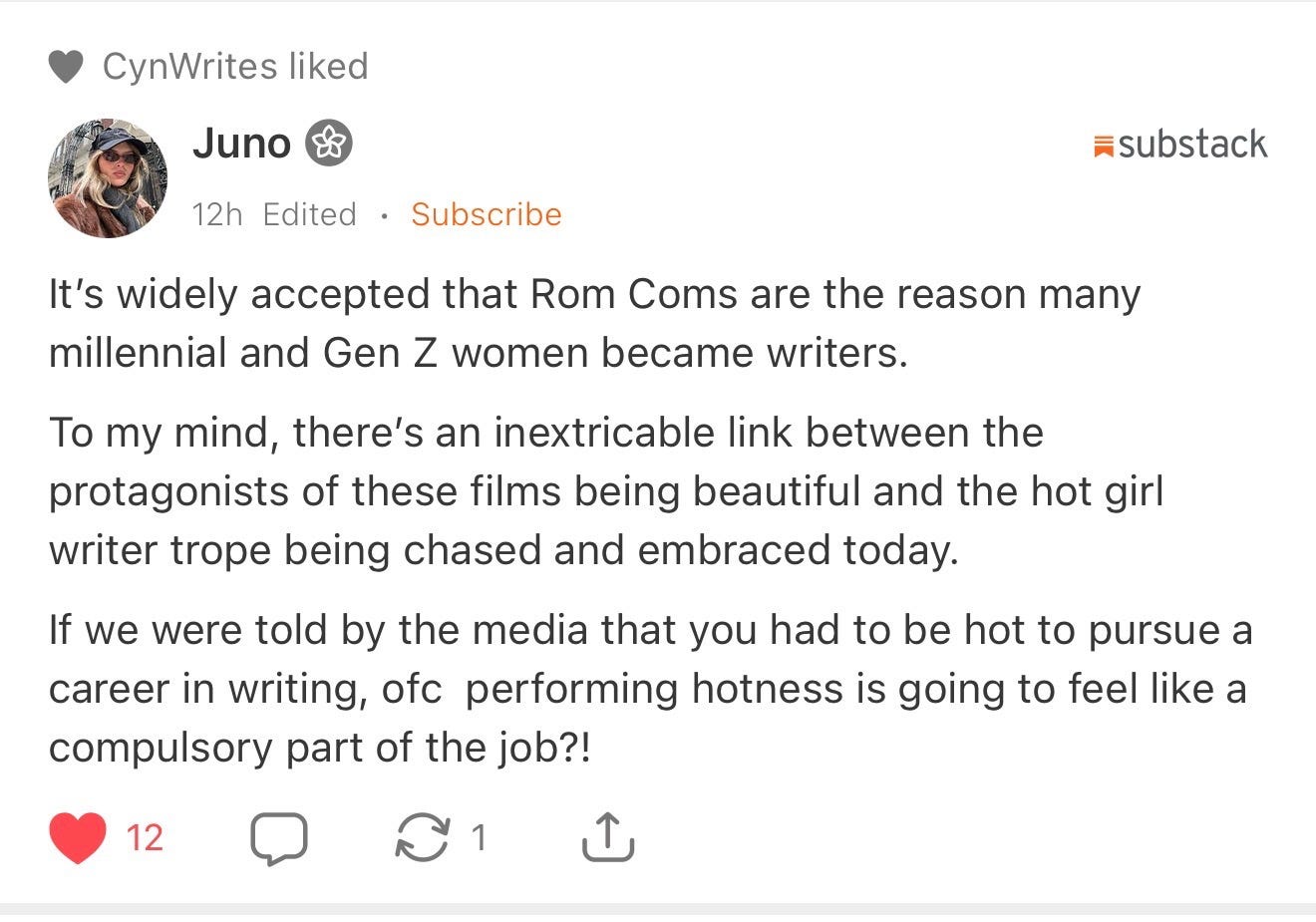
It is no wonder that the women most marketed to by Capitalist Glamourism revolted against it. I was lucky enough to come of age around these films, but also around shows that disillusioned Capitalist Glamourism for me–Girls, Broad City, Insecure. These women lived and worked in big cities but had decisively unglamorous lives. Millennial women only had the glamorous media job romcoms to grow up on.
And so in those TV shows, but also in a smattering of Millennial Novels and Memoirs– Severance by Ling Ma, Luster by Raven Leilani, Halle Butler’s novels, Beautiful World, Where Are You? by Sally Rooney, Famesick by Lena Dunham, and Bad Lawyer by Anna Dorn–the disillusionment with the life promised to us by Capitalist Glamourism is a dominant theme.
This piece is already too long, so I won’t do an in-depth analysis of each novel. But altogether, they all more or less say: We were promised a glamorous life of strutting and creative writing. What we got instead was student loan debt, apartments which rent-burdened us, jobs which didn’t pay enough to afford to live in their cities or buy the outfits we wanted to wear while working them. The men are not like Chris Pine. The friendships are fleeting and hard to come by, all of us too stressed and screen-addicted and tired and atomized to casually run into each other and spend time together every evening after work.
In Bad Lawyer by Anna Dorn, the book jacket reads: “Like many of her peers, [Anna] had listened to her parents or watched Legally Blonde one too many times and thought it looked kind of badass. But between the unflattering suits, kissing up to old judges, and spending her days sequestered in a soul-sucking cubicle, she quickly learned that the law wasn’t quite as glam as Hollywood made it out to be.”
And honestly, thank Gd for that, because she instead became a novelist to some of the funniest and smartest contemporary lesbian writing we have.
In terms of Millennial fictional works, Ling Ma’s Severance best captures the disillusionment with Hollywood. In it, the protagonist Candace follows the traditional stream for women of her generation: major in something related to art, move to New York, where she gets a job at Spectra, a Manhattan-based publishing company. While Candace likely imagined a glamorous life of art-directing and creative envisioning for the books produced by Spectra’s factories, she works instead in the Bibles department.
The novel’s opening scene of her job features not just the disappointment and exploitation of the relatively privileged women in media offices, but the more violent exploitation that these media jobs enable.
Candace is handling an order for a Bible which comes with a gemstone. The order gets cancelled because during the process of sanding down the gemstones, the dust gets blown into the workers’ lungs (in this novel, the factories are in China), slowly killing them. When Candace explains this to the client, she doesn’t care at all. She simply threatens to go with a different production company.
This is an even deeper excoriation of this media job fantasy; who are the laborers behind those glossy pages? The perfume sample inserts? Who makes the beauty products and clothes in the advertisements? Behind this whole system, is a far less glamorous, more bleak and horrifyingly unethical form of labor which sustains the illusion—a form of labor so concealed we forget it’s there at all. Other millennial novels like this one disabuse us of the idea that there is anything glamorous, virtuous, or good about this work.
And yet, Candace stays at Spectra for the promise of working in the Art department, of being an “Art Girl”:
“The Art Girls, for they were all invariably girls—colt-legged, flaxen-haired, in their late twenties, possessors of discounted Miu Miu and Prada, holders of degrees in Art History or Visual Studies, frequenters of gallery openings, swishers of pinot, nibblers of canapés—carried themselves like a rarefied breed, peacocking through the hallways in Fracas-scented flocks. They worked exclusively on the most detail-intensive, design-savvy projects— coffee-table books and color-sensitive exhibition catalogs. Their clients were galleries, museum presses, and, most important, the big glossy art publishers. Phaidon, Rizzoli, and Taschen. Lane, Blythe, and Delilah. Everyone wanted to be an Art Girl. I wanted to be an Art Girl.”
And don’t we all want to be art girls? Despite it all?
What’s funny is that now, a lot of the hallmarks of those 2000s films are outmoded. For instance, who the hell is wearing those suits and heels to work? Is anyone even going to work now?
My mom, telling me about her and my father’s first years as attorneys in the early aughts, said, “When I started working in those law offices, having the right suit was a huge deal. All the women bragged about their $900 Armani suits and judged me for getting my $85 Jones New York suits from the outlet mall. But who the fuck were they wearing those suits for? We rarely ever saw clients.”
What my mom–fortunately for her credit score–didn’t understand, is that these women were wearing that suit for the movie shot, for that 30-second clip of them surpassing the multitudes of Manhattan, for emerging from the subway, latte in hand, wearing a fitted skirt suit that cost more than their rent. The part after–the ten hours stuck in an office building–didn’t play.
When I asked my mom more about it, she said: “The biggest scam show was Sex in the City. That show made a whole generation of women think ‘Oh, I’m going to have a career and have a pencil skirt and a latte and my life is gonna be great.’”
My mom then offered another anecdote. A woman at her law firm, who had perhaps lapsed into some form of corporate psychosis from reading too many litigation briefs, would use her lunch breaks to walk up and down the blocks of Downtown LA talking rapidly into her flip phone. Only, there was no one on the other end. The co-workers called her “reality tv show lady.”
Only, she wasn’t trying to star in reality tv—but something far less real, and far more fictional, more glamorous. My mother said that it seemed as if her female co-workers in those years were all living and dressing for a camera that wasn’t there. After a few years, when they realized it was all a lie, maybe this one woman in particular decided to salvage what she still could of her fantasy. Honestly, what better way to spend your one hour of freedom than pretending you’re in the movie you were promised?
As a follow-up, I asked where my Jewish father got his suits–Brooks Brothers?
“No,” my mom said. “He thought Brooks Brothers was too WASPy. Ironically, he got his suits instead at Hugo Boss, which was a Nazi uniform supplier.”
—femcel
No posts
Comments
Nothing yet. Say the first thing.
Sign in to join the conversation.