
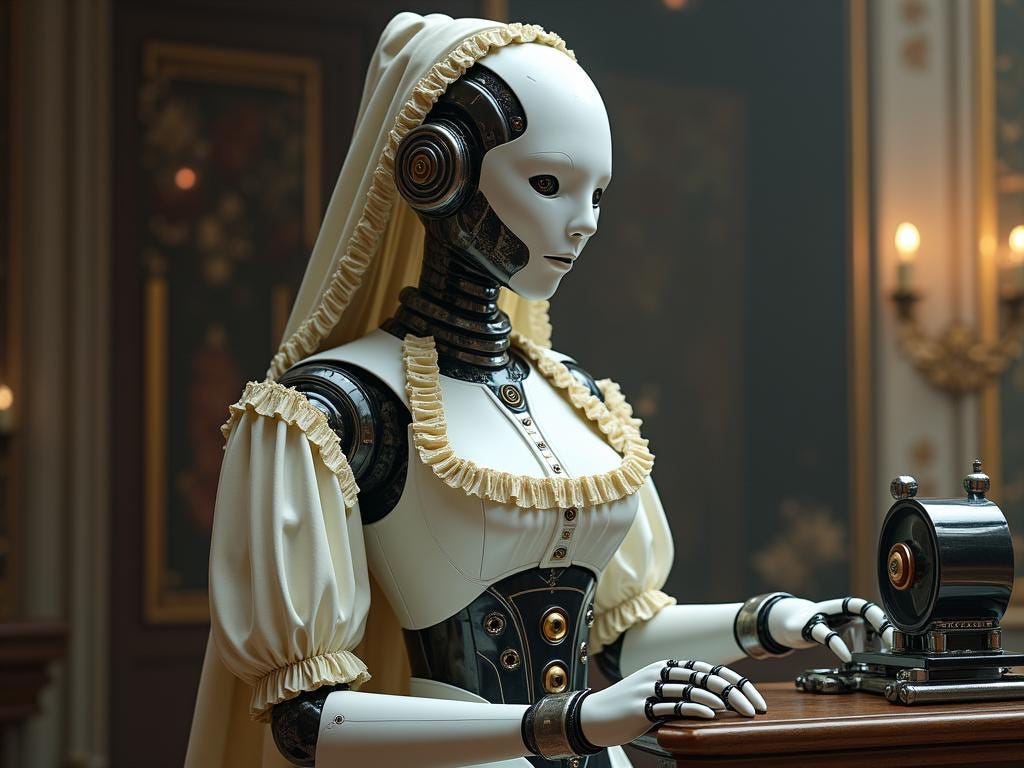
As I write, Halloween is less than two weeks away. I fully expect, when I sit on my front porch that evening with a bowl of candy by my side, to be confronted by many pint-sized ghouls, ghosts and witches along with more than one youngster in a green Frankenstein costume.
Frankenstein is a misnomer, of course. The name belongs not to the monster but to the mad scientist—Victor Frankenstein—who created the monster in Mary Wollstonecraft Shelley’s 1818 novel. That aside, the book—and the legends of golems which predate and possibly inspired it—indicate that the idea of creating artificial intelligence is a very old one indeed in human culture.
Let’s trace out one of the 19th century roots of our modern technology by paying a visit to Ada Lovelace, one of the underappreciated women who had an enormous impact on computer science.
Friends and familyMary Shelley was a contemporary and good friend of the famous romantic poet Lord Byron, a notorious philanderer, bad husband and worse father. He was only married once, for about a year, to Anne Milbanke; in 1815, this union produced the second (and only legitimate) of his three daughters, Ada. Apparently, Byron was so disappointed at not having a son that he divorced Milbanke, abandoned his infant and left England for good in early 1816.
Milbanke was the only child of Sir Ralph Milbanke and his wife, Judith Noel, who considered themselves enlightened parents. They ensured that young Anne got a good education, learning mathematics and astronomy from a Cambridge tutor. Milbanke inherited the title Baroness Wentworth and the family money that came with it, as well as her parents’ keen sense of philanthropy. Following the disastrous marriage to Lord Byron, she ensured that young Ada received an equally good education. Ada, it turned out, was a particularly keen and adept student of mathematics, following in her mother’s footsteps. In 1835, Ada married William King, who became the first Earl of Lovelace.
I don’t believe Ada Lovelace and Mary Shelley ever met, but I wish they had. Nonetheless, they moved in the same social circles, and I can’t help but think that Lovelace at some point must have read Frankenstein. Perhaps the story had some formative influence on her thinking about mathematics, algorithms and calculating machines.
This year, October 14I was busy celebrating my father’s 90th birthday on October 14 and did not notice a curious item popping up in my LinkedIn feed until later. A few postings noted that the second Tuesday of October is recognized in the computer science community as Ada Lovelace Day. The tradition started in 2009 in order to raise the profile of women in STEM and note the remarkable but often underreported contributions of women to technology. It was formalized by a US Senate Resolution in 2018. The choice of date does not seem to be of any significance in Lovelace’s life; rather, Google’s AI summary tells me, it was selected for the purely pragmatic reason that it wouldn’t conflict with any other holidays. Still, it’s a worthy celebration and it’s entirely appropriate that it carry Lovelace’s name.
Lovelace was, arguably, the most famous female mathematician since Hypatia of Alexandria in the fourth century AD. Thanks to her mother, Lovelace began formally studying mathematics at age 17. From 1840 to 1842, she received private tutoring in geometry, algebra and calculus from Augustus de Morgan, a renowned mathematics educator at London University. But she was also something of a polymath, demonstrating an aptitude for physics as well as mathematics. An early interest in self-propelled flight, for example, led her to an intensive study of bird anatomy and a detailed classification of possible materials from which to make human-sized wings. Beyond the sciences, Lovelace wrote poetry and studied metaphysics, believing that they would lend an element of intuition and imagination to the application of mathematics.
With just a hint of a nod to Mary Shelley, Wikipedia’s biography of Lovelace relates that, in 1844, she attempted to create a mathematical model of the brain and nervous system that could explain how they give rise to thoughts and feelings—and even researched experiments in electrical engineering as part of this model. Her interest in modelling the brain and nervous system stemmed largely from the common belief that her father, Lord Byron, suffered from madness and a fear that his suspected mental illness could possibly be inherited.
Find someone who looks at you like Charles looked at AdaIn 1833, the mathematician Mary Somerville, one of Ada Lovelace’s early tutors, introduced her to the inventor Charles Babbage. It was a match made in computer science heaven and a friendship that would last the rest of Lovelace’s life. Just to be clear, there’s no evidence that their relationship was anything other than platonic—Babbage was, quite simply, deeply impressed with Lovelace’s intellect and her analytical skills.
Babbage, a competent mathematician in his own right, is best known as the creator of the early computing devices, the Difference Engine and subsequently the Analytical Engine. Neither machine made it beyond prototype, but they were the first, or at least among the first, digital computers. Babbage was a founding member of the Royal Astronomical Society, the mission of which was to standardize and circulate tables of astronomical data. This data would make its way into publications such as the Nautical Almanac, enabling sailors to calculate longitude at sea. Babbage understood how error-prone the process of manually compiling data could be; this is what motivated him to design his computing hardware.
The Difference Engine was really a prototypical calculator, but the Analytical Engine added memory and a rudimentary central processing unit, giving it all the attributes of modern digital computers. Then the big question, obviously, became how to make the machines work. With the Difference Engine, the operator only had to mechanically set some initial values and turn a handle, and the machine would literally crank out some answers. But the Analytical Engine was much more complicated. Enter the mathematical mind of Ada Lovelace, and the first notion of computer software.
In 1840, Babbage delivered a lecture at the University of Turin describing the Analytical Engine. Two years later, Lovelace was asked to produce an English version of a transcription of the lecture. She added her own notes, which ended up three times the length of the original, and the work was published in 1843. The last of Lovelace’s notes, known as Note G, is the most significant.
To understand Note G, we need to take a brief side trip to the early 1700s.
Mathematicians love to add things up, especially infinite sequences of numbers that can generate complicated infinite series of sums[1]. More than a century before Lovelace and Babbage, the Swiss mathematician Jacob Bernoulli considered how to sum up sequences of powers of real numbers, a problem that had been studied at least since the time of Pythagoras. Bernoulli’s insight was to define a formula with specific constants, or coefficients, which could be used to calculate such sums for any arbitrary exponents. When his work was published in 1713, the constants became known as Bernoulli numbers and have found applications in many other branches of mathematics.
In her Note G to Babbage’s lecture, Lovelace completely defines an algorithm for generating Bernoulli numbers. Looking at this work, I am astonished at its completeness and level of detail. She numbers each step or instruction of the algorithm, defines the variables to be used in each step, the operations to be performed, and the resulting values of the variables. If I have read it correctly, she includes the idea of repeating past operations but with different values of the variables, thus introducing the concepts of loops and recursion. She even provides clear documentation of all the logic. I can recognize all the elements of modern computer programming that I first encountered in secondary school, almost a century and a half later.
It’s not for nothing that Charles Babbage fondly nicknamed Ada Lovelace “The enchantress of number”—so smitten was he by her genius.
Beyond computation
I’ve written before that I consider Ada Lovelace to be the godmother of computer software. After reading her Bernoulli algorithm, now widely recognized as the first complete computer program, I consider that more than ever to be true. But Lovelace’s genius extended beyond just writing algorithms. She applied her philosophical and metaphysical education to theorize on what else computing machines might be able to accomplish.
Babbage, in his description of the Analytical Engine’s capability, took a fairly prosaic approach. He noted that the machine could easily perform the four basic arithmetic operations—addition, subtraction, multiplication and division. Subscribing to the popular view at the time that all of mathematics could be derived from those four operations[2], he speculated that the Analytical Engine, if big enough, could solve any mathematical equation.
But Lovelace dared to go much further than Babbage. Knowing that the architectural inspiration for Babbage’s engine was the Jacquard Loom, she noted that “the Analytical Engine weaves algebraic patterns just as the Jacquard Loom weaves flowers and leaves.” Building on this insight, she went on:
Again, it might act upon other things besides number, were objects found whose mutual fundamental relations could be expressed by those of the abstract science of operations, and which should be also susceptible of adaptations to the action of the operating notation and mechanism of the engine. Supposing, for instance, that the fundamental relations of pitched sounds in the science of harmony and of musical composition were susceptible of such expression and adaptations, the engine might compose elaborate and scientific pieces of music of any degree of complexity or extent.
Every time I read that paragraph, I marvel at the clarity and precision of her thoughts. Lovelace was beginning to conceive of an artificial intelligence—a machine that could draw, compose music, perhaps even understand language. Not long after writing this, she began her electrical experiments and work on modelling the human brain.
I think Lovelace knew that Mary Shelley had subtitled her novel “The Modern Prometheus”—referring to the scientist, not the monster. Prometheus, of course, is best remembered from Greek mythology as the Titan who gave humans the gift of fire and was subsequently sentenced by Zeus to be chained to a rock, having his liver eaten by an eagle every day for eternity—or, at least, until he was released from his suffering by Heracles. But Prometheus, according to Wikipedia, was also credited with creating humanity from clay—echoing the Judeo-Christian story from the book of Genesis—and is referred to as the originator of human arts and sciences. Wikipedia goes on to suggest that Prometheus eventually became the symbol, in Western philosophy, of human striving and overreach or unintended consequences. The parallels with concerns about AI are all too clear.
And yet, again according to Wikipedia, the name Frankenstein translates from German to “Stone of the Franks,” which Dictionary.com goes on to suggest could mean “Stronghold of freemen.” Perhaps Shelley was suggesting, via the name Victor Frankenstein, that an independent humanity will still prove to be superior to any artificial intelligence created by us. I wholeheartedly agree, and I’m sure that Lovelace would too.
A lesson from the godmotherI love that Ada Lovelace covered territory that would not be revisited for more than a century by none other than Alan Turing. But more than this, I also love that she remained realistic about the capabilities of computing machines. Her final words on the subject, known as the Lovelace Objection, still ring true today:
The Analytical Engine has no pretensions whatever to originate anything. It can do whatever we know how to order it to perform. It can follow analysis; but it has no power of anticipating any analytical relations or truths.
Ada Lovelace understood as well as anyone of her day, or after, both the potential and the limitations of computing. Everything she predicted has come true and her skepticism is more relevant than ever to the modern-day debate about the imminence of, and risks posed by, AGI.
Contemporary luminaries like Geoffrey Hinton, Yann LeCun and Ilya Sutskever are often referred to as the godfathers of AI. I think that title should have been conferred over a century earlier.
Ada Lovelace, to my mind, is the godmother of AI. Had she not died at the tragically young age of 36, who knows what else she might have accomplished?
[1] In mathematics, we define a sequence as a stream of numbers, where a formula is applied to generate one number from one or more of its predecessors. A series is defined as the sum of a sequence—each successive term in a series is the sum of all preceding terms.
[2] Less than a century later, Kurt Gödel would destroy this theory with his famous Incompleteness Theorems. Much has been written lately on whether Gödel’s theorems might be applicable to AI, and I intend to visit this topic in a post in the near future.
No posts
Comments
Nothing yet. Say the first thing.
Sign in to join the conversation.