
The Nobel Prize for Physics has been awarded almost annually since 1901[1]. Of all the subdisciplines within physics, I think quantum mechanics has received more than any, with astrophysics probably coming a close second. The Nobel committee got the ball rolling, so to speak, in 1918 by giving the award to Max Planck “for his discovery of energy quanta.” Subsequently, Albert Einstein won in 1921 for discovering the photoelectric effect, and Niels Bohr a year later for his work on the structure of the atom and how it emitted radiation.
There followed a spate of prizes going to the now-familiar quantum pioneers: Louis de Broglie in 1929 for the discovery that atoms and, indeed, all particles behave as waves; Werner Heisenberg in 1932 for defining quantum mechanics itself; Erwin Schrödinger and Paul Dirac in 1933 for their work on atomic theory, and the list goes on. By my own informal count, at least 15 more Nobel prizes were awarded to quantum physicists up to this year, for everything from entangled photons to practical applications like the scanning tunneling microscope. Interestingly, Aage Bohr shared the prize in 1975 for work on the structure of the atomic nucleus—making, with Niels, the only father-son combination to win.
Last year, I wrote about the Nobel Prize for Physics going to Geoffrey Hinton and John Hopfield for their work in artificial intelligence—an unusual award but perhaps justifiable due to their application of statistical mechanics to neural networks and machine learning. But in 2025, the Nobel committee returned to more familiar territory, awarding this year’s Physics prize to John Clarke, Michel Devoret and John Martinis for “the discovery of macroscopic quantum mechanical tunneling and energy quantization in an electric circuit.”
That’s a mouthful, to be sure, but it’s significant work and directly relevant to quantum computing and especially IBM’s specific implementation of qubits. To see why, we’ll have to go back five decades or so and review one of the other Nobel prizes for quantum technology—the 1973 award to Brian Josephson “for his theoretical predictions of the properties of a supercurrent through a tunneling barrier, in particular those phenomena which are generally known as the Josephson effect.” More scientific jargon, yes, but IBM’s success thus far in quantum computing is due to Josephson’s work, built upon by Clarke, Devoret and Martinis.
Let’s look at how this mid-to-late-20th century physics inspired a new paradigm of computing, which IBM is bringing to fruition.
Follow the bouncing particle
Josephson’s work involved the practical applications of one of the strangest phenomena in quantum mechanics—tunneling. To understand tunneling, you have to be prepared to suspend some of your most cherished beliefs about solidity and the very nature of matter itself. I introduced the concept of tunneling earlier this year, when discussing quantum technology, but it’s worth revisiting at a deeper level of detail. The bottom line is: matter, in its most fundamental form, is mathematics.
What I mean by that is based in the original work of Heisenberg, Schrödinger and de Broglie in the 1920s and early 1930s. One of their most significant results is what is now called the wave-particle duality of matter. Light, for example, was long considered to be a wave—it could be diffracted into different colours of different wavelengths, and wave interference patterns were easily detectable. But Einstein’s discovery of the photoelectric effect could only be explained if light were a particle; soon enough, the existence of photons with measurable mass was proven.
Electrons, by contrast, were originally thought of as particles—tiny, almost massless objects with a negative electrical charge circling the atomic nucleus in defined orbits. But the closer physicists looked, the less clear this picture became, until now all we can say about electrons is that they exist in a probability distribution, or cloud, surrounding the nucleus. And, of course, the uncertainty principle tells us that we can’t know both their speed and location with complete precision at the same time.
Electrons, like photons, have turned out to be particles which are best described mathematically, by wave functions—bringing us back to tunneling.
For example, we know from high school physics that an electrical current is just electrons moving through a conductive material like, say, copper wire. But if the flow of electrons encounters a non-conductive barrier like a ceramic insulator or plastic sheathing around the copper, the current stops. This is a very reliable effect, easily observable in the macroscopic world where we normally operate. But what if we make the non-conductive barrier extremely thin, perhaps only the thickness of a couple of atoms? This is the question that Brian Josephson asked in 1962, and the answer he predicted was surprising.
If the barrier is thin enough, and we consider the electron as a wave, then its wavelength might span the barrier. This would result in a non-zero probability of some electrons—now considered again as particles—appearing on the other side, effectively “tunneling” through the barrier and creating a current where normally none should exist. It’s as if, at a macro level, you were throwing a baseball at a brick wall and catching it every time it bounced back—except, every once in a random while, the ball wouldn’t bounce back but would just pass through the wall and fall to the ground on the other side. The work, purely theoretical at the time, earned Josephson the 1973 Nobel prize for physics and became known as the Josephson Effect.
Down in the tunnel
Now, let’s combine tunneling with another strange quantum effect: superpositioning.
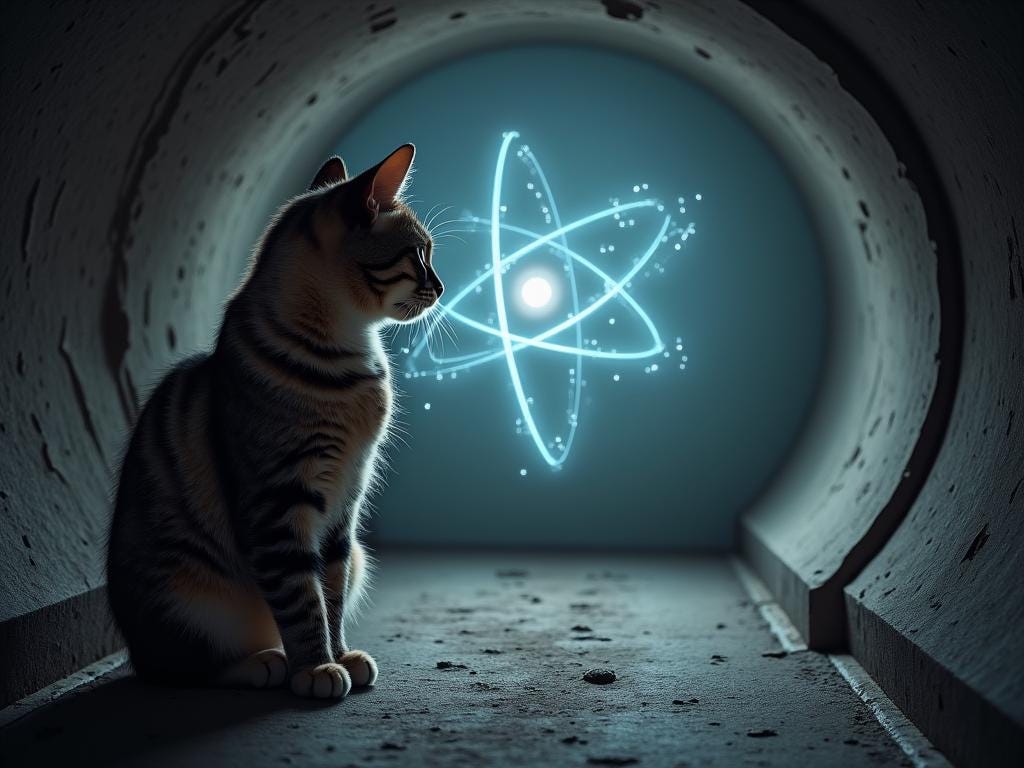
Schrödinger’s cat is probably the most misunderstood meme in all of quantum mechanics. The thought experiment was designed not to explain the quantum effects of superpositioning and tunneling, but to demonstrate their absurdity when translated to the macroscopic scale of the world we inhabit. An unstable, radioactive isotope decays by randomly emitting radiation—alpha, beta or gamma rays—so if it is not observed, it can be considered to be in a superpositioned state—both decayed and not decayed at the same time. Schrödinger suggested connecting such an isotope, inside a closed box, to a hammer that would break a vial of poison only if radiation is emitted—by way of an alpha, beta or gamma particle tunneling its way free of the isotope’s atomic structure. If a cat were also placed inside the closed box, then superpositioning suggests that the cat is both alive and dead at the same time, until the box is opened and its condition is observed. “Aha!” says Schrödinger—it’s ridiculous to think of a cat as simultaneously alive and dead; therefore, it’s equally ridiculous to think of a subatomic particle in multiple states at the same time.
And yet, as they say, here we are. Quantum superpositioning and tunneling are real at the subatomic level, even though cats are not both alive and dead, and baseballs don’t pass through brick walls. But never say that physicists don’t have a sense of humour: the term “cat state” is used to describe a subatomic particle, or even a system of connected particles, in superposition, with probabilities of being in state “L” (living), or “D” (dead).
This dichotomy between what happens at the subatomic level and what we normally observe at the macroscopic level has been a puzzle for the past century—as old as quantum mechanics itself. Physicists wondered whether there was a clear line that separates the two, but it has never been well defined. The work of Clarke, Devoret and Martinis investigated whether there was an in-between area: larger than the traditional subatomic, but very small for macroscopic, where superpositioning and tunneling could be observed and harnessed for practical applications.
Deep freeze
The answer, of course, turned out to be yes—by way of a quick detour to visit Albert Einstein in 1925. Einstein was inspired by a paper written by the mathematician Satyendra Nath Bose on the quantum statistics of photons. He applied Bose’s theories about light to gases—which are made up of physical particles, after all—and predicted that if certain types of gases were brought to a very cold temperature, their constituent particles might coalesce and act together as a large, macroscopic quantum object. Such a theoretical object became known as a Bose-Einstein Condensate (BEC)[2], and the particles exhibiting this behaviour are referred to as bosons. The existence of BECs was not experimentally verified until 1995.
BECs predicted the existence of both superfluidity, a state in which supercooled liquids lose all viscosity and flow without resistance, and superconductivity, where, similarly, a supercooled conductor loses all electrical resistance so that a current can flow without any loss of energy.
Bose, Einstein, Schrödinger and Josephson bring us all the way back to this year’s Nobel laureates. Clarke, Devoret and Martinis were able to prove quantum tunneling at the macroscopic level, and along the way built what is now called a Josephson Junction—exactly as predicted, from superconducting materials cooled to nearly absolute zero and separated by a very thin nonconductive barrier with electrons tunneling through the barrier. The trio further realized that, using microwave pulses, they could put the barrier into an excited atomic state, where its electrons move to higher-energy orbits. In the excited state, more electrons are able to tunnel through the barrier, creating a stronger current than in the non-excited (or, “ground”) state of the barrier. Thus, they discovered the ability to superimpose, and subsequently measure, two cat states of the Josephson Junction based on the observed current flowing through it.
Compute this
Clarke, Devoret and Martinis had all the pieces needed to create a macroscopic qubit. IBM and other researchers took the final practical steps of applied physics and built exactly such a qubit, calling it a transmon.[3] Transmon qubits, it turned out, had several advantages over other atomic or subatomic qubits like ions and photons. They are more stable and resistant to noisy effects like background radiation and are able to maintain a coherent state for much longer—up to three milliseconds in some experiments. This stability, in turn, is enabling much greater circuit depth (the number of gates, or instructions, that can be executed), which in turn will allow for the development of more complicated quantum algorithms.
IBM further realized that transmon qubits could be made in silicon wafers, much like classical computer transistors are. This means that existing fabrication plants for computer chips could, in theory, be easily retooled for large-scale production of quantum computing hardware.
Trasmon qubits are not without their disadvantages, however. Chief among these is the requirement for supercooling to just a fraction of a degree above absolute zero. This is an engineering challenge which I believe could inhibit the ability to manufacture IBM’s quantum hardware at scale. If you’ve ever seen the “golden chandelier” structure of an IBM quantum computer, much of this is due to the dilution refrigerator, which uses helium isotopes to provide the necessary cooling.
Built on a silicon or other type of wafer, transmon qubits are effectively two-dimensional, limiting their ability to interconnect with other qubits, which will be necessary to create more stable logical qubits from multiple physical qubits. IBM has been experimenting with other designs, including a virtual torus architecture to increase qubit connectivity. But this is still a work in progress.
The other thing you will notice about the IBM quantum computer chandelier is the enormous tangle of wires surrounding and connecting to the tiny computer at the bottom. These are meant to deliver microwave pulses to control the qubits, causing them to change state and enabling the results of calculations to be read out. Microwave control is difficult to manage, requiring extreme precision to maintain the transmons in their two desired states.
There is also an upside to microwave control of qubits—if refined further, it could create three, four or even more excited states of the transmon, potentially enabling more than two superpositioned states for quantum computation. According to Wikipedia, experiments are already being done on three-state qutrits, and qudits of more than three states will follow. If quantum computing already promises exponential speed ups over classical computers, then qutrits and qudits may suggest yet another exponential improvement—with, probably, a decade or two of additional work.
I don’t think any of the aforementioned challenges are insurmountable. IBM has two decades of experience working with transmon qubits already and has achieved a remarkable success rate in reaching the milestones in their quantum computing roadmap, which the company updates annually. The current roadmap suggests they will reach 2,000 qubits and circuits of up to a billion gates by 2033, ushering in the era of large-scale, fault-tolerant quantum computing. Inside a quantum-centric supercomputing architecture, such a system will deliver real quantum advantage and solve problems currently intractable for classical computing alone.
Seriously: follow Schrödinger’s cat through the electron tunnel of computing potential and you’ll be amazed at what you see.
[1] The prize was not awarded in 1916, 1931, 1940, 1941 and 1942.
[2] Nature, last month, published an excellent and readable retrospective on BECs.
[3] Refer to Wikipedia if you really want to know how they came up with the name and what it stands for.
No posts
Comments
Nothing yet. Say the first thing.
Sign in to join the conversation.