
Our minds see training programs as discrete chunks of work. We focus on the intervals, sets, sessions and days as if they are independent variables which can be manipulated with the goal of improving future performance. A better way is seeing the connection across sessions, as well as what happens between sessions. This lowers the stakes for any single day, or workout, and increases the focus on long-term compound gains.
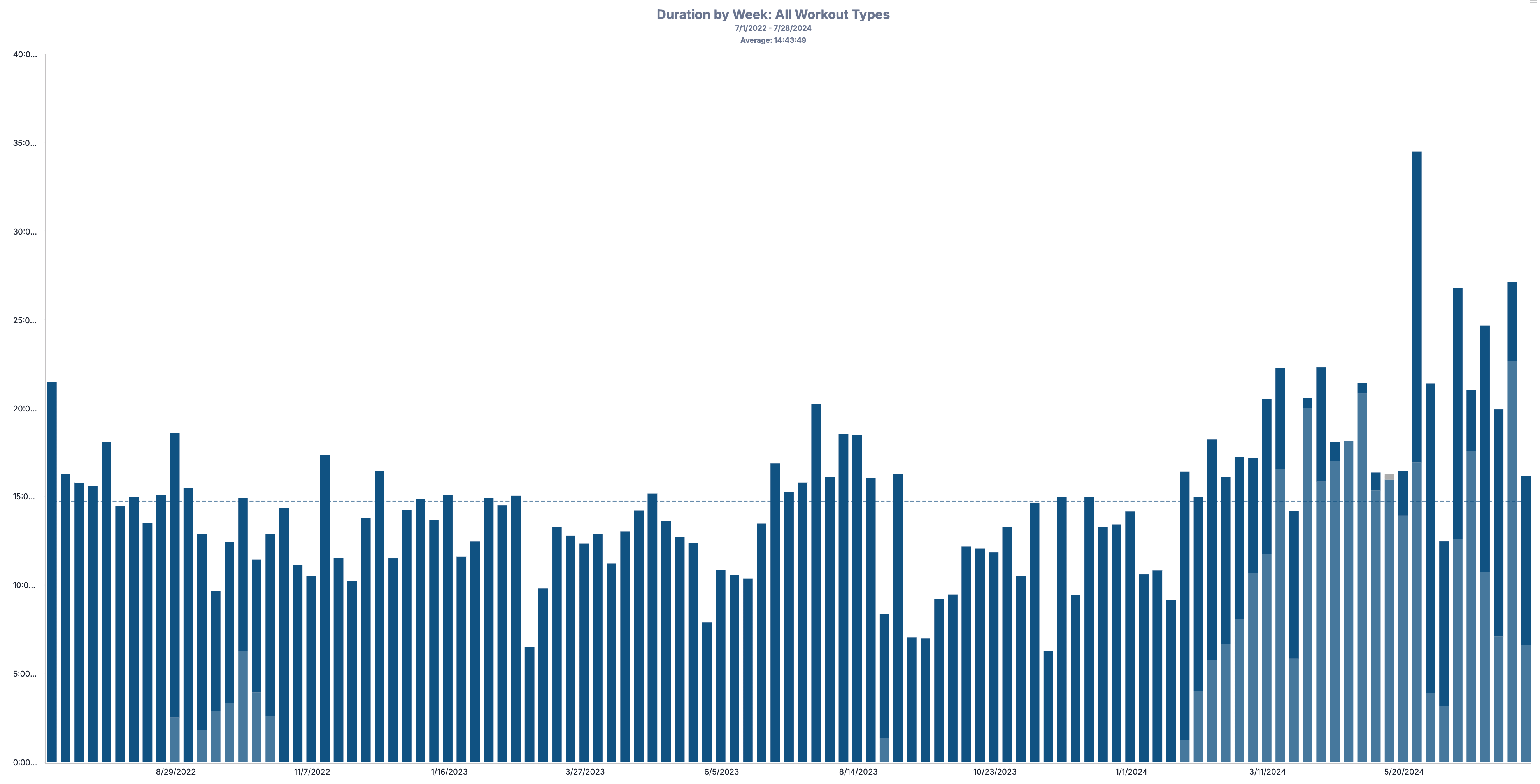
The big weeks you see on the right side of the chart depend on my body having absorbed the many moderate weeks across the entire chart. The average weekly volume across this period was 14 hours and 45 minutes.
The high-volume training explained in the previous four chapters builds on the many weeks of moderate, compounding volume explained at the start of the book. Without a moderate start, and the regularity of that work, I would not have had the general capacity to absorb the challenging training that came later.
Even with a moderate start, there were times when my body either stopped responding or started to break down. When faced with those realities, I backed off, rather than pushing through. Backing off while continuing to cross train enabled me to continue compounding.
Seeing your training as a continuous process will serve you well. In the short term, there will be minor frustrations when plans need to scale down. However, in the long term, you will get more work done, and you will compound even greater gains. More and better gains are what lead to breakthrough race performances.
Coming off the high of a European training camp, and an age group win, it would have been easy to think that the secret of further improvement was more big training. However, when I printed up the weekly volume chart (above), I saw there was a far easier way to get more into my program.
The faint dotted line you can see running across the chart is my average weekly volume across the 25-month period: 14 hours and 45 minutes. Look at the chart and notice that from September 2023 to February 2024, nearly all my weeks were below this level of training. This is the normal pattern of an amateur athlete. Across the winter, both consistency and volume fall off.
I saw an opportunity. Rather than trying to sustain my summer loads, I would immediately take my off-season, then fill in the gaps from my prior fall and winter. At the end of a successful summer, it’s always tempting to trying to keep it rolling. This can work, but it’s risky. It’s even more risky when the prior season saw a big jump in load and performance.
What I’ve just explained is a lower risk strategy to boost long-term load. Have a look at what you completed the prior fall/winter/spring on a weekly basis. Then seek to bring as many of those weeks up to your 12-month average. By doing this, we lift our rolling 12-month volume safely, and without increasing life stress.
My strategy worked great. The chart below is September 2023 to April 2025. The dotted line for weekly average volume is now at 15 hours and 30 minutes.
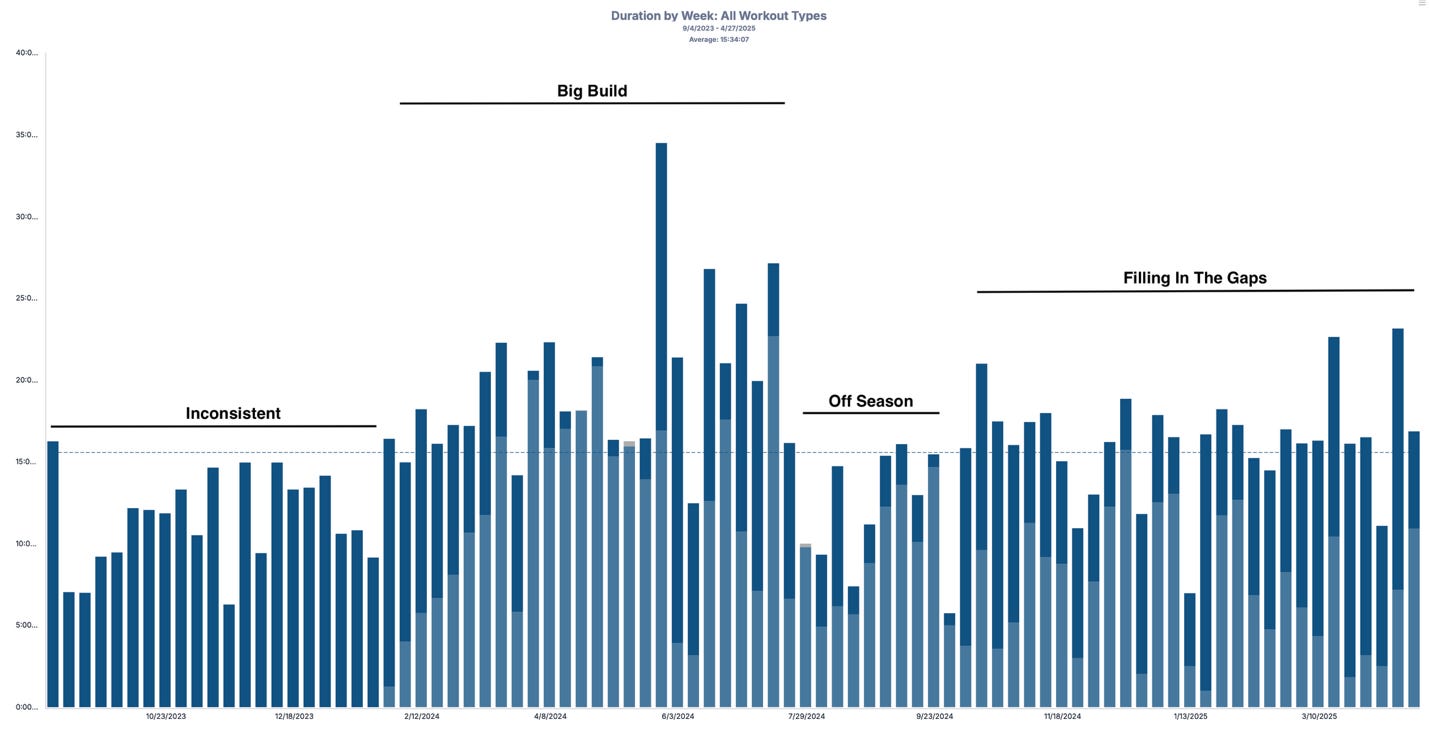
Above, we can see four phases:
The inconsistent phase of the fall/winter of 2023/2024.
The big build of the spring/summer of 2024.
A deep off-season following Epic Camp and the Alpe Tri.
A long block of moderate training, materially above what I achieved the prior winter.
Filling the gaps, rather than pushing the peaks, works. As a bonus, it puts minimal stress on your larger life. So you should:
Look backwards for a year.
Calculate your average weekly volume.
Set that level of training as your target.
Do this and you’ll set yourself up for greatly improved general capacity. It sounds simple, and it is. However, I was about to bump into my biggest setback so far. We will get into that in the next chapter.
I’d love for you to share this with a friend who is passionate about more and better gains.
Back to How To Train - Preview Chapters
Back to eBook Table of Contents
No posts
Comments
Nothing yet. Say the first thing.
Sign in to join the conversation.