
Following my article on the work of Atsuo Yanagisawa, I decided to write a new article on the science of vitamin C. I know I’ve already written about this topic, but this article will focus solely on practical applications. I’ll discuss the different ways to supplement with vitamin C and the various approaches. When people first start looking into vitamin C, they don’t know where to begin; they come across conflicting information about oxalates, kidney stones, dosages, and so on. It’s all very confusing for people who are simply trying to get back to good health. In this article, I’m going to make things easier for you.
In this article, you will learn:
- the different forms of vitamin C
- how to dose them respectively
- how to maximize the effect of ascorbic acid in cells
- specific examples for each condition
- common misconceptions about this vitamin
This article is part of the Feed Your Mind Large Series, a collection of comprehensive guides exploring the nutrients, supplements, and biological mechanisms that shape human health.
In this edition, we take a deep dive into vitamin C—its functions, history, science, supplementation strategies, and the many debates surrounding its optimal use. From mainstream recommendations to the ideas of researchers such as Irwin Stone and Linus Pauling, our goal is to provide a clear, balanced, and practical overview of this remarkable nutrient.
Whether you’re a beginner or an experienced health enthusiast, this guide aims to answer your questions and help you better understand what may be humanity’s lost superpower.
We all know that vitamin C is good for us, it prevents scurvy and can be found a lot in fruits and vegetables. The current medical approach is that our body only need a tiny amount, around 80mg a day, in order to prevent the return of the aforementioned dreadful disease. Scurvy is the name given to the state in which enters the body when it lacks ascorbic acid, also known as vitamin C. This vitamin is essential for tissue health, through its role in collagen synthesis, brain health, immune system and overall vitality. Very early on, medical literature described how people with scurvy were more prone to illness due to a weakened immune system. They then develop a wide range of physical and mental symptoms, including hallucinations, depression, and other issues. Vitamin C deficiency causes numerous symptoms, and I am convinced that many people have health problems as a result. The problem is that many people aren’t aware of them.
“Discovery consists of seeing what everybody has seen and thinking what nobody has thought.”
— Albert Szent-Györgyi
However some scientists have pointed out that our body could benefit from much higher of vitamin C, basing their reasoning on simple observations. The idea is very simple. The majority of disease, despite being very different in their symptoms expression, share common points in their biochemical causes. The main cause is a very famous process called oxidative stress. You may ask yourself, what is oxidative stress ?
Well, oxidative stress is a state in which the body has too much pro-oxidant species around and not enough antioxidants ones. If you want a memory tip to remember what oxidation is, you could replace it by toxicity. Oxidation happens when there is too much accumulation of reactive oxygen species (ROS) around the molecules of your body and not enough protection against them, or a good way to detoxify them. Such situation happens when there is not enough antioxidants. Antioxidant are substances that will give an electron to the oxidized substances, that lost an electron and therefore became unstable, from a chemical point of view.
When we study each chronic disease, especially neurologic ones and brain related issues, we see that oxidation plays a major role in the etiology. Therefore, many scientists and people started to think that, if this is the case, providing people with extra-amount of antioxidants could have a dramatic impact on both the prevention and on the treatment of disease. The first person to say this was Linus Pauling, which you may already know if you have read my previous articles. In an article called Orthomolecular Psychiatry, published in 1968, Pauling demonstrated that the current medical model and their theory about vitamin dosages was partly wrong. Due to our genetic differences, some people can have troubles and problems to absorb some nutrients and don’t really know how to use them. Now, we found proofs of this for some B-vitamins, like folate and the MTHFR gene, which can prevent the metabolism to the active vitamin.
Linus Pauling observed that due to our modern lifestyle and the presence of many polluant and toxins in our food, a lot of people could benefit from extra antioxidant, either through food or through supplement. Many substances have antioxidant properties (vitamin E, Selenium, etc) but some of them are much more powerful than others. Vitamin C is one of those (ascorbic acid). Its chemical formula is C6H8O6.
In the 1940s and 1950s, some American doctors had already used very high doses of ascorbic acid to treat diseases, including multiple sclerosis and serious infectious diseases. When given in very high doses, ascorbic acid ceases to be a simple vitamin and acquires very special properties, including antiviral, anti-inflammatory, and antipyretic (fever-reducing) effects.
One example is the pioneering work of Frederick Klenner, a doctor from Reidsville, North Carolina, who was the first to use massive doses of vitamin C to treat polio. If you tell a doctor that you think vitamin C could be useful in treating such a disease, they will probably laugh at you or think you are a fraud. Klenner demonstrated that in extra doses, vitamin C was the ultimate support of the immune system and was able to fight the most dreadful infectious diseases. This was in the 1940s. Klenner also used vitamin C to treat some children poisoned by agricultural polluant. This has been documented in some publications that you can find on the ISOM website.
Following this, Irwin Stone, a Californian biochemist, also became interested in the vitamin. He patented vitamin C as a food preservative and made a fortune from it. It was thanks to him that Linus Pauling became interested in the subject. We should also mention Robert Cathcart III, a Californian pediatrician who used to prescribe the vitamin to his patients, including children. There are numerous videos and interviews with Cathcart online, which are a wealth of information on the subject.
I’ll admit that the world of alternative medicine can have its share of charlatans. This is especially true when it comes to promises of miracle supplements. One of the biggest scams involves “natural vitamin C,” which is often sold at a high price and derived from plants like acerola. There’s no such thing as natural vitamin C. Just because the word “natural” is attached to a product or a vitamin doesn’t mean it’s better for you. Conversely, just because something is “synthetic” doesn’t automatically make it bad. This pointless dichotomy has persisted for far too long in people’s minds, and I’m taking this article as an opportunity to debunk this urban legend.
Almost all the vitamins you buy are synthetic, since producing them naturally or extracting them through natural processes would be far too expensive. All the B vitamins in your multivitamins, ascorbic acid, magnesium, etc., are synthetic, and there’s nothing wrong with that.
There is no such thing as “natural” vitamin C. The only form of vitamin C that has existed for about 10 million years is the chemical formula C6H8O6. That is the one and only form, I assure you. Personally, I think spending money on “natural” forms is a waste, and too many people are spending thousands of dollars on supplements that are sometimes ineffective.
Many people lie for marketing reasons and end up deceiving people.
One last thing. Many people have questions about their vitamin C because it says “Made in China (PRC)” on the label, and they think it’s poor quality. The reason is simple. The People’s Republic of China is where the chemical synthesis formula for ascorbic acid derived from corn was patented in the 1960s and 1970s.
They pioneered the “Two-Step Fermentation” process, which drastically reduced the production costs of ascorbic acid and boosted global production.
Previously, it was produced in Europe (Switzerland) using the Reichstein process, derived from glucose. Today, nearly 100% of the vitamin C in dietary supplements comes from China. In any case, the doses found in acerola-based supplements are insufficient, and all serious orthomolecular practitioners know this.
“Vitamin C is one of the safest and most effective nutrients known to man.”
— Linus Pauling
There is more than one form of vitamin C in dietary supplements. These include traditional ascorbic acid (vitamin C), liposomal vitamin C, and sodium ascorbate, among others. These are the three most commonly used forms. In addition, there are other forms such as vitamin C crystals and ascorbate minerals (magnesium ascorbate, etc.) but I will not talk about these ones as they are rarely used. Each of those forms have specific characteristics and distinctive elements (ex: level of acidity, absorption potential, etc).
Ascorbic acid (regular vitamin C)
Liposomal vitamin C
Sodium ascorbate
Regular vitamin C, also known as ascorbic acid, is the most common and widely used form of vitamin C.
Ascorbic acid is well absorbed at low to moderate doses but its absorption becomes less efficient as the dose increases. When taken in large amounts, excess vitamin C is not absorbed and instead draws water into the intestines, which can cause loose stools or diarrhea. This effect is often referred to as “bowel tolerance.”
Typical daily doses range from 500 mg to 2 grams per day for general health and immune support. For higher-dose protocols, such as during infections or periods of high oxidative stress, doses may be increased to much higher doses, such as the one exposed by Robert Cathcart in his work.
Because ascorbic acid is acidic, it can cause gastric discomfort or irritation in sensitive individuals, especially when taken on an empty stomach. This is one reason buffered forms (such as sodium ascorbate) or liposomal vitamin C are sometimes preferred for high-dose use. However, this gastric discomfort is due to the fact that the intestine can only absorb a given dosage in one take. The diarrhea is caused by the excretion of the remaining vitamin C.
Despite these limitations, regular vitamin C remains effective, inexpensive, and biologically active. It reliably supports immune function, collagen synthesis, antioxidant defense, and neurotransmitter production. For many people, ascorbic acid is sufficient and effective when doses are adjusted to individual tolerance.
For those interested in high-dose vitamin C strategies, the work of Linus Paulingand Thomas Levy is often cited, as both contributed significantly to the understanding of vitamin C’s role in health and disease.
The incredible advantage of sodium ascorbate is that it is less acidic than the regular form, ascorbic acid. Therefore, it is much more gentle on the gut and does not cause stomach problems. It is a buffered form of vitamin C, made by combining ascorbic acid with sodium. When vitamin C supplementation is initiated, some people with sensitive tummy can have some side effects from classic ascorbic acid (AA). Taking sodium ascorbate is a good way to avoid this. However, on the’ long term, high dose ascorbic acid tends to heal the gut lining and people can use it. I have seen it many times on Facebook groups and forums.
Because it is non-acidic, sodium ascorbate can be taken in higher doses with fewer digestive side effects such as nausea, cramps, or diarrhea. This makes it especially useful for children, sensitive individuals, and people who require large or repeated doses of vitamin C. Neutral acidity makes it a good candidate for IV formulations in cancer care. If you want informations about that, feel free to look at the work of Robert Cathcart.
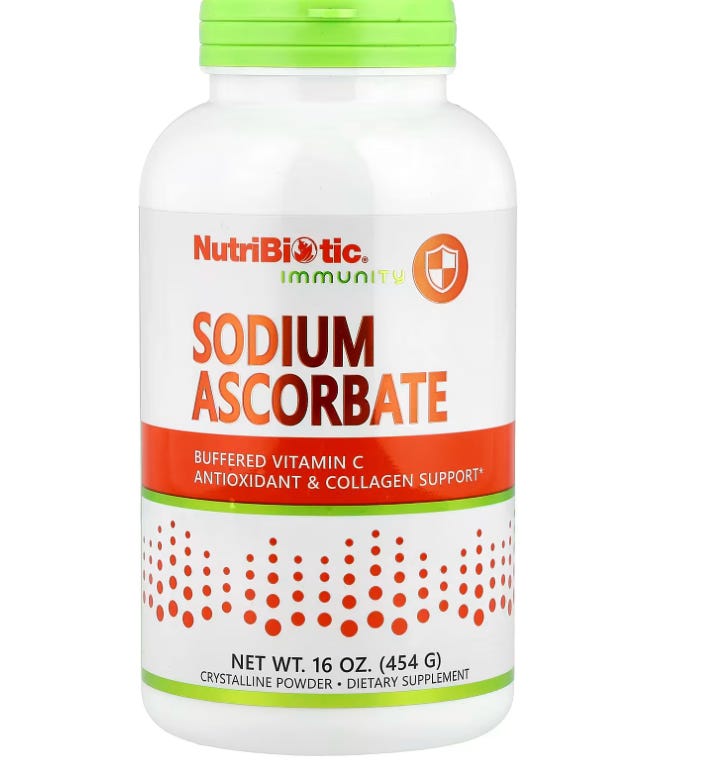
In terms of absorption, sodium ascorbate is well absorbed, though not as rapidly or efficiently as liposomal vitamin C. However, compared to standard ascorbic acid, it offers a better tolerance-to-dose ratio, allowing users to reach higher total daily intakes more comfortably.
Typical doses range from 1 to 4 grams per day for general support. In cases of chronic illness, infections, or increased oxidative stress, doses may be increased to 4 to 40 grams per day, divided throughout the day. Because it contains sodium, very high doses should be used cautiously in people with sodium-sensitive conditions.
For deeper clinical perspectives on vitamin C dosing and forms, the work of Thomas Levy is frequently referenced, particularly his research on high-dose vitamin C in chronic and serious diseases.
Liposomal vitamin C is a form that is more absorbable than regular vitamin C. Liposomes are tiny, nano-sized bubbles that mimic the body’s own cell membranes. By protecting and helping Vitamin C travel through the body, liposomes aid and speed absorption. Liposomal vitamin C.
Due to its high absorption capacity, it has a very favorable ratio. In fact, 1 gram of liposomal vitamin C is equivalent to approximately 3 to 5 grams of normal vitamin C (ascorbic acid). For people with serious illnesses or cancer, taking liposomal vitamin C can be very useful as it allows high concentrations to be reached very quickly in the body.
Furthermore, liposomal vitamin C has no side effects on intestinal transit, which is very beneficial, especially for children. For people taking mega-doses of vitamin C, liposomal vitamin C is taken at a dose of between 2 and 6 grams per day. In cases of major chronic diseases, the dose can be increased to between 4 and 12 grams per day.
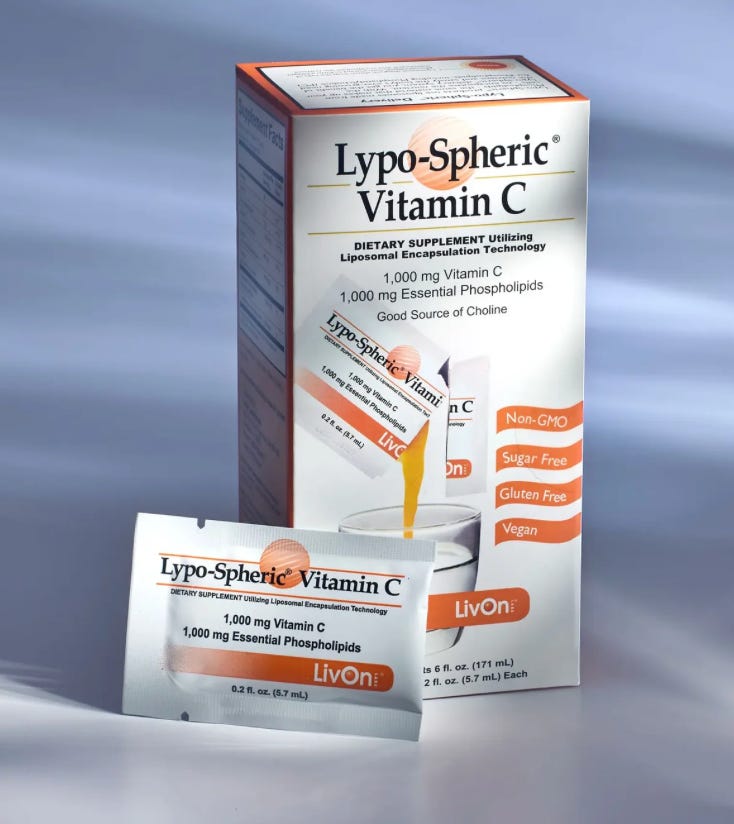
If you want to learn more, I recommend looking at the work of Thomas Levy MD, who worked with LiveOn Labs, the American company that developed liposome technology. Levy is considered the world’s leading expert on vitamin C and has written several books on the subject.
Summary:
Liposomal is the best and most absorbable form but is way more expensive. Sodium ascorbate is your preferred form when you want to use powder form and supplement through a drink or shaker. Ascorbic acid is the original and most widely used form, but come with more gut side effects.
This method is named after the late Robert Cathcart MD. Cathcart was a pediatrician in California who first discovered vitamin C after working with Irwin Stone, the author of the famous book The Healing Factor. Following Stone’s ideas and reasoning, he thought that massive doses of ascorbic acid were necessary to resolve the oxidative stress caused by diseases.
The idea is quite simple. Cathcart knew this compound very well and took it himself. He noticed that when he was feeling well, without stress or a cold, he couldn’t take more than ten grams a day. If he took more, he experienced “bowel tolerance,” which manifested as diarrhea. But when he was sick, with an infection or the flu, he could take up to 50 grams a day (divided into several doses) without experiencing any gastrointestinal symptoms. It was strange. When his body was under some form of physical stress (an illness constitutes physical stress), his body seemed able to absorb a very large dose of ascorbic acid.
Comments
Nothing yet. Say the first thing.
Sign in to join the conversation.