
In The White Heart of Mojave (1922), after discovering the breathtaking landscapes of Death Valley, American writer Edna Brush Perkins asked a simple yet profound question:
“How could rocks and sand and silence make us afraid and yet be so wonderful?”
This is the impression that this rather hostile and mysterious place left on her mind. After all, many things fascinate us and exert a sense of fear and disbelief. More than a century later, the same question could be asked about the humain brain. Few things are as fascinating, as mysterious or as misunderstood as the brain. Like the Californian desert, it is a landscape of extraordinary beauty-one that we are only beginning to explore.


Edna Brush Perkins (1880–1930) was an American writer, explorer, and one of the earliest literary voices to capture the beauty of Death Valley. In her acclaimed book The White Heart of the Mojave (1922), she described the desert with a rare blend of wonder and introspection, portraying it as both a place of harshness and extraordinary beauty. Her reflections remain among the most enduring and poetic accounts ever written about the American desert.
When I was reading Perkins’s book, I began to reflect on an interesting topic: how people have adapted to extreme environments, such as Death Valley. In her book, she describes the lives of the Shoshone tribes, who have managed to live in this hostile environment for centuries. Since my Substack focuses on the human brain, I looked for examples of lifestyles that have allowed people to preserve their cognitive abilities—particularly through diet. That’s why I decided to title this article: Tea, the Mind, and the Desert.
Although that won’t be the only topic I’ll cover. It’s time to take you on a little trip around the world to welcome in the summer.
This article will truly be multidisciplinary and will prompt us to reflect on humanity’s place in its environment. I will present four examples of extreme climates and analyze the dietary patterns and traditions that have been developed to cope with them, always with a focus on the brain.

Environment: Extreme heat and aridity.
What can the hottest place on Earth teach us about feeding the brain?
On July 10, 1913, a man named Oscar Denton recorded a temperature of 134 degrees Fahrenheit. He was a handyman at Greenland Ranch in the small town of Furnace Creek, California. Today, this place is considered the hottest spot on Earth. And for good reason: of the top 10 highest temperatures ever recorded on Earth, five were recorded here. In his notes, Denton wrote that on that day, birds were falling dead from the sky because it was so hot. He was the first white man to survive two consecutive summers in Death Valley. I specify “white man” because the local tribes had developed ways of life that allowed them to live for generations in this hostile environment.

As its name suggests, Death Valley is a very hostile environment for any form of life. It is therefore interesting to wonder how people managed to settle there and carry out activities. This is the case with the local Native American tribes, some of which still remain in certain areas.
Long before neuroscience explained caffeine, L-theanine, or polyphenols, the people of the world’s deserts had already discovered something remarkable: sometimes, protecting the mind begins with sharing a cup of tea. The example of Death Valley really illustrates this point. I decided to use this example, even though I’ll be talking about hot, desert climates in general.
It is very interesting to see how these peoples managed to adapt to this extreme environment and how they developed dietary practices that enabled their survival. The Timbisha Shoshone tribes had developed a remarkable understanding of their environment and adapted to the changing seasons. For centuries, this people survived in one of the harshest environments on Earth, Death Valley. Their diet was remarkably diverse, relying on mesquite beans, pinyon pine nuts, wild seeds, cactus fruits, desert herbs, and seasonal game. Every food served a purpose: providing energy, preserving strength, and helping people endure intense heat, long journeys, and scarce resources. Those seeds were high in tryptophan, essential amino acids and minerals like zinc.
Modern nutritional science reveals that many of these traditional foods were naturally rich in nutrients now recognized as essential for the body and the brain.
Pinyon pine nuts supplied healthy fats, magnesium, zinc, and vitamin E—nutrients involved in neuronal communication and protection against oxidative stress. Mesquite beans offered slowly digested carbohydrates, fiber, and minerals, providing a more sustained source of energy than refined sugars. Wild plants and cactus fruits contributed vitamin C, polyphenols, and antioxidants that helped protect cells from environmental stress. Again, I’m not claiming that they had a better physical or mental health than other people at that time. The interesting is to see how they adapted to this harsh environment.

The Timbisha also relied on lean wild game, a valuable source of complete protein, iron, vitamin B12, and other micronutrients necessary for producing neurotransmitters and maintaining cognitive function.
Without knowing anything about mitochondria, neurotransmitters, or oxidative stress, they had developed a way of eating that emphasized nutrient density over abundance. Their survival depended not only on physical endurance but also on memory, attention, sound judgment, and an intimate knowledge of the landscape. A good example of how people evolved and managed to adapt to an environment that would otherwise be seen as dangerous for our organism. Also, please remember that some of those tribes used to migrate to the mountains during summer, in order to avoid the blazing heat of this region.
How can hot tea can help people survive in the desert?
Hot tea triggers earlier sweating, helping the body cool more efficiently through evaporation.
It is usually sipped slowly, promoting steady hydration throughout the day.
Warm drinks are often easier to tolerate than ice-cold beverages in extreme heat.
Tea provides water, antioxidants, and beneficial plant compounds that support the body’s response to environmental stress.
Drinking tea also encourages resting in the shade, reducing heat exposure and conserving energy.
Environment: High altitude (>4,000 m)
For centuries, Tibetan communities have lived at elevations exceeding 4,000 meters (13,000 feet), where oxygen levels are nearly 40% lower than at sea level. In this harsh environment, staying warm and maintaining mental clarity are constant challenges. I often go to the French Alps, at altitude of roughly 2000 meters, and I can tell you that I can feel the lack of oxygen already.
One of the region’s most iconic traditions is po cha, or yak butter tea. Made from black tea, yak butter, water, and salt, it is consumed throughout the day, often in large quantities. To an outsider, the drink may seem unusual, but for generations it has been an essential part of life on the Tibetan Plateau.

Yak butter provides a concentrated source of calories and fat—critical in an environment where energy demands are exceptionally high. The tea contains caffeine, which helps sustain alertness during long days of work, travel, or prayer, while the added salt helps replace electrolytes lost through physical activity and the dry mountain air. It is important to remember that exercise and physical effort usually depletes the body of essential nutrients, making the supplementation / nourishment even more important. Many people in the workout community don’t emphasize this enough.
Today, modern neuroscience offers an interesting perspective on this ancient tradition. The human brain accounts for only about 2% of body weight, yet consumes roughly 20% of the body’s energy. At high altitude, where oxygen is limited and metabolic stress is increased, maintaining a reliable supply of energy becomes even more important. The combination of fat, hydration, electrolytes, and mild stimulation found in yak butter tea may have helped generations of Tibetans remain resilient in one of the world’s most demanding environments. As you can see, the tea is popular in all extreme environments. Regardless if you are in the desert or in the foothills of the Himalaya. This beverage is truly magic. Magic.

Yak butter tea (po cha) made from black tea, yak butter, water, and salt, consumed throughout the day.
A high-fat diet providing concentrated calories to meet the enormous energy demands of high-altitude living.
Frequent consumption of yak dairy products (butter, milk, yogurt, cheese), rich in fat and fat-soluble vitamins.
Barley (tsampa) as the staple food, supplying complex carbohydrates, fiber, and sustained energy.
Moderate amounts of yak meat and mutton, providing high-quality protein, iron, vitamin B12, and zinc.
Limited but seasonal intake of wild herbs and mountain vegetables, contributing vitamins and antioxidants.
A dietary pattern focused on warmth, energy density, hydration, and electrolyte balance, helping people cope with cold temperatures, low oxygen levels, and demanding physical conditions.
Environment: Extreme cold and months of darkness.
Life above the Arctic Circle has always demanded extraordinary resilience. With months of darkness, freezing temperatures, and a landscape where crops could not grow, Inuit communities developed a way of eating almost entirely based on the sea. Fatty fish, seals, whales, and other marine mammals became the foundation of their diet, providing the calories needed to survive one of the planet’s most unforgiving climates.

Today, we know that these foods are exceptionally rich in omega-3 fatty acids (EPA and DHA), which play a central role in maintaining healthy neuronal membranes. Many people are deficient in it, especially in our modern societies. They also provide vitamin D, vitamin B12, selenium, iodine, and highly bioavailable iron—nutrients essential for brain function, energy metabolism, and cognitive performance. Iodine provides a good protection against cancer and other thyroid related problems. Vitamin D and vitamin B12 usually protects a person from depression and anxiety, even if those conditions are more complex.
Without realizing it, Arctic peoples had built a nutritional strategy that supplied many of the compounds modern neuroscience now considers fundamental for a healthy brain.

From a biochemical standpoint, this diet makes perfect sense. For people living north of the Arctic Circle, the priority is to consume enough fat and ensure adequate vitamin D levels. As numerous studies have shown, Scandinavian countries and some northern European countries had slightly higher rates of psychiatric disorders than the rest of the world. This is likely due to low levels of sunlight and the resulting deficiency in natural vitamin D. To compensate, people have had to consume foods rich in this vitamin, such as fatty fish and mushrooms, for example. In Scandinavia, certain population subgroups (particularly people of African descent) sometimes have dangerously low levels of vitamin D, due to skin with high levels of melanin, which absorbs the few rays of sunlight available each year even less effectively.
A diet centered on fatty fish (salmon, Arctic char, trout), providing omega-3 fatty acids, vitamin D, and high-quality protein.
Regular consumption of seal, whale, and other marine mammals, supplying energy-dense fat, iron, vitamin B12, selenium, and iodine.
Limited intake of wild berries, seaweed, and seasonal plants, contributing vitamin C, antioxidants, and fiber when available.
Minimal reliance on carbohydrates, with a dietary pattern naturally high in fat and protein to meet the demands of extreme cold.
Frequent consumption of organ meats, particularly liver, which are exceptionally rich in vitamins A, D, B12, folate, and essential minerals.
A nutrient-dense diet designed to support thermoregulation, brain function, energy metabolism, and survivalduring long winters and months of darkness.
Environment: Long meditation sessions.
If there’s one country surrounded by stereotypes and preconceived notions, it’s Japan. I feel free to say this because I’m French, and my country is no exception to this rule. I don’t have a good knowledge of the Japanese civilization, to be honest. But I know one thing for sure, is that they love to drink tea. Like many people in Asia.
Few beverages have shaped a civilization quite like green tea has shaped Japan. Introduced from China around the 9th century, it gradually became inseparable from Zen Buddhism, where it was valued not merely as a drink, but as a companion to contemplation. It is true that drinking a cup of green tea clears the mind. From a biochemical point of view, it is perfectly normal.
In the 12th century, the monk Eisai, often regarded as the father of Japanese tea culture, wrote Kissa Yōjōki (Drinking Tea for Health), one of the earliest texts to describe tea as a way to preserve both physical vitality and mental clarity. He famously argued that tea was “the elixir of life” and beneficial to the heart and mind. When I studied abroad, I met a diplomat from Pakistan that used to drink tea a lot. He always told me it cleared the mind like nothing else. It helped him in his work a lot.
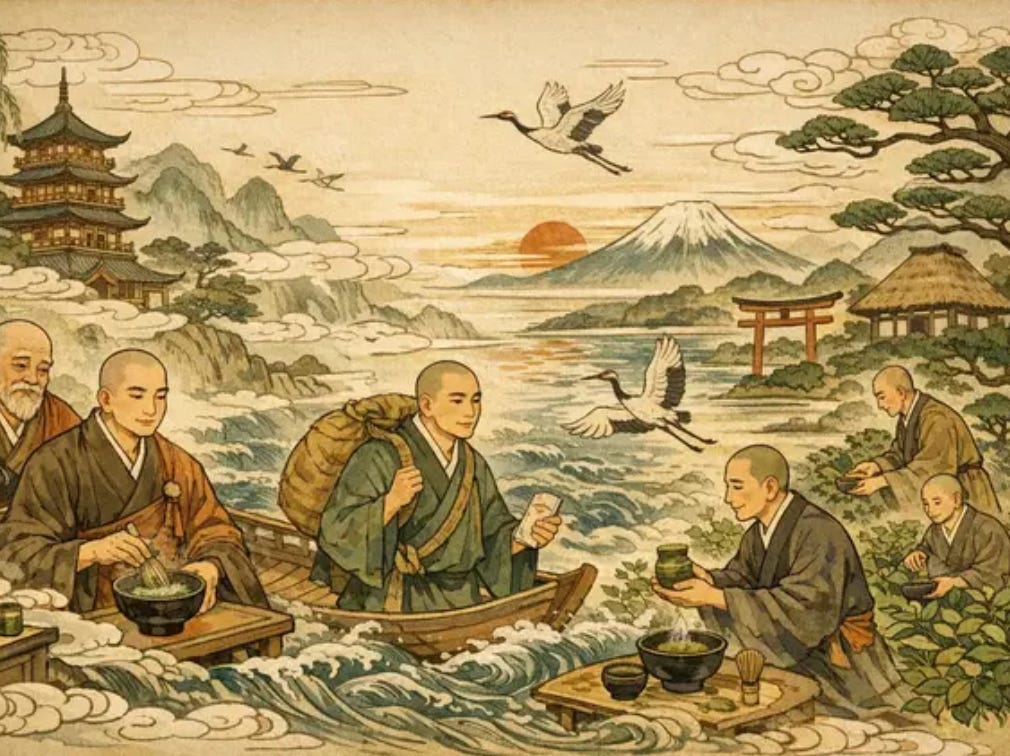
Within Zen monasteries, monks traditionally drank green tea before long hours of meditation. The objective was not stimulation alone, but sustained awareness—a calm, attentive state that could be maintained for hours without distraction. Over time, tea became deeply embedded in Japanese culture, eventually giving rise to the tea ceremony (chanoyu), where every movement reflected mindfulness, patience, and presence. The molecules in green tea have profound effects on the brain, on our cognitive abilities and our overall wellbeing. In the nootropic world, many people swear by it.
Modern neuroscience offers an intriguing explanation for this centuries-old tradition. Green tea naturally combines caffeine with L-theanine, an amino acid almost unique to tea that appears to promote relaxation while preserving alertness. Together, these compounds have been associated with improvements in attention, working memory, and executive function, producing a smoother cognitive effect than caffeine alone. Rich in catechins and other polyphenols, green tea has also become one of the world’s most extensively studied traditional beverages for its potential role in healthy brain aging. In my opinion, Green tea is one of the most ancient traditions with a clear goal to improve the mind’s abilities. And it works, believe me. I used l-theanine off and on when I was experimenting with nootropics and cognitive enhancers in the past.
Long before neuroscience described neurotransmitters or brain networks, Japanese culture had already recognized that the mind performs best when alertness and tranquility exist in balance.
Daily consumption of green tea (sencha or matcha), providing caffeine, L-theanine, catechins, and powerful antioxidants.
A diet rich in fatty fish, supplying omega-3 fatty acids, vitamin D, vitamin B12, iodine, and high-quality protein.
Regular intake of soy-based foods (tofu, miso, natto), providing plant protein, minerals, and beneficial isoflavones.
Frequent consumption of seaweed, rich in iodine, magnesium, calcium, and trace minerals essential for thyroid and brain function.
A wide variety of vegetables, mushrooms, and fermented foods, contributing fiber, polyphenols, vitamins, and a diverse gut microbiota.
A balanced dietary pattern emphasizing mental clarity, sustained energy, and long-term brain health, supported by nutrient-dense foods and the ritual of green tea.
Benton, D. (2010). The influence of dietary status on the cognitive performance of children. Molecular Nutrition & Food Research, 54(4), 457–470.
Einöther, S. J. L., & Martens, V. E. G. (2013). Acute effects of tea consumption on attention and mood. The American Journal of Clinical Nutrition, 98(6 Suppl.), 1700S–1708S. https://doi.org/10.3945/ajcn.113.058248
Gómez-Pinilla, F. (2008). Brain foods: The effects of nutrients on brain function. Nature Reviews Neuroscience, 9(7), 568–578. https://doi.org/10.1038/nrn2421
National Park Service. (n.d.). The Timbisha Shoshone Homeland. Death Valley National Park.
Perkins, E. B. (1922). The White Heart of the Mojave. Boni & Liveright.
Pollan, M. (2001). The Botany of Desire: A Plant’s-Eye View of the World. Random House.
UNESCO. (2022). Traditional tea processing techniques and associated social practices in China. Representative List of the Intangible Cultural Heritage of Humanity.
United States Department of Agriculture. (2019). FoodData Central. U.S. Department of Agriculture.
Wang, Y., Kasper, L. H., & others. (2014). The role of nutrition in brain development and cognitive function. Nutrition Reviews, 72(4), 267–284.
Young, S. N. (2007). How to increase serotonin in the human brain without drugs. Journal of Psychiatry & Neuroscience, 32(6), 394–399.
Comments
Nothing yet. Say the first thing.
Sign in to join the conversation.