
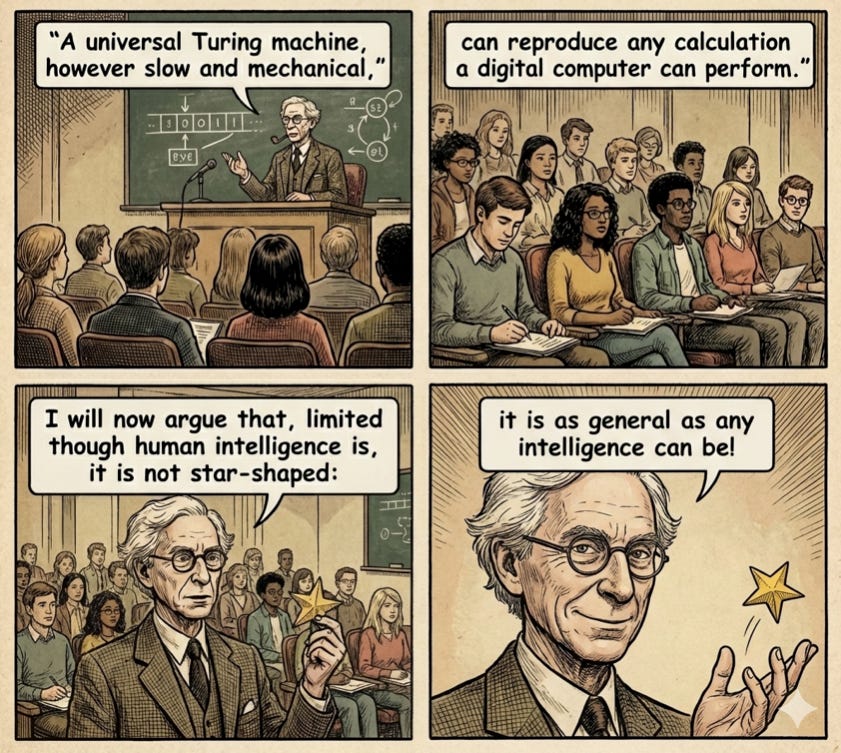
Lately, the question of whether human intelligence is truly general has been occupying an increasing share of the public debate on intelligence. Coincidentally, this tendency gained traction after current machine learning systems like LLMs fell short of the promised goal of artificial general intelligence (AGI) — a computer system that can perform every cognitively important task as well as, or better than, any human. By contrast, only a few years ago researchers and tech enthusiasts alike spoke as though such an AGI were just around the corner, and rarely questioned the generality of human intelligence. Denying the very existence of a general intelligence offers now a comfortable escape.
To be fair, cognitive scientists, neuroscientists and psychologists — beginning from Howard Gardner — have argued for decades that in humans there is no such a thing as a single intelligence, but rather a collection of distinct intelligences: musical, motor, linguistic, logical-mathematical, social and so on. More recently, Alison Gopnik forcefully restated this thesis, under yet another lens: intelligence would be either exploitative, explorative or teaching/caring and these different intelligences would allegedly work in opposition.
I believe these theories mistake the concept of generality for the notion of being implemented by a single internal mechanism — whatever that might mean. The fact that intelligence employs different tools or brain areas to accomplish its goals implies neither the existence of multiple intelligences nor the lack of a general one. This would be akin to claiming that since the motor system is made by agonist and antagonist muscles that mainly work in opposition, there must be two distinct motor systems. It is true that the biceps and triceps respectively flex and extend our forearms, and therefore cannot be the main drivers of movement at the same time. Nevertheless, they work in concert: for example, the action of antagonists is essential for regulating agonists and prevent them from tearing apart. In presence of multiple skills and modules, a general intelligence may function as an orchestra director. Another related error would be to claim that reading is not a single skill because it involves the motor system moving the eyes, the visual circuit identifying the linguistic symbols, and the Broca area decoding language.
If this essay were devoted to examining every version of such theories of multiple intelligences or narrow intelligence in humans, it would be among the longest ever written. So I will proceed now by presenting my own argument that human intelligence is not only general, but as general as any intelligence can be.
Any rational discussion of human intelligence should begin with a definition or an axiom, since there is no universal, cultural consensus on the meaning of the term. Determining a necessary property of human intelligence is therefore our first goal.
That humans can learn an extraordinary range of things is all too obvious. We can learn radically different languages, from natural ones such as English to highly artificial symbolic idioms like programming languages and musical notation. We can learn to use arbitrary tools of our own invention, play unfamiliar musical instruments, and master diverse games, from sports to computer games, governed by arbitrary rules. We can invent new science and mathematics, and come to master it. The list is endless.
The aim of this essay, however, is to draw attention to something more subtle: human intelligence is general in an even more profound sense. A fundamental trait of human intelligence is the ability to invent, construct and use tools. Human intelligence succeeds precisely because it avails itself of instruments, tools, and machines that overcome our biological limitations.
This is entirely consistent with the way we have been using the concept of intelligence so far. We trace the dawn of human intelligence to the very point in the archeological record where artifacts first appear, often buried alongside early hominids.
Indeed, what would become of our kind were it unable to craft and use stones to produce fire, weapons for hunting, or symbolic words for communication? Language, perhaps the first of our inventions, is so vital that some of its general structures are likely encoded in our genes. Very little of human intelligence would remain if we chose to exclude toolmaking from its definition.
Very little of any intelligence would be left if it were incapable of tool invention. This is so because every living entity is, of necessity, finite and limited. It would be an odd sort of “intelligence” one that refused to overcome its own limitations through tools. Imagine a self-satisfied alien species attempting to invade our planet without any weapons, confident in a working memory that can manage 25 elements in contrast to our meager 5. “Our minds are so powerful”, the aliens might say, “we will figure out another way”: I suspect they would meet a bitter surprise.
Why, after all, did evolution engineer intelligence in the first place? For survival. Little does Nature care if a leopard uses vegetation to conceal its approach or land on the prey from above. Nature cares nothing if some species digs a burrow or employs a twig to extract ants from a mound. Evolution selects for survival. It does not matter if the solution is a biologically sharper claw or a technologically sharpened spear. Many species manipulate the environment to attain their goals. Using the environment for survival is a profoundly intelligent strategy. We can now state our axiom:
TOOL AXIOM: A fundamental trait of human intelligence is the ability to invent, construct and employ tools. Every success humanity achieves thanks to its tools counts as an accomplishment of its own intelligence.
One of the most common arguments today for viewing human intelligence as narrow rather than general is the claim that it is “star-shaped”. By measuring human performance across isolated tasks, one may observe that an AI or other animals sometimes display superior performance, and thus infer that our intelligence lacks generality. Indeed, machines now easily defeat us at chess, folding proteins, and in the sheer number of languages they command. Even a bat, by virtue of its biological sonar, would appear more intelligent than humans at navigating darkness.
But the Tool Axiom reveals a deeper problem: what, exactly, are these benchmarks measuring? Does assessing performance quantitatively has anything to do with the quality of being general? Moreover, since creating and using tools is a fundamental property of human intelligence, it makes little sense to evaluate absolute performances in settings where tools are forbidden. Life is not a game with self-imposed rules.
For example, comparing humans to bats conflates sensory with intelligence limitation. Indeed, humans have used their general intelligence to construct sonars and night-vision goggles, thereby extending their “star.” That we are general enough to beat the bat at its own game demonstrates the adaptability of human intelligence rather than undermining it. Similarly, human intelligence is not deficient because we can’t perform 10,000 calculations per second: it is like saying humans are hopelessly slow because we can’t run 60 mph, while ignoring that we built the car.
This is again consistent with our historical use of the word “intelligence”. No one suggests that Kepler or Newton “cheated” to obtain their scientific achievements because they employed ink and paper as external tools to perform their vast calculations. Nor has it ever been claimed that Galileo’s use of a telescope to observe the remote or the use of a microscope to probe the minute is cheating. Nor that the discovery and use of these tools diminishes the intelligence in our achievements.
The Tool Axiom tells us that human intelligence is as general as any intelligence can be, because we can devise workarounds to successfully reach any attainable goal. That’s how we managed to create astonishing theories such as relativity or quantum mechanics. That’s how we managed to improve and facilitate our existence in millions of different ways. No real general intelligence can avoid using tools.
By the Tool Axiom, the discoveries made by AI systems we design count as our own achievements and serve our goals. AI is just a long mathematical formula computed by brute force. No one would claim that the applications of the Gaussian method to solve linear equations do not count as our achievements.
It is also worth recalling that every operation a digital AI can perform can also be carried out by humans through manual calculations with pen and paper. The very mathematical nature of AI implies that computers merely accelerate the processing and generation of information. If humanity devoted itself to carrying out those computations, the very same results would be obtained. This demonstrates that limitations in short-term or long-term memory, or in other mechanisms, do not in principle establish insurmountable barriers to our own intelligence.
Human intelligence has thus evolved past a critical threshold, rendering it general in the same sense that a universal computing system is. I suspect this threshold consists in a crucial level of abstraction, which enables at first the invention of natural languages, then the discovery of mathematics and physical sciences, and at last the notion of universal computation. Once an intelligence reaches this threshold, it achieves the highest degree of generality. Beyond that, there is only optimization.
One might object that modern AI is agentic: it discerns patterns its creators never explicitly program. Were a child to win a Nobel prize, would the parents deserve the credit because they “created” the child?
Yet, parents do not engineer children; they merely reproduce biologically. A child’s genius, therefore, is largely matter of biological fortune the parents deserve no credit for. By contrast, humans do engineer every single detail of the mathematical structures from which AI systems are built. We design the architecture, the learning rate, and the objective function. Even if the mathematical system learns “on its own,” it learns nothing more and nothing less than our definition enables it to do.
Another objection might raised: if a tool produces a solution the human mind cannot comprehend, can the human still be said to own the tool’s success? The brain, limited by a scant working memory, may struggle to grasp the hundred-dimensional mathematics an AI might employ.
This argument suffers from two issues. First, it is not clear why the concept of understanding should be relevant to the notion of generality at all. Generality appears to concern not so much how a result is attained as whether it can be. Deep understanding is certainly a crucial property of intelligence, since taming complex problems often requires reducing them to abstract and compact principles. But in this sense understanding is no more than a useful, guiding heuristic: a psychological state. If truth and logical derivations can be otherwise reached without direct understanding, this does not seem to affect the generality of the intelligence.
Second, it should be evident by now that human intelligence is not a closed system, bound by fixed storage, fixed processing speed and other immutable hardware constrains. Writing expands the short term memory, while reading books the long-term memory; computers augment our computing speed. The Tool Axiom thus suggests that the human brain actually functions as a conscious kernel of an open system. A neural interface expanding our memory even further might be invented; the resulting hybrid system would then be capable of grasping the most complex mathematics. Our intelligence is also in this sense potentially general. This view aligns with the Extended Mind Thesis, proposed by Clark and Chalmers.
Therefore, nobody can predict the ultimate limitations of our understanding. There may be limits, yet we are sufficiently general that we may never, in practice, encounter them. We might be perfectly capable of understanding a grand theory of the universe, and any machine or system of practical relevance.
What about AI itself, however: doesn’t this mathematical formula defeat us at chess? Yes, but it is a matter of little consequence. We could, after all, use one AI to beat another — provided that ever mattered. That is why the narratives of an AI apocalypse lack credibility: humans can construct well-behaved superintelligent systems capable of countering any purported malevolent artificial intelligence. The theoretical no-tool inferiority of the human mind would play no role, for Nature is concerned with survival, not with the provenance of our methods.
Similarly, imagine a war between humanity and alien civilization. Reluctant to blow away the very planet they seek to occupy, humanity and aliens decide that the only rational choice is a chess match to reward the superior intelligence. Our champion versus theirs. Both sides would almost certainly employ their most advanced tools: perhaps quantum computers merged with neural machines of astonishing power, and other technologies we cannot yet imagine. In the end, those who win will be those wielding the better tools.
Survival, progress, and knowledge, rather than rewarding naked cognition, promote effective cognition — and effectiveness almost always involves tools. Nature is indifferent to whether a solution is biological or technological. To judge intelligence without tools is like judging car locomotion by forbidding wheels. Human intelligence appears “star-shaped” only if one artificially suppresses its defining move: transcending its own limits. Human intelligence can overcome its most sever limitations:
in sensory data, by extending the scope of perception with microscopes, telescopes, or sonars; by detecting electric and magnetic fields, and in general by measuring the tiniest forces that act in nature;
in computational speed, through silicon processors that function as though they were perfectly integrated extensions of our cognition;
in its hardware, by extending biological neural networks with digital ones, as occurs every time we interact or collaborate with an artificial intelligence.
The Tool Axiom carries significant weight and bears strong consequences: it may appear to be too heavy an assumption. But what, indeed, is the alternative? To reject it would be to render much of humanity’s intellectual and technological history inexplicable. Strip away our tools and the footprint of human civilization would differ little from that of the great apes.
Tools, moreover, cannot easily be disentangled from our biology. When we invented the tool of controlled fire, we began cooking. Cooking made calories easier to digest, which allowed our guts to shrink and our hungry brains to grow. Nowadays, using particle accelerators creates new empirical information, which enables new conceptual advancements and in turn propel our intelligence towards further technological devices. Furthermore, language allows us to inherit the wisdom of our ancestors. No single human needs to reinvent the wheel when its blueprints are stored in the tool of language. A tool that AI itself must rely upon for learning.
Lastly, if we define human intelligence by only what happens inside the skull, we are forced to conclude that a modern person is no smarter than their ancestor from 10,000 BC. Yet, by the Tool Axiom, we can say humanity is objectively more intelligent today because our “extended mind” has access to vastly superior tools, including previous knowledge and more profound conceptual apparatus.
We have, in my view, no rational alternative but to accept the Tool Axiom and its inevitable consequences.
Thanks for reading. If you enjoyed my essay, please share it!
No posts
Comments
Nothing yet. Say the first thing.
Sign in to join the conversation.