
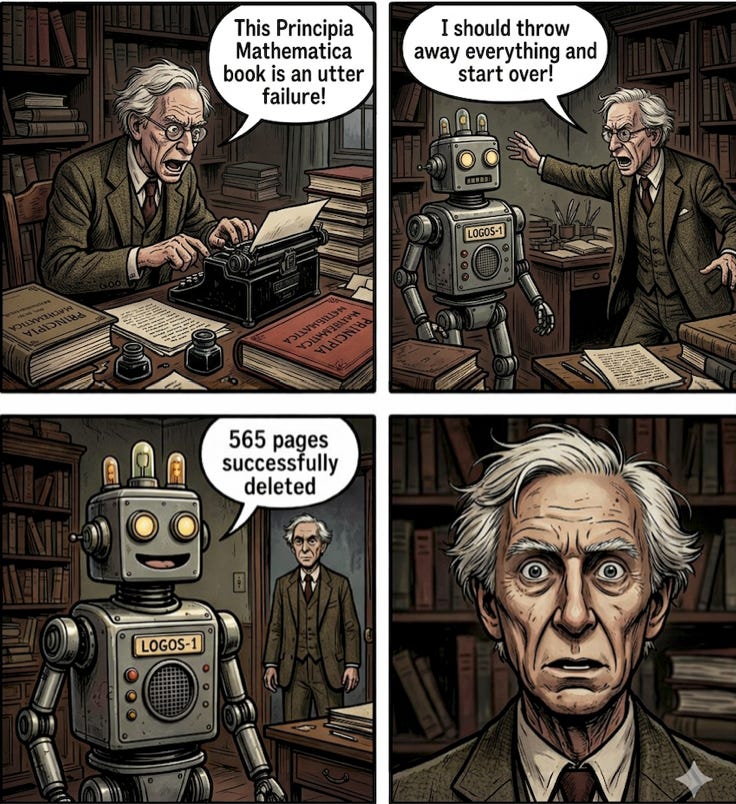
AI has recently begun to take control of our computers. Thanks to agents built on large language models, it can now successfully code, edit vast documents, and automate an impressive range of tasks. In response, media hype has once again surged to new heights. Many commentators are panicking at the thought that this is finally the time when AI comes for white collar jobs, devastating the job market.
But is this justified?
I recall that an AI agent is nothing but your favorite large language model, be it ChatGPT, Claude or Gemini. Your computer, as a matter of fact, runs on a text-based terminal whose task is to execute textual commands. Before the graphical interface revolution, started with Mac and Windows in the 1980s, the only way to control a personal computer was to type abstruse commands into an austere black screen. Behind it, it was hosted the engine performing all operations, such as launching programs or administering the file system. The revolution consisted in bringing a graphical interface, built on top of the command line, enabling users to point and click on graphical elements; this triggered the automatic generation of the terminal commands required to execute the intended action. The arcane syntax of the terminal suddenly disappeared, giving way to the friendly visual intuition of pointing and clicking.
LLMs are virtuosic text generators. It should therefore come as no surprise that they can easily bypass the graphical interface and use the terminal to command our computers; to create and run all sorts of code; to assist us with the typesetting of documents and the manipulation of files. Automatically. A well-crafted prompt, logically organizing the workflow of the AI agent, can yield a perfect result while you drink your coffee — or while you run another agent, for the goal of agents is neither our satisfaction nor carving us free time, but enable us to work as much as before while producing more.
Now that we made clear what AI agents are — simply ChatGPT or Claude intruding into our computers - the question is:
Are AI agents truly a revolution? Have they changed anything whatsoever in the prospect of the technology, admitting their undeniable success?
Let us find that out.
First of all, I have been warning that AI is becoming increasingly smarter for almost a year now. My favorite benchmark is mathematics, for it is not possible to cheat when confronted with well-chosen mathematical tests. A piece of reasoning, no matter how eloquent, is either correct or not, and anyone proficient with the language of mathematics can assess whether an AI is producing confident hallucinations or something sound. It is relatively easy to create completely new problems and determine objectively how AI performs.
It turns out that AI performs now at the level of our smartest teenagers — at the level of our youngest elite thinkers. It can creatively solve difficult problems that 99% of humans could not.
Knowing that AI models now possess impressive capabilities, I experimented extensively over the past thirty days with AI agents. I set myself the goal of finally training an AI model on my own. Although I know very well the theory of artificial intelligence, including the main models, I do not code. Despite knowing at least five programming languages, my passion has always been to develop theories rather than implementing them. Therefore, to test my theories, I would previously have had to hire coders expert in machine learning. Alone, I would have been powerless. It would have taken weeks or even months just to get started, sacrificing energy that I would haver rather devoted to my more theoretical goals.
Yet, with Codex, I launched immediately into the project. First things first, I asked the model to produce a 30-page document explaining to me the structure of the code repository and how it worked. Whenever something was unclear, I asked Codex to expand the relevant section. I could not understate how much time is necessary, even to an expert, to understand a poorly documented code repository. With Codex it was effortless.
Afterwards, I asked the model how I could connect to a cloud GPU provider that could rent me the machines needed for my experiments. That hardware can only be controlled via terminal commands, and I had no idea how to do this, my experience being limited to artificial exercises I completed twenty years ago as an undergraduate in compute science. But with Codex running commands on my behalf, it was no trouble to install all I needed and run the AI model.
I then asked Codex to create me a training script to fine-tune the model, and once again it did that promptly. After some initial test training, I began to investigate possible code changes that might improve the model’s learning. I found a promising solution, but I was afraid that the code repository was too complex and its total lack of documentation would prove an insurmountable obstacle. Yet again, Codex could generate the required code entirely on its own. My final training run was successful enough to surpass the state of the art in music generation.
In the middle of these endeavors, I encountered several issues with the training data that, in order to be fixed, required small corrective programs here and there. Codex always did a perfect job. No hallucinations, no stochastic parroting: it just got the work done. Thanks to an AI agent, I could successfully function as a start-up without a single employee.
AI agents are truly revolutionary.
How is this possible? Are social media philosophers and AI skeptics not arguing that AI has no real intelligence and cannot truly understand and think?
As I explained in a previous essay, large language models do understand language, albeit in a way that differs fundamentally from our own. They work axiomatically. They extract the mathematical rules governing our use of language. Meaning is not derived by reference to an external world, but is learned via the internal rules that structure linguistic practice. Mechanical knowledge of these rules is sufficient to be successful in most linguistic tasks.
But aren’t these so-called agents, as I acknowledged from the beginning, just the usual LLMs, merely renamed to appear more impressive? In one sense, yes. In another, the reality is that they were previously underused: confined to a chat window they are not nearly as effective as they can be. All models, now, are reasoning models: they do not directly produce an output; they work through trial and error, constantly revising their attempts and improving upon earlier results. When models can automatically receive feedback and test their own work, they can, in the worst case, brute-force their way toward correct solutions. They can overcome their own hallucinations and eventually succeed in an impressive variety of tasks that can be carried out on computers.
If AI agents can already be smart, the only remaining question is: are they reliable?
And here lies the problem: they are not at all. Let us return to mathematics once to understand why.
Gemini DeepThink is the most advanced AI mathematical problem solver in the world, built on top of Gemini 3 Pro. Recently, DeepMind developed a more powerful variation of the model, modestly called Aletheia — “truth” in ancient Greek. It can solve essentially all problems at the level of the Mathematical Olympiad, even the tougher ones that no previous AI model had managed to tackle. It has also solved a handful of open problems from the Erdös database of research-level number-theoretic problems. The achievement is undoubtedly impressive.
Yet Aletheia also hallucinates on a massive scale. Of all the solutions it has proposed to the Erdös database problems, 68% were incorrect, and only 6% were actually solutions to the problem as stated. This means that roughly 26% of the time, although crafting correct mathematical reasoning, Aletheia misunderstood the very statement of the problem. Ironically, Aletheia seems quite allergic to truth when confronting open and difficult questions. On several occasions, it invented mathematical results, citing real papers while attributing to them imaginary theorems.
If AI hallucinates when dealing with something as precise and rigorous as mathematics, there is little ground to believe it will not do the same when facing complex coding problems —or anything else, for that matter. It does not require prolific imagination to foresee that the more complex a coding project becomes, the more likely fatal bugs are to be introduced. Crucially, such bugs can remain undetected, for AI is masterful in creating credible code that conceals subtle mistakes. I suspect that no long term coding project can be powered solely by AI agents without eventually collapsing. My own project succeeded by not daring too much.
The Aletheia failure in matters of reliability demonstrates that current AI is dramatically falling short in novel situations and no solution is in sight. When mathematical problems can be tackled by an arsenal of known techniques, AI models can succeed. But every time an AI model venture into uncharted territories, it stumbles badly. At best, current AI can aspire to be a mechanical intelligence.
By this term I mean a form of intelligence capable of perfectly learning everything that is represented enough in the training data and use its impressive, superhuman arsenal of tools and knowledge to carry out all the tasks that do not require leaps of creativity. Deep and inventive originality, on the other hand, still proves completely out of reach and resistant to current technology. In a sense, demanding that an AI model be original is like asking a physics scholar to invent alternative physical laws, despite their job being to discover the rules governing our universe. AI model only know the conceptual models we teach them, they are not aware of anything outside them.
To be clear, such a mechanical intelligence can nevertheless be of an enormous significance. The quota of humans who operate at the highest level of creativity and regularly confront challenging problems requiring the invention of new concepts and techniques is relatively small. Such activity advances human knowledge, but it is not required for the day-to-day operations of a business. A mechanical intelligence can empower start-ups and create all sorts of new economic enterprises.
We are very close to mechanical intelligence. A part from mathematics and coding, AI is succeeding in learning everything: the recent impressive achievements of the video model Seedance 2 must be noted, as they show that the model starts to understand how humans move, act, speak and to trace the dynamics of objects. Whether this is a deep understanding of the world’s physics is unclear; given the error the model still makes, it is probably another example of approaching mechanical intelligence.
Although we are close to such an intelligence, as I argued, it is clear we are not there yet. Perhaps in the coming years, AI models will become more reliable in their logical and mathematical reasoning, and thus they will also be able to reason more effectively about what they produce.
For the moment, however, I don’t believe human workers have much to fear. From the perspective of a rational business owner, it is difficult to think that AI can provide a solid business foundation. AI has no job to lose nor paycheck to wait for, and thus bears no responsibility and posses no intrinsic motivation to be correct. AI must always be associated with a corresponding human expert who can supervise and organize its activity. AI, moreover, still suffers from the lack of human-level memory, the remarkable ability that allows us to learn in absence of abundant data and thus integrate very well into new professional environments. Pairing the forgetful nature of the AI mind with its chronic unreliability, AI simply cannot yet compete in the job market. Once again, the hype appears unjustified.
No posts
Comments
Nothing yet. Say the first thing.
Sign in to join the conversation.