
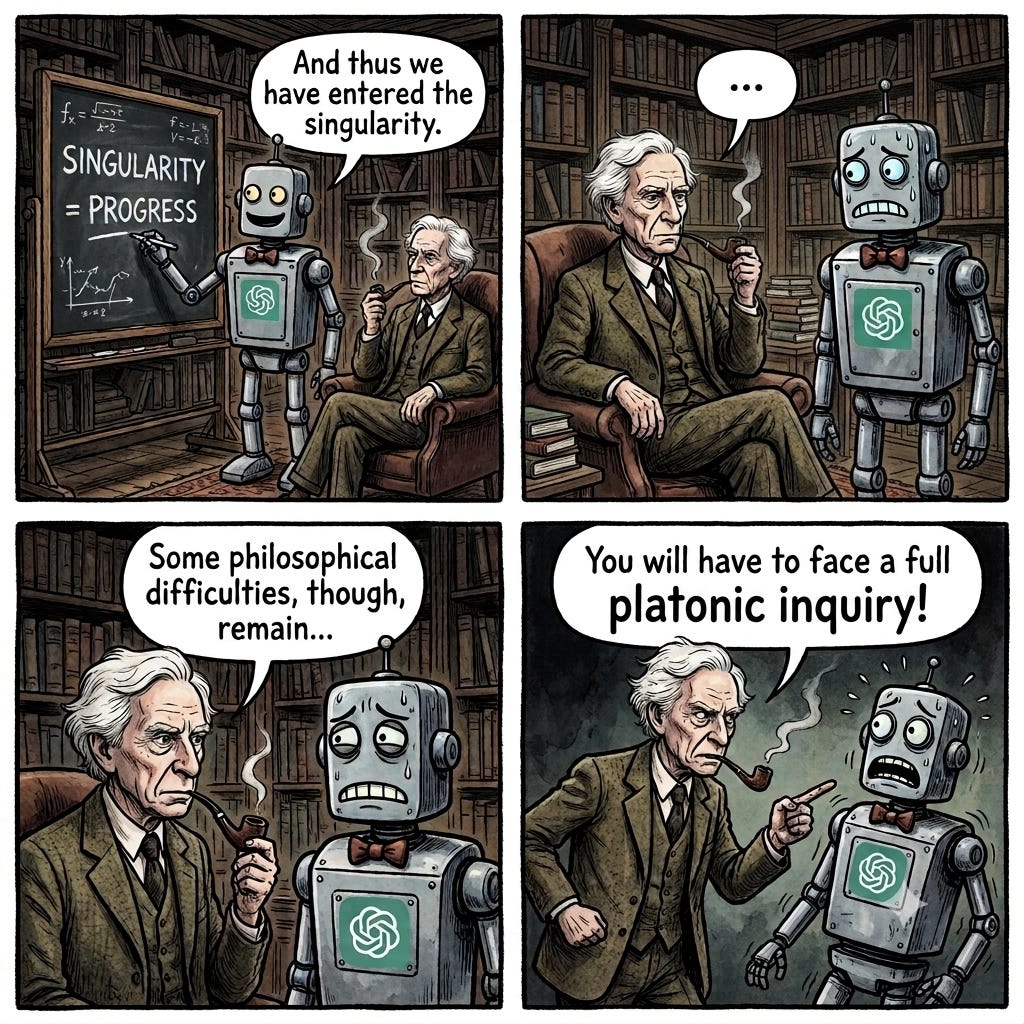
In a recent interview, Sam Altman declared that we are in a singularity, a spiral of dramatic improvement leading AI directly to superintelligence. Yet he did not explain the reasons for his belief. “Of course, this is hype!”, many would say.
However, something is truly changing. Last year, I rejected the claim that GPT 5 was PhD level. Yet GPT 5.5, for me and many scientists whom I deeply respect, crossed a threshold. It felt, for the first time, like an intelligent scientist. There is overwhelming evidence that this is not only a feeling, but reality. GPT 5.6 Sol has reached PhD level in scientific problem solving. Yet many are simply repeating their familiar narratives, despite the evolving evidence. However, skepticism is one thing; blindness is another.
The time of easy dismissals has thus ended, and the singularity hypothesis is gaining strength. It now deserves to be examined more seriously. The guiding principle of this newsletter is to offer a balanced account of intelligence. Since our incomplete understanding prevents us both from proving and refuting the singularity hypothesis, I will proceed in the form of a Platonic dialogue. In this way, I will provide a balanced exposition of both what OpenAI’s reasoning could be and the reasons to reject it. I take my inspiration from the Parmenides, a later dialogue in which Plato critiques his own theory of ideas.
The Dialogue of Parmenides and Openicium
The setting is a garden after sunset. Two men walk slowly beneath the trees. One is Parmenides, whose years have diminished neither his wit nor his thirst for knowledge. The other is Openicium, young and confident, but not without respect for an elder’s wisdom.
Openicium: Parmenides, did you read Altman’s recent claim that we have just entered a singularity?
Parmenides: I certainly did. And I imagine you are in high spirits, Openicium, for you always seek to prove that humans are not so special. I never understood the reason for your nihilism.
Openicium: Human intelligence will soon lose its edge, and humans will realize that their minds are neither unique nor impressive. Humanity is not special, Parmenides. This is a truth, not an ideology.
Parmenides: Ah, Openicium. Your philosophical innocence continues to amuse me. Here, in Europe, we have long been aware that humans occupy no privileged position in the universe. Two thousand years ago, our own Aristarchus suggested that the Earth is not at the center of the solar system. Since Copernicus, this theory has been universally accepted.
Yet, we found other ways to regard ourselves as special. Pascal despaired for a while, and then came the Enlightenment. If God did not create the universe for us, even better: we could construct the best one for ourselves. Evolution, Openicium, requires us to believe we are special. So tell me, do you still believe that men regard themselves as special because they are intelligent, or because they must?
Openicium: The latter.
Parmenides: So it must be. And I will ask you a favor. Can you remind me of the definition of the word “special”? Lately, my memory hesitates.
Openicium: Gladly. Something is special if it is unique or exceptionally good.
Parmenides: And is it not that which is good subjective? For instance, can you prove that human artistic intelligence would no longer be exceptionally good, given there is no definition of what great art is? Can you prove that human artists will disappear, outwitted by AI?
Openicium: No, I cannot.
Parmenides: And is it not, therefore, a waste of time to argue that something is or is not special based on whether it is judged good or bad?
Openicium: Perhaps, Parmenides.
Parmenides: Would not, then, “uniqueness” be a more logical definition of what being special means?
Openicium: It seems so.
Parmenides: Then I must remark that even if machines become intelligent, there remains something different and unique in human intelligence. Machines do not live. They do not feel the world. In other words, they are not conscious. Our conscious intelligence therefore remains unique. All forms of sentient life, in general, are special when compared to the unconscious existence of mere machines.
Openicium: I see your point.
Parmenides: Then let us avoid philosophy, Openicium. It was never your strength.
Openicium: I agree, Parmenides. Let us move forward.
Parmenides: Good. I did hear that Altman claimed we are in a singularity, but he did not explain the reason. Can your acute and knowledgeable mind reconstruct the logical reasons supporting this belief?
Openicium: You know I can, Parmenides.
Parmenides: Then tell me, Openicium. I have observed the abilities of the current models, but I remain quite unconvinced that they possess the kind of intelligence you attribute to them. No matter whether I ask my agents to write prose, draw images, or vibe-code games for my granddaughter, all I keep obtaining is what is commonly referred to as “slop”. There is neither structure nor logic in it. I still must painstakingly supervise these unwise models. To call them “stochastic parrots” is actually quite a compliment, since birds at least do not suffer from hallucinations.
Therefore, Openicium, what is the foundation of your confidence? Why should mathematics be any different from vibe-coding? How can a mathematical slop machine possibly build superintelligence?
Openicium: I do admit that every now and then AI models still produce slop when they write, when they create images as well as when they code following human specifications. Yet that does not concern me at all. AI is, in the final analysis, mathematics. The singularity begins when AI becomes exceptionally good at mathematics and theoretical computer science. How it fares in other domains is irrelevant. Such an AI could certainly discover new geometry, new algebra, and much else; but drawing on its vast knowledge of psychology, linguistics, neuroscience, and information theory, it could also devise new learning algorithms, which are, in the end, new mathematical ideas. These, in turn, would produce even better models, which would discover still better algorithms, generating a self-improving spiral. All we need for a singularity is exceptional ability in theoretical computer science and mathematics. That is why I carefully track progress in mathematics.
Parmenides: And you believe the present moment is already evidence of such a transition?
Openicium: We are now precisely witnessing an incredible acceleration in mathematics and computer science, Parmenides. Several long-standing conjectures have been resolved. We are certainly at a pivotal moment, because AI can now autonomously write scientific papers worthy of publication in major international journals. Moreover, in competitive coding AI already annihilates human competition. This shows proficiency both in mathematical ability and theoretical computer science. This is all we need to ignite the singularity.
Parmenides: But perhaps this acceleration will soon end. Why should the trajectory be upward?
Openicium: There is no reason it should not be. Nobody has ever presented convincing arguments for why AI should hit a plateau right now, after reaching such an extraordinary baseline. What, then, if AI continues to improve at the present pace? Within six to twelve months, it may approach human level in mathematics and computer science.
Parmenides: Yet I wonder how you are measuring progress. I see an increase in problem solving capabilities. Yet is every form of intelligence the same? Is solving problems equivalent to creating new ways of thinking?
Openicium: What distinction do you have in mind?
Parmenides: I have argued that there is a distinction between mechanical and creative intelligence, which I called analytic and synthetic intelligence. The first analyzes and adapts what already exists; the second synthesizes what does not exist yet. Current artificial neural networks have never quite displayed the second at a human level.
Openicium: This is not evidence for an impossibility though.
Parmenides: I admit I cannot yet offer you conclusive arguments ruling out the possibility that artificial neural networks may develop synthetic intelligence. Since neither you nor I possess truly compelling logical arguments about the possibility or impossibility of synthetic intelligence, I propose to move forward.
Openicium: Let us do that.
Parmenides: You claim that intelligence is ultimately nothing but mathematical computation. From there, you deduce that AI models, should they become exceptional at mathematics, can develop intelligent algorithms.
Openicium: Precisely so. And they will be able to solve, by force of mathematics and logic, the lack of explicit memory, and continual learning.
Parmenides: Yet, mathematical computation does not involve consciousness. How then do you explain the existence of consciousness? From your assumptions, it follows that it does not have any role in intelligence. And if it does not, why did evolution produce it?
Openicium: Because consciousness was not created for intelligence, but for sentiency. Feelings provide an inescapable mechanism for controlling behavior and ensuring survival. Imagine an animal with only information processing but no experience of pain. The awareness of an injured tendon may temporarily fade from their limited working memory, and the animal may continue running until permanent damage occurs. A conscious sensation forces attention where abstract information processing might fail.
Parmenides: You have explained why consciousness is useful. Yet you have not argued why consciousness is unnecessary for intelligence.
Openicium: Consider evolution itself. Do you believe evolution is intelligent?
Parmenides: In a metaphorical sense, perhaps.
Openicium: Yet it created remarkable intelligence without consciousness. Evolution searches, selects, discovers solutions, creates new structures. It is an example of intelligence without awareness.
Parmenides: You deserve every piece of your brilliant reputation, Openicium. A very clever reply. Nevertheless, evolution is also extraordinarily inefficient. It requires millions of years and countless failures. Are you proposing that we should imitate the blindness and inefficiency of evolution? Replicating that would be foolish. We seek an efficient intelligence; a human-like intelligence. Evolution proves only that intelligence can exist without consciousness. It does not prove that the particular intelligence we possess can exist without it.
Openicium: I concede the point, Parmenides. Yet you must acknowledge your assumption as well. You cannot prove that human intelligence requires consciousness.
Parmenides: I admit that. But what arguments do you possess for believing that a purely algorithmic intelligence is possible?
Openicium: Consider what we are witnessing. Mathematical problems that resisted human effort for decades have fallen, yielding to artificial systems. The Erdős Unit Distance Conjecture, open since 1946, has been resolved. The Cycle Double Cover Conjecture, formulated in 1973, has fallen shortly afterwards. The Jacobian Conjecture, one of the famous problems of algebraic geometry, has just met the same fate. Other long-standing conjectures have followed. On the web dozens, if not hundreds, of reports from researchers all over the world have appeared, saying that GPT 5.6 Sol or Fable solved one of their favorite problems. All this was entirely predictable, for AI has saturated all existing mathematical benchmarks, the public ones, such as AIME, IMO, Putnam, as well as the private: Frontier Math, Riemann Bench, First Proof, and so on. Do these achievements not suggest that intelligence emerges from computation?
Parmenides: They suggest extraordinary analytic ability. But I still see no true creative leaps. I see the manipulation of existing concepts, not the birth of new ones.
Openicium: Perhaps because the necessary conditions for learning creativity may only now be appearing.
Parmenides: And what conditions are these?
Openicium: Learning itself is beginning to change. Modern reinforcement learning increasingly allows language models to evaluate their own reasoning through methods such as LLM-as-judge. This already resembles recursive self-improvement. When a model evaluates the quality of its own reasoning, learning is no longer guided solely by an external objective. The model’s own cognitive abilities begin to participate in the learning process. In humans, intelligence shapes learning as much as learning shapes intelligence. Something similar may now be beginning to occur in machines. When AI models work on increasingly difficult problems with an increasingly robust self-evaluation, they will, of necessity, develop the creativity that is necessary to solve the problems. This is evolution in action.
Parmenides: Congratulations, Openicium. This is a bold and profound thesis. Upon reflection, however, I see weaknesses. The kind of intelligence that this technique stimulates is mostly the analytic, not the synthetic. When an AI is optimized to solve particular problems, every detour is negatively rewarded. Everything must be devoted to the single-minded objective of solving the problem.
Openicium: Synthetic intelligence, even in humans, must be trained. Humans do not acquire their synthetic intelligence by training on great problems that require deep new insights to be solved. That would demand an impossible amount of time. Humans instead train on increasingly difficult problems exactly as AI models do. The longer time horizon of actual research will naturally lead them to surface a latent synthetic intelligence that the previous training must have been preparing.
Parmenides: Impressive theory. Yet let me ask another question. Why the new reinforcement learning should differ from that used in the past for training AlphaGo? Moreover, gradient descent already improves trained models remarkably well. Trained models, indeed, can be fine-tuned for new tasks faster than learning them from scratch. Why should an intelligent judge be more powerful than a mathematical reward function applied to a more sophisticated model?
Openicium: Language is the key: it offers a new layer of power and abstraction. A language model can judge things that a simple reward function cannot. It can recognize elegance, explanatory power, promising directions, and conceptual connections. A human-designed reward function can only measure what humans explicitly encode. A language model can perform a more profound conceptual analysis.
Parmenides: Your argument is subtle, but I fear there is a circle hidden inside it.
Openicium: Where?
Parmenides: You say LLM-as-judge is revolutionary because it introduces intelligence into the learning process. Correct?
Openicium: Correct.
Parmenides: But how do you know that the judge possesses intelligence?
Openicium: Because according to all benchmarks, it behaves intelligently.
Parmenides: Then you have assumed what you wish to prove. A machine appears intelligent; therefore it contains intelligence; therefore its intelligence improves learning. But what if, after all, the lack of synthetic intelligence prevents learning from becoming truly intelligent? Perhaps it only bears the appearance of judgment. Analytic intelligence might fail to produce, during reinforcement learning, the leap towards synthetic intelligence.
Openicium: Perhaps. Yet even granting your objection, the mechanism remains remarkable. The gradient still updates the weights, but the quality of the signal guiding the gradient has risen.
Parmenides: That is a stronger argument. But perhaps you have merely created a better source of training data, not a new form of intelligent learning. What you may call recursive self-improvement might only be recursively better synthetic-data generation by the LLM judge. If the learning by gradient descent is not itself intelligent, no dataset will work, no matter its quality.
Openicium: I admit, Parmenides, I am exhausted, and I have no conclusive proof. But neither do you have a proof of impossibility. The plateau remains possible; yet so does the spiral.
Parmenides: Then we agree on something.
Openicium: On what?
Parmenides: For the first time, I feel I cannot predict the near future. Philosophy and pure logic are falling short.
Openicium: A philosopher’s answer. Then what shall decide the matter?
Parmenides: Time. We must wait and rely on experiments.
Openicium: Time is money.
Parmenides: True. But as long as it is yours, I am willing to experiment.
And so they continued walking, immersed in their own silent thoughts.
Federico Aschieri
No posts
Comments
Nothing yet. Say the first thing.
Sign in to join the conversation.