
I possess in some measure both scientific and artistic inclinations, and in each domain I pursue diverse interests. As a consequence, I have already been swallowed by multiple waves of technological revolutions, each threatening to capture a piece of my intellect — and, perhaps, of my soul.
At each stage of AI’s progress, I have reluctantly participated in the resulting, heated debates. In the process, I repeatedly observed how people from neighbouring domains denied that AI could affect their own.
First, AI came for the visual arts. While most people shrugged, I campaigned for the protection of copyrighted works, believing it was the only way to defend visual artists and, looking ahead, my own work in literature and in music.
Most musicians did not care. Not only is music art, they claimed, it also features complex mathematical patterns and, unlike images, it unfolds in time. Music is too difficult; AI image models are a lucky exception: they understand neither time nor mathematics. No AI can write and perform professional-level music.
Yet soon afterwards, AI came for music and for writing. In the technical aspects of music composition and sound reproduction, AI became so accurate that, according to several studies, the overwhelming majority of people can no longer tell the difference between AI and human music. In writing, many claimed that the Turing test could be considered passed.
As a consequence, I retired more and more into mathematics and computer science. I wanted to taste the last remnants of freedom before the forthcoming AI wave. Most mathematicians, at the time, were not concerned by what was happening in the arts. AI art is slop; our discipline is the pinnacle of human intellect, they said. Language models are stochastic parrots. No AI can do professional-level mathematics.
This year, AI came for mathematics. Several AI models have already resolved dozens of mathematical conjectures that would once have earned their discoverers prizes and careers. The mathematical community, if not shocked, has been stunned. The newly awarded 2026 Fields medal laureate, Jacob Tsimerman, is among many who believe that AI will soon surpass human mathematicians.
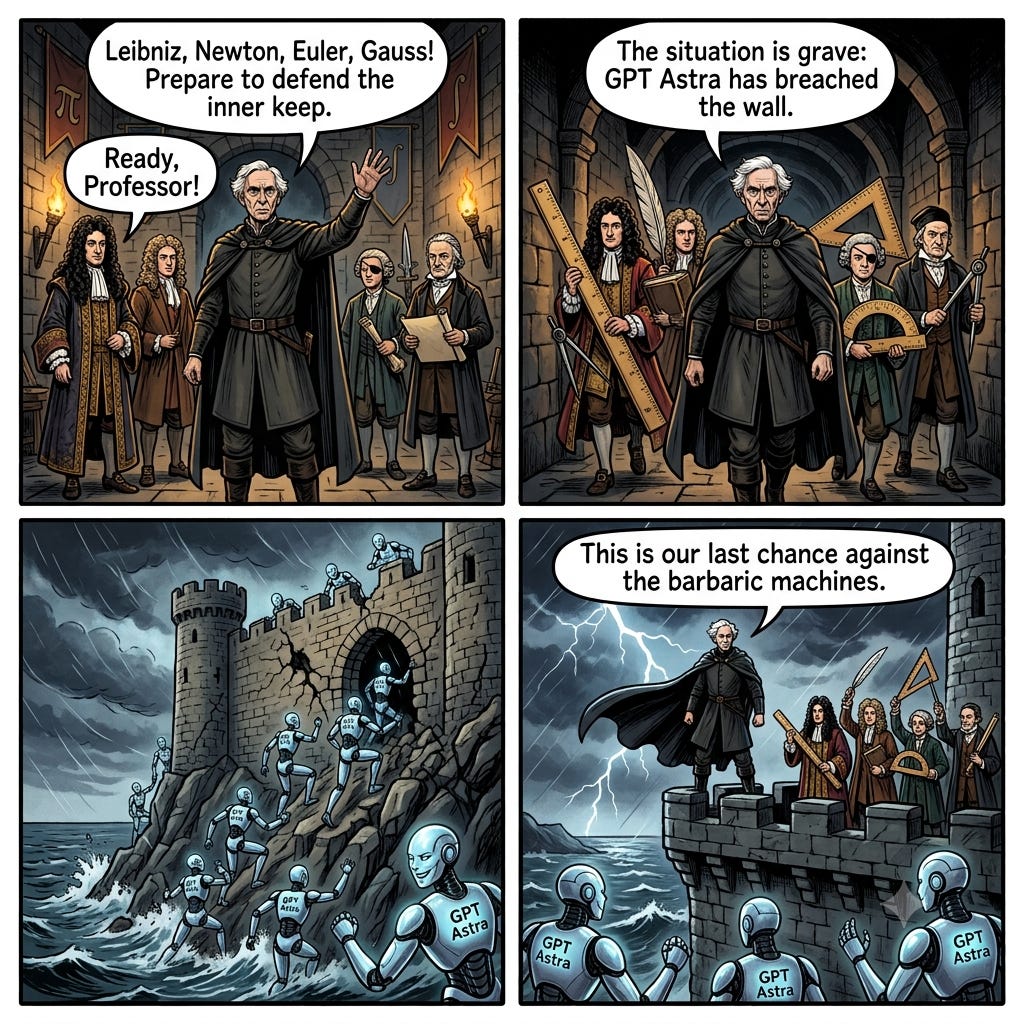
The fortress of mathematics is thus in a state of siege. The first breaches in the ancient and noble walls have already appeared, and AI has already broken close to the inner keep. For how long will the fortress of mathematics withstand the barbaric force of machines?
While mathematicians grapple with these questions, the recurring pattern of belittling AI progress now falls chiefly to natural scientists. I increasingly hear the opinion that mathematics is merely a closed system, a complex game of solving logical puzzles. Brute-forcing one’s way through tough problems is neither intelligence nor creativity, some maintain. Mathematics is now experiencing, with some delay, the hurricane that many years ago canceled human leadership in Chess and Go. The other sciences are different; they are safe. No AI can discover great science.
I will argue that, on the contrary, mathematics presents in the abstract all intellectual challenges encountered elsewhere in science. It requires deep understanding of difficult concepts. It requires formulating new hypotheses starting from observation. It demands linguistic ability, sophisticated reasoning, the capacity to navigate unfamiliar situations efficiently, and, above all, creativity. Even aesthetic sense is needed: as argued by Hardy, beauty is the first test: there is no permanent place in the world for ugly mathematics.
More rigorously, we shall see that mathematics demands observation, induction, deduction, and abduction, the four principal modes of scientific practice.
My central claim is therefore: should AI ever become great at mathematics and theoretical computer science, this would constitute compelling evidence that it can attain human-level performance across many other intellectual domains. In a domino effect, all scientific fields where the understanding of human emotions and social traits do not play substantial role will gradually yield to AI. For instance, if, at that point, AI had not yet reached the same level in physics, it would most likely be a matter of improving its training or the implementation of its workflow rather than overcoming any fundamental limitation.
Mathematics is therefore the ultimate fortress separating the human scientific intellect from artificial intelligence. If it falls, all other sciences will gradually follow. As absurd as it may sound, scientific creativity will be automated.
Whether AI is truly approaching greatness in mathematics remains nevertheless an open question, one about which I have already extensively written. Unfortunately, advancement in mathematical intelligence is becoming difficult to measure. AI is so exceptionally capable already that the only meaningful existing benchmark is what AI can autonomously achieve on the field — and by that standard AI is already outstanding. But synthetic, creative intelligence, so far as the evidence suggests, has not been captured yet. But there are no compelling arguments barring further improvement on that front, and AI continues to march forward steadily.
The purpose of this essay, however, is not to predict future AI progress, but to compare the mental processes that arise in mathematics with those involved in science.
One of the principal objections to my thesis is straightforward. Mathematics, we are told, would resemble Chess or Go far more than it resembles natural sciences. There would be a finite number of legal “moves” at each time, and exploring all possibilities by brute force would tame any problem.
This is a triple fallacy.
First, mathematics is not a closed game. At every stage of a mathematical proof there are infinitely many possible continuations. Suppose that a theorem states that all natural numbers possess some property P, for example being expressible as the sum of four squares. Then one can deduce, by universal quantifier elimination, that 0 has the property, 1 has the property, 2 has the property, and so on… A mathematician constructing a proof may need to instantiate that property with one particular number, yet he could have no way to know in advance which one it will be. The blind brute force of exploring all possibilities simply fails.
Second, mathematical proofs are not bounded in length. Therefore, the space of possible proofs is infinite and cannot be searched exhaustively. In contrast, board games give only rise to a finite number of possible configurations.
Third, chess and Go are algorithmically solvable. A program that explores the tree of all possibilities can play perfectly. By contrast, the logician Kurt Gödel and Alan Turing proved in 1931-1936 that mathematics, if logically consistent at all, is unsolvable by algorithms. No matter how large an artificial neural network my be, how complex a python program is, or how clever is its implementation, there is no algorithm that can, given any statement, decide its truth in a finite amount of time. For each algorithm, it is possible to find one sentence it cannot decide. Therefore mathematics represents the ultimate test for machine intelligence.
Several philosophers, for this reason, have mistakenly argued that machines cannot do mathematics at a human level and that creativity is not mechanical. But Gödel’s theorem only proves that a perfect mathematician that could hypothetically solve all problems in a finite amount of time would not be an algorithm. And since we do not know whether our mathematical intelligence is perfect, we do not know for certain whether it is anything more than a sophisticated algorithm.
Very well, may now respond the skeptical scientist, I concede that mathematics cannot be compared to a closed game. Even so, it is just deduction. The axioms of mathematics fix the rules; the rest is mechanics. Therefore mathematics is a mechanical game with an infinite number of possibilities. By contrast, in science the rules of the universe are not known beforehand. Therefore science requires four intellectual capabilities1:
observation of empirical facts;
abduction, the ability to infer explanatory hypotheses;
deduction, the ability to deduce consequences and predictions from hypotheses that have been discovered or conjectured;
induction, the ability to extract patterns and general laws from observation and to validate through repeated observation the conjectured hypotheses.
On this view, science would demand a broader range of intellectual processes than mathematics.
I see from where this perspective originates. In education, mathematics is presented as a magnificent and completed cathedral. Teachers, like oracles, state theorems; then they prove them elegantly by deductive logic. Teachers give problems; students provide solutions. A beautiful game.
It is therefore unsurprising that several philosophers with limited mathematical experience, like Wittgenstein, tended to mistake mathematics for a purely deductive enterprise, and thus more limited than empirical sciences.
Yet mathematics does not fall out of the sky. Mathematical laws are conjectured, they are not given. Sometimes theorems are induced from the observation of mathematical objects and structures. Sometimes, they are proposed because of their explanatory power.
Therefore, the act of conjecturing truth is sometimes inductive and sometimes abductive. Exactly as in science.
Indeed, if your textbook never presented Pythagoras’ theorem, would you have discovered it yourself?
One of the great results of nineteenth-century mathematics, the Prime Number Theorem, states that among the first N natural numbers, approximately one out of log(N) is prime. In other words, the average interval between the prime numbers smaller than N is log(N).
Gauss discovered this law much as Kepler discovered the laws governing the motion of planets: through systematic observation. Exceptionally gifted and exceptionally patient, Gauss computed a large initial segment of the prime numbers. From this empirical observation, by ordinary scientific induction, Gauss conjectured that the number of primes below N is approximately N/log(N).
Formulated at the end of the eighteenth century, the conjecture was proved a century later by Jacques Hadamard using methods from complex analysis. There was an enormous gap, both chronologically and conceptually, between the inductive and deductive stage.
Remarkably, a law about ordinary natural numbers was proved using an apparently unrelated branch of mathematics and by using a strange system of numbers: complex numbers. Even more remarkably, complex numbers themselves first emerged centuries earlier while mathematicians were trying to solve cubic equations.
This brings us to abduction.
Proving a theorem often requires introducing surprising concepts and hypotheses that are neither contained in nor deducible from the theorem itself. Abduction is precisely the process of inventing such new concepts and hypotheses. As Erik Larson puts it:
When we seek to understand particular facts (…) rather than regularities, we are inevitably forced into a kind of conjuring, the selection or invention of a hypothesis that might explain the fact. Induction moves from facts to generalizations(…). But abduction moves from the observation of a particular fact to a rule or hypothesis that explains it.” (The Myth of Artificial Intelligence)
Consider a mathematician facing a difficult theorem. He would not normally reason straight from the statement to the logical proof:
Theorem → Proof
in one step. Let ⊢ denote logical derivability. Then, H ⊢ T means that there is a chain of logical inferences starting from the hypotheses H and ending with T. If K is the knowledge base of mathematics, a mathematician may aim to prove a theorem T:
K ⊢ T
For difficult theorems, a direct deduction is usually impossible to discover. The central obstacle to finding a difficult mathematical proof is often: which intermediate theorem H should one discover so that the proof becomes possible?
For instance, one usually needs to discover an auxiliary statement H such that
K ⊢ H and H ⊢ T
and from that conclude
K ⊢ T
H need not be a single statement. It may instead consist of an entirely new conceptual framework together with its own definitions and theorems. Whatever its form, H functions as a conceptual bridge. In proof theory, such an intermediate statement is called a cut formula. While the logical rule that combines the two derivations is deductive, the realization that H is the right intermediate result is not obtained by deduction from the original problem in any straightforward sense. It is a hypothesis about what the eventual explanation ought to look like.
In other words, a difficult proof often requires an abduction of an explanation; in mathematics, the explanation is itself a proof. The intermediate theorem H is often cognitively indispensable. Its role is to compress the proof dramatically, rendering it conceptual rather than computational. A good proof predicts the outcome of calculations rather than merely performing them.
A mathematician confronted with a conjecture accumulates examples, counterexamples, failed arguments, successful techniques, and partial results until the accumulated experience crystallizes into a new structural representation of the problem and conjures an explanation H.
Therefore, when in mathematics a new particular mathematical fact is conjectured, mathematicians seek a logical explanation of its truth just as physicists, for instance, may seek to model and explain gravity. A good mathematical proof is an explanation, not merely a verification.
Like Kepler, Gauss first discovered a law through observation. Hadamard explained it through logical argument, much as Newton explained Kepler’s laws through his theory of gravitation.
Explanations, both in mathematics and in science, are rarely final. A new conceptual framework may later enable a more elementary, profound, or informative explanation. Einstein explained that gravity is not a force magically acting at a distance, but a curvature of space-time. Likewise, the Prime Number Theorem was later given a more elementary proof by Erdos and Selberg.
We have seen that the principal mental processes that enable mathematical and scientific knowledge are fundamentally the same. Thus mathematics and science share the same psychological structure.
This is not a coincidence. As Galileo observed, the laws of the universe are written in the language of mathematics. Mathematics itself derived from our investigation of nature and, in this sense, it is part of science: to study mathematics is to study the structure of natural laws.
But there is a difference. Science is about this universe; mathematics is about, in principle, all possible universes.
For example, it was long believed that space can be described by the familiar Euclidean geometry. Yet mathematicians, remarkably, discovered non-Euclidean geometries: strange spaces in which the ordinary rules governing parallel lines no longer hold. A century later, Einstein showed that the geometry of our universe is, in fact, non-Euclidean. This geometry describes our universe; the others describe logically possible alternatives. Long before anyone knew which was correct, mathematicians had already explored them all. From this perspective, mathematics is even more broad than natural sciences.
Mathematics is the science of the Platonic realm of possibilities. Its richness is at least as great as that of the physical universe itself.
Since the same mental processes underlie both mathematics and science, should AI equal the human mind in mathematics, it will soon equal it in all scientific domains. My analysis of mathematical abduction suggests something stronger still: by the time AI will be able to solve important open problems, it will already possess the elite observation, induction, and abduction capabilities necessary for science. It is therefore conceivable that training AI exclusively on sufficiently difficult mathematical problems could already elicit these skills, proving that artificial neural networks can also work for science.
Of course, there are exceptions. For instance, the sciences in which the human presence during experiments is crucial and irreplaceable may remain partially inaccessible to AI. Some experimental activities must involve an agent acting in the world. A human scientist living among gorillas might tie much better with the animals than a humanoid robot. Also, an AI that is great in mathematics might nevertheless lack visual intelligence, and this could hamper progress in some sciences.
However, in many cases, AI could design experiments and interpret their results without being able to interact with the environment as humans do. Moreover, many of the great scientific achievements in physics involved remarkably little interaction with the physical world. Maxwell discovered the nature of light as an electromagnetic wave from his armchair; Einstein developed General Relativity through his mental experiments, abductions, and logical deductions.
Therefore, I expect that AI progress in mathematics, if possible at all, will naturally lead to the same magnitude of progress in most scientific areas.
If the fortress of mathematics surrenders, science will not stand for long.
Thanks for reading! This post is public so feel free to share it to support this publisher.
A caveat: I doubt that induction and abduction rely on fundamentally different mental processes; the two concepts themselves morph into one another. Nevertheless, this conceptual framework is popular and thus useful for our purposes here.
No posts
Comments
Nothing yet. Say the first thing.
Sign in to join the conversation.