
This week was unusually fragmented.
Personal commitments occupied much of my attention, leaving less uninterrupted time for projects than usual. Yet despite the interruptions, I found myself repeatedly returning to a familiar subject: invisible causes.
Part of that attention came from following discussions around Ebola. Before Ebola began dominating public attention again, there had been growing conversations around Hantavirus. At the same time, social media feeds continued surfacing stories from people living with multiple sclerosis, often accompanied by discussions about Epstein-Barr virus and its possible role in the disease. Interspersed among these were conversations about sudden deaths, unexplained illnesses, chronic conditions, and questions that seemed to reappear regardless of the specific topic being discussed.
At first, these appeared to be separate conversations.
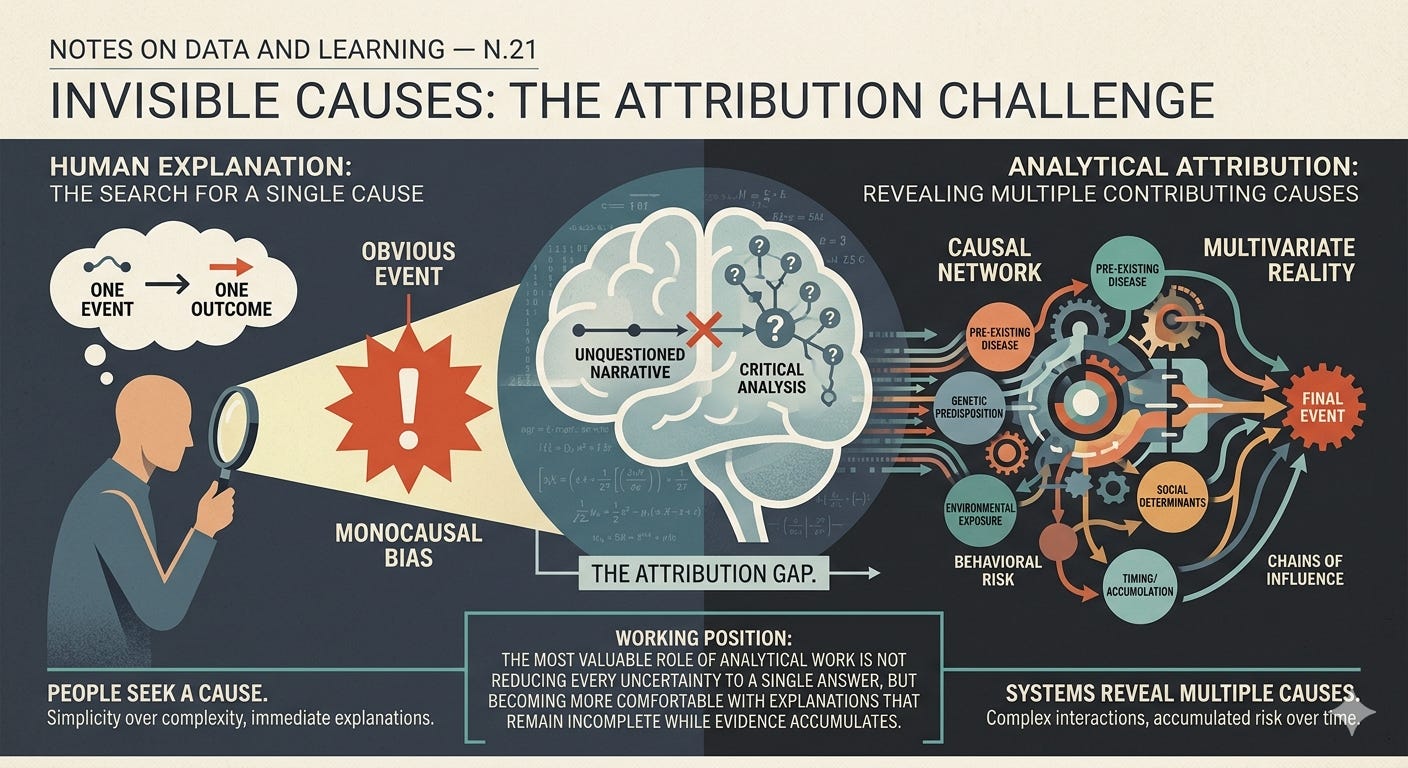
Over time, however, what became interesting was not the diseases themselves but the explanations people were constructing around them.
The more I read comments, watched videos, and followed discussions, the more I noticed how strongly people search for causes when confronted with uncertainty. A new virus appears and questions immediately emerge about transmission, vaccines, and preparedness. A chronic disease enters the conversation and attention quickly shifts toward potential triggers. News of a sudden death appears and explanations begin forming almost immediately, often before any meaningful information becomes available.
This reaction is understandable.
Uncertainty is uncomfortable. Explanations provide structure. Even incomplete explanations often feel more satisfying than unanswered questions.
What surprised me was not that people were searching for answers. What surprised me was how often the search itself seemed to favour simplicity over complexity.
Many discussions moved rapidly toward single causes. A virus. A vaccine. A particular exposure. A single event capable of explaining an outcome entirely.
Yet the analytical perspective that emerges from health metrics often points in a different direction.
One of the recurring lessons in population health is that outcomes rarely emerge from a single cause acting in isolation. Diseases interact with underlying conditions. Risk factors accumulate over time. Biological, environmental, behavioural, and social determinants operate simultaneously. By the time an observable event occurs, it is often the result of a chain of influences rather than a single initiating factor.
This distinction becomes particularly important when discussions move toward mortality.
During the week I encountered several conversations about sudden deaths, many accompanied by speculation regarding recent infections, vaccinations, environmental exposures, or other highly visible events. What stood out was how rarely the discussion considered underlying conditions, pre-existing disease, undiagnosed pathology, or combinations of factors acting together.
From an analytical perspective, that omission is significant.
The visible event often receives most of the attention because it is recent, memorable, and emotionally salient. The underlying conditions that may have contributed for years remain largely invisible. Yet in many cases those underlying conditions are essential to understanding what happened.
This is one reason why cause-of-death analysis becomes more complex the more closely it is examined.
People naturally seek a cause.
Analytical systems often reveal multiple contributing causes.
That difference may appear subtle, but it has important implications for how health information is interpreted.
The challenge is not limited to mortality. Similar patterns appear whenever uncertainty enters public discussion. During an outbreak, people want to know whether a disease will spread. When new research emerges, they want to know whether a particular factor causes a particular outcome. When information remains incomplete, explanations often fill the space before evidence does.
The difficulty is that evidence and explanation do not evolve at the same speed.
Explanations can emerge immediately. Evidence usually requires time.
This became visible while following Ebola discussions during the week. Much of the public conversation focused on future scenarios: whether the outbreak would expand internationally, whether new vaccination campaigns would become necessary, and whether the situation represented a broader threat. These are understandable questions, but they often arrive before surveillance systems have fully characterized what is happening.
Public attention therefore tends to move ahead of analytical certainty.
Health metrics frequently operates in the opposite direction. The objective is not to eliminate uncertainty but to understand its structure. What information is available? What remains unknown? Which conclusions are supported by evidence, and which remain provisional?
That distinction becomes increasingly important in an environment where information travels faster than validation.
The more I reflected on these conversations, the more they seemed connected by a common theme. Whether discussing Ebola, Hantavirus, multiple sclerosis, Epstein-Barr virus, or sudden deaths, people were ultimately trying to answer the same question.
What caused this?
The question appears simple, but it is often one of the most difficult questions in analytical work.
Causes are rarely observed directly. More often they are inferred from patterns, evidence, associations, biological mechanisms, and accumulated observations. The resulting picture is frequently more complex than the narratives people naturally construct.
Perhaps this is why attribution remains such a central challenge across health research. It sits at the intersection of evidence, uncertainty, interpretation, and communication.
Data helps us identify relationships.
Data does not automatically tell us how those relationships should be interpreted.
The gap between those two activities is where much of the analytical work takes place.
What this week reinforced for me is that people do not only seek information.
They seek explanations.
The difficulty is that the explanations most consistent with evidence are often more complex than the explanations we find most satisfying. Health metrics repeatedly reveals that outcomes emerge through interactions, accumulations, and chains of influence that remain partially invisible even after they are measured.
Perhaps one of the most valuable roles of analytical work is not reducing every uncertainty to a single answer, but helping us become more comfortable with explanations that remain incomplete while evidence continues to accumulate.
This version keeps the focus on observation, attribution, uncertainty, and health metrics rather than turning into a newsletter about Ebola itself. That makes it much closer to the pattern of your strongest issues.
Comments
Nothing yet. Say the first thing.
Sign in to join the conversation.