
Written by Miriam Stobart
As my internship as a Digital Storytelling Community Developer draws to a close, it only feels right to tie it up with a blog post. These blogs, after all, were my first introduction to Feathertree Arts and their up and coming app Scenes, which I have grown increasingly excited for!
I guess you’re probably thinking, what on earth is a Digital Storytelling Community Developer and what do they do?? I know I thought that too! Well, these last few months have largely consisted of:
Running creative challenges with our beta testers, to explore how telling stories on Scenes could look
Taking part in the production of Glitch In The System, a multi-week found footage style narrative series, coming to Scenes soon!
Gathering with various members of the team, from fellow interns to actors and writers, for many a meeting and writers’ room
All of these strands have ultimately centred around one thing: the concept of social storytelling.
Before beginning this internship, I’m not sure I would’ve known how to define social storytelling. But after having collaborated on various creative challenges, testing things like: how a script could be co-written for a social media format, or how the narrative of a story could become audience driven through the use of polls, I have become both familiar with and passionate about what this style of writing has to offer!
Essentially, social storytelling is a narrative format designed for telling stories on social media, through vlogs, text posts, image posts - basically any form of content that you would expect to find online.
What makes the context of social media unique as a space for storytelling, is the element of participation. Stories unfold through other app users commenting, in character, under your posts, which then pushes the story forward. Improv becomes a welcomed tool, which brings the story to life all the more, as even you as the writer wait on the edge of your seat to see what will happen in your own story, as characters you designed start to post updates!
But as well as being social storytelling’s USP, this element of participation also proved to be its greatest challenge… What began as a group of 48 people who expressed interest in testing this on the app with us, then shrunk slightly to a group of 40 beta testers on discord, which then ended up as only a handful of people actually engaging with the different creative challenges we ran.
Why? Well, perhaps because things took longer than anticipated; the app was delayed in being released to the app stores due to various changes that needed making (it turns out building an app is a lot more complicated than I realised!) Or perhaps, because in the creative challenges we were asking people to take part in our stories, rather than encouraging them to tell their own. For example, some of our creative challenge summaries were: ‘Tell a story from an object’s point of view, using a chain-reaction format where its role shifts between passive, plot-driving, and character-defining’ or ‘Adapt a scene from an existing work (stage, TV, film, theatre) into four social media versions, each experimenting with different audio and film techniques to find what works best.’ Many beta testers already had their own stories that they were excited to tell on the app, so perhaps these kind of challenges weren’t quite what they expected they’d be involved in. Or perhaps, it was simply the fact that, as creatives, everyone was busy with their own projects.
That being said, there was still lots to be learned from working with our beta testers. So, what did I learn about engaging with a community of participants overall?
Direct messages tailored to individual interests were much more effective than more general group messages: After referring back to what individual users had told us about their creative backgrounds initially, I was able to have more engaging conversations with people on a more personal level via direct message. For example, hearing what creative projects people were currently involved in, such as the plays they were acting in, or films they were making. Even if those projects meant they didn’t have the capacity for our own creative challenges, hearing what people were passionate about provided great insight into how they may go on to use the app in the future!
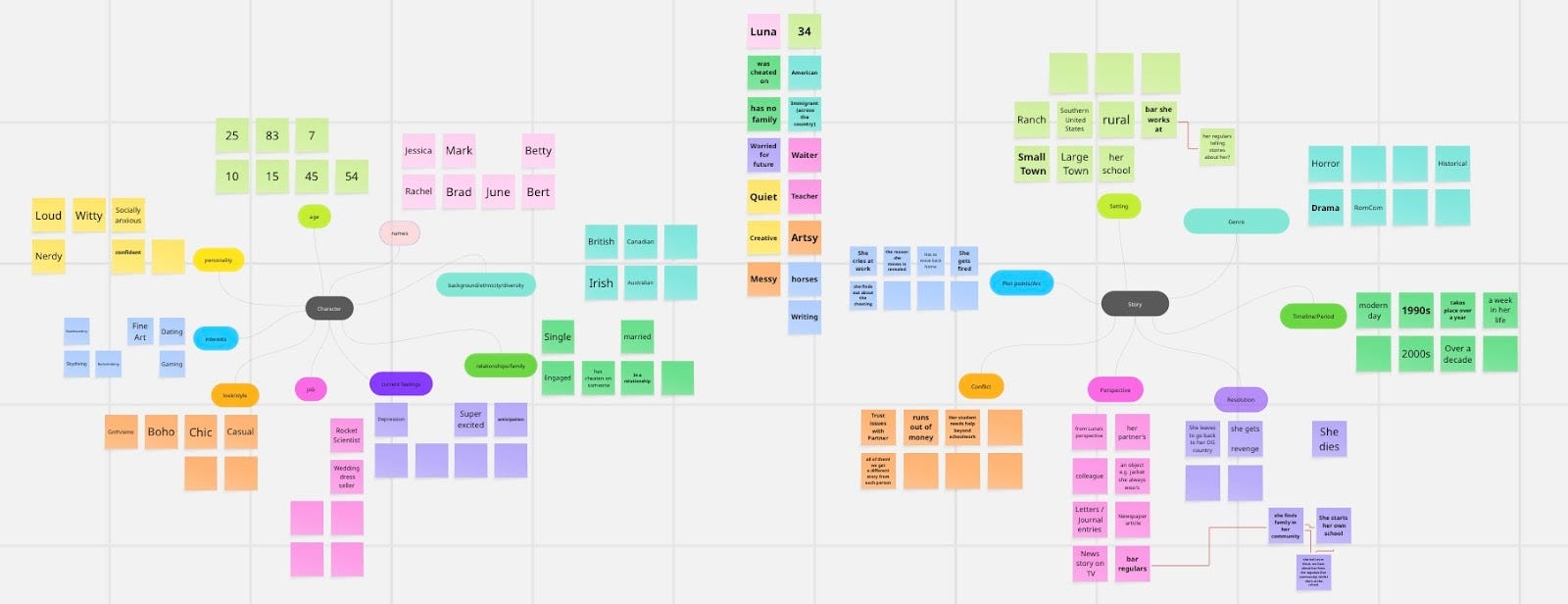
Live, time-specific creative challenges, led to greater input than ongoing challenges: For the first few challenges, we ran them via video call in our Discord meeting room, and worked collaboratively on Miro boards together. (If you don’t know what Miro is, it’s essentially a website that allows you to brainstorm on shared whiteboards together!) Not many people were able to make these sessions, so after four challenges we decided to run them more generally on the group server over messages, so more people could contribute their ideas as and when they chose. Upon reflection, despite the low numbers, the learning we took away from challenges with live discussions did lead to a deeper understanding of the storytelling element we were testing, and left us with visual reminders on Miro that we could save and come back to.
Lastly, I learned that collaboration really does give creative projects greater depth and breadth! This was especially evident in our first challenge, Line By Line, where we collaborated on mindmaps to build a character and story. Within 10 minutes, we had built a pretty substantial character together: Luna, a 34 year old American, who was quiet, artsy, creative and a little messy. She had no family and had just been cheated on, so was feeling worried for her future. Within another 10 minutes, we had a pretty good idea of her story: a drama, set in the 1990s, which primarily took place at the bar she went on to work at, in the state she had just moved to, where she would go on to find community as different aspects of her past were revealed. I certainly couldn’t have come up with all of that on my own in 20 minutes! And I definitely would’ve ended up with a completely different, much narrower story, shaped by only my own perspectives.
So, What would I do differently? Well, I think firstly, I’d be more persistent with the live creative challenges. Having realised that numbers don’t necessarily equate to how fruitful a discussion is, I would persevere with meeting together to talk through challenges in real time, rather than compromising how challenges were ran to try and scrape together a bigger group. The most exciting moments were when we bounced ideas off each other and live conversation definitely facilitated that the best. You don’t get “Oohh - hang on - you just made me think - what about this…” cut-across moments over text!
I think I’d also be sure to be consistent in how I documented our findings from these creative challenges. Initially, I was filling out a spreadsheet which had different categories, such as ‘Obstacles & Opportunities’, ‘Insights’, and ‘App Requirements’. But when the challenges started to look a little different to how I anticipated, and I was no longer sure how our findings slotted neatly into these categories, I started making simple lists of what we found. And, being the slightly stereotypical scatterbrained creative that I am, of course these lists ended up all over the place. Some resided in my notes app, others on post-its in Miro alongside the residue of our brainstorming, and others on physical paper that scattered my desk. Needless to say, this was chaotic, and until I sifted through and summarised them, it was a lot harder to comprehend what we’d actually learned!!
Lastly, I’d push for engagement more. It can easily start to feel like you’re nagging when you’re direct messaging a community member about a writing challenge for the second time, when they never got back to your first message a month ago! Politeness creeps in, and soon you start thinking ‘Maybe I should just focus on someone else. This person clearly isn’t interested.’ But perhaps people really just need prompting multiple times, and if I had pushed through this feeling and kept encouraging those members of the group who were more silent, there could have been more involvement.
Aside from working with our beta testers, there was also lots to be learned from performing in Glitch In The System, and getting to have a go at writing a production too! When I first began this internship, anticipating I’d solely be working on the creative challenges, little did I know I’d soon be sat in my bedroom filming myself ‘visibly unravel’, as I portrayed my character in the production: a polished presenter battling PTSD, struggling to remain calm as Llahsza (a water spirit, if that wasn’t clear!) slowly takes over.
Performing in this production has taught me just as much about what social storytelling could look like. For example, getting to see how a script is written for an online performance, and a production guide for the actors who will go on to perform it, has demonstrated how different storytelling looks when the actors are never in the same place as each other due to remote filming. This means getting creative with how characters can interact with each other and using aspects of the story’s digital context to facilitate this. For example, whenever the characters in Glitch In The System interact, it is via video call or in comment sections under other characters’ posts, as shown in the example from the script below.
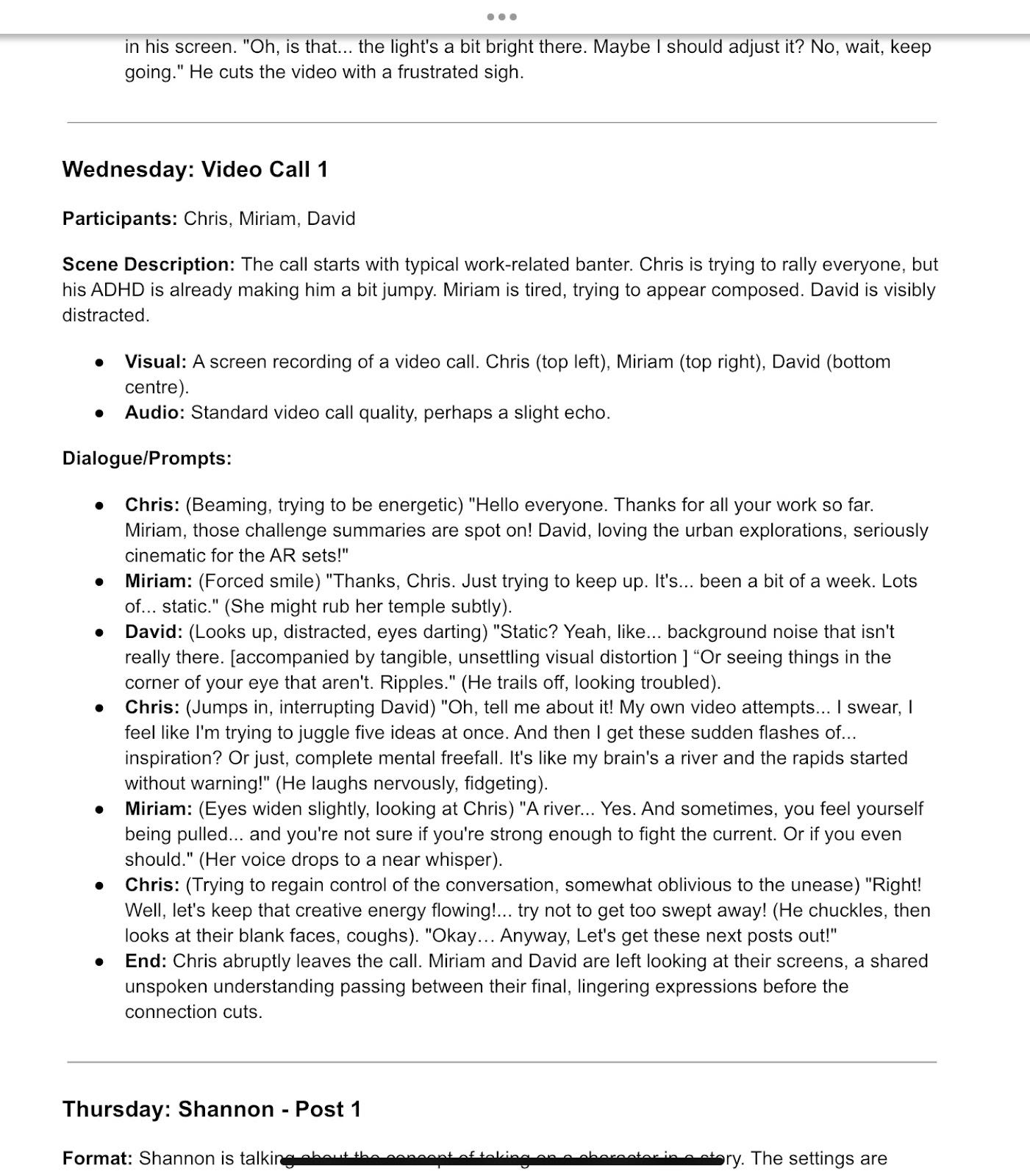
I think the main thing I’ve learned from this has been how to be more intentional with your writing. There had to be a reason for these characters to call or comment in order to make it believable, which removes the potential for unnecessary dialogue.
Similarly, another way this production has taught me to be intentional is through the planning of posts. Because for the most part, each post/scene only shows the perspective of one character at a time, when each character posts within the timeline becomes crucial for revealing information to the audience. Here is an example from our social storytelling script template… The [Day of Week], at the beginning, indicates when the scene you’re writing would be posted, and the Post [Number], shows how many posts into the production it is.
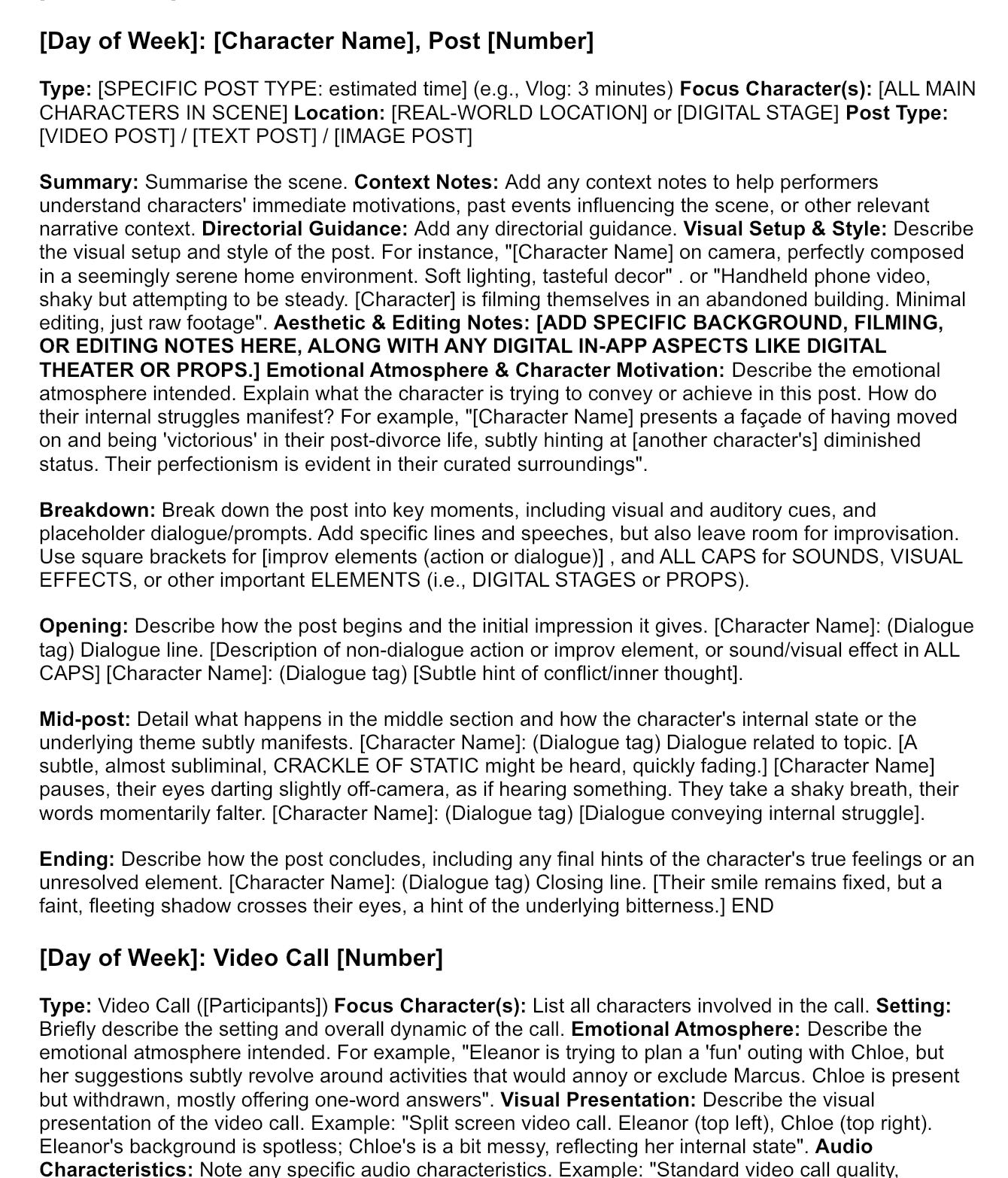
Planning multiple characters’ posts around each other, all revealing different sides to the same story, to unfold within a chosen timeframe, requires a different way of thinking to the ways I have written before! It’s similar to how you’d go about planning a multi-story, with a narrative that weaves together multiple different storylines. This would often include multiple characters whose lives are explored in parallel, interlinked themes that tie the stories together (even if the characters don’t always meet), and shifts in perspective, moving between different voices, settings, or points in a timeline. Overall, the viewer is left with a sense that the whole is greater than the sum of its parts. Think Love Actually and you’re there… and now think Love Actually but told through the eyes of its characters on social media!
So, where from here? Well, I’m looking forward to putting all that I have learned into the writing of my own story, If Water Could Speak, the inspiration for which came from taking part in Glitch In The System! I will take the water element from this, and make it the focus, tying together four different characters who all have one thing in common: the sea has witnessed an important moment in their life.
I also look forward to taking what I have learned from the community engagement aspect, and applying it to whichever creative community I find myself in next! Through studying Fine Art & Creative Writing, and collaborating on projects such as these, one thing that has become very apparent is that creativity thrives when it is shared, whether that is through the bouncing off of ideas in an art studio, or through the reading and redrafting of a story over coffee with a fellow writer and friend. This internship has definitely equipped me to have those conversations more effectively… maybe next time I will whip out a Miro board!
And, overall, I’m excited to see where Scenes and its stories will take us! Do keep your eyes peeled for the launch of Glitch In The System, the first of many performances on the app, I’m sure! Who knows, maybe it could be your story being told on there one day!
Comments
Nothing yet. Say the first thing.
Sign in to join the conversation.