
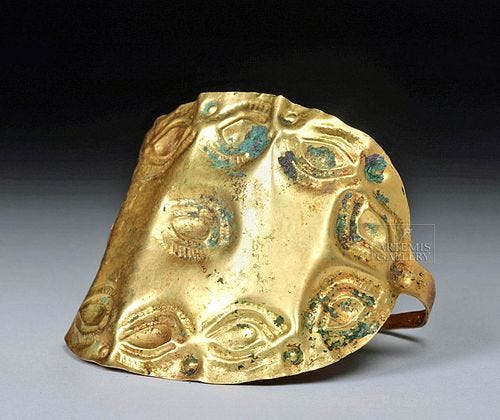
Above: A magical (apotropaic) bracelet from Central Europe, 8-7th century BC. The eye motifs are what give this bracelet its supposed “magical” properties.
And I will give them one heart, and I will put a new spirit in them. I will remove their heart of stone and give them a heart of flesh, that they might walk in my statutes and keep my rules and obey them. And they shall be my people, and I will be their god.
Ezekiel 11:19-20
In today’s reading Ezekiel focuses his ire against the Judean elite. He begins with a condemnation of twenty-five Judeans—two of them named—for crimes that are not entirely clear (11:1-13). Then Ezekiel gives one of his most important prophecies. Like Isaiah and Jeremiah, though Ezekiel predicted the destruction of the kingdom he also foresaw its restoration. He claims that even though God would exile the Judeans far from their homeland, God would protect them while in exile and then restore them to their land (11:16-17).
This would create a new problem, though. Did God not just exile the Judeans because of their sins? If God forgave and restored them, what would stop the Judeans from simply sinning again? To solve this problem, Ezekiel says that God would transform their hearts. He says that one day, God would change the Judeans to make them want to obey the Law (11:18-20). He calls this replacing their “heart of stone” with a “heart of flesh” (11:19).
As we have seen, this prophecy was fulfilled around 600 years later, when Jesus came to give the Holy Spirit to all believers. Now, through the Spirit, when we are “born again” we have our “heart of stone” replaced with a “heart of flesh.” This allows us to live upright, faithful, selfless lives as Christians. We believe that this gift of the Holy Spirit is the fulfillment of this prophecy from Ezekiel.
The prophet continues by piling more abuse onto the heads of Judah’s leadership. First Ezekiel vividly depicted the upcoming exile by acting out the process of escaping from the city (12:1-7). This was to symbolize that all of the Judeans, including their king, would thus flee in ignominy (12:12).
Ezekiel also condemned the prophets and other religious leaders of Judah. They had apparently been saying that Israel would not be ultimately defeated by Babylon. They preached that there would be “peace” and they gave religious blessing to the building of the walls of the city (13:10). This was to symbolize that God would protect them. Ezekiel promised that that wall would be destroyed, along with the prophets who blessed it (13:11-16).
Finally Ezekiel condemned a mysterious group of women who seem to have been making some kind of magical charms. They are described as making “magic wristbands” and “hunting for souls” (13:18). They also apparently preached a form of ethics that was incompatible with Ezekiel’s understanding version of ancient Judaism (13:22). Whatever the exact background of this latter condemnation, the use of magical amulets clearly contradicts the Law.
No posts
Comments
Nothing yet. Say the first thing.
Sign in to join the conversation.