
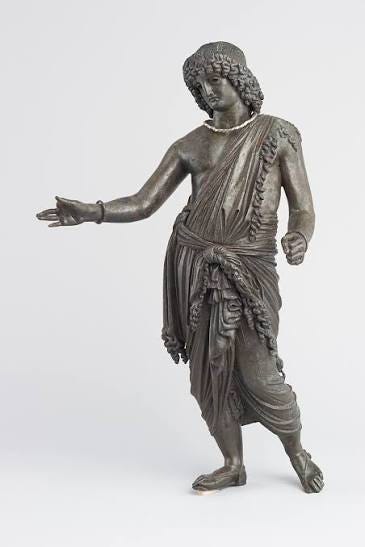
Above: Statue of Tammuz/Adonis, Syria, 2nd century AD. We have evidence (cf. below) of Adonis/Tammuz being worshipped in Judea around the same time he began to be worshipped in Greece.
And it happened in the sixth year, in the sixth month, on the fifth day of the month, as I sat in my house and the elders of Judah were before me, the hand of my lord Yahweh fell on me there. And I looked and behold, a form that had an appearance like a man. Below the appearance of his waist was fire, and above was the appearance of brightness, like gleaming metal. He put out the form of a hand and took me by a lock of my head and brought me in spirit between heaven and earth, and brought me to Jerusalem in visions of God, to the entrance of the gateway that faces north, where was the image of jealousy that makes jealous.
Ezekiel 8:1-3
In today’s readings we encounter another of Ezekiel’s prophecies against Jerusalem, this time focusing on the sins of the priests in the temple. We are told that this occurred “in the sixth year” (8:1). Assuming this means the sixth year of the exile of the former Judean king Jehoiachin (cf. 1:2), that would locate this story in 591 BC: a mere five years before the final, climactic Babylonian Exile.
We are told that Ezekiel was in his house, surrounded by the elders of Judah (8:1). These were the nobles of Judah who had been taken in the original exile of 597. While Ezekiel met with them, God gave him a vision of what was happening back in Jerusalem. It is, religiously speaking, very bleak. The text begins by mentioning an “image of jealousy that makes jealous” (8:3) standing by the north gate of the city. This presumably refers to an idol.
Next God shows Ezekiel what kind of religious sins the Jews back in Judea had been practicing in secret. He claims that the Judean elders—one of whom he even names—had been worshipping pagan gods and idols (8:7-13). Ezekiel also sees visions of Judean women “weeping for Tammuz” (8:14-15). This pagan god, also called Dumuzid, later became known in Greece under the name “Adonis.” Finally, God shows Ezekiel a vision of people in the Jerusalem temple worshipping the sun (8:16).
This vision occurred in 591 BC. Even then, at the midnight hour, the Judeans were still mired in sin. No matter how harshly they were warned or severely they were punished, they continued to commit spiritual adultery against their god. And for that reason, God pronounces the two great judgments of chapters 9 and 10.
First in chapter 9, God promises vengeance each individual Judean who worshipped pagan gods. Ezekiel was given a vision in which a man with a writing kit wandered throughout Jerusalem, marking some people on the forehead. These were everyone who “groaned” over the sins being committed in Jerusalem (9:4). They were innocent, and so God protected them with a mark. After the man with the writing kit marked off the innocents, God commanded six executioners to mercilessly slaughter everyone else (9:5-6). This prophecy both warned the Judeans about the wrath to come, while comforting the innocent that God would protect them.
Then in chapter 10 comes one of the most consequential scenes in Ezekiel. In that chapter the prophet is given another vision of the Jerusalem temple. This time he saw the glory of God in the temple, with the sky appearing like sapphire and mighty, mysterious angels standing in the temple (10:1-5). In this scene the angels, representing the glory of God, depart from the temple (10:18-19). This symbolizes God’s presence leaving the temple.
After this point the temple, without God’s presence, was no longer sacred. It was no longer God’s “house,” and therefore was no temple at all. This prophecy would be fulfilled just a few years later, when the Babylonians came to destroy the building that had once been the temple of God. And with that, in 586 BC, Ezekiel’s prophecy would be vindicated and the Babylonian Exile would begin.
No posts
Comments
Nothing yet. Say the first thing.
Sign in to join the conversation.