
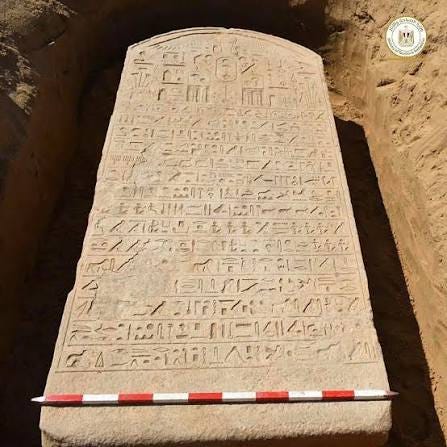
Above: A stele made by pharaoh Hophra/Apries, discovered by an Egyptian farmer in 2021. The text is still currently being translated, but once it is complete it may shed light on some of the last events discussed in today’s reading guide.
And it happened in the seventh month that Ishmael, son of Nethaniah, son of Elishama, from the royal family, one of the chief officers of the kind, came with ten men to Gedaliah son of Ahikam, at Mizpah. And they ate bread there together at Mizpah. But Ishmael son of Nethaniah and the ten men with him rose and struck down Gedaliah son of Ahikam, son of Shaphan, with the sword and killed him, whom the king of Babylon had appointed governor in the land. And Ishmael struck down all the Judeans who were with Gedaliah in Mizpah, and all the Chaldean soldiers who were found there.
Jeremiah 41:1-3
In today’s reading we encounter a relatively self-contained narrative about the aftermath of the Babylonian Exile of 586 BC. After Babylon destroyed Jerusalem and deposed king Zedekiah, they installed a Judean governor named Gedaliah over the territory. It had now been incorporated into the Babylonian empire as the province of “Yehud.” We learn at the beginning of chapter 41, though, that a group of Judean radicals led by an “Ishmael” assassinated Gedaliah along with a group of Judean collaborators and a detachment of Babylonian soldiers (41:1-3).
After a brief reign of terror, Ishmael was defeated by a Judean general named Johanan. But the damage had been done. Gedaliah had been installed by the Babylonians as governor, and some upstart Judean had assassinated him. The Judeans would have naturally expected Babylon to return once again to punish the recalcitrant Judeans for this slight. So Johanan and the other leaders of Judea considered fleeing Judea to travel to Egypt.
The leaders of Judah then sought Jeremiah’s advice, and bound themselves by an oath to obey what he said (42:1-6). As we have come to expect by now, Jeremiah said to remain in Judah and not to flee to Egypt. If they remained in Judah, they would be spared; if they fled to Egypt, the sword would follow them to Egypt (42:7-22). The people, of course, ignored Jeremiah’s warning and fled to Egypt—taking Jeremiah with them by force (43:1-7).
For that reason, Jeremiah delivered another prophecy in the Egyptian city of Tahpanhes where they had fled. He told the Judeans that, because of their rebellion, God would cause Babylon to continue its advance through Judea and down into Egypt. Because of the Judeans’ flight, God would also hand over Egypt to king Nebuchadnezzar of Babylon. Jeremiah predicted that Babylon would come and conquer, or at least pillage, Egypt. He predicted that the king of Babylon would take control of the Egyptian palace (43:10), that he would kill many Egyptians as a consequence of war (43:11), that the Egyptian temples would be pillaged and destroyed (43:12-13). Later on, in the next chapter, Jeremiah specifically claims that pharaoh Hophra (Apries: r. 589-570 BC) would be defeated “by his enemies.”
We do not know the details of how these latter predictions were resolved. The Roman-Jewish historian Josephus claimed that pharaoh Apries really was killed during an invasion of Egypt by Babylon under Nebuchadnezzar. The Greek historian Herodotus, however, claims that Apries was killed in a civil war. However the small details of this latter prediction are to be resolved, however, the story of Jeremiah is clear. Though Jeremiah had warned the Judeans not to flee to Egypt, they did so anyway. And they took Jeremiah with him, against his will, and the prophet would probably ultimately die in that exile.
No posts
Comments
Nothing yet. Say the first thing.
Sign in to join the conversation.