
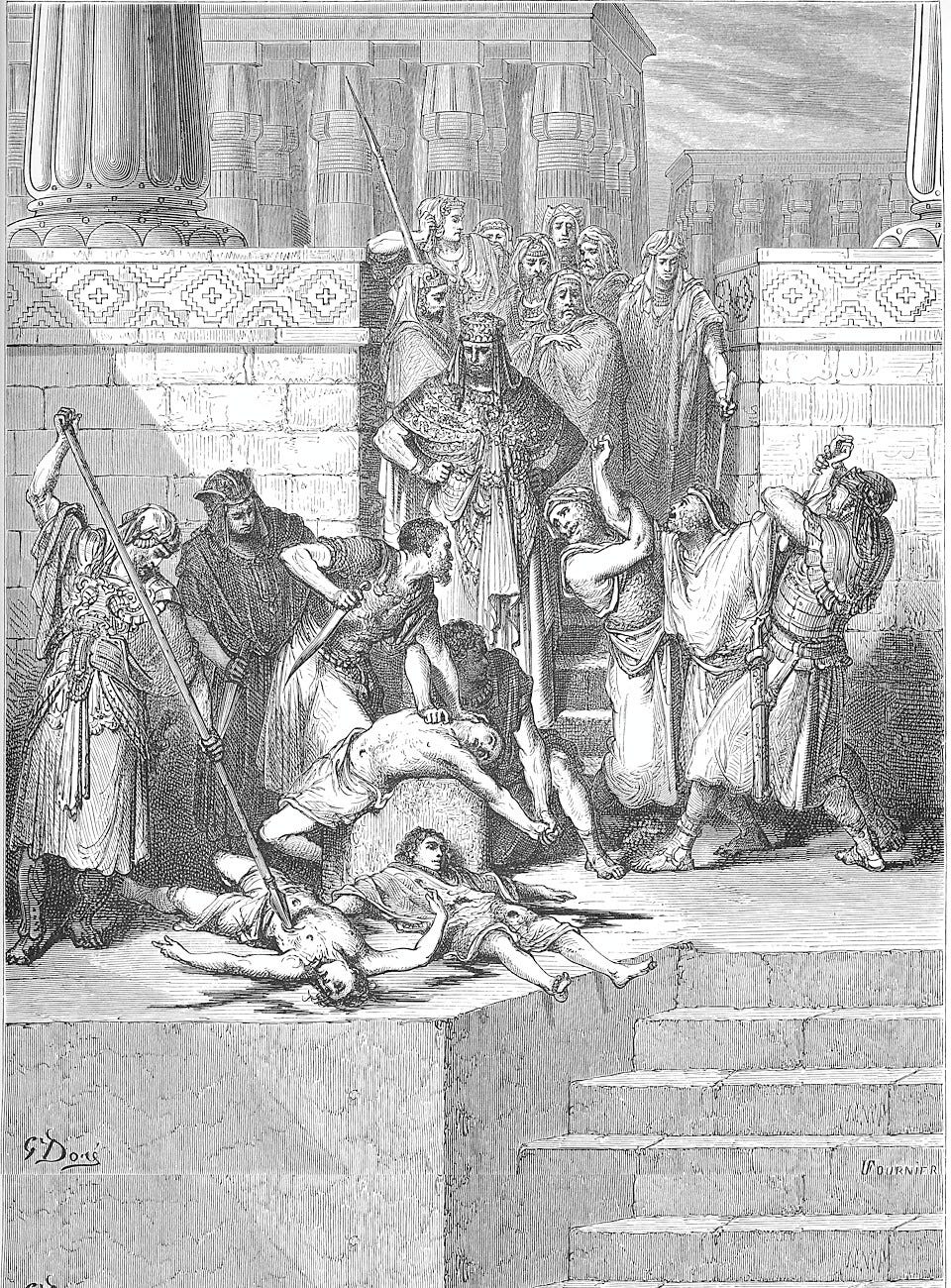
Above: Gustave Doré. Zedekiah’s sons are slaughtered before his eyes. France, 19th century.
And Jeremiah said to Zedekiah, “Thus says Yahweh, god of war, god of Israel: If you go out to the officials of the king of Babylon, your life shall be spared and this city shall not be burned with fire, and you and your house shall live. But if you do not go out to the officials of the king of Babylon, then this city will be given into the hand of the Chaldeans, and they shall burn it with fire, and you shall not escape from their hand.”
Jeremiah 38:17-18
In today’s reading Jeremiah gave another eleventh hour warning to king Zedekiah. Jeremiah had continued to preach that Judah must surrender to Babylon, and this understandably annoyed all of the leaders of the capital who were trying to mount a defense. So, to get rid of the troublesome prophet, the leaders of the city put Jeremiah down at the bottom of a dry well (38:1-6). The prophet was rescued, however, by an Ethiopian eunuch named “Ebed-melech” (“servant of the king”; 38:7-13). After this Jeremiah again came to king Zedekiah to warn him that he must surrender to Babylon.
This story probably reveals the true dynamics at work within Judean politics during its final days. Zedekiah seems to have genuinely respected Jeremiah and sought out Jeremiah’s advice (38:14-16), but was afraid to act on it. Jeremiah’s message was the same as ever: surrender. He told Zedekiah that if he surrendered, then both his own life and the city would be spared (38:17). If he did not surrender, however, and waited for the Babylon siege to succeed, then Zedekiah would be killed and the city would be burned. Either way Babylon would win, but there would be less death and destruction if the Judeans surrendered.
King Zedekiah’s response to this prophecy is intriguing. He merely told Jeremiah that he was afraid of the Judean deserters, that Babylon would hand him over to them for revenge (38:19). He was presumably also afraid of his own nobles within the city, but this is not explicitly stated. Jeremiah assured the king that if he surrendered he would be spared, and if he resisted he would be killed viciously. Unfortunately for the king, however, he was more afraid of his own nobles than the treatment he would receive from Babylon. Though he may have believed the prophet, he kept Jeremiah’s prophecies secret (38:24-28) and seems never to have acted on them. In the very next verse we begin to hear of the success of the Babylonian siege.
God had offered Zedekiah a good deal at the end. Even at the end, once the damage was done and the weight of Babylon bore down on Jerusalem, God gave Zedekiah a choice: If you repent now and obey the command of the prophet, you will be saved and many of your people will be saved. Zedekiah refused, however, and the punishment was unbearable. The king of Babylon captured Zedekiah, brought out all of his sons, and had them slaughtered in front of him. Then all of the Judean nobles were slaughtered in front of him. Then, for good measure, they blinded Zedekiah so that the last thing he would ever see was that slaughter (39:6-7). Then the Babylonians destroyed the royal palace, some public buildings, the temple, and the city wall (39:8). Then they took a large number of Judeans—everyone except the poorest farmers—as exiles back to Babylon. This second exile, in 586, is the Babylonian Exile. It was much more devastating and at a much larger scale than the initial Babylonian exile of 597.
This story shows how, even in the Old Testament, God punished and rewarded people on an individual basis. God was not merely interested in judging nations, but would also distinguish between one person and another. Here is Jeremiah 39, king Zedekiah was offered personal salvation if he repented at the last minute. Similarly, both Jeremiah and the Ethiopian eunuch Ebed-Melech were spared because of their personal righteousness (39:11-18). This is a good reminder that even while God is moving the mountains of nations to accomplish his grand designs, he still pays attention to the small pebbles like us.
No posts
Comments
Nothing yet. Say the first thing.
Sign in to join the conversation.