
Before we climb the tree with Zacchaeus, I want to ask you for something directly.
Recently, one of our readers wrote:
“I SO need spiritual fulfillment now... and I am finding it here.”
Those words mean more to me than I can adequately express.
Every day, I hear from people who are rediscovering a faith they thought they had lost, finding spiritual grounding after years of disappointment with the Church, and learning how to carry the teachings of Christ into complicated adult lives. I am increasingly convinced that, despite my occasional capacity to get in the way, the Holy Spirit is at work here.
The remarkable thing is how quickly this community is growing into more than a publication.
Our podcast launches this Monday, August 17. Live Hermeneutical Bible Studies will begin next month. I receive between two and ten emails each day from people seeking pastoral care. We pray for one another when life falls apart, celebrate with one another when grace breaks through, and continue building new ways for people to explore Scripture, deepen their faith, and find a spiritual home.
Nearly everything we create remains available to everyone who enters these virtual doors. There is no paywall standing between someone and the pastoral or spiritual help they need. There are no intrusive advertisements interrupting the work. I make myself available to all who need me. I handle the trolls who occasionally come our way. I am enormously proud of that commitment.
Paid supporters and the Holy Spirit are the people who make it possible.
Substack keeps informing me that publications should expect to receive financial patronage from about 10 percent of their audience. Message From the Margins currently sits at approximately 2 percent despite inspiring levels of engagement. I am just going to be honest, the amount of work this community needs and deserves cannot remain sustainable indefinitely unless more readers raise their hands and say, “Heck, I’m in.”
So I am asking you to please consider making today the day you support this work.
If these essays have helped you understand Scripture differently, if this ministry has helped you recover a faith you thought was gone, or if you believe this kind of honest, intelligent, compassionate spiritual formation should remain available to people regardless of their ability to pay, please become a supporting subscriber.
If an annual subscription is within your means, that provides the stability we need most. Every paid subscription allows me to spend less time worrying about whether the publication can support itself and more time producing the highest-quality spiritual formation, pastoral care, podcasts, Bible studies, and resources I can offer.
If you already support this work, thank you. You are helping keep these doors open for everyone.
If you have been waiting for a reason to raise your hand, I hope this is it.
Your Brother In Christ,

Now, let’s go tree climbing…
A familiar story becomes extraordinary when one stubborn verb, two wealthy men, and an angry crowd reveal how Christ holds grace and accountability together.
Zacchaeus may be one of my favorite people in the Bible. This is not necessarily because I think he was such a great guy. “Chief tax collector” is hardly the biblical equivalent of a glowing character reference. I love Zacchaeus because, even if our lives do not correspond one to one, I recognize something of myself in him.
I know what it feels like to be up in that tree, clamoring for a glimpse of Jesus. My failures and unfinished places do not make me a tidy disciple. Then again, tidy disciples do not exist. Some of us are simply better at arranging the clutter before company arrives.
Still, Zacchaeus climbs. I understand that longing. Whatever else may be true about me, I keep trying to draw nearer and nearer to Christ.
Most of us learned a much tidier version of the story in Sunday school. Zacchaeus was short. He climbed a tree. Jesus saw him and ate at his house. Zacchaeus was a bad man who became a good man. Bing, bang, done. It fits neatly into a picture book, much like the version of Noah we revisited last week.
Luke’s account is considerably less tidy.
There are details in this story that our picture-book version passes over, words whose meaning is far less settled than we may have been taught, and a crowd whose response deserves more careful attention. Even Zacchaeus himself may not be saying what many of us assume he is saying.
I am excited to take this deep dive with you. We will begin, as we always do, with the reading itself. So please put aside everything you think you know about our pal Zacchaeus. Lace up your sandals, and let us visit the world of Saint Luke.
Luke 19:1–10
He entered Jericho and was passing through it.
A man was there named Zacchaeus; he was a chief tax collector and was rich.
He was trying to see who Jesus was, but on account of the crowd he could not, because he was short in stature.
So he ran ahead and climbed a sycamore tree to see him, because he was going to pass that way.
When Jesus came to the place, he looked up and said to him, “Zacchaeus, hurry and come down, for I must stay at your house today.”
So he hurried down and was happy to welcome him.
All who saw it began to grumble and said, “He has gone to be the guest of one who is a sinner.”
Zacchaeus stood there and said to the Lord, “Look, half of my possessions, Lord, I will give to the poor, and if I have defrauded anyone of anything, I will pay back four times as much.”
Then Jesus said to him, “Today salvation has come to this house, because he, too, is a son of Abraham.
For the Son of Man came to seek out and to save the lost.”
Welcome to Jericho.
By the time Jesus enters the city, Luke has been taking us toward Jerusalem for nearly ten chapters. The journey began when Jesus “set his face to go to Jerusalem,” knowing full well what awaited him there. Now he is approaching the final stretch. Jericho is not his destination. Luke tells us that Jesus enters the city and is passing through.
Of course, Jesus has a habit of doing rather important things while he is supposedly passing through.
Jericho sat along an important route toward Jerusalem, with people and goods moving through the region. That made it a natural place for collecting tolls and duties. A man overseeing that work could acquire influence, wealth, and a reputation that arrived several minutes before he did.
“Chief tax collector” appears only here in the New Testament. Whatever the precise shape of the office, Zacchaeus is more than the fellow sitting at a booth collecting a few coins. His title suggests authority within a system that moved money from the local population through layers of administration ultimately serving Roman power. The opportunities for abuse were considerable.
Luke does not tell us that every coin Zacchaeus possessed was stolen, and we should not invent financial records the Gospel never gives us. Still, his title is not morally harmless. Zacchaeus has become rich inside the machinery of Roman occupation. His neighbors may have had very real reasons to resent him.
A crowd has gathered around Jesus, and Zacchaeus cannot see over them. His wealth cannot solve the problem. His title cannot make the people step aside. If anything, one suspects that allowing the chief tax collector through was not especially high on their list of civic priorities.
So Zacchaeus runs ahead and climbs a sycamore-fig tree.
There is something almost comic about a powerful man pulling himself onto a branch because nobody will let him stand near the front. Whatever dignity his office provided has taken the afternoon off. This is not exactly a power pose.
Luke does not tell us why Zacchaeus wants to see Jesus so badly. But people with money, authority, and a reputation do not usually climb trees to satisfy mild curiosity. Something has drawn him into the branches.
He does not call out like the blind beggar Jesus encountered on the road into Jericho. He does not ask for healing. He does not request a private audience or offer an explanation for his life. Zacchaeus only wants to see who Jesus is.
He does not merely want to see Jesus. He wants to see who Jesus is. For now, a glimpse appears to be enough. From the tree he can observe without joining the crowd or becoming part of the story.
He has arranged to see Jesus without being seen by Jesus.
Luke will not allow him that luxury.
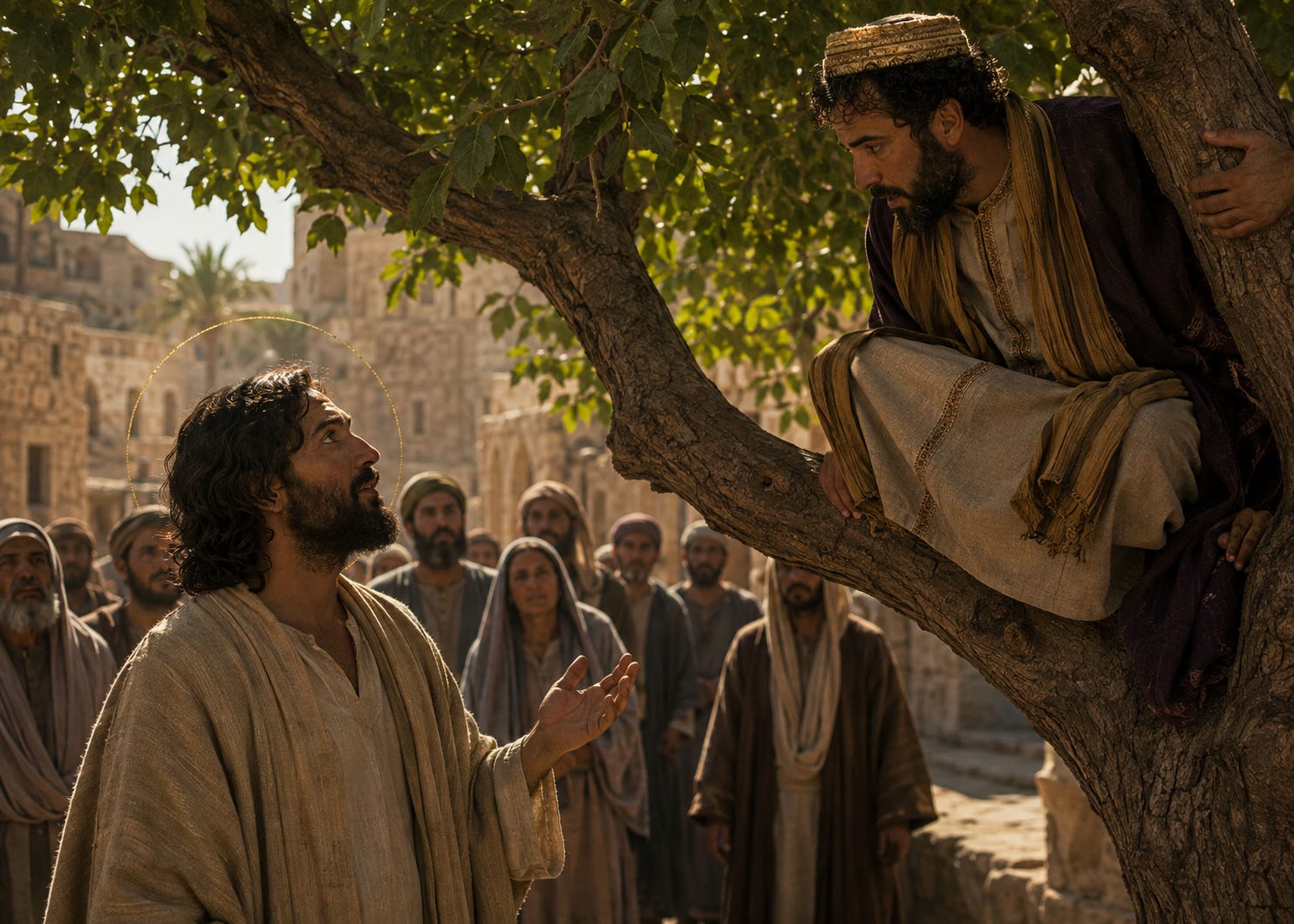
Jesus reaches the tree, looks up, and calls Zacchaeus by name.
That alone is extraordinary. Zacchaeus wanted to see who Jesus was. He apparently did not expect Jesus to know who he was.
“Zacchaeus, make haste and come down; for I must stay at your house today.”
There is urgency in the sentence. Jesus does not say that he might stop by if the afternoon remains open. He says he must stay at Zacchaeus’s house. Luke frequently uses this language of necessity when something belongs to the purpose of God. Jesus must proclaim the Kingdom. He must continue toward Jerusalem. He must suffer, die, and rise. Now, standing beneath a sycamore tree in Jericho, he must enter the home of a chief tax collector.
This is not an accidental encounter or a spontaneous lunch plan. Jesus regards entering this particular man’s home as part of the work he came to accomplish.
Pay close attention, however, to what Jesus does not say.
He does not confront Zacchaeus about his profession. He does not accuse him of stealing. He does not demand a confession or require him to promise restitution before coming down. Jesus offers no miniature sermon about money, corruption, or Roman occupation. He does not even ask Zacchaeus why a grown man with a government job is hiding in a tree.
Jesus calls him by name and announces that he is coming home with him.
That is the entire exchange.
Zacchaeus scrambles down and receives Jesus joyfully. The crowd is considerably less enthusiastic.
Luke tells us that everyone who sees what has happened begins to grumble. The disapproval is widespread. The crowd appears to agree that Jesus has made a serious mistake.
Their complaint is directed at Jesus: “He has gone in to be the guest of a man who is a sinner.”
Notice the distance they create. They do not speak to Zacchaeus. They speak about Jesus for associating with him. They do not call Zacchaeus by name. He has become “a sinner,” a category broad enough to contain his entire life and final enough to make further conversation seem pointless.
We should not dismiss the crowd as narrow-minded villains. Some may have paid tolls assessed by Zacchaeus’s operation or watched neighbors struggle while he became rich. “Chief tax collector” is not a neutral entry on a résumé. Their anger may have been born from injury rather than self-righteousness.
Their failure is not that they recognize morally consequential information. Their failure is believing that this information gives them the whole man.
They have reached the end of Zacchaeus’s story before Jesus has spoken to him.
Jesus refuses to begin where the crowd has ended. He does not deny the questions surrounding Zacchaeus’s wealth. He does not declare that harm is irrelevant or that accountability would be unkind. He simply refuses to treat Zacchaeus as someone who can only be discussed and never addressed.
Christ recognizes a person before the moral accounting is complete.
That order can make us uncomfortable. Many of us would prefer Zacchaeus to confess everything, repay every debt, demonstrate sustained improvement, and endure a probationary period. Once the proper committee approves his application, Jesus may enter.
Jesus goes to the house first.
That does not remove accountability from the story. It creates the relationship within which Zacchaeus can answer for his life. Welcome gives him neither innocence nor immunity, but it returns something the crowd has taken from him: a future that has not already been decided.
Then Zacchaeus stands and speaks.
And this is where the story becomes much stranger than the version most of us were taught.
When I write for you guys, I work from my Ignatius Catholic Study Bible, which uses the Revised Standard Version, Second Catholic Edition translation. It’s a very impressive tome, about twice the size of a normal textbook. I cracked it open as I always do, thumbed over to Luke, began to read... then I reached Zacchaeus’s declaration:
“Behold, Lord, the half of my goods I give to the poor.”
“I give?”
Huh?
Those two words stopped me.
I have read, heard, and taught this story more times than I could count. Somewhere along the way, I learned to hear his words in the future tense: “I will give half of my possessions to the poor.”
That is a very different sentence.
I reached for another Bible, a New American Bible I have owned for most of my life, because I wanted to make sure I had not invented the discrepancy. I remembered its wording as “I shall give.” I jumped over to Luke, found the passage, and there it was...
“I shall give...”
So Father is apparently not crazy, or at least not this time.
Confused? Yes. Crazy? Not completely.
We will take our victories where we can find them.
The difference sent me back to the language behind our English translations. I promise I am not going to make you complete a Greek worksheet. There will be no quiz, and your eternal salvation does not depend upon correctly identifying a present active indicative verb before you finish your cappuccino.
Here is what we need to know: the two main verbs in Zacchaeus’s statement, “give” and “repay,” are written in the present tense.
That does not settle the question. Greek present-tense verbs can describe an action pledged for the future, so many reliable translations render Zacchaeus’s words as a new promise: “I will give” and “I will pay back.”
But the verbs can also be translated in their straightforward present sense: “I give” and “I repay.”
Joel B. Green, a New Testament scholar, ordained elder in The United Methodist Church, and Senior Professor of New Testament Interpretation at Fuller Theological Seminary, argues that Zacchaeus may be describing his customary practice rather than announcing a new one. Shout out to our United Methodist readers, because the Church is vast, this community is wonderfully ecumenical, and apparently Methodists have been hiding some excellent Zacchaeus scholarship from us.
On Green’s reading, Zacchaeus is saying, in effect, “Look, Lord, I give half of what I possess to the poor, and whenever I discover that I have defrauded someone, I repay four times the amount.”
Now the story looks entirely different.
If Zacchaeus is announcing a new commitment, the crowd cannot imagine that a man with his history might change. Christ’s presence becomes the setting in which repentance and repair can take visible form.
If Zacchaeus is describing what he has been doing all along, the crowd has judged him without knowing the whole truth. His occupation remains compromised, but the people calling him “a sinner” may know far less about his conduct than they believe. Jesus’s declaration of salvation may become his public restoration.
Scholars disagree about which reading best fits the story, and that’s okay. The traditional interpretation remains grammatically possible and fits Luke’s concern for repentance. The customary-practice reading takes the present-tense verbs seriously and exposes assumptions readers bring to the passage before Zacchaeus ever speaks.
The ambiguity is not a problem we need to make disappear. It allows the Gospel to press us from both directions.
Perhaps Zacchaeus has been living with more integrity than anyone in Jericho bothered to learn. Perhaps he is making a costly commitment because being received by Christ has reordered his life. In one reading, the crowd does not know who he has been. In the other, they cannot imagine who he might become.
Either way, their verdict arrives too early.
And Luke has already placed another wealthy man beside this one, a man who approaches Jesus with every mark of respectability and then walks away sorrowful.
To understand what Zacchaeus may be showing us, we need to back up a few verses.
The chapter number makes Zacchaeus’s story look as though it begins a new subject. Chapter numbers are helpful when we are hunting for a verse, but they can also function like little walls inside a story that was never written with them.
Remove the wall between Luke 18 and Luke 19, and Zacchaeus acquires a neighbor.
A ruler approaches Jesus and asks what he must do to inherit eternal life. We commonly call him the rich young ruler, although Luke gives us the ruler and the wealth while Matthew supplies the youth. Either way, this man appears to be excellent disciple material.
He is respectable, disciplined, wealthy, and apparently serious about eternal life. He says he has kept the commandments since his youth. If the disciples were assembling a recruitment brochure, this gentleman would have photographed beautifully.
Then Jesus identifies the place where his discipleship stops.
“Sell all that you have and distribute to the poor,” Jesus tells him, “and you will have treasure in heaven; and come, follow me.”
The ruler becomes sorrowful because he is very rich.
Luke never says the man storms away or formally rejects Jesus. The story leaves him in his sadness, unable to follow where Jesus has asked him to go. His wealth has given him choices. Faced with Christ, it becomes the one choice he cannot make.
Jesus watches him and says how difficult it is for those who have riches to enter the Kingdom of God. It would be easier for a camel to pass through the eye of a needle.
Before anyone begins searching for a conveniently oversized needle or a tiny camel, Jesus’s image is supposed to be impossible. The people listening understand that perfectly. They respond with the obvious question:
“Then who can be saved?”
Jesus answers, “What is impossible with men is possible with God.”
Do not rush past that exchange, because a few verses later Jesus enters Jericho and meets another rich man.
Luke has placed these encounters close enough that they begin interpreting one another. Both men possess wealth and authority, and both face a decision involving their possessions. From there, they move in opposite directions.
The ruler approaches openly with an impressive religious record, asks what he must do, and becomes sorrowful. Zacchaeus begins at a distance with one of the least impressive résumés in Jericho, asks for nothing, receives Jesus joyfully, and places his money in motion toward the poor and anyone he may have defrauded.
The respectable man appears close to the Kingdom but cannot follow. The man everyone considers hopeless discovers that salvation has arrived at his house.
The question raised by the ruler is answered by Zacchaeus.
Who can be saved?
Even this man.
Even a rich man. Even a chief tax collector. What looked impossible when the ruler stood sorrowfully before Jesus becomes possible in a home nobody thought Jesus should enter.
Between these two wealthy men, Luke places one more encounter. As Jesus approaches Jericho, a blind beggar cries out for mercy. The crowd tries to silence him, but he keeps calling until Jesus stops, restores his sight, and receives him as a follower.
Inside Jericho, Zacchaeus is also trying to see Jesus, and once again the crowd is in the way. One man cries out from the roadside. The other runs ahead and climbs.
Luke has arranged a procession of people trying to see and be seen. The wealthy ruler sees Jesus clearly but cannot imagine life without his possessions. The blind beggar receives his sight and follows. Zacchaeus strains for a glimpse, only to discover that Christ has already seen him.
The crowd keeps both men at a distance for very different reasons. The beggar is too insignificant to interrupt Jesus. Zacchaeus is too compromised to host him. One is pushed aside because he possesses nothing. The other is condemned because of how much he possesses and how he acquired it.
Jesus stops for both.
This is the strange economy of grace in Luke. The people considered interruptions become part of Christ’s journey. Human beings have arranged everyone according to wealth, respectability, usefulness, and reputation. Jesus walks through those arrangements as though they were never binding upon him.
Still, salvation does not merely give Zacchaeus a warm feeling and a memorable lunch.
His money enters the conversation.
And when it does, Luke makes a distinction that the Church, our institutions, and most of us would occasionally prefer to avoid: giving generously is not the same thing as repairing the harm we have done to acquire it.
Zacchaeus places two very different actions on the table.
First, he gives half of his possessions to the poor.
Second, if he has defrauded anyone, he repays that person four times the amount.
We tend to blend these together under the general heading of “Zacchaeus becomes generous.” Luke keeps them separate. Giving to the poor responds to human need. Restitution responds to a particular injury.
Suppose I take one hundred dollars from you and later donate one hundred dollars to a food pantry. The pantry has received something good. You are still missing one hundred dollars. My charitable gift may help someone else, but it has not repaired what I did to you.
This distinction seems embarrassingly obvious when stated that plainly. It becomes less convenient once institutions, churches, corporations, governments, and our carefully managed consciences enter the conversation. We are remarkably fond of generosity when we choose the recipient, the amount, and whether there will be a small plaque involved. Restitution requires us to face someone with a legitimate claim against us.
Zacchaeus does not attempt to substitute one for the other.
He gives to people experiencing poverty, and he repays people he may have personally defrauded. The first is an act of generosity. The second is an act of justice.
His offer of fourfold repayment has deep roots in Israel’s Scriptures, but we should be precise about the connection. The Torah did not require fourfold repayment for every kind of fraud. Different offenses carried different forms of restitution.
Leviticus and Numbers describe cases involving deception or dishonest possession in which the person responsible must return what was taken and add one-fifth of its value. Exodus sets out more severe penalties for certain forms of theft. If someone stole a sheep and then sold or slaughtered it, the repayment was four sheep. If the stolen animal was recovered alive, the penalty could be double instead.
Fourfold repayment also appears in the confrontation between the prophet Nathan and King David. Nathan tells David about a rich man who takes a poor man’s beloved lamb. Furious at this imaginary injustice and still oblivious to the fact that the story is about him, David declares that the rich man must repay the lamb four times over.
That is an especially human piece of Scripture. David possesses tremendous moral clarity right up until he realizes he has been talking about himself.
Zacchaeus reaches for one of the strongest measures of restitution available in his scriptural world. Whether he is describing his regular practice or announcing a new commitment, fourfold repayment treats the injury with enormous seriousness.
This is accountability with an economic cost.
An apology may be sincere and repentance emotionally wrenching. But if another person remains burdened by our damage while we receive congratulations for spiritual growth, the work is incomplete.
Zacchaeus does not merely announce that he feels differently about his life. His money begins moving toward people who need help and people who have a claim against him.
That does not answer every question surrounding his wealth. Under the established-practice reading, it is astonishing that Luke can still call Zacchaeus rich while he gives half to the poor and practices severe restitution. Under the new-commitment reading, Luke calls him rich before the money moves, and the story never gives us his ending balance.
What Luke does give us is a man placing his wealth under the judgment of the encounter he has just experienced.
Private generosity cannot make an oppressive system righteous. Zacchaeus may possess real virtues while participating in a corrupt system. He may also be undergoing a genuine conversion that cannot repair the entire Roman economy before dinner.
Participation in a compromised system does not eliminate personal agency. Zacchaeus can decide how he uses his authority, what he does with his wealth, how he responds when harm is discovered, and whether another person’s injury will cost him anything.
Our retirement accounts, purchases, employers, churches, tax dollars, and conveniences connect us to systems we did not create and cannot repair by ourselves. That complexity can deepen our moral responsibility, or become a sophisticated excuse for doing nothing.
Zacchaeus does what is in front of him.
He cannot dismantle Rome from his dining room. He can feed people who are poor, examine the conduct attached to his authority, repay those who have been harmed, and allow proximity to Christ to reach the place where power and money meet.
The Church needs this distinction badly.
A church can operate a food pantry while refusing to compensate people it harmed. A corporation can sponsor a community project while underpaying workers. A government can announce relief while avoiding responsibility for its policies. An individual can give to charity while ignoring a debt owed to one person.
The good accomplished by generosity remains good. But generosity in one direction cannot erase a claim against us from another.
People who have been harmed should not be asked to accept someone else’s charitable donation as payment for their injury.
This is why Zacchaeus’s response is so powerful under either reading. If these practices are new, grace has reached his finances and produced concrete repair. If they are longstanding, his words reveal a moral complexity the crowd’s label has completely erased.
Either way, salvation does not float above the material conditions of his life. It enters his home, examines his wealth, reaches his neighbors, and takes seriously anyone who may have suffered because of him.
Only then does Jesus speak again.
He does not call Zacchaeus a tax collector.
He does not repeat the crowd’s word, “sinner.”
Jesus calls him a son of Abraham.
Jesus’s final words do more than confirm that Zacchaeus has experienced a private spiritual conversion.
“Today salvation has come to this house, because he also is a son of Abraham.”
That word “also” is carrying a great deal of weight.
The crowd has called Zacchaeus a sinner. Jesus calls him a son of Abraham.
Zacchaeus was Jewish before Jesus arrived in Jericho. His occupation did not erase his ancestry, although collaboration with Roman power had made him someone his neighbors could no longer imagine among the faithful. Jesus publicly contradicts them. This man, with this title, wealth, history, and all the unanswered questions surrounding him, is still a son of Abraham.
He is still one of us.
We should resist reading this as Jesus rescuing Zacchaeus from a deficient Judaism and welcoming him into a superior religion. Everyone in the scene is Jewish. Jesus restores a Jewish man to his own covenant community. The Church stands under this story’s judgment whenever religion becomes our reason to declare someone permanently beyond belonging.
Jesus’s declaration is spoken to Zacchaeus, but it is also meant to be heard by everyone who has been grumbling about him.
Salvation has come to this house. It reaches Zacchaeus personally without remaining sealed inside his heart. His household, wealth, neighbors experiencing poverty, anyone he may have defrauded, and his relationship with the community are all affected.
This is salvation with social consequences.
Jesus then tells us why he stopped beneath that tree: “For the Son of Man came to seek and to save the lost.”
Zacchaeus thought he was seeking Jesus.
All this time, Jesus was seeking Zacchaeus.
That changes the center of the story. Zacchaeus runs, climbs, looks, hurries down, receives Jesus joyfully, and places his money under scrutiny. Still, salvation begins with Christ entering Jericho, reaching the place where Zacchaeus is hiding in plain sight, and calling him personally.
Christ does what the crowd has stopped doing. He addresses Zacchaeus as someone capable of hearing and responding.
That is where this ancient road through Jericho arrives in our own world.
We place titles on people every day: politician, prisoner, pastor, billionaire, addict, immigrant, Republican, Democrat, fundamentalist, atheist, woke, MAGA, feminist, queer, divorced, bankrupt, disgraced, cancelled, excommunicated.
These words do not carry the same moral weight. A criminal conviction is not equivalent to a political affiliation. A diagnosis is not a moral failure. Discernment requires us to understand what a description truthfully discloses.
The danger begins when a description becomes a complete biography.
Once we believe the title tells us everything, curiosity feels like compromise. We speak about the person rather than to them. We stop asking what they have done, what they owe, what they have repaired, what they still refuse to face, and who they may be capable of becoming.
The crowd in Jericho has real concerns about Zacchaeus. Jesus does not rebuke them for caring about justice. Their failure is allowing a justified concern to harden into a final verdict.
We do this in the Church with remarkable efficiency.
Sometimes we demand transformation at the door before offering proximity in the pews. People may enter once they have resolved every doubt, conquered every addiction, put on the right clothes, and no longer require the kind of grace the Church exists to proclaim.
At other times, we confuse welcome with the absence of accountability and avoid hard questions about injury, restitution, power, and changed behavior.
Jesus follows neither path.
He enters Zacchaeus’s home before the accounting is complete, and his presence does not prevent the accounting from occurring. Grace reaches Zacchaeus before he can prove himself. That same grace reaches his wealth, his conduct, and the people who may have been harmed.
Welcome and accountability belong in the same house.
There is an essential pastoral boundary here. This story does not require injured people to restore trust automatically or give an unsafe person renewed access. Forgiveness does not eliminate consequences, and repentance does not erase the need for restitution. A person may remain dangerous after saying all the correct religious words.
Victims are not required to reenact Jesus’s dinner with Zacchaeus to prove their holiness. Jesus is the Savior. We are permitted to have locks on our doors, boundaries around our lives, and good reason to expect evidence before rebuilding trust.
Accountability protects the dignity of the person harmed. It also takes the humanity of the person responsible seriously by treating them as capable of choosing, repenting, repairing, and changing.
Consequences may remain while the future stays open.
Most of us lean toward one side. We excuse people we love and condemn people we dislike. We discover complexity when someone from our group causes harm and absolute certainty when the offender belongs to another.
Zacchaeus gives us nowhere comfortable to stand. If his words describe a new commitment, we must face the people whose transformation we have declared impossible. If they describe his established practice, we must face the people we have judged without knowing nearly as much as we imagined. Either way, the crowd’s verdict arrives too early.
I began by telling you that I have always related to Zacchaeus. I know what it feels like to be in that tree, trying to see Jesus from a life that does not fit anyone’s tidy picture of discipleship. I know the distance between the priest I want to be and the man who gets impatient, carries old wounds, makes new mistakes, and occasionally needs two Bible translations to confirm he has not completely lost his mind.
I keep climbing because I just want to see Christ.
The grace in this story is that Christ does not merely pass beneath the tree and reward Zacchaeus with a good view. He stops.
He looks up.
He calls him personally.
He enters the home everyone else has judged unworthy, and he brings salvation close enough to touch the table, the ledgers, the relationships, and the unfinished life of the man who lives there.
Christ’s compassion does not pretend that Zacchaeus’s choices are harmless. It refuses to accept that his failures are the only true things about him.
Perhaps this is what an untidy disciple looks like. We climb because we want to see Jesus. When he calls, we come down. We open the parts of our lives we would prefer to observe from a safe distance. We allow his presence to reach our money, our power, our wounds, our debts, and the people we have affected.
Then we discover that drawing nearer to Christ is possible because Christ has already drawn near to us.
The crowd may know your title. It may know your worst decision, your public failure, your history, or the category into which you have been placed. Some of what it knows may even be true.
It still does not know the end of your story.
Christ sees the whole person in the tree. He knows what must be confronted, what can be restored, what remains unfinished, and what may yet become possible.
He looks up.
He calls us down.
And he is not at all afraid to enter our home.
Before today, did you hear Zacchaeus’s words as a promise to change, or had you ever considered that he might be describing what he was already doing? Which reading do you find more compelling, and how does it change the way you understand Jesus, the crowd, or Zacchaeus himself? Tell me what you noticed in the comments. I would also love to know which part of this passage challenged you most: the crowd’s premature verdict, the contrast with the rich ruler, or the difference between generosity and restitution.
If this essay reopened a familiar story for you, please share it with someone who thinks they already know Zacchaeus, or with someone who needs to hear that the crowd does not get to decide the end of their story.
Christ who stops beneath the tree,
find me in the places where I have learned to watch from a distance.
Call me by name when I have mistaken my failures for my identity. Call me down when shame, fear, pride, or the judgment of others has persuaded me to hide. Enter the rooms of my life that I have kept closed, and do not leave my faith floating safely above the choices I make.
Where I have caused harm, give me the courage to face it, the humility to listen, and the willingness to repair what can still be repaired. Where I have been harmed, protect my dignity. Give me wisdom to hold necessary boundaries without surrendering my heart to bitterness or allowing another person’s failure to consume my life.
Keep me from reducing anyone to a title, a reputation, a political affiliation, a diagnosis, or the worst thing they have ever done. Teach me to see people clearly without pretending that their choices are harmless. Help me hold compassion and accountability in the same house.
Free me from whatever I possess that has slowly begun to possess me. Let your presence reach my money, my power, my relationships, my wounds, my debts, and every part of my life where love must become more than a beautiful idea.
When the crowd speaks as though it knows the end of my story, help me hear your voice above it. Remind me that you see the whole person in the tree: who I have been, what I must face, what can be restored, and who I may yet become through your grace.
I will keep climbing because I want to see you.
Teach me to trust that you have already seen me.
Look up, Lord.
Call me down.
Come home with me.
Amen.
Thank you for reading and for being part of Message From the Margins. If this work has helped you rediscover Scripture, find spiritual nourishment, or believe that there may still be a home for you within the Christian faith, please consider becoming a paid supporter today. Right now, about 2% of our subscribers financially support the publication. Our goal is to reach 10%, which would give this ministry the stability it needs to continue, grow, and endure. This work means too much to too many people for us to simply hope it somehow holds together. If you are able to raise your hand and say, “Heck, I’m in,” your support would mean more than I can adequately express. And if an annual subscription is within reach, that gives us the greatest help in planning for the year ahead. Either way, thank you for being here. I am grateful that we found one another.
Comments
Nothing yet. Say the first thing.
Sign in to join the conversation.