
They say the average man thinks about the Roman Empire ten times a day. I have never seen the research behind this claim, which naturally means the internet repeats it with great confidence.
By the nature of my work, I think about the Roman Empire considerably more. Occupational hazard. Some priests collect vestments; I apparently collect third-century persecutions.
Today we are heading back to Rome to meet St. Lawrence, a deacon who gave the empire a rather inconvenient lesson about what the Church considers valuable. Before we go, a quick word about how this work gets made.
Most of what I publish remains free because I want thoughtful, compassionate, intellectually honest Christian formation to be available to anyone who needs it. Paid subscribers are the people who make that possible. They give me the time to research, write, pray, and occasionally spend an unreasonable portion of the morning investigating Roman administrative practice.
One reader recently told me, “I support your work because I feel like you really understand what people are feeling.” I receive words like that with gratitude, and just enough holy terror to keep me honest.
If this publication helps you think more clearly, pray more deeply, or hold onto a form of Christianity rooted in the actual Gospel, I would be grateful if you considered becoming a paid subscriber. You are helping keep the doors open for everyone.
A Roman deacon, an emperor’s demand, and the people Christianity cannot afford to treat as expendable
By Father Rich V | Message From the Margins | August 10, 2026
Saint Lawrence has the rare distinction of being remembered for a joke allegedly made while he was being tortured to death. According to the familiar story, as he lay on a gridiron over the fire, he told his executioners that one side was done and they could turn him over. It is dark humor, even by martyr standards. Lawrence became the patron saint of cooks and comedians, which may be the Church’s strangest two-for-one deal.
The line is memorable. It is also part of a tradition whose precise historical details cannot be verified. Lawrence himself is no legend. He was a deacon of the Roman Church, he died during the persecution of Emperor Valerian in 258 CE, and Christians were honoring him within a century of his death. The gridiron account came to us through later witnesses, including St. Ambrose and Prudentius. We can receive that tradition reverently while admitting that history does not give us a video recording of the event.
I suspect the joke has endured because it gives us a safe distance from the more dangerous part of Lawrence’s story. A brave man mocking his torturers is easy to admire. A deacon forcing the Church to identify its treasure is much harder to domesticate.
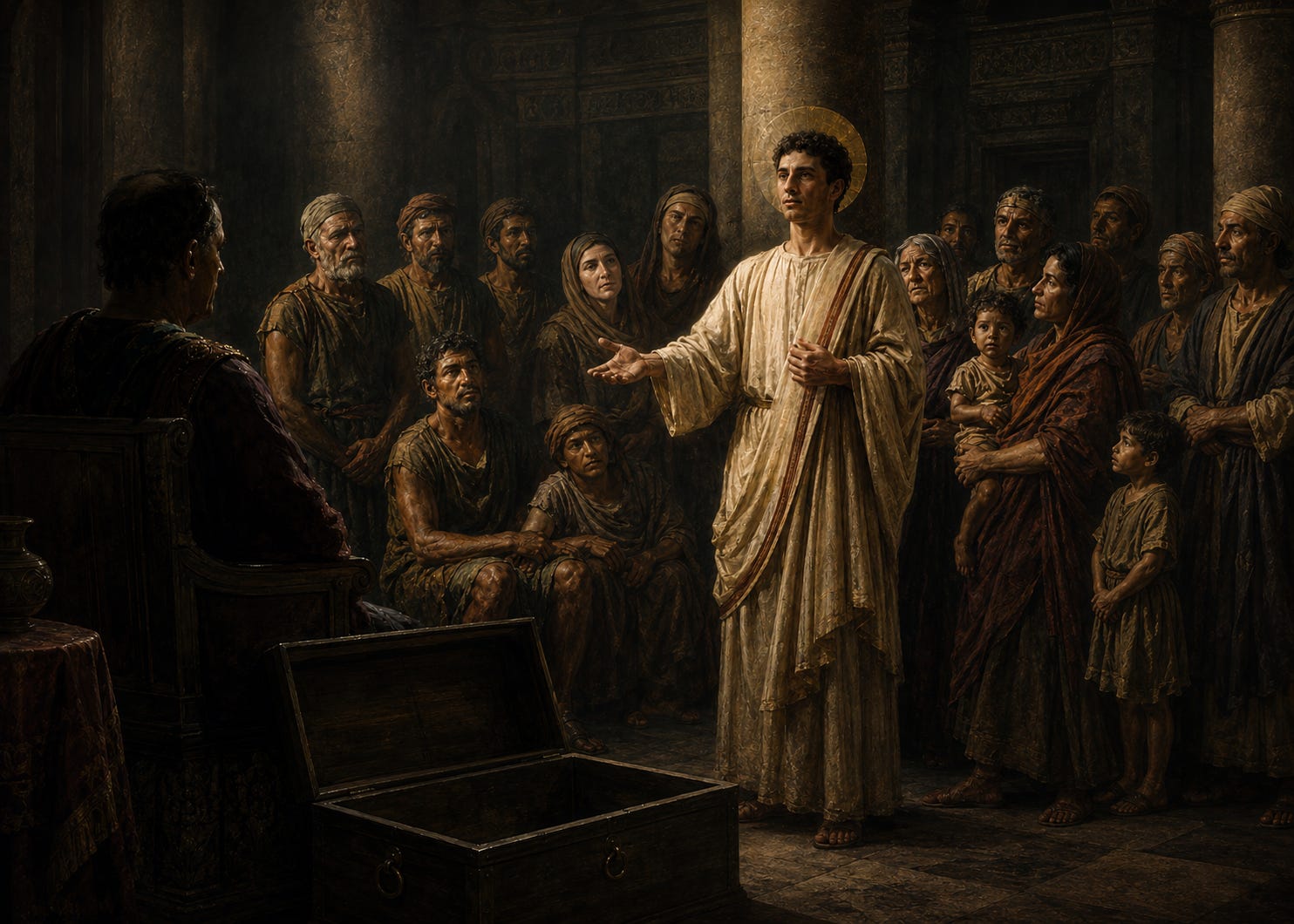
Before Lawrence faced the instruments of death, Roman authorities demanded the wealth of the Church. Ancient Christian memory says he gathered the poor, the disabled, widows, orphans, and others who depended on the Church’s care. Then he presented them to the prefect and declared, in effect: Here are the treasures of the Church.
Rome asked for gold. Lawrence answered with people.
That answer still burns.
The Feast of St. Lawrence is celebrated on August 10. Lawrence served as one of the deacons of Rome during the brief pontificate of Pope Sixtus II. In the third-century Church, a deacon’s work joined the altar to the street. Deacons assisted in worship, proclaimed the Gospel, administered resources, and made sure the community’s care reached those who were hungry, widowed, imprisoned, sick, or abandoned.
This is important because our imaginations can make holiness strangely decorative. We picture halos, dramatic last words, and heroic endurance. Lawrence’s holiness also lived in ledgers, food distribution, decisions about money, and the faces of people who needed help. He handled the Church’s material goods without confusing those goods for the Church’s wealth.
The emperor Valerian issued an order in 258 that bishops, priests, and deacons were to be put to death. Sixtus II was arrested while celebrating the liturgy in the cemetery of Callixtus and was executed on August 6. Lawrence was killed four days later, on August 10. The Church remembers him as both deacon and martyr because those two identities belong together. His death confirmed the life he had already been living: service to Christ expressed through service to people Rome pushed to the margins.
By the fourth century, devotion to Lawrence was firmly established in Rome. His name entered the Roman Canon of the Mass, and churches rose over the places associated with his burial and witness. Christians did not preserve his memory because he died spectacularly. Many people died under Rome. They remembered him because his life revealed what Christian fidelity looks like when political power demands that the Church surrender its soul along with its property.
The Church chooses readings for Lawrence that speak in the language of seed, generosity, justice, service, and life poured out. In the first reading, Paul is collecting material assistance for believers in need. His point is not that generosity will make the giver rich. His point is that grace loosens our grip so that God’s provision can move through us toward someone else.
“Whoever sows sparingly will also reap sparingly, and whoever sows generously will also reap generously.”
2 Corinthians 9:6, NIV
Paul does not separate spiritual maturity from material practice. He writes about money, intention, reluctance, sufficiency, and the “harvest of righteousness.” Holiness reaches the budget. It appears in what a community funds, what it protects, whose emergency becomes its concern, and whether its generosity preserves another person’s dignity.
“Good will come to those who are generous and lend freely, who conduct their affairs with justice.”
Psalm 112:5, NIV
Notice the psalm’s final word: justice. Charity cannot be reduced to the occasional kindness of comfortable people. The biblical vision asks whether our affairs are conducted justly, whether the arrangements that benefit us are crushing someone else, and whether the people receiving help are allowed a voice in what help should look like.
Then the Gospel takes us to the grain of wheat. Jesus is speaking about his approaching death, and he refuses the fantasy that life can be secured by clutching it. A seed kept safely on a shelf remains alone. A seed given to the earth becomes capable of a harvest.
“Whoever serves me must follow me; and where I am, my servant also will be.”
John 12:26, NIV
Lawrence followed Christ into the dangerous place where worship becomes solidarity. His martyrdom should never be used to glorify abuse, teach vulnerable people to tolerate mistreatment, or suggest that God enjoys suffering. Christian martyrdom is witness. The martyr does not chase pain; the martyr refuses to purchase survival by handing someone else over to the machinery of death.
Lawrence could not save himself by surrendering the Church’s dependents as expendable mouths or inconvenient liabilities. His service had taught him where Christ was. When the state demanded treasure, Lawrence would not speak the empire’s language of value.
Churches need buildings. Ministries need bank accounts, insurance, technology, competent staff, and enough money to keep the lights on. Message From the Margins does not run on incense and good intentions, regrettably. Material resources can serve holy purposes, and pretending otherwise usually leaves the bill with the most generous person in the room.
Lawrence does not condemn responsible stewardship. He exposes the moment when stewardship becomes institutional self-protection. The Church begins to lose herself when preserving assets, access, reputation, or political influence requires her to step over the people the Gospel placed in her care.
A Church can possess priceless things and still have forgotten what it treasures.
We see the consequences whenever Christian institutions speak passionately about their freedom while remaining strangely quiet about families choosing between rent and medicine. We see it when churches cultivate relationships with powerful donors but treat a person asking for help as an interruption. We see it when the poor appear in fundraising photographs yet remain absent from decision-making. We see it whenever a congregation’s idea of success is measured by visibility, property, attendance, and cultural access, while nobody asks whether vulnerable people are safer because that church exists.
Lawrence’s declaration is often softened into a charming lesson about being nice to the poor. It is much sharper than that. He identified people living in poverty as belonging at the center of the Church’s understanding of herself. They were not props in someone else’s spiritual development. They carried wisdom, agency, wounds, gifts, claims upon justice, and the image of God.
Pope Leo XIV returned to Lawrence’s witness in his 2025 apostolic exhortation Dilexi Te. Drawing on St. Ambrose, he wrote that Lawrence pointed to the poor and called them the Church’s treasures. The exhortation goes further by describing people who are poor as active participants in the Gospel’s life, not passive recipients of pastoral care. That distinction is deeply important. You can give someone food and still refuse to hear them. You can fund a shelter and oppose every policy that might reduce the number of people who need it. You can serve a meal, take a photograph, and never learn a guest’s name.
Christian generosity begins with giving, but it grows into relationship, justice, and shared life. Lawrence did not display a category called “the needy.” He brought forward human beings whose lives contradicted Rome’s account of worth.
Every empire keeps a ledger. Some lives are marked productive, respectable, useful, desirable, and worth defending. Others are recorded as expensive, suspicious, disposable, or simply invisible. We still use cleaner language for the same arithmetic. We talk about burdens, undeserving people, acceptable losses, bad neighborhoods, difficult populations, and people who should have made better choices. The vocabulary changes; the contempt travels remarkably well.
Lawrence’s act challenged that accounting system at the point where it expected compliance. The prefect believed the Church’s value could be confiscated. Lawrence showed him a wealth power could neither recognize nor own.
This is also why the feast must examine the Church before it examines the culture. Christians can become skilled at condemning society’s cruelty while reproducing its hierarchies in the parish office, the diocesan budget, the hiring process, the communion line, and the comment section. Lawrence offers no congratulatory escape. He asks whether the people at the margins are genuinely treasured or merely discussed.
For those who are poor, disabled, unhoused, elderly, undocumented, imprisoned, mentally ill, or otherwise treated as a problem to be managed, this feast should not assign another burden. Lawrence’s witness does not ask marginalized people to prove their holiness by suffering quietly. It addresses the Church and everyone entrusted with power. It commands us to recognize, protect, listen, share, and reorder our common life.
Most of us will never face an imperial official demanding the treasury. We will face smaller moments that reveal the same loyalties. A person will need more time than our schedule allows. A ministry budget will expose what our mission statement tried to conceal. Someone with no influence will tell us that our system is hurting them. A friend’s need will arrive after we have already decided we are tired.
Courage in those moments rarely feels cinematic. It looks like returning a call, changing a policy, sharing money, challenging a cruel remark, admitting that a program serves our image better than our neighbors, or allowing the person receiving care to help design it. Diaconal faith lives there, close to the ground, often without applause.
Lawrence did not begin becoming a martyr when the fire was lit. He became capable of that final witness through years of deciding what the Church’s resources were for. Martyrdom revealed the pattern; it did not invent it.
That may be the feast’s most useful word for us. The courage we hope to possess in a crisis is being formed by what we treasure on an ordinary Monday.
Read the day’s readings slowly. Sit with 2 Corinthians 9:6-10, Psalm 112, and John 12:24-26. Notice how often generosity, justice, service, and fruitfulness appear together.
Audit one line of your spending. Choose one recurring expense, personal or institutional, and ask what it says about what you treasure. Make one change that directs care toward someone who has less leverage than you do.
Serve with relationship, not distance. If you donate or volunteer, learn a name, ask what is actually needed, and listen without turning another person’s life into a lesson about your generosity.
Defend someone’s dignity in public. Interrupt one joke, policy, post, or conversation that treats a vulnerable group as disposable. Quiet charity and public justice belong to the same Gospel.
If Lawrence placed the treasures of the Church in front of us today, who would be standing there? And if someone examined your calendar, spending, attention, and loyalties, what would they conclude that you treasure?
I would be grateful to hear where this feast presses on your life, your church, or your community.
If this reflection gave you language for something your church needs to hear, please share it with one person or congregation willing to wrestle with the question.
God of mercy and justice,
you formed your servant Lawrence
at the altar and among the poor,
then gave him courage
when power demanded that he betray
what he had learned.
Through his intercession,
free us from the fear
that makes us clutch our resources,
protect our reputations,
and look away from people
whose needs may cost us something.
Teach your Church
to recognize her true treasure
in every person
the world discounts or discards.
Give wisdom to those who administer money,
strength to those who serve without recognition,
and justice to those who have been treated
as objects of charity
rather than members of one body.
Keep us from romanticizing suffering,
and make us brave enough
to confront the arrangements that produce it.
Plant in us the generous life of Christ,
the grain of wheat
given for the life of the world.
May what we possess
become an instrument of love,
and may those at the margins
be welcomed as teachers, neighbors, and kin.
Amen.
Well, we made it back from the Roman Empire.
Thank you for accompanying me through Valerian’s persecution, a deacon with an empty treasury chest, several uncomfortable questions about church budgets, and more Roman history than most people encounter before lunch.
I am always grateful that you are willing to travel through these old stories with me. The saints become far more interesting when we stop treating them like marble statues and allow them to ask difficult questions of the Church we are building now.
Lawrence leaves us with a particularly stubborn one: if someone examined what we protect, fund, and defend, would they recognize the people at the margins as our treasure?
Thank you for making the trip back to Rome with me. You may remove your toga now.
For those who support this work as paid subscribers, thank you for helping make these journeys possible. If you are reading as a free subscriber and would like to help sustain the research, writing, and ministry behind them, I would be honored to welcome you.
Comments
Nothing yet. Say the first thing.
Sign in to join the conversation.