
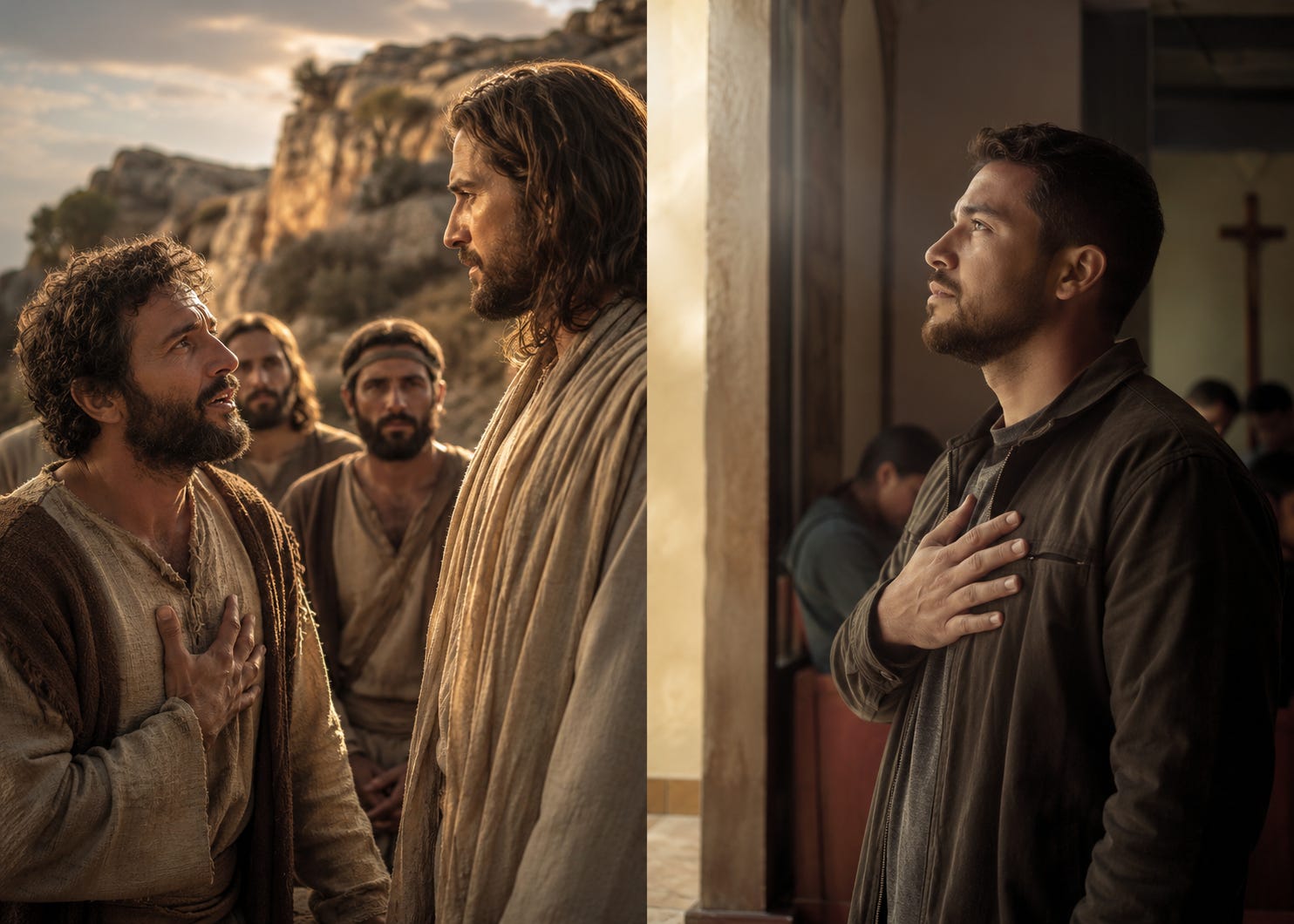
Good morning, friends.
Before we get to Peter, I want to say something I try not to let the convenience of Substack obscure.
If you have access to a parish that is safe, loving, and spiritually honest, please go worship there today. A screen can carry a homily to you. It cannot hand you the peace, let you hear a roomful of imperfect voices sing together, put you beside another human being who may need you, or place the Eucharist in your hands, if that is part of your tradition. Christianity is an embodied faith. We need one another.
I also know that some of you are reading this because church has wounded you. Some are homebound, caregiving, traveling, sick, between parishes, or simply not ready to walk through those doors again.
Then pull up a chair.
For this morning, let this be church. Pray with me. Hear the Word with me. Bring whatever you are carrying. You are welcome here.
And if you would like help finding a parish where you can worship safely and be treated with dignity, write to me. I will help if I can.
Your Brother in Christ,

Now... Peter has gotten himself into something… again
Lectionary: 121
Isaiah 22:19–23
Thus says the LORD to Shebna, master of the palace:
“I will thrust you from your office
and pull you down from your station.
On that day I will summon my servant
Eliakim, son of Hilkiah;
I will clothe him with your robe,
and gird him with your sash,
and give over to him your authority.
He shall be a father to the inhabitants of Jerusalem,
and to the house of Judah.
I will place the key of the House of David on Eliakim’s shoulder;
when he opens, no one shall shut,
when he shuts, no one shall open.
I will fix him like a peg in a sure spot,
to be a place of honor for his family.”
Psalm 138:1–2, 2–3, 6, 8
R. Lord, your love is eternal; do not forsake the work of your hands.
I will give thanks to you, O LORD, with all my heart,
for you have heard the words of my mouth;
in the presence of the angels I will sing your praise;
I will worship at your holy temple.
R. Lord, your love is eternal; do not forsake the work of your hands.
I will give thanks to your name,
because of your kindness and your truth:
When I called, you answered me;
you built up strength within me.
R. Lord, your love is eternal; do not forsake the work of your hands.
The LORD is exalted, yet the lowly he sees,
and the proud he knows from afar.
Your kindness, O LORD, endures forever;
forsake not the work of your hands.
R. Lord, your love is eternal; do not forsake the work of your hands.
Romans 11:33–36
Oh, the depth of the riches and wisdom and knowledge of God!
How inscrutable are his judgments and how unsearchable his ways!
For who has known the mind of the Lord
or who has been his counselor?
Or who has given the Lord anything
that he may be repaid?
For from him and through him and for him are all things.
To him be glory forever. Amen.
Matthew 16:18
R. Alleluia, alleluia.
You are Peter and upon this rock I will build my Church
and the gates of the netherworld shall not prevail against it.
R. Alleluia, alleluia.
Matthew 16:13–20
Jesus went into the region of Caesarea Philippi and
he asked his disciples,
“Who do people say that the Son of Man is?”
They replied,
“Some say John the Baptist, others Elijah,
still others Jeremiah or one of the prophets.”
He said to them,
“But who do you say that I am?”
Simon Peter said in reply,
“You are the Christ, the Son of the living God.”
Jesus said to him in reply,
“Blessed are you, Simon son of Jonah.
For flesh and blood has not revealed this to you, but my heavenly Father.
And so I say to you, you are Peter,
and upon this rock I will build my church,
and the gates of the netherworld shall not prevail against it.
I will give you the keys to the kingdom of heaven.
Whatever you bind on earth shall be bound in heaven;
and whatever you loose on earth shall be loosed in heaven.”
Then he strictly ordered his disciples
to tell no one that he was the Christ.
There are some things in life that are remarkably easy to say.
“I’ll have a Big Mac with cheese.”
“I have read and agree to the terms and conditions.”
I bet you haven’t.
Nobody has.
Somewhere there is probably a lawyer whose entire career depends upon all of us continuing this little charade.
And, strangely enough, in much of American life today, saying “Jesus Christ is Lord” can be nearly as easy.
It may even come with perks.
You are in the club. You are one of the good people. You can put “Christian” in your biography. You can quote Scripture on Facebook. You can run for office. You can talk constantly about Christian values. Depending on where you live, you can do all of this and never go anywhere near an actual church.
Christianity can become a cultural accessory.
A cross around the neck. A Bible on the coffee table. A phrase in the campaign speech. Something nice to put beside “husband, father, patriot, small-business owner.”
And all of that is hogwash.
Because Jesus asks Peter a question in today’s Gospel that sounds, at first, almost embarrassingly simple.
“Who do you say that I am?”
Peter gives Him the answer.
“You are the Christ, the Son of the living God.”
Bingo.
Ding ding ding.
Peter advances to the bonus round.
Except Peter has absolutely no idea what he has just gotten himself into.
And neither, I suspect, do we much of the time.
Because when Peter says, “You are the Christ, the Son of the living God,” he is doing considerably more than getting the theology right.
He is making a commitment.
He is saying, in effect:
You have authority over me.
And, merciful heavens, this is where Christianity starts getting inconvenient.
I have been a Christian for essentially my whole life... In fact, due to some medical complications when I was born, I was baptized within days of my appearance on this earth. I am a priest. I wear the collar almost every day. I preach the sermons. I know the Creed and unreasonable amount of church trivia. You could probably wake me from anesthesia halfway through surgery and say, “The Lord be with you,” and some deeply conditioned Catholic reflex would whisper, “And with your spirit.” (I prefer “And also with you” but that’s a conversation for another article)
Anywho, the point I’m trying to make is the words are not the hard part.
The hard part comes when Jesus starts asking whether I meant them.
Because if Jesus is Lord, then Rich is not.
I know. Terrible news.
I had plans.
Neither is my money, Lord.
Neither is my anger.
Neither is my sexuality.
Neither is my political tribe.
Neither is my nation.
Neither is my ambition, my comfort, my reputation, or the grudge I have been carefully polishing for seventeen years because, frankly, I still think I was right.
(I was)
If Jesus is Lord, then eventually He gets a vote on all of it.
Actually, He gets considerably more than a vote.
And there is probably a more respectable way for a clergyman to say what comes next, but I cannot seem to find it this morning:
If your Christianity is window dressing for an otherwise dirtbag life, you are in trouble.
I do not mean that Christians never sin.
Good heavens.
If Christianity required moral perfection before entry, the Church would contain Jesus, Mary, my surrogate Grandma Lois, and perhaps three other people, and one very confused usher.
Peter himself would not make the cut.
We lie. We fail. We lose our tempers. We hurt people. We make selfish choices. Sometimes we know perfectly well what the Gospel asks of us and decide that, upon further consideration, Jesus must surely have been speaking metaphorically.
That is why Christianity has repentance.
That is why we confess.
That is why we forgive.
That is why we come back to the table again and again with empty hands.
Failure is part of the Christian story.
But there is a tremendous difference between falling short of the life Christ calls us to live and having no intention whatsoever of allowing Christ to interfere with the life we have already decided to live.
Jesus is remarkably blunt about this.
Earlier in Matthew’s Gospel, near the end of the Sermon on the Mount, He warns that simply calling Him “Lord, Lord” is not enough.
And I wish we could soften that.
I really do.
A nice little footnote perhaps.
“Lord, Lord, terms and conditions apply.”
But Jesus does not leave us much wiggle room.
He says you will know the tree by its fruit.
Then He talks about people who call Him Lord, invoke His name, and even point to impressive religious things they have done.
And still He says: you missed it.
Then He tells the story of two people who build houses.
Both hear Him.
That is important.
Both hear the sermon.
Both know what Jesus said.
Both perhaps nodded thoughtfully.
One of them actually does something about it.
That is the house built on rock.
Which brings us back to Peter.
Because today Jesus looks at Peter and says, essentially, “You are rock.”
And Peter is going to spend the rest of his life learning how to become the thing Jesus has already called him.
I love that.
I really do.
Because Peter gets the answer right before he gets the life right.
That gives me enormous hope.
Almost immediately after today’s Gospel, Jesus starts explaining where this road is going.
Jerusalem.
Suffering.
Rejection.
Death.
Resurrection.
And Peter says, essentially:
“No.”
I always imagine Jesus giving him one long look.
Peter has just said, “You are the Christ.”
Jesus starts explaining what Christ means.
And Peter replies, “Well, obviously not like that.”
There may be no more perfectly Christian exchange in all of Scripture.
“Yes, Lord, You are absolutely Lord. Now let me explain how I think You should proceed.”
I have prayed that prayer.
Perhaps not in those exact words.
But I have prayed it.
Jesus, You are Lord... as long as You do not touch this relationship.
Jesus, You are Lord... but I intend to keep hating that person.
Jesus, You are Lord... but I really need You to understand my financial situation.
Jesus, You are Lord... but everyone I know agrees with me politically, so perhaps You could adjust the Gospel accordingly.
Jesus, You are Lord... but this particular commandment feels terribly dated.
We laugh because we recognize ourselves.
Peter certainly gives us plenty of material.
Later, at the Last Supper, he announces that even if everyone else falls away, he never will.
Which is exactly the sort of declaration one should probably avoid making in front of Jesus.
A few hours later, Peter is standing in a courtyard.
Someone recognizes him.
“Aren’t you one of His?”
And suddenly “You are the Christ, the Son of the living God” has become expensive.
Peter says:
I do not know Him.
Three times.
The great confession collapses in the face of fear.
And I need Peter in this homily because otherwise it would become much too easy for you and me to spend the next ten minutes thinking about somebody else.
You know the person.
“Oh, Father, I know EXACTLY who needs to read this.”
No.
Put down your phone.
We are not texting them the link during the homily.
Peter makes sure the question comes back to us.
Because every one of us has some price at which our Christianity starts getting negotiable.
For Peter, in that courtyard, the price was fear.
For me, perhaps it is comfort.
For you, perhaps reputation.
Or money.
Or belonging.
Or sex.
Or politics.
Or pride.
Or simply the almost irresistible human desire not to admit that we were wrong.
And then comes one of the most beautiful parts of the Christian story.
Jesus comes back for Peter.
The Resurrection happens, and Christ does not say, “Well, that fellow turned out to be disappointing.”
Thank God Jesus does not run the Church the way I occasionally manage my inbox.
Peter failed Him spectacularly.
Jesus restores him.
“Do you love Me?”
“Yes, Lord.”
“Feed My sheep.”
Again.
“Do you love Me?”
“Yes.”
“Feed My sheep.”
The man who denied Jesus three times is given three chances to say again what his life will mean.
Grace does not pretend the failure never happened.
Grace refuses to let the failure have the final word.
And Peter continues learning how to live inside the confession he made today.
Eventually, according to the ancient tradition of the Church, Peter carries that confession all the way to Rome and to martyrdom.
And I want to stay with that word for a minute, because we tend to hear “martyr” and immediately imagine stained-glass saints standing serenely beside whatever instrument was used to kill them.
Christians can be a strange people.
The Greek word underneath our word martyr is martys.
It means witness.
That is what a martyr is.
A witness.
The earliest Christians were not supposed to go looking for terrible ways to die. They were not trying to win some sort of suffering Olympics.
They had simply made a claim.
Jesus Christ is Lord.
And sometimes the world around them said:
No.
Caesar is lord.
Power is lord.
Empire is lord.
Your own survival is lord.
Now tell us which one you really mean.
And some Christians answered with their lives.
Peter, who once became frightened enough to tell a servant girl that he did not know Jesus, is remembered by the Church as a man who eventually became willing to die rather than deny Him.
There is a whole lifetime of grace between those two Peters.
And that, I think, is where this Gospel finds us.
Most of us are not going to face martyrdom today.
I sincerely hope nobody leaves church this morning and immediately encounters a Roman emperor.
That would be an unusually eventful coffee hour.
But the martyr’s question arrives in smaller forms every day.
Did you mean what you said?
When telling the truth will cost me money... did I mean it?
When the person Christ commands me to love is somebody I genuinely cannot stand... did I mean it?
When the stranger is actually strange, when the immigrant speaks another language, when the poor person is inconvenient, when the prisoner really did something terrible... did I mean it?
When fidelity gets boring...
When forgiveness feels unfair...
When generosity means I actually possess less afterward...
When defending somebody unpopular makes people I like angry with me...
When my preferred politician behaves in a way I would condemn instantly if the other party did it...
Did I mean it?
Christianity is costly.
And I want to be very precise here.
Grace is free.
You cannot purchase God’s love.
You cannot earn salvation by becoming sufficiently impressive.
You cannot stack enough good deeds on a heavenly counter until God finally says, “Well done, you have accumulated the necessary points.”
God loved Peter before Peter understood.
God loved Peter while Peter failed.
Christ loved Peter in the courtyard.
Christ loved Peter on the beach.
Grace is free.
But following Jesus will cost you things.
It may cost money.
It may cost comfort.
It may cost popularity.
It may cost a relationship that is destroying you.
It may cost the pleasure of having an enemy.
It may cost an opinion you have cherished for thirty years.
It may cost your certainty.
It may cost your place in the in-crowd.
And every once in a while, in the long and bloody history of Christianity, it has cost somebody everything.
This is why I become a little nervous when Christianity becomes too useful to power.
When faith requires nothing, threatens nothing, changes nothing, and conveniently blesses everything I already wanted to do, I begin to wonder whether I have encountered Jesus Christ or simply commissioned a religious portrait of myself.
Because the Christ Peter confesses does not leave Peter where He found him.
He loves him far too much for that.
And, friends, He loves us far too much for that too.
So I do not want you walking away from this thinking, “Well, Father Rich says I am a terrible Christian.”
Father Rich is far too busy examining his own rather cluttered spiritual house to conduct inspections of yours.
I want us to hear the question.
That is all.
“Who do you say that I am?”
And perhaps today our answer is the same as Peter’s.
“You are the Christ, the Son of the living God.”
Wonderful.
Now let us allow Him to spend the rest of our lives teaching us what we just said.
Maybe there is a room in your life where Jesus is still standing outside.
You have given Him most of the house.
But not that room.
“This one is mine, Lord.”
Maybe you have been guarding it for years.
I have a few myself.
And perhaps today you simply crack the door.
You do not need to have conquered every sin by lunchtime.
Peter certainly did not.
You let Christ in.
You repent where you need to repent.
You apologize where you owe an apology.
You tell the truth where you have been living inside a lie.
You forgive as you become able.
You give something away.
You stand beside someone who needs you.
You come to the altar with your hands open again.
And when you fail, you return.
Remember today’s Psalm:
“Do not forsake the work of Your hands.”
That is us.
The unfinished work of His hands.
Peter was unfinished when he made his confession.
He was unfinished when he denied Christ.
He was unfinished when Jesus restored him.
He was unfinished right up until the day he died.
So are you.
So am I.
But Christ keeps working.
That is the good news hiding inside the hard question.
Christian discipleship is not one heroic declaration made on a mountain somewhere.
It is a lifetime of letting the words become true.
“You are the Christ.”
A little more true in me today than yesterday.
“You are the Son of the living God.”
A little more visible in the way I treat people.
“You are Lord.”
A little less competition from all the other things I keep trying to put on Your throne.
Jesus asks Peter:
“Who do you say that I am?”
Peter answers Him.
Today, Jesus asks us.
And if we give Peter’s answer, then sooner or later He will ask the question underneath it:
Did you mean what you said?
God willing, by grace, by repentance, by failure and forgiveness, by Eucharist and prayer and service and a thousand small acts of costly love...
may our lives slowly learn to say:
Yes, Lord. I meant it.
Where has following Christ actually cost you something?
Is there a part of your life where you find it much easier to call Jesus “Lord” than to allow Him to have the final word?
And where have you experienced the grace Peter experienced, the grace to fail, repent, return, and discover that Christ was not finished with you?
Pull up a chair and tell us in the comments. I suspect we could learn quite a bit from one another today.
If someone you love has ever wondered what it really means to call Jesus “Lord,” share this homily with them. It may be a conversation worth having.
Lord Jesus Christ,
Son of the living God,
we have called You Lord.
Teach us to live what we confess.
Where our faith has become decoration, convert us.
Where we have excused what You ask us to surrender, give us courage.
Where we have failed, give us the humility to repent and return.
Where discipleship becomes costly, give us strength to remain faithful.
Do not forsake the work of Your hands.
Make our lives bear good fruit,
our words truthful,
our love courageous,
our mercy generous,
and our witness worthy of the name we bear.
And when we fail, as Peter failed,
meet us again with mercy, restore us,
and teach us once more to follow You.
For You are the Christ,
the Son of the living God,
and You are Lord.
Amen.
If someone you love has been struggling with the difference between calling themselves Christian and actually following Christ, share this homily with them. Perhaps it can begin a good conversation.
Nearly everything I publish through Message From the Margins remains open to everyone, and I would very much like to keep it that way, without political ads or the absurd internet advertising that somehow wants to sell you toenail fungus medication while you are trying to pray.
If this ministry helps you and you are able to support it with a paid subscription, your support makes this work possible and helps keep it available to people who cannot pay.
If you cannot, please stay anyway.
I am grateful you are here.
May Jesus Christ, the Son of the living God, give you the courage to mean what you say, the humility to repent when you do not, and the grace to begin again.
Amen.
Comments
Nothing yet. Say the first thing.
Sign in to join the conversation.