
Before we go wandering through first-century Galilee together, a quick note for those waiting for Episode II of the Message From the Margins podcast.
It is coming later this week.
I am still very new at this, and I am discovering that producing a competent podcast apparently requires more than placing a microphone in front of a priest and allowing him to geek out for an hour. Frankly, this feels like false advertising. An out-of-state funeral this weekend, along with some diocesan business that needed my attention, left fewer days in the week and fewer hours at the computer than the episode deserved. I keep begging the Lord to add a few extra hours to the day, He keeps leaving me on read. So, I am aiming for Wednesday or Thursday, probably Thursday. I will give you a firmer answer tomorrow, so keep your eyes open.
In the meantime, thank you for being here, whether you read, comment, share, pray, or support this work financially. Every form of participation helps this little ministry travel farther. If these essays have become part of your spiritual life and a paid subscription is comfortably within reach, your support helps keep the core of Message From the Margins open to everyone. If it is not comfortably within reach, please stay. Read. Pray with us. You belong here, and I mean that.
Support Message From the Margins
Your Brother in Christ,

Now, let us go to Nazareth.
St. Bartholomew began with a prejudice, took one honest step toward Jesus, and spent the rest of his life witnessing that something very good had come from Nazareth.
I bet you’ve never heard of this place, but down in Lower Galilee stood the city of Sepphoris, the sort of place people noticed.
It had wealth, public buildings, administration, trade, and the polished confidence of a place accustomed to appearing on maps. Herod Antipas rebuilt it into a regional capital while Jesus was young. If you wanted to know where the influence was, where the money moved, or where something important might happen, Sepphoris was a reasonable guess.
I know what some of you are thinking. Sepphoris, incidentally, is not related to Sephora. Although, if it existed in America today, it might have had one.
Might.
Probably the kind inside Kohl’s.
So anyway, that is quite enough time in Sepphoris, because almost nobody today cares about it.
Our story takes us four miles south, to a place almost nobody cared about then, but people across the world care tremendously about now.
Nazareth.
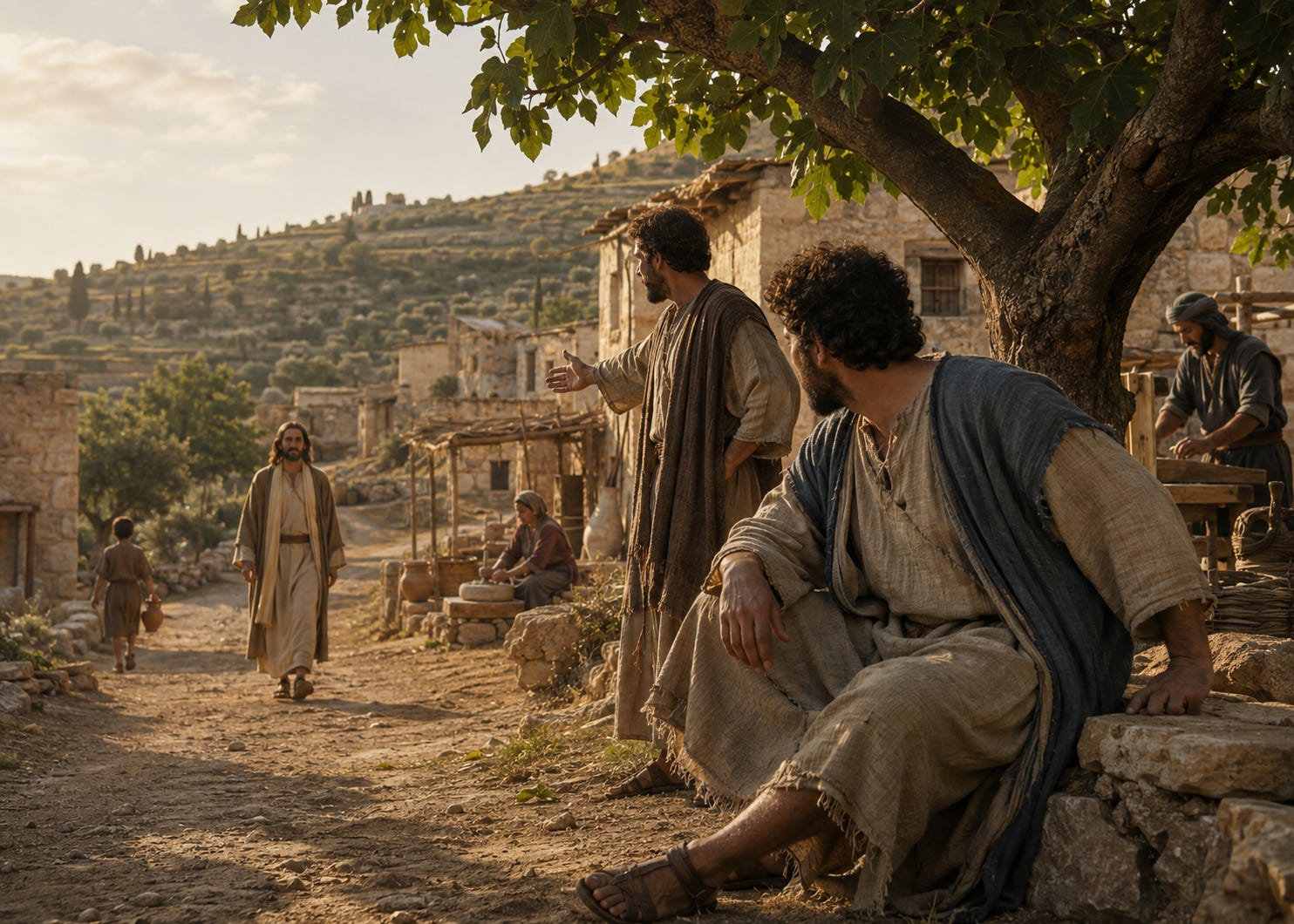
Picture a settlement of perhaps a few hundred people folded into the hills of Galilee. No marble avenues. No monumental gates. No civic skyline announcing that history should pay attention. Just modest homes of local stone, some gathered around courtyards where nearly everything happened.
The courtyard was kitchen, workshop, laundry room, playground, gathering place, and, when one relative was “staying temporarily” for the seventh consecutive year, probably guest room as well. Privacy was not among the abundant natural resources of first-century Galilee.
People dressed simply. Men generally wore basic tunics, often around the knee, with a mantle when weather or work required it. Women’s garments tended to fall longer, and hair was commonly bound, covered, or gathered in a net or cloth. Wool and linen took work to produce. Clothing was made by hand, mended repeatedly, handed down, and worn until the garment had acquired both a history and, very likely, opinions.
There were no walk-in closets in Nazareth. I realize some Gentiles may need a moment.
The work was ordinary and relentless. People cultivated grain, grapes, and olives. They kept sheep and goats. They pressed oil and made wine. Some quarried stone or shaped it. Others worked wood, wove cloth, carried goods, repaired tools, tended children, prepared food, and performed the thousand daily tasks that keep a small community alive without ever earning anyone a statue.
Education was mostly oral, practical, familial, and religious. Children learned the work of the household by doing it. Scripture was heard aloud, remembered, repeated, and prayed in community. Some boys learned letters and acquired the ability to read, while advanced study belonged to very few. There was no universal village schoolhouse, no guidance counselor asking whether a promising young Galilean had considered Jerusalem University, and certainly no laminated five-year plan.
There were simply families teaching children how to live, work, worship, remember, and belong.
And everybody knew everybody.
Many were related by blood. More were related by marriage. The rest knew enough about one another to make the distinction feel academic. People knew who had helped whose family through a failed harvest, whose daughter was expected to marry whose son, which cousin could be trusted with a tool, and which uncle should never be trusted with a secret.
When somebody new entered the village, everyone noticed. Before the stranger had finished explaining why he had come, at least three households had already developed a theory. By supper, those theories had acquired supporting details.
If you want an American parallel, imagine a town without a stoplight just beyond the prosperous county seat. My mind goes to the rural counties of central Pennsylvania where I had spent some time in a different stage of my life, but every state in the union has a place like this. There is a quarry, a few family businesses, a congregation everyone has belonged to forever, and directions given by family names instead of street numbers. Outsiders pass through without slowing. Locals know that Mr. Henderson’s barn means you have gone too far, even though Mr. Henderson died in 1987 and the barn came down during the Clinton administration.
The wider world would call a place like that insignificant.
The people living there would simply call it home.
Now imagine Philip hurrying toward his friend Nathanael with news too large to carry calmly:
“We have found the one about whom Moses wrote in the law, and also the prophets, Jesus, son of Joseph, from Nazareth.”
Philip has found the Messiah.
Nathanael hears, “Joseph’s boy from that little village down the road.”
And then he says the sentence that the Holy Spirit, in what I can only assume was a lapse of apostolic public-relations sensitivity, preserved for the entire Church to read forever:
“Can anything good come from Nazareth?”
Before we judge him too harshly, this may be the first recorded example of a future saint saying something he would have preferred the evangelist leave out.
Before we get too far, let me clarify something.
If today is the Feast of St. Bartholomew, why is Father prattling on about Nathanael?
Ancient Christian tradition identifies Nathanael and the Apostle Bartholomew as one and the same person. “Bartholomew” is probably a patronymic, which is a ten-dollar word for “a name that tells you who his father was.” In this case, Bar-Tolmai means “son of Tolmai,” while Nathanael was his personal name.
In today’s Church, he might have appeared on the diocesan letterhead as The Most Reverend Nathanael Bartholomew, D.D.
Scripture does not pause to explain the connection, but the tradition is ancient and entirely plausible. So the disciple who appears in John’s Gospel as Nathanael is the man whom Matthew, Mark, Luke, and Acts list among the Twelve as Bartholomew.
In any event, his first appearance in the Gospel is not especially flattering, so he might appreciate the little bit of confusion over attribution.
He has not met Jesus. He has heard only the name of Jesus’ hometown, and he has decided he already knows enough.
We do this too.
We hear the neighborhood, the denomination, the political party, the accent, the university, the occupation, the age, the diagnosis, the family name. We place the person neatly inside a category and then quietly congratulate ourselves for having understood somebody we have never bothered to meet.
Nathanael has a Nazareth in his imagination. It is a place too small, too ordinary, too unimpressive, too unpolished, too poor to produce anything worthy of his hope.
Most of us have one too.
Philip does not launch a debate. He does not assemble a presentation on Nazareth’s economic potential or become defensive about regional Galilean development policy.
He says three words:
“Come and see.”
And Nathanael goes.
That may be the most important thing we learn about him.
His sanctity begins in the distance between that sentence and his next step. He went to see.
Nathanael is skeptical, but not sealed shut. He has an opinion, but he does not confuse that opinion with a prison sentence. He is willing to put his assumption in the presence of a person. That willingness gives grace somewhere to enter.
When Jesus sees him coming, He does not humiliate him. He does not say, “Ah, here comes the man with strong views about my home town.” Jesus says:
“Here is a true Israelite. There is no duplicity in him.”
What tenderness there is in that greeting.
Jesus sees the flaw, but He also sees what can be redeemed inside it. Nathanael is blunt. He speaks too quickly. He may be prejudiced, but he is not performing. There is no hidden strategy in him. The same honesty that allowed him to say something foolish also allows him to recognize the truth when the Truth is standing in front of him.
Sincerity does not make every opinion correct. It does, however, leave a door open that cynicism would have bolted shut.
Nathanael asks how Jesus knows him. Jesus replies:
“Before Philip called you, I saw you under the fig tree.”
And whatever happened under that tree changes everything.
We do not know what Nathanael was doing there. He may have been praying. He may have been studying Scripture. The fig tree was sometimes used as an image of peace, safety, or reflection. There are lovely sermons one can preach about all of this. There are also confident sermons that know considerably more about the fig tree than the Gospel writer chose to tell us.
For a preacher, admitting that Scripture has not supplied a detail that’d make for excellent homiletic material is annoying, but here we are.
In any event, We don’t get to know what happened under the tree.
But Nathanael knew, and that’s what’s important.
He suddenly understands that the man from the village he dismissed has seen a part of him no stranger should know. His categories collapse. His sarcasm becomes confession:
“Rabbi, You are the Son of God; You are the King of Israel.”
This is breathtaking. Within a handful of verses, Nathanael moves from “Can anything good come from there?” to one of the most complete early confessions of Jesus’ identity in John’s Gospel.
Jesus then promises that Nathanael will see greater things: heaven opened and the angels of God ascending and descending upon the Son of Man. The image reaches back to Jacob’s ladder, but Jesus now stands where the ladder stood. He is the meeting place of heaven and earth. He is the One through whom God comes near.
And He came from Nazareth.
John gives us one more precious glimpse of Nathanael after the Resurrection. He is there by the Sea of Tiberias when Peter announces that he is going fishing. He shares the long, unsuccessful night, the mysterious voice from shore, the net suddenly heavy with fish, and breakfast prepared by the risen Christ.
Think about that journey.
The man who once doubted that anything good could come from Jesus’ village now eats breakfast with Jesus after He has walked out of the grave.
Acts names Bartholomew among the apostles gathered in Jerusalem after the Ascension, waiting in prayer for the promised Holy Spirit. After that, Scripture grows quiet about him. The Church’s memory, however, does not.
The fourth-century historian Eusebius, our old friend from the premiere episode of the Message From the Margins podcast, preserved an account of the Christian teacher Pantaenus traveling east and finding believers whose community traced its faith to Bartholomew. They were said to possess a copy of Matthew’s Gospel in Hebrew characters that Bartholomew had left with them.
The ancient geographical term “India” could cover a wider and less precise region than the modern nation, so I am not going to pretend that we can reconstruct Bartholomew’s itinerary with the confidence of a Southwest Airlines route map. I am a priest, not a history professor.
If you have not yet met Eusebius, you can learn more about him in our premiere podcast episode, How the Bible Became the Bible. He is surprisingly good company for a bishop who has been dead for seventeen centuries.
Other ancient traditions carry Bartholomew through lands east of the Roman world, including regions associated with Syria, Mesopotamia, Persia, and Armenia. The Armenian Church venerates Bartholomew and Thaddeus as the apostles who first brought the Gospel to Armenia. Later tradition remembers Bartholomew enduring a brutal martyrdom, commonly described as being flayed alive before his death.
Can I prove every stop on a modern map? No. Can we recover the exact sequence of his death as though someone filed a first-century police report? Also no.
But across the Church’s ancient memory, the same shape remains. Bartholomew carried the Gospel far beyond Galilee, and he sealed his witness with his life.
The man who once used geography to judge Jesus spent the rest of his life crossing geography so that others could meet Him.
We live in a culture that rewards immediate judgment.
The faster the opinion, the better. The sharper the dismissal, the more likely someone is to share it. We are encouraged to decide who people are before they finish speaking, then treat changing our minds as weakness, betrayal, or proof that we never had principles in the first place.
Admitting that we were wrong can feel like losing part of ourselves.
Bartholomew offers another possibility.
He shows us that a mistaken first judgment does not have to become a permanent spiritual condition. He says the foolish thing. Then he goes anyway.
He does not stay home polishing his objection. He does not demand that Philip produce a credential worthy of his skepticism. He walks toward Jesus. And because he does, the assumption is not merely corrected. The man is transformed.
Every one of us has a Nazareth.
It may be a person whose background makes us suspicious. A neighborhood we discuss but never enter. A generation we have decided is hopeless. A church community we caricature. A family member whose old failure has become the only story we permit them to have. It may even be a part of ourselves we have written off as too ordinary, too wounded, or too compromised for God to use.
“Can anything good come from there?”
Jesus does not always answer that question with an argument.
Sometimes He sends a Philip.
Sometimes He offers an invitation.
Sometimes He asks us to walk three steps beyond the certainty that has kept us safely unchanged.
Come and see.
The Church is not built only from people who were right at the beginning. Thank God. The Church is built from people willing to discover that their assumptions were wrong, their vision was too small, and grace had already arrived from the direction they had dismissed.
That is why today’s first reading gives us such a glorious final image. John sees the holy city, the new Jerusalem, descending from heaven. Its wall rests upon twelve foundations, and upon them are written the names of the twelve apostles of the Lamb.
Bartholomew’s name is there.
The name of the man who once doubted that goodness could come from one overlooked village is written into the foundation of a city whose gates face every direction.
God did not erase Bartholomew’s embarrassing first sentence. He redeemed the life that followed it.
Perhaps holiness is not never having said, “Can anything good come from there?”
Perhaps holiness begins when we become willing to hear, “Come and see.”
Bartholomew went from “Can anything good come out of Nazareth?” to offering his life to witness to the fact that something had.
And His name was Jesus.
Jesus of Nazareth.
What is your Nazareth?
Who is the person, community, place, or part of your own story that you may have judged before you truly encountered it? You do not need to manufacture instant agreement, and you do not need to surrender wisdom or healthy boundaries. Bartholomew’s example asks for something more honest: the humility to let a real encounter test the story you have already told yourself.
In the comments, name a time when God surprised you through someone or somewhere you had underestimated. Your story may become Philip’s invitation for another reader.
And if someone came to mind while you were reading, share this reflection with them. Not as a correction. As an invitation: come and see.
Lord Jesus Christ,
You came to us from a place the world overlooked,
and You saw Nathanael before he knew how to see You.
Look with mercy upon the people and places
we have reduced to our assumptions.
Free us from the certainty that keeps us distant,
the cynicism that keeps us safe,
and the pride that would rather remain right than be transformed.
Give us the honesty of Bartholomew,
the courage to come and see,
and the faith to follow You beyond every boundary
we once mistook for the edge of grace.
When we discover that we have been wrong,
teach us not to hide in shame,
but to walk more deeply into truth.
Make our lives a witness
that something good has indeed come from Nazareth,
and that His name is Jesus.
Amen.
St. Bartholomew, Apostle,
pray for us.
In the Sistine Chapel, Michelangelo depicted St. Bartholomew holding the knife associated with his martyrdom and the skin removed from his body. The face on that hanging skin is widely recognized as Michelangelo’s own self-portrait, one of the most haunting signatures in Western art.
The Basilica of St. Bartholomew on Tiber Island in Rome, traditionally associated with the apostle’s relics, also serves as a memorial to modern martyrs and witnesses of the faith. Its side chapels preserve memories and relics from Christians killed under Nazism, Communism, and other forms of persecution in the twentieth and twenty-first centuries.
Roman Catholics celebrate St. Bartholomew on August 24. In the Byzantine tradition, he is also commemorated with St. Barnabas on June 11. The dates differ, but the Church’s memory meets around the same apostolic witness.
Among the trades traditionally placed under Bartholomew’s patronage are plasterers. It is one of those wonderfully specific Catholic details that makes the communion of saints feel less like an abstract roster and more like an extended family with somebody assigned to every corner of human life.
By longstanding tradition, Emperor Otto III brought relics attributed to St. Bartholomew to Tiber Island in Rome in 983. The basilica built there still bears his name, linking the apostle’s ancient witness to a place of prayer in the heart of the city.
This is one of the reasons I love keeping the saints close. Their statues can make them look as though they arrived in heaven with polished halos and flawless spiritual résumés. Then the Gospel lets us overhear Bartholomew saying something provincial, unfair, and deeply human. God did not discard him for it. Jesus met him inside it, called him forward, and made that very weakness the doorway to a worldwide witness.
Thank you for spending part of your day with Message From the Margins. If this reflection gave you something to carry, please tap the heart, leave a comment, or send it to one person who might need it. Those small acts help this work reach people I could never reach alone. And if a paid subscription is comfortably possible, it helps provide the time and tools required to keep the central ministry free. If paying would be a strain, your presence here is already a gift. Please keep coming back.
Comments
Nothing yet. Say the first thing.
Sign in to join the conversation.