
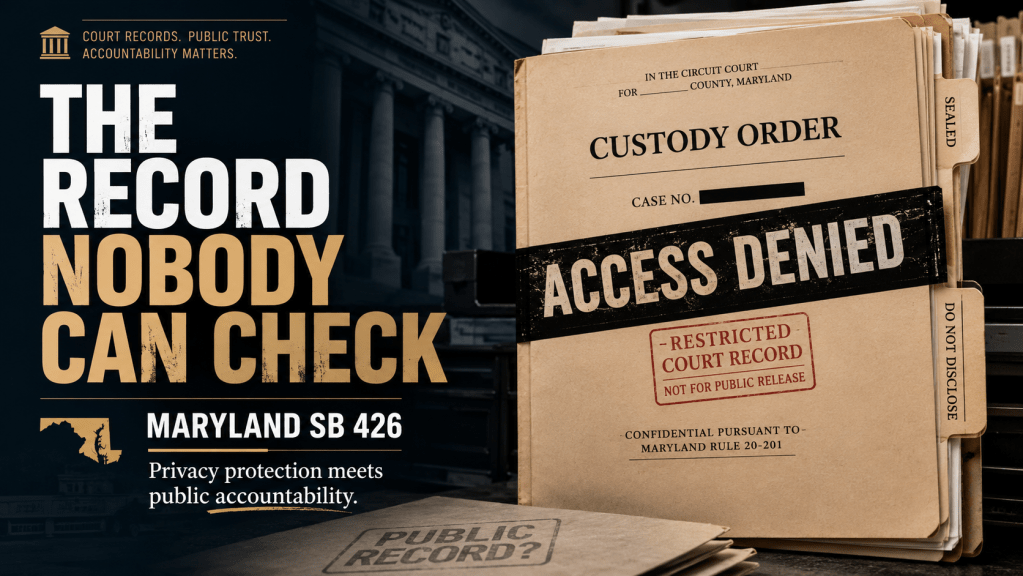
On August 4, the Maryland General Assembly overrode Governor Wes Moore’s veto of Senate Bill 426. The override was unanimous in both chambers — a rare thing in Annapolis, and a signal of just how sympathetic the underlying case was.
The bill’s origin story is straightforward and genuinely ugly. A constituent of Senate Bill 426’s sponsor, Sen. Charles Sydnor III (D-Baltimore County), had her divorce records posted online. The documents became ammunition in a harassment campaign against her and her ex-partner. Governor Moore, in his veto letter, didn’t dispute that it happened or that it was serious. He vetoed the bill anyway, arguing the fix was broader than the injury — that Maryland already had tools to shield sensitive filings case-by-case, and that a blanket exemption under the Maryland Public Information Act risked “curtailing public oversight of additional types of legal cases and judicial rulings in the future.”
The legislature disagreed, and as of the override, SB 426 requires that public records requests for divorce applications, financial and settlement records, and custody orders be denied under the PIA. Final divorce decrees remain accessible. Everything else is now released only to a party in interest, that party’s attorney, or someone authorized by a court order.
That’s the mechanism. Here’s the structural problem underneath it.
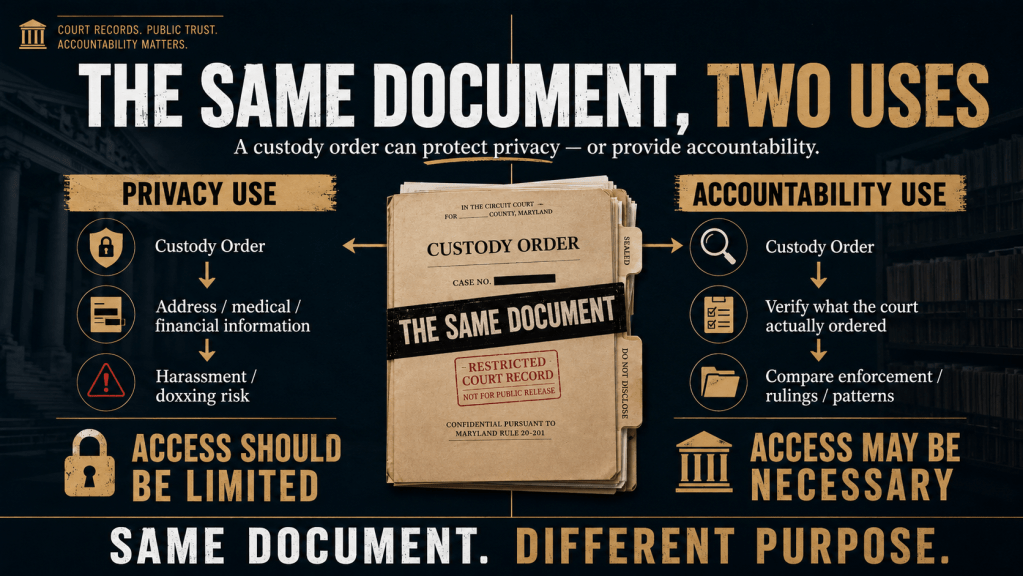
A sealed custody order protects the parent whose address, income, or medical history would otherwise end up screenshotted into a harassment campaign. It also protects the judge who signed off on a forged order, the evaluator whose recommendation never got checked against the record, and the parent — either parent — whose non-enforcement complaint depended on being able to show what the order actually said.
Run the swapped-jerseys test on it: does it matter whether the person seeking the record is a mother trying to prove her ex forged an amended custody order, or a father trying to prove the court never actually granted the visitation he’s been denied? No. The statute doesn’t ask who’s asking or why. It closes the file for the stalker and the watchdog in the same motion, because it was never built to tell them apart.
It closes the file for the stalker and the watchdog in the same motion, because it was never built to tell them apart.
That’s not a design flaw unique to SB 426. It’s the same shape as the harm it was written to fix. The original problem was a document with no gatekeeping — anyone could pull it, including people with bad intent. The solution has no gatekeeping either — now almost no one can pull it, including people with legitimate, adversarial-to-the-court reasons to need it.
The statute’s carve-out — party, attorney, court-authorized person — is built around active litigants in a single case. It has no lane for the use case that actually catches systemic failure: pattern analysis across many cases. A journalist verifying whether a specific custody order was forged, as in a case we’ve covered, isn’t a person in interest. Neither is a researcher trying to establish whether a jurisdiction’s non-enforcement problem is isolated or structural. Neither is an appellate attorney trying to show a judge’s rulings follow a pattern across dockets rather than the facts of any one case.
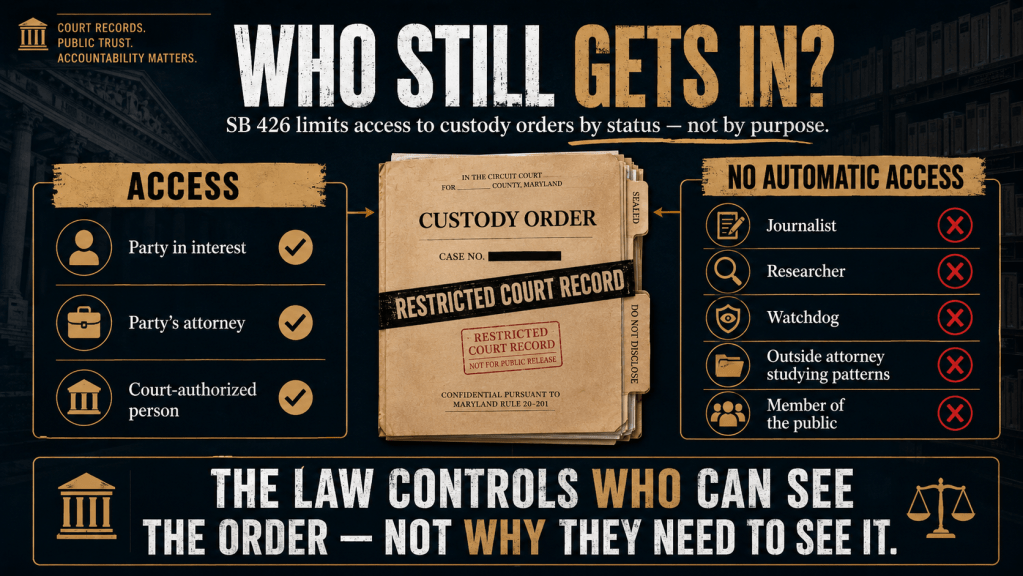
It has no lane for the use case that actually catches systemic failure: pattern analysis across many cases.
Governor Moore’s veto letter made a version of this point from the institutional side: the state already routes sensitive filings through the Maryland Rules on Access to Judicial Records rather than a blanket PIA exemption, and that existing framework lets a judge weigh the privacy harm against the public interest on a document-by-document basis. SB 426 replaces that weighing with a default. The default is closed.
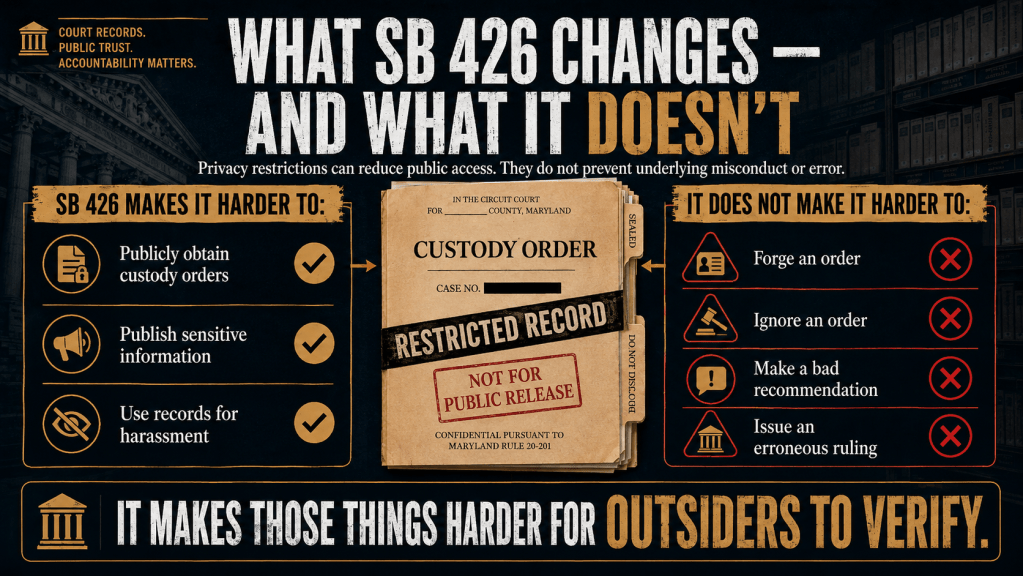
Nothing about SB 426 makes custody orders harder to forge, evaluators harder to pressure, or enforcement gaps harder to create. It makes all three harder to catch, because it removes the paper trail that catching them requires. The people positioned to exploit a closed system — inside it, with standing, with counsel — keep their access. The people positioned to expose it from outside lose theirs.
Maryland had a real privacy problem. It solved it by removing the record that would tell you whether the court solved anything else correctly.
This is the same seam we’ve flagged before under different statutes: a rule written to solve one failure mode, with no differentiated exception for the accountability mechanism that catches the other one. Maryland had a real privacy problem. It solved it by removing the record that would tell you whether the court solved anything else correctly.
Sources: Maryland Senate Bill 426 (2026); Gov. Wes Moore veto letter, May 22, 2026; Maryland General Assembly special session override, Aug. 4, 2026, reported by Maryland Matters and The Daily Record’s Maryland Family Law section.

Father & Co. offers non-legal document review and organization for people representing themselves. This includes clarity, structure, neutral tone, and timeline organization — not legal advice or representation.
Submissions are reviewed with care and discretion. We respect privacy and handle sensitive information responsibly.
Comments
Nothing yet. Say the first thing.
Sign in to join the conversation.