

Prenuptial and postnuptial agreements decide who keeps what when a marriage ends. Whether either party gets real protection while signing one depends less on fairness than on which state they happen to marry in — and that gap rewards whoever already has the resources to work it.
Two people get married in the same year, in the same country, under what looks like the same law. One of them signs a document that legally requires their state to make sure they had their own lawyer, seven days to review the terms, and full financial disclosure before their signature counts. The other signs a document governed by nothing but common-law contract principles — no independent counsel requirement, no waiting period, no statutory floor of any kind. Both documents are called a prenuptial agreement. Both are enforceable. Only one of them was built to protect the person with less leverage.
That split isn’t hypothetical, and it isn’t rare. It’s the baseline condition of marital contracting in the United States.
“Both documents are called a prenuptial agreement. Both are enforceable. Only one of them was built to protect the person with less leverage.”
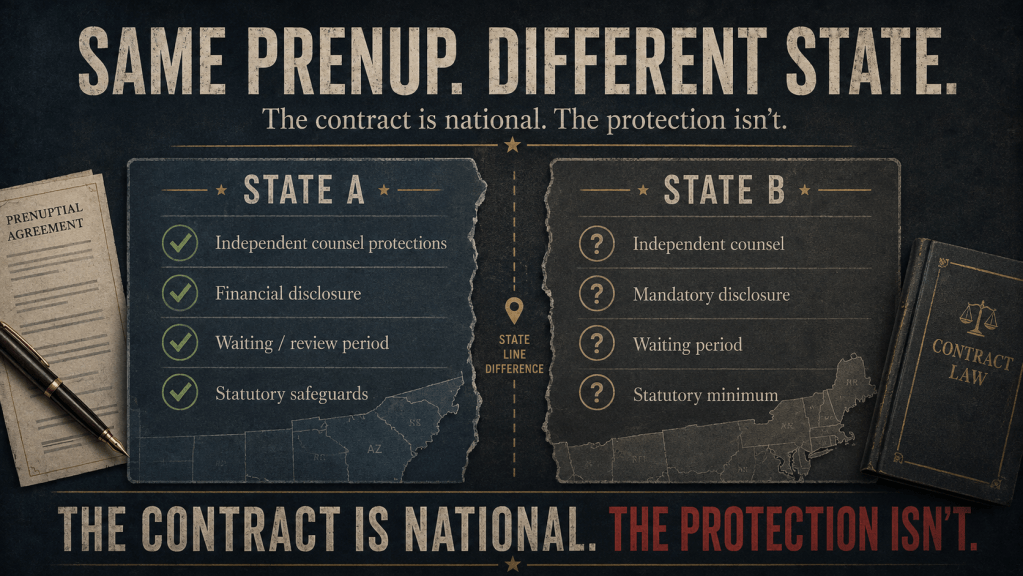
Prenups get talked about as if they’re a solved, standardized legal product — something anyone can walk into a lawyer’s office and get, with predictable rules attached. The recognition part is true: prenuptial agreements are legal in all fifty states and Washington, D.C. The predictable-rules part isn’t. Roughly twenty-nine states plus D.C. — the exact count creeps up slightly year to year as more legislatures adopt it — have adopted the Uniform Premarital Agreement Act or its successor, the Uniform Premarital and Marital Agreements Act, the model law meant to give these contracts a consistent floor of procedural protection. That leaves roughly twenty states running on whatever their courts have pieced together from general contract doctrine, one contested divorce at a time.
“Recognized in all fifty states” is true and almost beside the point. A contract can be legal everywhere and still be built with real teeth in twenty-nine states and built on sand in twenty-one.
Even inside the twenty-nine states that adopted a uniform framework, the framework isn’t uniform in practice. The UPAA has brought only limited consistency, because a substantial number of states haven’t adopted it, many that have adopted it changed it significantly, and courts in different states have interpreted its core provisions differently. Some states, like California, go further than the model law requires: California’s version mandates that each party be represented by independent legal counsel — or expressly waive that right — before a spousal-support waiver in a prenup can be enforced, on top of a seven-day review requirement and a duty of full financial disclosure. Other adopting states impose none of that. The label “UPAA state” tells you almost nothing about how much protection a person actually gets before they sign.
“A contract can be legal everywhere and still be built with real teeth in twenty-nine states and built on sand in twenty-one.”
If prenups are inconsistently protected, postnuptial agreements — the version signed after the wedding, inside an existing marriage — are protected almost nowhere. The power imbalance that can produce a coerced signature doesn’t go away once the rings are on; if anything, it gets sharper, because now there’s a marriage, and often a household and children, on the table as leverage. The law has been slow to catch up to that.
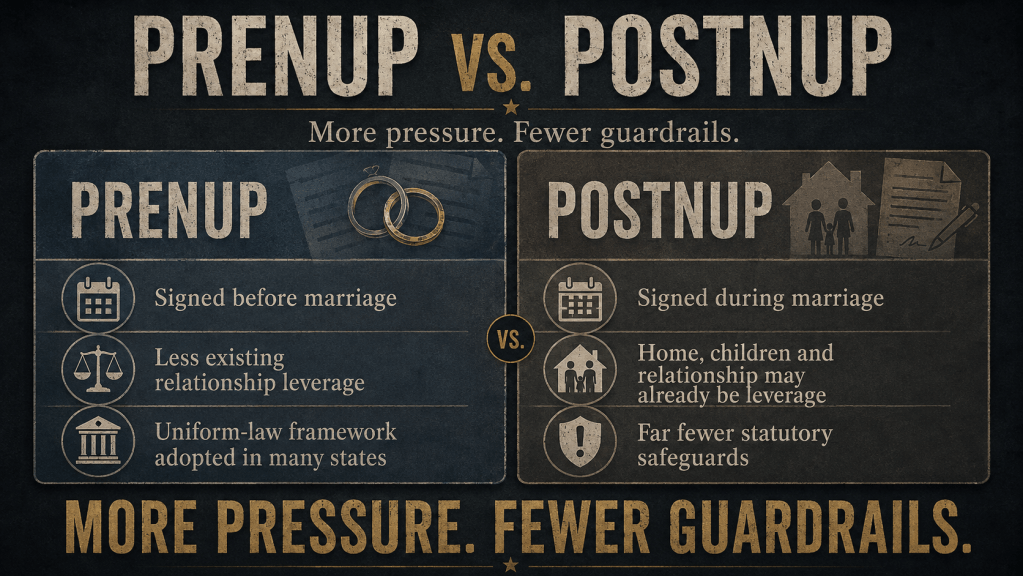
Only two states — Colorado and North Dakota — have adopted the newer Uniform Premarital and Marital Agreements Act, the version that extends real anti-coercion procedural safeguards to postnuptial agreements the way the original UPAA did for prenups. Colorado’s version has applied to agreements signed there since July 1, 2014, under C.R.S. § 14-2-303; North Dakota adopted it the year before. No other state has followed. Everywhere else, a postnup is negotiated and signed with less statutory protection than the prenup that preceded it, even though it’s the agreement most likely to be shaped by pressure that’s already inside the relationship rather than outside it.
“The contract signed under the most relationship pressure is, nationally, the one with the thinnest legal guardrails.”
That’s not a footnote. It means the contract signed under the most relationship pressure is, nationally, the one with the thinnest legal guardrails.
The doctrine that’s supposed to catch the worst cases — the escape hatch when a prenup was signed under real pressure or real information asymmetry — is unconscionability. It shows up in nearly every state’s case law in some form: an agreement can be voided if one party was pressured to sign, didn’t receive full financial disclosure, lacked independent legal counsel, or if the terms themselves are grossly one-sided.
A recent New York case shows what that actually looks like when it plays out, and it cuts against the assumption that this is a women’s-only issue. In J.M. v. G.V., 87 Misc. 3d 171 (Sup. Ct., Kings Co. 2025), the husband moved to set aside the couple’s prenuptial agreement — signed roughly a week before their 2018 wedding — as unconscionable, fraudulent, and the product of overreaching. He had entered the agreement without independent counsel; the parties disputed their financial pictures at the time, with the husband putting his own net worth at roughly $27,000 against a wife whose net worth he placed at $455,000. The facts track the exact pattern the doctrine is built to catch — but the sex of the disadvantaged party is irrelevant to whether the pattern is real. Unconscionability doesn’t ask who wore which jersey. It asks who had the money, who had the lawyer, and who had the leverage when the document was signed.
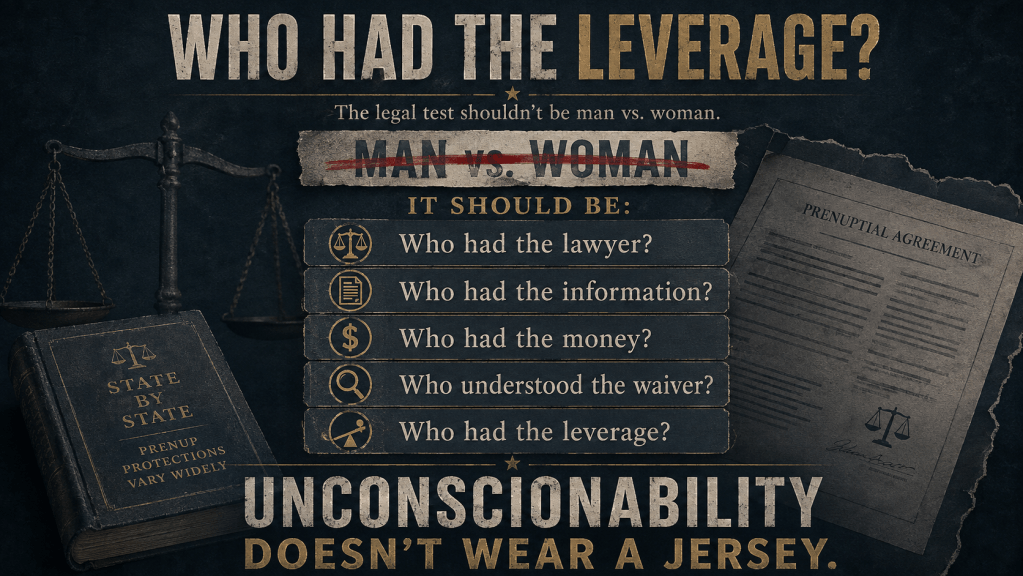
The court didn’t just entertain the argument — it used the case to set new precedent on exactly the disclosure gap this piece is about. Justice Jeffrey Sunshine held, as a matter of first impression, that a self-represented spouse must be given the actual presumptive dollar calculations of the maintenance they’re waiving before that waiver can be treated as knowing and voluntary. In other words: New York’s courts have now recognized, in this one ruling, that a spouse without a lawyer can’t meaningfully waive a financial right they were never shown the numbers on. That’s the disclosure floor this piece has been describing — built by a single trial judge, case by case, in the one state where the dispute happened to land, rather than guaranteed nationally before anyone signs.
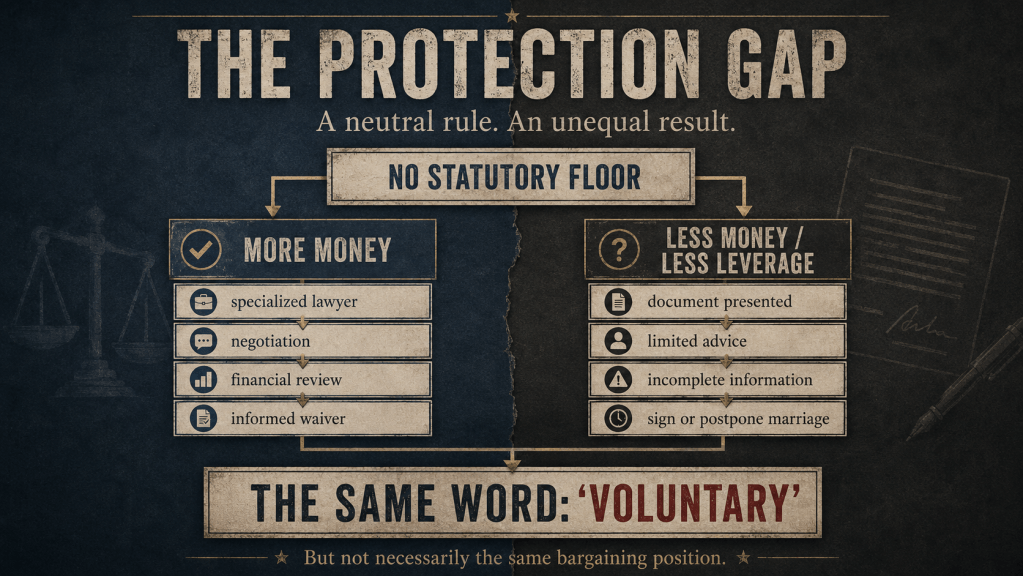
None of this requires anyone to have written a biased law. The rule in most states — “premarital agreements are enforceable contracts, evaluated under general principles of fairness” — is facially neutral. It doesn’t name a gender, an income bracket, or a class of person. That’s exactly the problem.
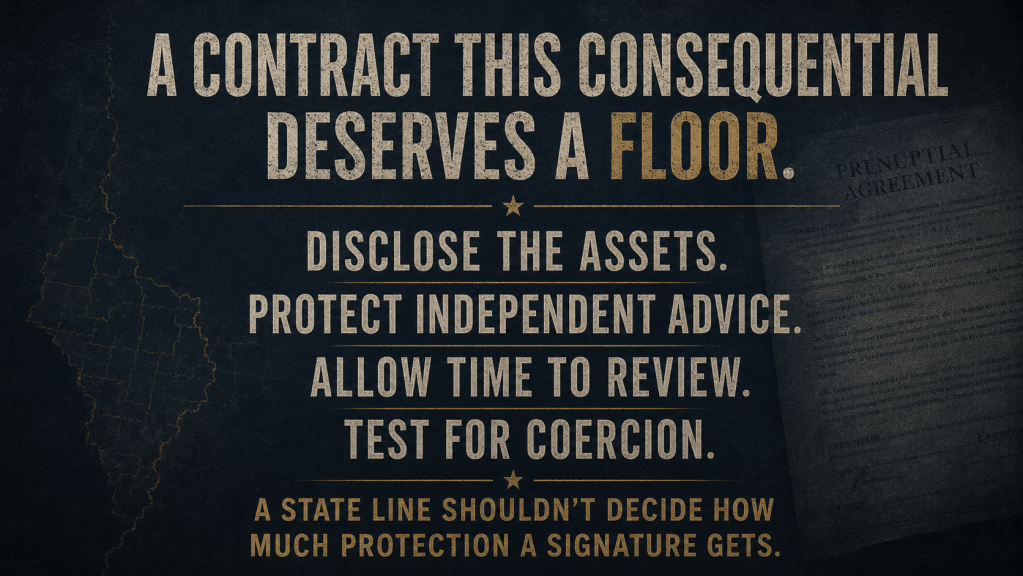
A neutral rule with no floor underneath it doesn’t produce neutral outcomes. It produces outcomes that track whoever already has the resources to act on the rule effectively: the spouse who can afford specialized counsel, who knows to insist on independent representation even where it isn’t required, who can afford to negotiate rather than sign what’s put in front of them a week before the wedding. In a state with no independent-counsel requirement, nothing stops one spouse’s attorney from drafting the entire agreement while the other spouse signs it cold. In a state with no disclosure floor, nothing forces either party to show their full financial picture before the other agrees to waive a claim on it. The rule doesn’t discriminate. The absence of the rule does the work instead — and it does that work in favor of whoever needed the least protection to begin with.
“The rule doesn’t discriminate. The absence of the rule does the work instead.”
This is worth naming because it’s easy to describe patchwork state law as a technical curiosity — the kind of thing that shows up in a “know before you sign” listicle rather than a structural problem. It isn’t technical. It’s the difference between a spouse walking into a marriage with an enforceable right to information and independent advice, and a spouse walking in with neither, based entirely on which state line they happened to be standing on.
This gap is getting more consequential, not less, because far more people are exposed to it now. Prenups have moved well past their old reputation as a wealth-preservation tool for the already-rich. Millennials and Gen Z are getting them at rates their parents’ generation never approached, and that shift shows no sign of reversing. Every year the practice becomes more mainstream, more people sign a document whose actual protections are determined by an accident of geography rather than by any deliberate national standard.
“A contract that decides who keeps the house, who owes support, and who walks away with nothing is not a minor administrative document.”
A contract that decides who keeps the house, who owes support, and who walks away with nothing is not a minor administrative document. It deserves the same floor of protection everywhere it’s signed. Right now, it doesn’t have one — and the gap isn’t neutral. It never is.
Sources: State-by-state adoption of the Uniform Premarital Agreement Act (UPAA) and its 2012 successor, the Uniform Premarital and Marital Agreements Act (UPMAA), drawn from the Uniform Law Commission’s enactment history and cross-checked against a 2025–2026 Michigan Senate bill analysis; Colorado’s UPMAA adoption confirmed via C.R.S. § 14-2-303 and Linda J. Ravdin, “Premarital Agreements and the Uniform Acts,” Family Advocate, ABA Family Law Section (2017); California’s independent-counsel and disclosure requirements under Family Code § 1615(c); and J.M. v. G.V., 87 Misc. 3d 171 (Sup. Ct., Kings Co. 2025), 2025 NY Slip Op 25004, with case background from the New York State Bar Association’s case analysis, “Presumptive Calculations of Waived Maintenance: A Case of First Impression.”

Father & Co. offers non-legal document review and organization for people representing themselves. This includes clarity, structure, neutral tone, and timeline organization — not legal advice or representation.
Submissions are reviewed with care and discretion. We respect privacy and handle sensitive information responsibly.
Comments
Nothing yet. Say the first thing.
Sign in to join the conversation.