
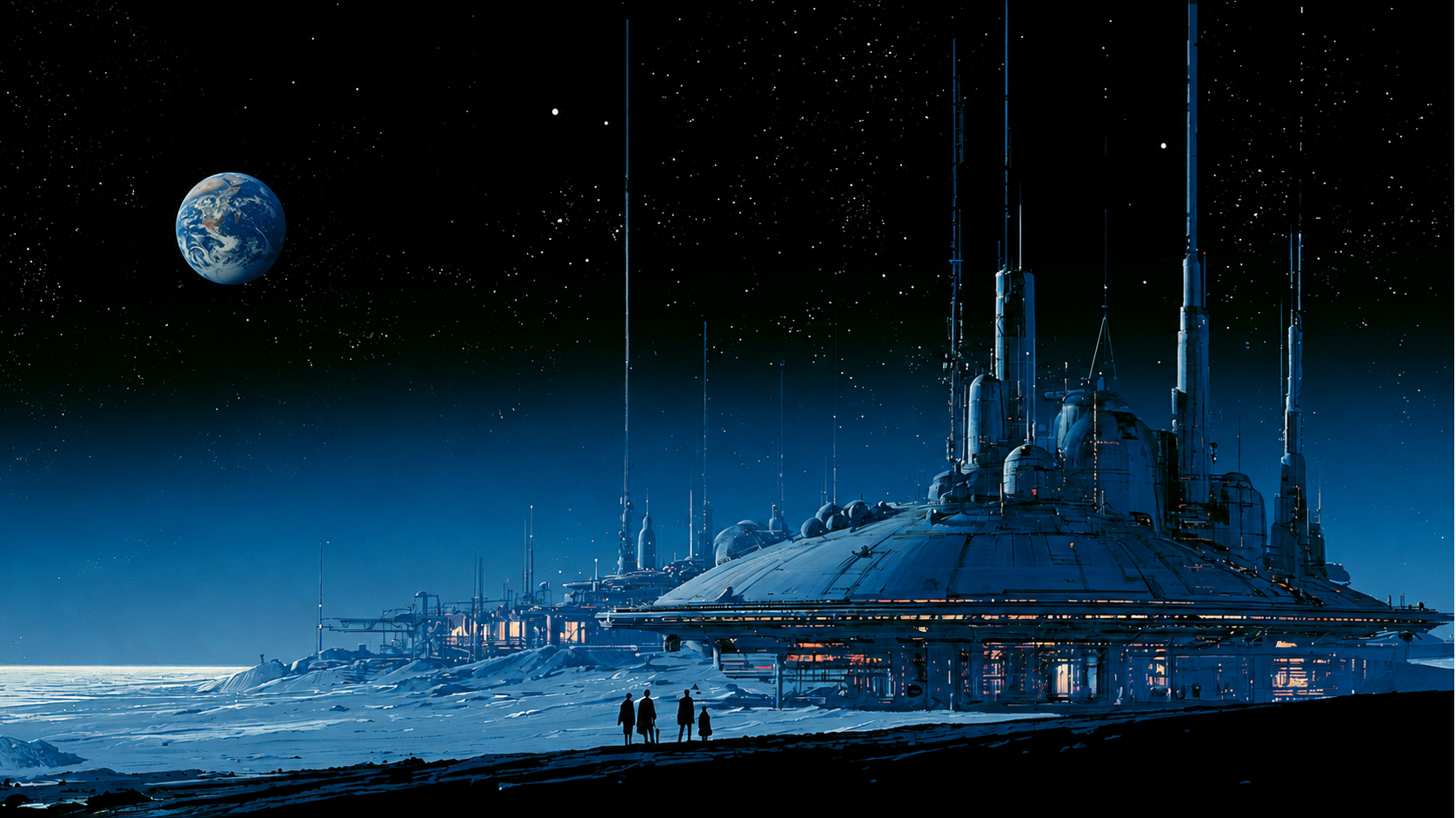
Thanks in large part to the massive drop in the cost of getting a pound or kilogram of stuff into orbit and beyond, many of the boldest Space Age dreams are now possible. The business of space makes economic sense like never before. And here comes the AI Revolution to really give the sector a boost.
Today, on Faster Please!—The Podcast, I am joined by Phil Metzger. Phil is a professor of planetary science at the University of Central Florida and director of its Stephen W. Hawking Center for Microgravity Research and Education. Before joining UCF, Phil spent nearly 30 years at NASA, where he worked as a senior research physicist. (I also highly recommend his X account.)
In this episode, we talk about why AI has made the economics of space work by providing a “killer app,” what the first off-world industries might look like, what obstacles we still have to overcome to make them viable, and what the long-term future holds.
In This Episode:
The economics of space (0:49)
Industries launching in space (7:36)
Cutting space expenses (11:31)
How do we start? (16:55)
Dealing with lunar dust (22:31)
What does the future hold? (29:31)
A lightly edited transcript of our conversation will appear in my Week in Review issue on Saturday. (Another option is using the Substack auto transcript function.)
But here are some edited highlights from the chat:
On orbital and lunar manufacturing…
We have a lot of work to do. But it isn’t gonna require any new physics. It’s just gonna be industrial engineering, aerospace engineering, civil engineering on the moon, and a straightforward effort to do it. And so we’ve got to spend the effort building these technologies. But there are already companies getting ready to build commercial space stations in low Earth orbit. There are companies getting ready to start launching data centers in space. I believe that once that begins to expand and grow, the economics of space in every sector of the space industry will be pulled upward by the huge economic value of AI.
On how the case for AI is the case for space…
We were hoping that Mars settlement would drag up the entire in-space industry. I ran models on Mars settlement, and I believe it’s very doable. But the new thing now is AI. AI swept in like a storm two, three years ago. Suddenly everybody woke up and realized, “No, this is the killer app for space.” Elon immediately started talking about “Mars is gonna have to wait a couple years because we’re gonna do the moon right away.” And it’s all because of AI. So AI has changed our whole assessment of the business case for space.
On the economics of orbital data centers…
The amount of throughput of spacecraft hardware will be so gigantic that there will be this huge motive to shorten the supply chains and move more industry closer to the launch pads. And then the workforce we’re gonna need is gonna grow gigantically. Maybe we’ll do AI and robotics, but there will be an opportunity for huge growth in the labor force. So I think governments, universities, everybody in industry and in finance needs to get ready for this tidal wave that’s about to sweep through. …
So in Elon’s mind, the issue is the demand for AI will keep growing, and it’ll grow so fast that you can’t build the data centers fast enough and you can’t launch them off the earth fast enough.
It’ll be a logistics problem and a supply chain problem. [Musk] hasn’t said this, but I will add, it will be an atmospheric protection issue. If you start launching too fast, then it does cause some cumulative damage to the atmosphere. The atmosphere will heal pretty quickly, so it’s not long-term damage from rocket launch. But I believe there will be political pushback when people see gigantic rockets launching every hour, hour after hour, 365 days a year, from 50 launch sites around the world.
So Elon’s idea was we’re gonna have to build these AI systems on the moon using lunar resources, and we don’t need to launch them off the moon with rockets because the moon doesn’t have an atmosphere. We can just shoot them off the moon with a railgun. They call it a mass driver in that context.
On lowering launch costs…
We’re expecting launch costs to go from—right now they’re like $1,500 or $2,000 per kilogram to low Earth orbit—we’re expecting it to go down to like $35 per kilogram in 30 years, and that’s a conservative estimate.
On the future of humanity in space…
Most people don’t know this, but there are at least 150 planet-sized objects in our solar system. Most of them are dwarf planets far away. But the moons are amazing worlds, and pretty soon we’re going to have buildings being constructed. We’ll have architects designing buildings for the environment of Titan. I can’t imagine what beautiful architecture will be developed. Once we’ve got an abundance of robotics driven by AI, then we’re not gonna be doing things on the cheap. We won’t have to. And so we’ll be able to make beautiful cities on all these worlds. We’ll be bringing beautification to all these planetary bodies throughout the solar system.
On sale everywhere: The Conservative Futurist: How To Create the Sci-Fi World We Were Promised
Comments
Nothing yet. Say the first thing.
Sign in to join the conversation.