
Americans are gloomy about the future (even one without ubiquitous data centers, it seems). And of the 59 percent of us who say our country’s best years are behind us, at least according to Pew Research polling, I would guess some significant number actively fear what tomorrow might bring.
Not that I blame them a whole lot, really. For years, climate alarmists have warned that global warming risks ecological and civilizational collapse—that, unless we learn to live less well. Not surprisingly, given the decades-long Down Wing drumbeat, 71 percent of young Americans in a 2021 Lancet survey said climate concerns made the future “frightening” for them, while 48 percent believed “humanity is doomed.”
The emerging Age of AI doesn’t seem to have helped their mood. A new Pew Research survey finds 55 percent of young American adults saying they are “more concerned than excited” about the increased use of AI in daily life, with just 10 percent feeling the opposite. But why should they feel excited when AI company CEOs and other executives of the San Francisco Consensus keep making absurd claims about looming, massive socioeconomic disruption, not to mention existential risks?
It’s a core Faster Please! belief that what we as a society believe about the future matters. Progress requires disruption—you might call it “creative destruction”—and if people don’t believe the disruption will be worth the trouble, if they cannot imagine or believe in a happy ending, then they will oppose it.
Or to put it another way: If you want a world of greater prosperity and opportunity, futurist Herman Kahn wrote back in the 1970s, “the single most important thing that could be done would be to substitute reasonably accurate positive images of the future for the depressing images that now prevail, especially in the Advanced Capitalist nations.”
Our political leaders aren’t providing such images. Silicon Valley CEOs aren’t providing such images. Hollywood isn’t providing such images.
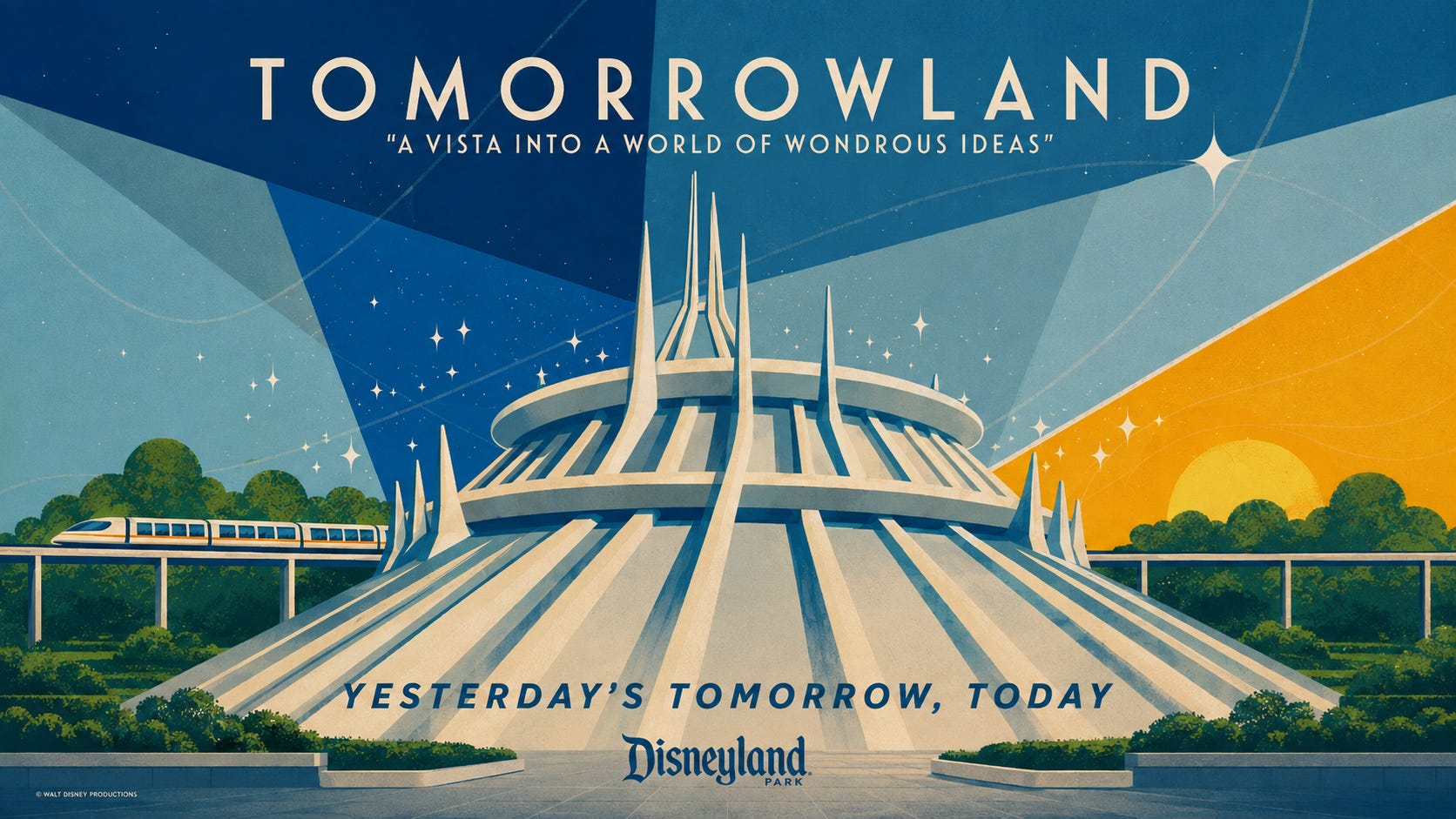
Maybe Disneyland can. It did so during America’s postwar Up Wing 1.0 period, and maybe it can do so again. At the House of Mouse’s recent D23 fan convention, the entertainment conglomerate announced a large-scale overhaul—or “reimagining,” in the words of one executive—of Tomorrowland at the original Disneyland theme park in Anaheim, California. Exactly what Disney plans on doing remains unclear, but this bit of Los Angeles Times reporting gives some sense of direction:
“Today, Tomorrowland is home to a number of popular attractions — Space Mountain, Star Tours and Autopia among them — but is also littered with underutilized buildings and a dead PeopleMover track. The latter closed soon after Tomorrowland’s 1998 refresh as the Rocket Rods, one of the shortest-lived rides in Disneyland history. The reimagined Tomorrowland, said Imagineer Emily “Emo” O’Brien, won’t ignore its history, noting the team has been researching Disney’s original thesis. “We were inspired by his vision of Tomorrowland being a vista into wondrous worlds, and we really garnered the sense of optimism that was at the core of everything he was thinking about.” And yet the future Tomorrowland will have “new attractions for sure,” said O’Brien, as well as more open, breathable spaces for guests. “We really want to keep the heritage and the responsibility to honoring that legacy at the center, but we have to evolve it for our new generations,” O’Brien said.”
The tagline of the promotional image (reproduced at the top of this newsletter) released by the company may also offer a clue into its thinking: “Yesterday’s Tomorrow, Today.”
I’m not a “Disney adult” superfan. I’ve been to Disneyland twice in the past 30 years, including a visit a few years ago, and I’ve never been to Walt Disney World in Florida. But I have a great interest in the company started and built by a person I describe in the first chapter of my 2023 book as “perhaps the most important American futurist of the twentieth century.”
That first chapter of that book, by the way, is titled “America’s Tomorrowland Problem.” I use the creative stagnation of a theme land meant to be, in Walt’s words, a “vista into a world of wondrous ideas” and “[a] step into the future, with predictions of constructive things to come” as a way of tackling a much bigger issue: the shocking decline of America’s ability to imagine a better future and then go build it.
Long story short: Walt wanted Tomorrowland to be forward-looking yet practical forecast of how the next 30 years might play out.1 The theme land’s star attraction when Disneyland opened in 1955 was Rocket to the Moon. Marking its entrance stood the Moonliner, a seventy-six-foot spacecraft gleaming white with red striping and the logo of sponsor Trans World Airlines. The ride itself, housed in a circular theater behind the rocket, simulated a round-trip lunar voyage in the near future.
By the mid-1960s, however, Walt and his Imagineers realized they had a “Tomorrowland problem.” With Project Apollo in full swing and many of the innovations showcased in the theme land’s exhibits—such as the microwave oven in the Monsanto House of the Future—beginning to make their way into American homes, Tomorrowland was starting to seem more like, in Walt’s words, “Todayland” or “Yesterdayland.” Technology was advancing so rapidly that Tomorrowland would need regular and expensive updates or risk looking dated and dowdy.
But within a decade, Disney’s Tomorrowland Problem flipped, which I describe thusly in my book:
By the early 1970s, the Space Age was grounded, the Atomic Age began powering down, and most importantly, the postwar “golden age” of rapid technological progress and economic growth abruptly ended. And Disneyland found itself with a different sort of Tomorrowland problem. Rather than struggling to stay 15 minutes ahead of a fast-accelerating technological present — the theme land was supposed to be grounded in reality — Tomorrowland now lacked a dynamic private-sector economy and big-thinking Washington to supply it with just-around-the-corner concepts to build upon and extend. If not ringing the Earth with space stations and populating the Solar System with colonies, perhaps the Next Big Thing after Apollo could have been a massive and aspirational project devoted to advanced energy, biology, or transportation. But there was nothing anywhere near the scale of Apollo. Tomorrowland was neither pushed by the technological reality of today nor pulled by the technological possibilities of tomorrow.
Disneyland has spent the past half century unsure what to do with Tomorrowland. The revamp announced at D23 is only the latest attempt, including an ill-advised (and mostly superficial) retro-futurist or steampunk phase in the 1990s. Space Age blue and white gave way to bronzes, golds, and dark browns. Space Mountain itself was repainted bronze, to the lasting consternation of Disneyland fanatics. The makeover’s flagship was Rocket Rods, a high-speed ride grafted onto the old PeopleMover track. It lasted barely two years, and the track has hung empty over Tomorrowland ever since. More recently, Disney has settled for a mashup of Disney’s Star Wars and Pixar franchises alongside Autopia, which has been there since 1955.
There’s an opportunity here—a need, really—for a revamped Tomorrowland to deliver on Walt’s original vision of presenting a realistic and inspiring near-future America that Disneyland visitors—a combined 35 million a year across Anaheim and the Magic Kingdom—would want to live in and be inspired to build.
Disney’s Imagineers have plenty of real-world material to work with. A Wall Street Journal story from last April, “Five Amazing Tech Innovations We Should Expect in the Next 25 Years,” highlighted a few of them: devices controlled by the mind, space mining, humanoid robots in the home, private weather control, and nuclear fusion.
Maybe frame the whole thing around the world of the American Tricentennial in 2076 and include lunar vacations, orbital factories, national parks populated by de-extincted animals like the woolly mammoth and giant ground sloth, and, critically, a depiction of a world where AI enhances rather than undermines the human experience. (My concern is that the “Yesterday’s Tomorrow, Today” tagline hints at a whimsical, Jetsons-kind of thing, another stab at a “future that never” theme. No thanks.)
There’s a lot to work with, but what’s needed is a vision to connect all these elements into a friendly and humane Up Wing World. Why not hire For All Mankind co-creator Ronald D. Moore to consult, along with Brad Bird, director of Disney’s own 2015 film Tomorrowland, which beautifully depicted a pocket universe where all those 1960s dreams came true. (Oh, yeah, there were jetpacks. Of course there were/)
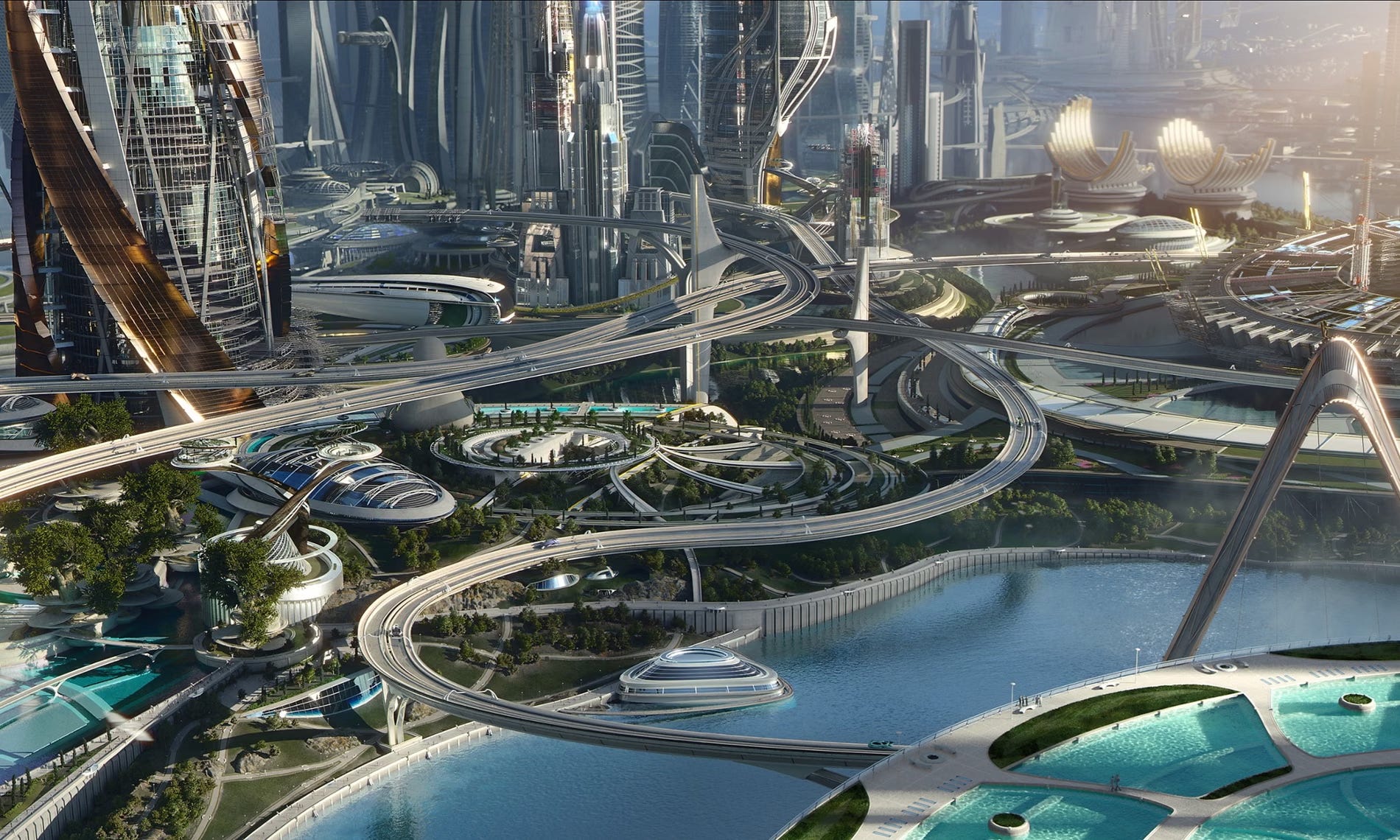
Tomorrowland the movie didn’t do well at the box office (although it did make my recent “The 7 most Up Wing films from Disney/Pixar this century” list), but the sort of future it depicts now seems more doable, at least technologically. I also think doomerism only goes so far, and people would welcome ideas that show how all this all can work out, both down here and up there. It’s something we need a whole lot more than we do a zippy new ride based on Toy Story 7 or The Incredibles 5.
Tomorrowland it got its true start as a series of episodes on the Walt Disney’s Disneyland anthology series that debuted on ABC in 1954. The prime purpose of the weekly program was as a funding source Disneyland itself. But the show was also a promotional tool, with each episode thematically linked to one of the then under-construction sections. The Davy Crockett mini-series in season one, for example, represented Frontierland. But Walt was scrambling for a strong Tomorrowland idea and assigned Walt Kimball, one of Disney’s original “nine old men” of core animators, the task of finding one.
As film critic Neal Gabler writes in his biography of Walt Disney, Kimball just happened to stumble across “Man Will Conquer Space Soon!,” a lavishly illustrated and scientifically accurate series on space exploration in Collier’s magazine, written by three of the world’s leading experts: Von Braun, Willy Ley, and Heinz Haber. Disney then hired the three engineers to help produce as well as appear in a three-part miniseries, including the animated Man in Space. That episode was later shown in theaters and nominated for an Academy Award in the Best Documentary Short category.
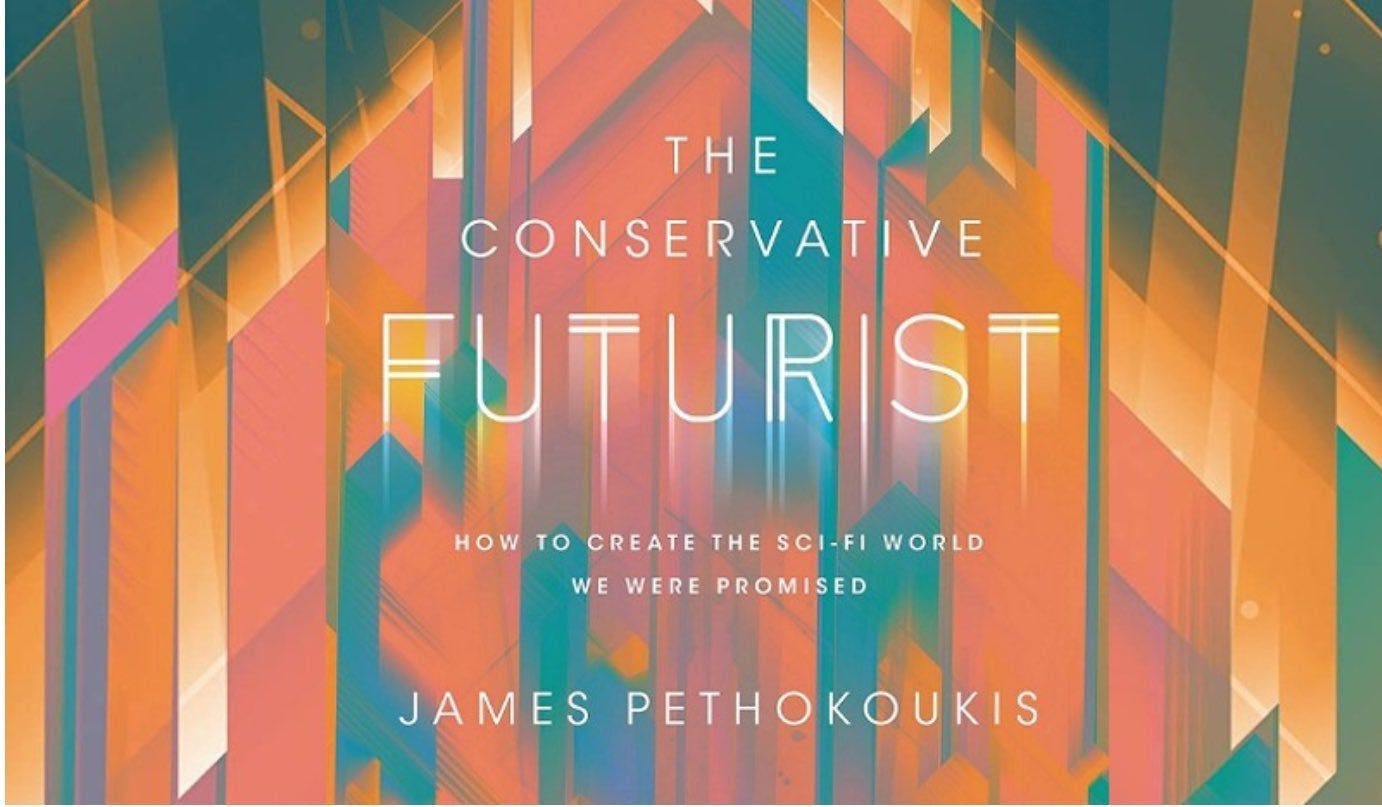
On sale everywhere: The Conservative Futurist: How To Create the Sci-Fi World We Were Promised
Comments
Nothing yet. Say the first thing.
Sign in to join the conversation.