
A few weeks ago I put out a poll to my subscribers asking about their favourite RPGs and their opinions on various aspects of superhero RPGs. I did this to satisfy some ideation I had been having around the topic and to give myself at least some data to work from in that realm. The result was between 33 and 35 people responding to those poll questions thanks to Substack’s ridiculously restrictive policy on responding to a poll, a point of contention that is driving me to hopefully greener pastures in the near future.
So, armed with those replies and the data I so craved, allow me to wax statistical about the current attitudes of my audience with regards to the broader spectrum of superhero TTRPGs. By no means do the statistics that follow say anything definitive about supers RPGs or the overall attitudes of the TTRPG community.
First off, let’s establish the demographics at play.
Of the 34 respondents who offered such information, 19 of them were from the United States and 15 of them were from outside the US, with only 3 commenters specifiying their nationalities as Portuguese, Italian and Canadian. There’s also myself and a buddy of mine to account for as Irish. Of those 34 respondents, assuming they’re the same people, 7 were between the ages of 25 and 40. 26 were between the ages of 41 and 60, and 1 was over 60. Not one single respondent to that poll was below the age of 25.
Now, obviously that’s because there aren’t many 25-and-unders on Facebook or Substack, which is where I tend to share these articles. It does also line up, however, with the results of Bob World Builder’s poll over on YouTube that inspired mine. This doesn’t mean people in that age bracket aren’t playing these games, of course. More than likely, it just means that older demographics are more likely to spend time researching or seeking out advice for running games on the internet. The hubris of youth, eh?
So, the average superhero TTRPG player, at least in the estimation of this poll and the results I tabulated from Bob World Builder’s own, is an English-speaking individual between the ages of 41 and 60 who lives in the Northern Hemisphere. This is the exact same demographic trend that Bob pointed out in his original video. Not at all surprising, given this is a niche within a niche.
Also unsurprsingly, every respondent had played a superhero TTRPG, but the overwhelming majority (29 of the 35) had played more than one. What’s quite stark to me about that stat is that if you gathered 35 random TTRPG players in a room and asked them what games they played, you’d probably be lucky to get anybody say anything other than Dungeons & Dragons. So, to see such a broad spread of even a small sample size say that they’d played more than one game is quite the thing. What it shows to me is that either folks who play supers RPGs are just more willing to try multiple systems, or the systems that have existed for all this time have always left players in want of something more befitting of their personal tastes.
Such is probably true of most genre games. Where fantasy is the monolithic genre of TTRPGs where characters are easily archetyped and the tropes are all-pervading, other genres like horror, sci-fi and superhero tend to come from individuals with unique perspectives not only on the genres themselves, but on the approach to emulating that genre through design as well. It’s why you can have games like Champions and Masks co-existing within the same genre despite being wildly different approaches to the actual gameplay experience. This breadth of game availability is likely a blessing and a curse, as the variety can be just as daunting as it is encouraging, especially to prospective GMs. It can help, based on observations from these polls, to know how the majority of people are enjoying these games.
I tried to steer clear of directly asking what people’s favourite games were, and instead posed broader questions that warranted more introsepctive responses. I wanted to know exactly what it was that people wanted or expected to see in their ideal superhero RPG, rather than simply asking what that game was.
As it shook out, the results were quite intriguing. In response to the question, “Which of these words best describe your favourite RPG?” only 9% of the 34 responses (about 4 people) said that words like “tactical” and “crunchy” best described their favourite RPG. Note here that I also specified in the question that it need not be a superhero game being referred to in their answer. On the flipside, 88% of the 34 respondents (about 30 people) used words like “narrative” and “cinematic”. The remaining 3% would have used a different word, but they didn’t leave a comment when prompted, so we’ll never know how they’d describe their favourite RPG.
This result intrigued me as well, as I have typically seen the opposite sentiment arising in discussions surrounding superhero RPGs. More often than not, games like Champions or the HERO system from which it was derived tend to be lauded as the pinnacle of superhero games, with Mutants & Masterminds also typically entering the conversation. From my experience, these are crunchy games that emphasise and reward tactical play in much the same way that Dungeons & Dragons does. They are games that emerged out of much the same war-gaming culture and attitudes that birthed D&D, and their longevity in the TTRPG space and likely popularity among an audience broadly consisting of people in their 40’s and 50’s would suggest that their traits as games would win out in a question like this one. The contrary is true.
Apparently, my audience prefers games that lean more into the narrative and cinematic style of play, though granted they may not think that superhero games should fit such descriptors. This suggests to me that these are people who prefer to play either in theatre of the mind or at least are quite heavy on their roleplay and individual narration during game sessions, minis and terrain be damned. In other words, these are people who don’t like math all that much and would rather the system handle all the jank on the back-end while they do all the cool stuff in the game proper. It’s worth noting here, these are also matters that can change and shift depending on your game master, and aren’t system exclusive. Though I will say that I’m probably jumping the shark a bit.
In response to what they’d most expect to see in a superhero game, the vast majority of responses (70%) said “broad character customisation,” with the next highest response being “soap opera narratives” (27%). With games like Champions and M&M, I know that much of the appeal comes from the customisability. While the games themselves differ drastically in terms of gameplay, their main focus is on a lot of front-loaded character creation mechanics for the purposes of faster gameplay during actual sessions.
Conversely, a game like Masks offers hyper-specific character archetypes and a narrow window of customisation for each, with the intent being to focus more on the character and less on their abilities during play. There is a lot of intent within the design of all of these systems, and they’re all trying to do completely different things. However, when coupled with some of the results from Bob World Builder’s poll, where Champions and M&M came out at 18 and 22 votes ahead of Masks respectively, it’s entirely within the realm of possibility that Masks’ restricted approach to character creation is exactly why it isn’t as popular within the superhero TTRPG space. That and it’s even greater niche of being a teen superhero drama game. That’s the soap opera bit, you see?
To recap what we’ve gotten so far: The typical supers RPG player is someone between the ages of 41 and 60 within the northern hemisphere who likes games that offer broad character customisation options and that support narratively impactful cinematic gameplay in their TTRPGs.
It’s likely my fault for not including it as an option, but it’s honestly quite baffling to me how often the term “cinematic” is used in conversations describing games belonging to a genre that, up until very recently, was rooted entirely within a completely different visual medium. Superheroes are the stuff of comics and cartoons to me, and it remains those formats where the genre shines best.
To me, this is where Marvel Multiverse has the edge on so many other supers systems, as it is designed specifically with the intent of giving players that Marvel feel, especially as it pertains to comics. Fantastic successes during play often have the weight of splash pages, and combats typically break down like a super-powered battle unfolding over the course of a few pages of an issue. I’ve said it before in passing and I should probably dive into it further, but TTRPGs and comics are unique in their ability to control the flow and perception of time in the universe of their story. The approaches may be different, but the end result is often quite similar. Like I said, it’s a talk for another time, but it’s a talk nonetheless.
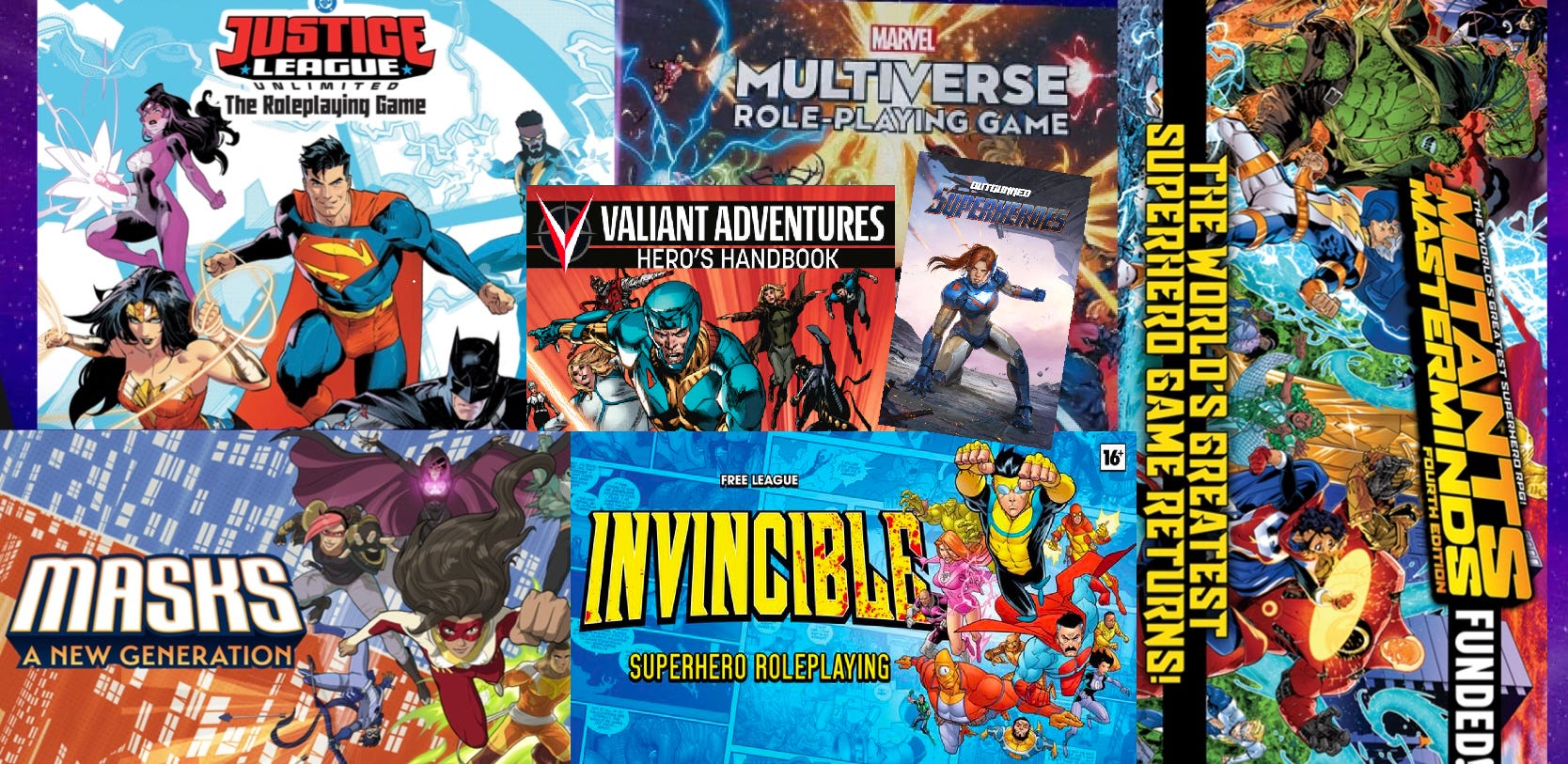
Off the back of that then we see that, given this blog’s typical subject matter, the Secret Wars Expansion is the most anticipated future release on the cards for superhero TTRPG players. It’s followed up by Justice League Unlimited, then M&M 4E, and then Masks 2E. In the comments, games like The Hero Instant, Outgunned Superheroes, and Free League’s Invincible - Superhero Roleplaying all got namedropped as other games folks were looking forward to.
In the case of The Hero Instant, it was game author Andrew Ashcraft who threw it in the mix, and he referred to the game’s approach to character creation being quite broad and dynamic, allowing people to create any kind of character they want. Outgunned is a cinematic game, the superhero supplement for which is inspired heavily by the MCU. And all I can say about Free League’s Invincible RPG is that I immediately went and pre-ordered the core rulebook after one read-through of the quickstart rules. It may end up being my go-to universal supers RPG, purely because it feels like it’s emulating comics and cartoons in much the same way MMRPG does, just in a more generic sense.
It’s no surprise that MMRPG and the forthcoming JLURPG are top of the tower in terms of anticipation. Ultimately, the big two will always dominate in the superhero space, regardless of what else is on offer from equally reputable publishers. Which is odd, because according to another poll in that article, 27 out of 35 people would rather play an original character over playing or altering an existent one, and folks also have a prefernece for mixing their own stories with pre-generated ones. Most folks, it seems, want to inhabit their favourite fictional superhero universes as an original character.
This is where games like M&M, Champions and Masks are hampered. It will be interesting to see if the advent of the Invincible RPG entices a younger player base into the hobby, because despite its mature subject matter and violent imagery, Invincible is very popular with teenagers. I said “despite” there as if kids are somehow violence-averse, but we all know they’re complete lunatics who thrive on destruction at the cosmic scale. It seems the same is likely true of the 41-60 year olds that make up the bulk of the superhero genre’s player base, seeing as “heroic action” came out as the primary appeal of the entire genre to my voters.
One of the last questions I posed to pollees was whether they had a positive, negative, or apathetic view on the future of superheroes in media, broadly speaking. Of the 34 votes, 29 had mostly positive as their outlook on the future of superheroes in media. Obviously that goes along with TTRPGs, and to be honest, I would say that those people are in the right. Much as superheroes have waned in popularity in recent years, especially among younger generations, I think there is a shift on the way.
That shift is being driven by a return to the genre’s roots both in comics and animation. DC’s recent Absolute line has reinvigorated comic readership that had largely transitioned toward Japanese Manga in younger demographics, and the advent of more compact and affordable collected editions has seen a greater interest from those like me in their mid-to-late twenties who have recently been struggling economically.
We’re also in the midst of X-Men ‘97’s second season, we’ve got animated series on the way for Absolute Batman, Blue Beetle, Starfire, and another season of Creature Commandos, plus another season of Your Friendly Neighbourhood Spider-Man and another three slated seasons of the aforementioned X-Men ‘97. Invincible is showing great promise among younger audiences and even drafting them into the ranks of comic book readers where the movies likely seldom did.
The main thing I’m wondering is how do you capture that audience for TTRPGs? D&D is bigger than ever, and that popularity will surely cause a swell in other genres, superheroes included, especially given the stipulations I outlined above. A rising tide raises all ships, after all. With more new supers games on the horizon, and a substantial move toward more narratively-driven gameplay, I foresee a future where the days of days-long, front-loaded character creation are far behind us, and the days of quick and easy but broad character creation are a-dawning.
As a last remark, let’s sum up the typical superhero TTRPG player one last time: They’re someone between the ages of 41 and 60 living in the Northern Hemisphere, with a penchant for games with broad character customisation, narratives punctuated by cinematic gameplay, and a desire to see themselves engaging in heroic action in a world they know and love.
There’s plenty to like about that, and some things I’d like to see change.
Posts are going to become a lot less frequent over the next while as I’m working on other creative projects at the moment. There will still be reviews and the occasional dump of homebrew, but there likely won’t be a weekly post for a while. Absence makes the heart grow fonder, as they say.
Till next time, have fun out there and stay safe.
Comments
Nothing yet. Say the first thing.
Sign in to join the conversation.