
I read through the Fantastic Four: From the Depths adventure for the first time recently, and there was a lot in there that sparked some ideas for me. Most of all was the section of the adventure in which the F.F. confront Mole Man in Subterranea and there’s a short breakdown of the kinds of tools Mole Man has at his disposal for the confrontation. Text like this isn’t uncommon in MMRPG adventures, but the use of the word “lair” is what really got the cogs turning for me.
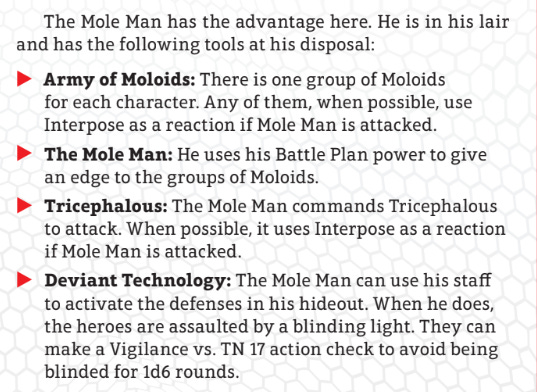
Now, I’m sure many of us are aware that other games make use of things like “lair actions” whenever a party of heroes come up against a substantially powerful villain, and lairs are a staple of superhero storytelling to boot. For those unaware, lair actions are basically a special kind of action that a villain can take on top of all their other regular actions; usually to much more devastating or beneficial of an effect, though only in a limited capacity. So long as they are in a place that has been designated by the GM or understood by the players to be the villain’s lair. These lair actions can occur at the top of every round of an initiative order rather than on the turn of the lair’s owner, essentially making the location a more dynamic and active environment for the purposes of the encounter.
While it isn’t explicitly stated in the text, I think it’s reasonable enough to infer that the bullet points above could all be used as the basis for some “lair actions” by Mole Man, rather than occupying an action on his regular turn or those of the other characters mentioned like the Moloids and Tricephalous. And if Mole Man can have them, then so can every other villain in the universe. After all, Mole Man may only be a Rank 2 villain, but he should definitely feel like a serious threat on his home turf. The same can be said of any villain that’s defending themselves against a superheroic assault inside their base of operations. So, I’ve drafted up a few Mole Man style lair actions for some of the biggest and baddest of Marvel’s villains to both bring some dynamism to your boss fights and reinforce the villain’s thematic motifs. Using the Mole Man example as a template, these lists of lair actions will mostly break down like so:
An action relating to a group(s) of Henchmen.
An action derived from one or more of the villain’s powers.
An action relating to a secondary obstacle for the heroes to deal with.
An action relating to a broadly applicable defensive measure.
Obviously not all villains will fit that bill, but if you’re ever in need of a template for your own encounters, then that’s not a bad place to start. Also note that any groups detailed in these lists will either have a link to a Demiplane profile for said group, just like the Moloids in the F.F. adventure, or an indication of which sourcebook has a relevant profile for the group. We’ll be kicking off, however, with the obvious choice:
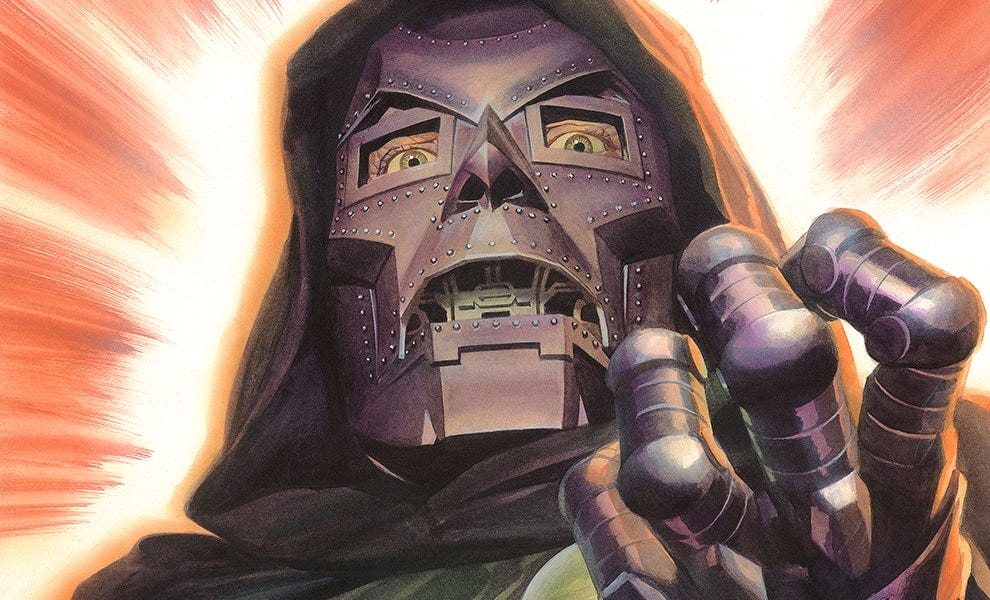
Some months back I did a whole article on running Castle Doom like a classic mega-dungeon, so when taken in tandem with this article then you could put together a real challenging encounter with the good doctor. Doom is an all-rounder, and you can kind of do whatever the hell you want with him, but there are of course a few staples of an encounter with Doctor Doom that are just too good to leave out.
Army of Doombots: There is one group of Doombots for each player character. Any of them, when possible, use Interpose as a reaction if Doctor Doom is attacked. Once summoned, each group targets a hero and acts immediately after that hero in the initiative order. A new army cannot be summoned until the first has been totally destroyed.
Doctor Doom: He can activate both his Attack Stance and Defense Stance powers simultaneously, leaving his regular turn intact.
Synthezoid Replicas: A machine fabricates a perfect replica of one of the player characters, complete with all of their abilities, traits and powers. Any fabricated synthezoids are immediately hostile to any intruders, and cannot be reasoned with. The maximum number of synthezoids that can be active at once is equal to the number of player characters, though these replicas can be multiples of a single player character or any combination of the player characters.
Dimensional Warp: The room in which the encounter is occurring is teleported to an alternate dimension of the Narrator’s design, though this is still considered to be a part of Doom’s lair. Upon entering the alternate dimension, players must make a Vigilance check against Doctor Doom’s Ego Defense. On a failure, the player character takes dMx4 damage to either Health or Focus. On a success or Fantastic failure, the player character takes dMx2 damage to either Health or Focus. On a Fantastic Success, there is no effect. On subsequent rounds, player characters who failed the action check take 1d6 of the damage type initially dealt to them upon entry into the alternate dimension.
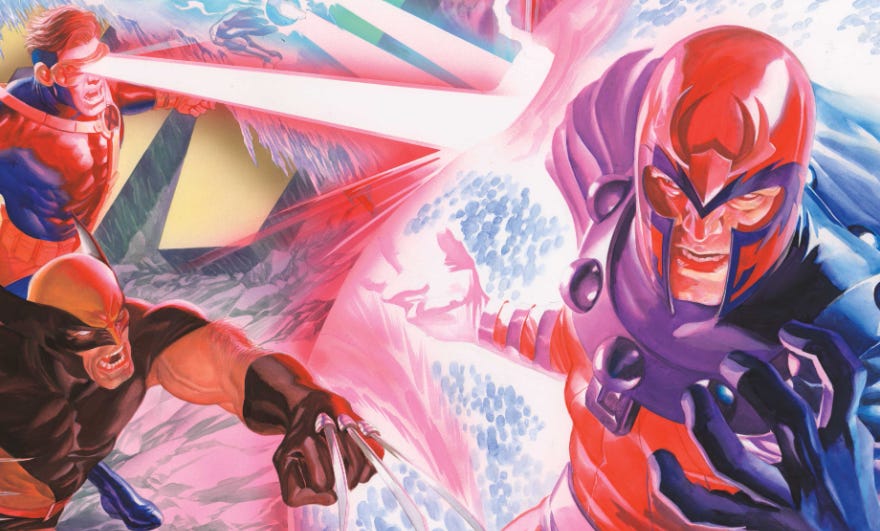
Often a zealous and stalwart advocate for mutant supremacy, Magneto will tend to use his powers to subdue his enemies and then try to talk them over to his way of thinking, or at the very least let them know why he’s so sure of his convictions. Failing that, he’s no stranger to having his acolytes in the Brotherhood of Evil Mutants use more aggressive means to exert his will upon his enemies.
Magnetic Maelstrom: Until Magneto is knocked Unconscious or leaves the scene, metallic debris swirls around the area. Any efforts to move through the maelstrom require an Agility check with trouble against Magneto’s Ego Defense. On a failure, the character is Pinned by a chunk of debris. Once per round, the maelstrom can Interpose on an attack made against Magneto.
Mutant Brotherhood: A member of the Brotherhood of Evil Mutants arrives on the scene to defend Magneto. When possible, they will use a reaction to Interpose any attacks made against Magneto but will otherwise focus their efforts on a player character, acting immediately after their chosen target in the initiative order. This can be repeated until the number of evil mutants is equivalent to the number of player characters, with each arrival taking their turn after one of the player characters. Potential mutants include: Sabretooth (Core Rulebook), Toad (X-Men Expansion), Mystique (Core Rulebook), Mastermind (X-Men Expansion), Pyro (X-Men Expansion), Quicksilver (Core Rulebook), Scarlet Witch (Core Rulebook) and Blob (X-Men Expansion).
Magneto Is Right: This action can only be taken once per combat encounter. Magneto delivers a moving monologue that cannot be interrupted, and all player characters within earshot must make an Ego check with trouble against Magneto’s Ego Defense. On a failure, any affected player character cannot attack Magneto until the end of the next round, nor can they assist in any efforts to harm him. On a success, affected player characters have trouble on their attacks against Magneto until the end of the next round. On a Fantastic Success, the monologue has no effect.
Enough… : Once he is below 30 Health or 30 Focus, if he suffers damage that would knock him Unconscious or render him Demoralized, Magneto can ignore that damage and instead immediately spend his next lair action to make an Ego check with an edge to emit an electromagnetic pulse against the Agility Defenses of all enemies involved in the encounter. On a success, the attack deals dMx10 Health Damage, and on a Fantastic Succeess, it deals double damage and the affected targets suffer knockback and are Pinned for one round. Magneto can also use the attack roll as a Recovery check for either Health or Focus, but afterwards he must either flee the scene or engage one of the player characters in Verbal Combat.
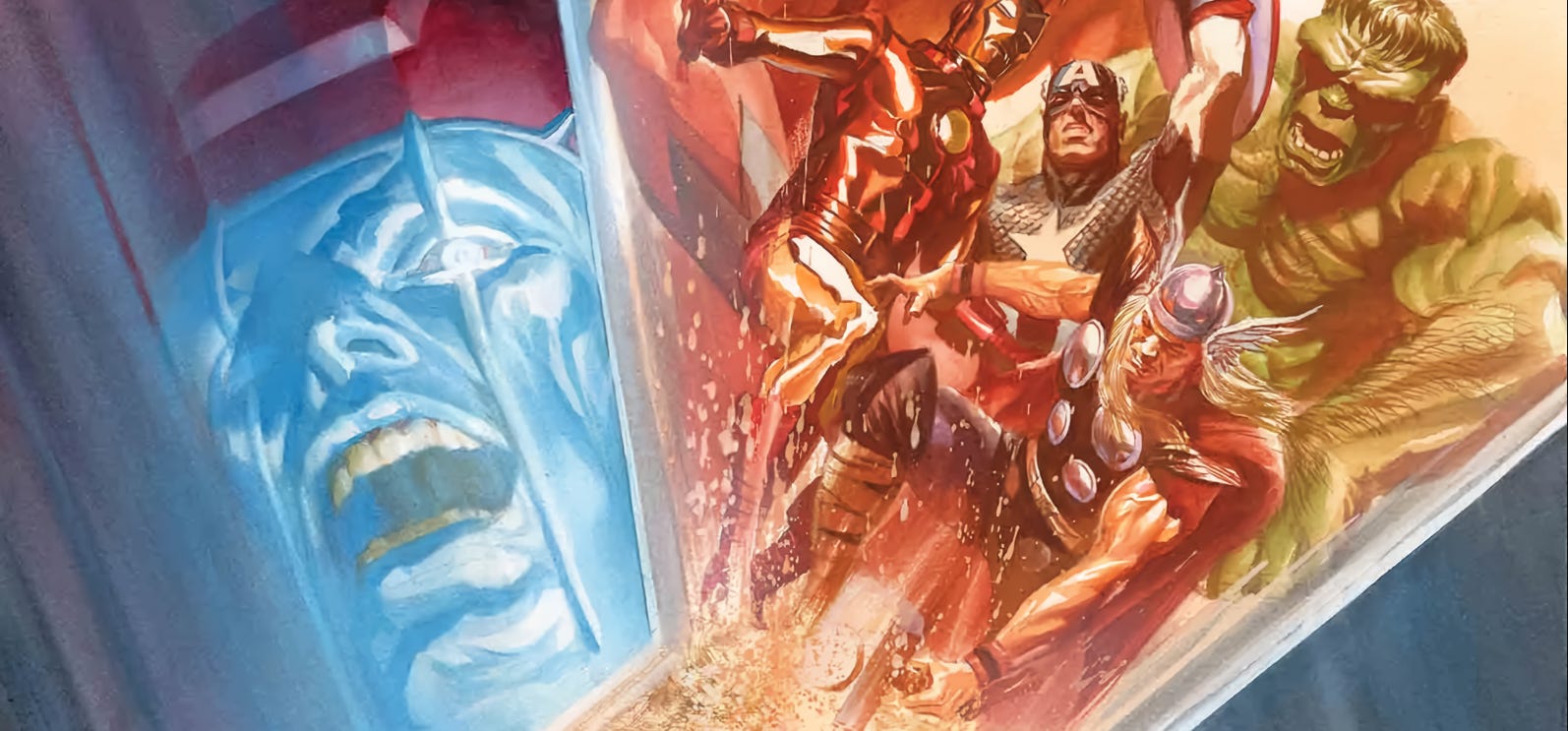
Motivated by an insatiable desire for conquest, Kang will treat time as little more than another arrow in his quiver whenever he’s got the means at his disposal. Portals to alternate timelines, armies conscripted from myriad epochs, and technology that beggars belief are all the hallmarks of an encounter with Kang the Conqueror.
Time-displacement: Kang summons one group of Henchmen through a series of time portals for each player character involved in the encounter. Each group has 150 Health and 60 Focus, and each one will take their turn after a different player character. The groups consist of time-displaced Henchmen from across history. Potential groups include:
Maggia Toughs from the 1940’s (Cataclysm of Kang)
Barbarians from the Hyborian Age (Avengers Expansion)
Public Eye Agents from the year 2099 (Spider-Verse Expansion)
A Sentinel from the early Heroic Age (X-Men Expansion)
Deinonychus raptors from the Cretaceous period
Hand Ninja from feudal Japan (Core Rulebook)
Vampires from medieval Europe (Core Rulebook)
Skrulls from the far flung future (Core Rulebook)
Hydra Agents from a dystopian future (Core Rulebook)
More groups cannot be summoned until all groups have been completely destroyed.
Resynchronisation: This action can only be taken once per combat. Once he is below 30 Health or 30 Focus, if he takes damage that would knock him Unconscious or render him Demoralized, Kang can immediately spend his next lair action to swap places with his past self from before the conflict began, gaining all of his Health and Focus back. Once he has done this, the Narrator can choose which Kang to focus on, perhaps continuing the fight with a reinvigorated Kang, or trying to have a wounded Kang negotiate with the player characters with the knowledge of how the fight might go. Or both, if you’re feeling really adventurous.
Time Blips: Kang activates a machine that disrupts the flow of time. For the remainder of the encounter, once per round, he can choose to take his turn whenever he wants in the initiative order or he can choose a player character to skip their turn. He cannot pick the same player character twice in a row, and he cannot retroactively force a turn-skip after someone has taken their turn. As soon as a character uses a Standard or Movement action, their turn has started and Kang cannot force them to skip their turn.
Variants: Kang summons one of his many variants to assist him in the fight. He can summon one variant at a time up to a maximum amount equal to the number of player characters involved in the encounter, and each one targets a player character and takes their turn immediately after their target. Some potential variants include: Immortus (Avengers Expansion), the Scarlet Centurion, Rama-Tut (Cataclysm of Kang), Iron Lad (Avengers Expansion), and Kid Immortus (Avengers Expansion). While some of these characters are typically heroic in nature, they can be villainous variants for the purposes of this lair action.
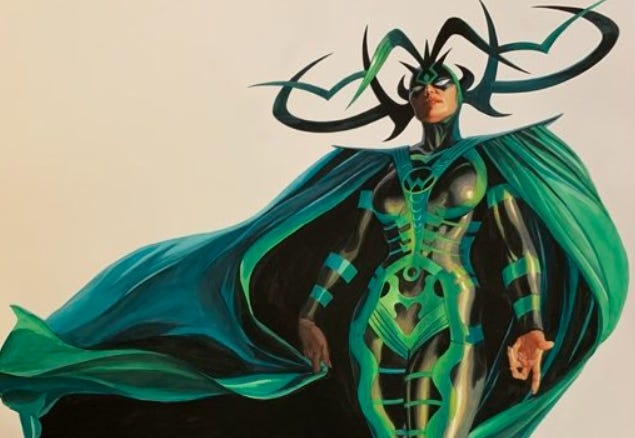
The Asgardian goddess of the underworld known as Hel, Hela takes great joy in the reaping of mortal souls and the committing of their spirits to an eternity in her domain. She uses magic and ancient guile to drive her forces to do her bidding, and an endless procession of shambling corpses mean an encounter with her is not likely to end with much more than a pyrrhic victory.
Damned Souls: Hela can summon ghostly spirits to torment any living creature that enters Hel. A character must succeed on an Ego check against her Ego Defense to resist the torment of the spirits. On a failure, the character has trouble on all actions and their movement speeds are halved for one round of their next encounter with Hela. On a success or Fantastic failure, the character has trouble on any attacks made against Hela for one round of their next encounter with her. On a Fantastic Success, the character is not affected by the tormenting spirits.
Fenris: Hela can summon Fenris to aid her in battle. Fenris will stay close to Hela and Interpose any attacks made against her, and he will act immediately after her in the initiative order. Use the Devil Dinosaur profile in the Core Rulebook.
Denizens of Hel: Hela can summon groups of corporeal viking spirits to fight in her defense. She summons one group for each of the player characters, and each group targets one player character then takes their turn after their targets finish theirs.
Leech Life: Hela can use her Leech Life power against any characters involved in the encounter, including those allied with her, to recover Health using a lair action. The maximum number of targets for this action is equivalent to her Rank.

Wilson Fisk, also known as New York City’s Kingpin of crime, is a resourceful man who is well able to hold his own in a fight with even the most prolific of superheroes, but prefers to keep his tailored white suits in pristine condition. Most of the time, if he’s going to fight, it’s because he has no other option. But it doesn’t take long for him to start making use of all the power he wields from atop his ivory tower.
Goons: Kingpin can summon a number of groups of goons equal to the number of player characters in the encounter to defend him from harm. Each group targets a player character and each group acts after their targeted character. Use the Veteran Mercenary profile from the Spider-Verse Expansion for Kingpin’s goons.
Penthouse Suite: Once he has fallen below 30 Health or 30 Focus, if Kingpin takes any damage that would knock him Unconscious or render him Demoralized, he can immediately spend his next lair action to make use of a secret elevator to escape while initiating a self-destruct sequence, or inject himself with a hidden revitalising serum that automatically restores 60 points of Health and Focus, but also gives him the Berserker trait until the encounter is over.
Criminal Connections: Kingpin can summon one career criminal per round to his location, up to a maximum amount equivalent to the number of player characters involved in the encounter. These criminals will focus on giving Kingpin a chance to escape, occupying the heroes’ time either by fighting them head on or endangering civilians nearby. The summoned character must have the Criminal or Assassin Occupation and the Villainous tag in order for Kingpin to summon them, and while they can be of any Rank, they must also be human and typically dwell on Earth. Potential criminals include Bullseye and Taskmaster from the Core Rulebook, or any number of the villains from the Spider-Verse Expansion.
Automatic Defenses: Kingpin’s office is rigged with various traps and weapons that will target any living creature that does not have his unique biometric data. Upon activation of these defenses, at the top of every round, player characters must succeed on a Vigilance check against Kingpin’s Ego Defense. On a failure, affected characters take dMx4 Health damage and suffer trouble on any attacks they make against the Kingpin for one round. On a success or Fantastic failure, affected characters take dMx2 damage and can make attacks as normal. On a Fantastic Success, there is no effect.
That’ll be all for this week, but don’t fret, because I’ve got plenty more ideas for these kinds of things ready for a later date. If you aren’t already subscribed and you don’t wanna miss those, then join the mailing list below to make sure you get my articles straight to your email inbox.
And if you have any ideas for lair actions relating to a particular villain, then why not leave them in the comments below?
Lastly, the link to the Fantastic Four: From the Depths adventure at the top of this article is my DriveThruRPG affiliate link, so if you want to support my work then you can buy yourself that adventure through that link and I’ll get a small commission off of it. It’s only $2.99, so if you wanna test out using lair actions with the Mole Man encounter then it’s an inexpensive and easy-to-run means of doing so.
Until next time, keep playing games and be sure to have fun out there!
Comments
Nothing yet. Say the first thing.
Sign in to join the conversation.