
Today we welcome back the Famous and Beloved Food Correspondent MMF for an update on the New York food scene, line culture, and Sarah Pidgeon. I’ll be back next week!
For more from MMF, check out his 100 ideas:
And subscribe to Meals Meals Food:
The first episode of Hulu’s Love Story introduced to the wider world Panna II, an average Indian restaurant in Manhattan’s East Village neighborhood which is mostly renowned among local college students for its BYOB policy. In recent years, business hasn’t been too great for Panna II, impacted by changing tastes of the neighborhood wrought by the COVID-19 pandemic. Its real draw, however, is its decor, which conjured an otherworldly ambiance for John Jr. and Carolyn Bessette’s limited series “first date.” A tinsel-covered entrance gives way to strands of multi-colored Christmas lights. Interspersed are various international flags which drape overhead of regally upholstered chairs, film and tv production regalia on one wall—Love Story is not the first to shoot here—and an end-to-end mirror on another.
There is no photographic evidence of the real John Jr. and Carolyn at Panna II; dining there is not quite the same as snagging the When Harry Met Sally table at Katz’s. But as John Jr. and Carolyn clones began to crop up around the West Village in Kangol hats and Manolo slingbacks, so too did they on the darkened stretch of 1st Avenue between 5th and 6th streets, waiting on line in the blistering mid-winter cold for ordinary food. They aren’t there for the cuisine, however, but the experience. They are performing in the same way that Paul Anthony Kelly and Sarah Pidgeon did, under whimsical lights, pretending to have a good time, pretending they are someone else.
What is fun about Love Story is not the show itself, but the possibility of performance implicitly encouraged by its consumption. Striving for a Tribeca loft, wearing an Armani suit with a backwards hat, is novice performativity, though; anyone can peruse eBay for the perfect pair of Levi’s 517 jeans, just the right wash and inseam to be as precisely cropped as Carolyn’s. But what if you live in New York City, too? You don’t just get to dress like John John and Carolyn—you can reenact the 90s as you see them on Hulu.
If filmed entertainment was the “seventh art,” restaurants are the eighth. Dining has usurped film and television as the ultimate capitalist artistic medium, patrons able to directly participate in the process as it happens, and then democratically submit real-time feedback afterward like a tip on their bill. It is immediate and thrilling, like what theatre-lovers always insist their preferred artform is to others who just “don’t get it.” It’s impossible not to “get” restaurants—to grasp their function and import—and every day they seem more and more preferable to any other form of social communion. If I ask my girlfriend whether she’d rather go to “the new Curry Barker film” or try to “walk in” at Thai Diner, which do you think she’d select? Note: this is someone with a PhD in movies.
Dining combines all the best elements of each preceding artform, culminating in sensual, full-body experiences both positive and negative. The stakes for disappointment are never higher at a restaurant, where you could potentially leave with a $300 hole in your pocket, or, worse: food poisoning. But the potential for spectacular enjoyment often outweighs the risks, the synergistic elation that comes with the perfect seat, the perfect view, the perfect order, the perfect service, the perfect eventual recommendation. For most young restaurant goers worldwide, dinner is no longer just an occasion to dress up, to see or be seen; instead, a moment to evaluate and catalogue, to signal and endorse.
My most memorable meal of the past year was at Babbo—not for any special occasion, but a weeknight reservation to try Mark Ladner’s new menu since Stephen Starr assumed ownership of the space in early 2025. Babbo is much the same as before its reopening—rock music still blaring at an unconscionable but necessary volume—yet it feels different, like when a celebrity gets a “new face,” despite their old one sufficing perfectly fine. It’s a performance in itself, Starr’s Babbo evoking the old to near perfection, a rechristening of proportions which beg the restaurant name heretofore only be printed in Italics like the title of some great work. Why let the restaurant close, the lease lapse, the beautiful Village townhouse it inhabits turn into some private member’s club, or, worse, a bad food restaurant?
“Lifeguard style” seafood pasta and bleu cheese budinos go down like an acclaimed broadway revival under Ladner’s tutelage, who danced back and forth across the room during our service presenting oven-crisped “Detroit style” lasagna to customers, only to then cut each into four quarters and re-present it with the same understated panache as before, comically tall chef’s hat and all. He’s not the only actor present, as servers and waiters dart up and down stairs, to and from a centerpiece station filled with olive oil, cheese, bread, and anything else that a patron might desire: it’s the Buca di Beppo “kitchen table” writ large and prestigious, dwarfing a similarly appointed setup at the meek Via Carota. It’s easy to notice all of this because two-tops are seated next to each other rather than across, so that you and your dining companion gaze directly at a wall of twin shadows absorbing all the smells, sounds, movements at once.
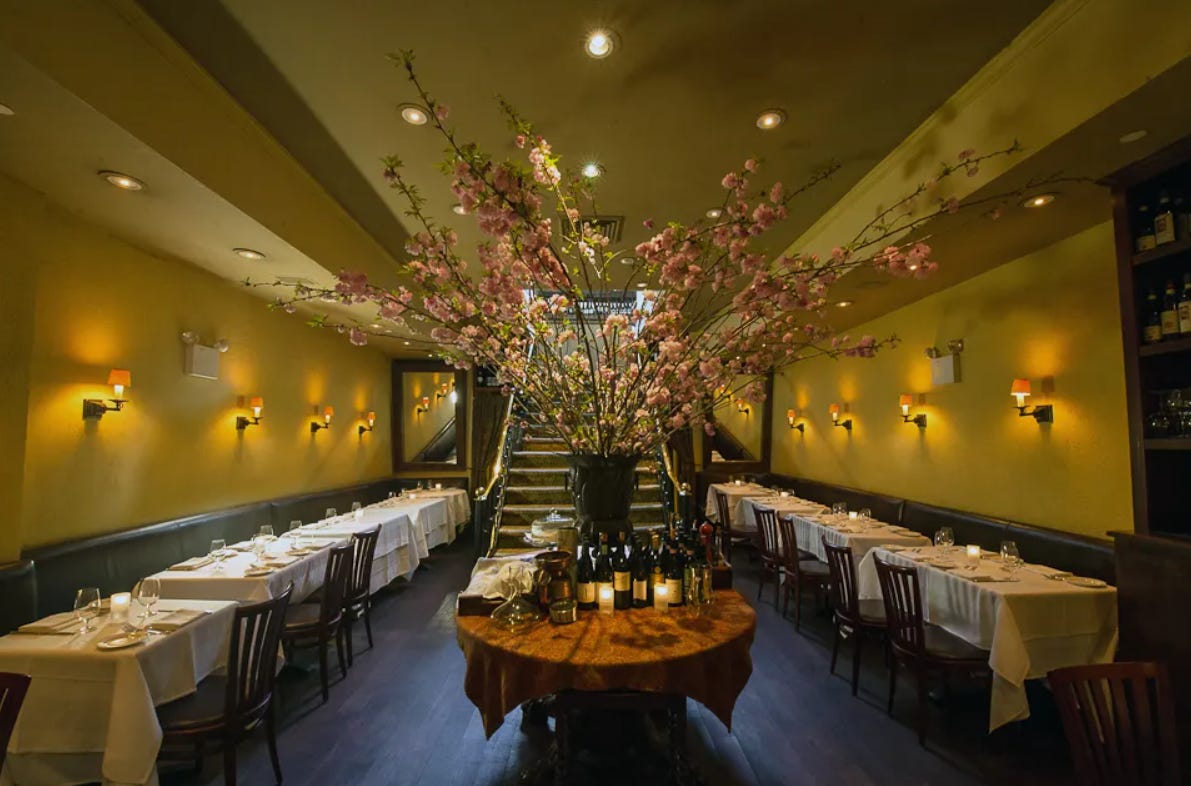
Midway through our meal, The Velvet Underground’s “Venus in Furs” began to play, disparate strings screeching and humming in tandem and highlighting the difference between playing music at a restaurant and creating a completely overwhelming atmosphere through layered textures of all senses. I’d been searching for this feeling since seeing Oliver Stone’s The Doors on 70mm earlier in the year, where “Venus in Furs” soundtracks Val Kilmer’s Jim Morrison first encountering Crispin Glover’s Andy Warhol. In that moment, I felt witness to a glimpse of total artistic expression and achievement: ridiculous awe.
Between droning Lou Reed and bites of pasta, gulps of non-alcoholic white negroni, my dining companion completely agreed that Oliver Stone and Stephen Starr and Mark Ladner were all equally unappreciated artists. This latter point didn’t survive long past dinner, however, when I attempted to show her The Doors at home and it bored her to tears. Sometimes you really do need to see a movie in a theater, and you really do need to spend $40 on one plate of pasta. A restaurant is only expensive when it’s bad: I’ll go anywhere for less than the price of Rachel Zegler’s Broadway turn in Evita. Will it be better than previous iterations? I guess I’ll find out, just like I did at Babbo. If not, however, it will sting all the worse because I paid $271 for two tickets (dinner for two at Babbo was $238), almost a year in advance.
Nothing could hurt more, however, than my anniversary dinner at the lauded Tatiana. If you’ve ever wanted to enter a 2010s Las Vegas restaurant to a white man greeting you with a startling “welcome home!”, Tatiana is for you. If you’ve ever wanted to be served soggy breaded eggplant still wet with old fry grease, Tatiana is for you. If you’ve ever wanted to dine next to carbon copies of Allison Williams’s family in Get Out, Tatiana is for you. If you’ve ever wanted to stare at yourself in a sole single occupancy restroom mirror—after waiting on line for 20 minutes while Chris Brown plays at unconscionable volumes—Tatiana is for you. At $265, the meal was a rotten performance where each misstep compounded to produce an outcome so sour that I was left speechless.
To feel so duped into believing something would be so profound is a feeling I’ve only ever experienced before with movies, books, plays. To perform enjoyment before a restaurant of performative diners and servers was humiliating, but also comforting, knowing cultural critics and normal people alike afford more money and attention than ever to restaurants and dining, and that my taste has evolved enough to lack both naivete and pretense.
I’m not embarrassed to have spent so much money on a meal I did not enjoy, just as I’m not particularly embarrassed to stand on line for a pastry or a bagel. “Line culture,” as it’s been coined, is just the same to me as waiting up until midnight to listen to a new album, as buying tickets weeks in advance to see a new Paul Thomas Anderson film. It doesn’t speak to taste so much as to the medium and its popularity, its discursive gravity. As with other art forms, I now know what I like and dislike without feeling the intense scrutiny of others, able to raise eyebrows but ultimately laugh off lists of “100 best places” or “restaurant” “reviews” as easily as word vomit from Letterboxd power users. Tatiana was a bad experience, a bad piece of art, constrained by the supposed freedom of food expression it espouses.
Yet great art always leaves room for nuance. A friend of mine had the meal of their life at Tatiana on a whim, and a less-than-positive experience at Babbo after my recommendation. I concede that maybe Tatiana had an uncharacteristically off night during my meal, but I couldn’t fathom a bad dinner at Babbo. When I found out my friend’s dinner was upstairs, however—away from the performance—it made more sense. In a subsequent Babbo meal, sitting upstairs at a three-top rather than downstairs in a pair, I realized how much of my initial opinion was dictated by the immersion of the restaurant’s ground floor. It was like watching The Doors at home. But realizing that made me enjoy the restaurant even more; I could now define what made it worth visiting to ensure everyone else had the same Babbo experience as me. If everything was perfect all the time, there would be nothing to recommend with gusto.
Thus, with the proper framing, the very best restaurants can seemingly perform universally, not limited to genre or demographic. “Cuisine” is as much a facade as the word “fusion,” and when I think about the best meals of my life, I don’t remember them in terms of where the food I was served originated on a map. Babbo is not great because it is “Italian,” like Titanic is not great because it is a “disaster movie.” When restaurants began to be judged on all aspects of a patron’s experience—including what the bathrooms look like, not just how clean they are—they transcended to total artistic expressions.
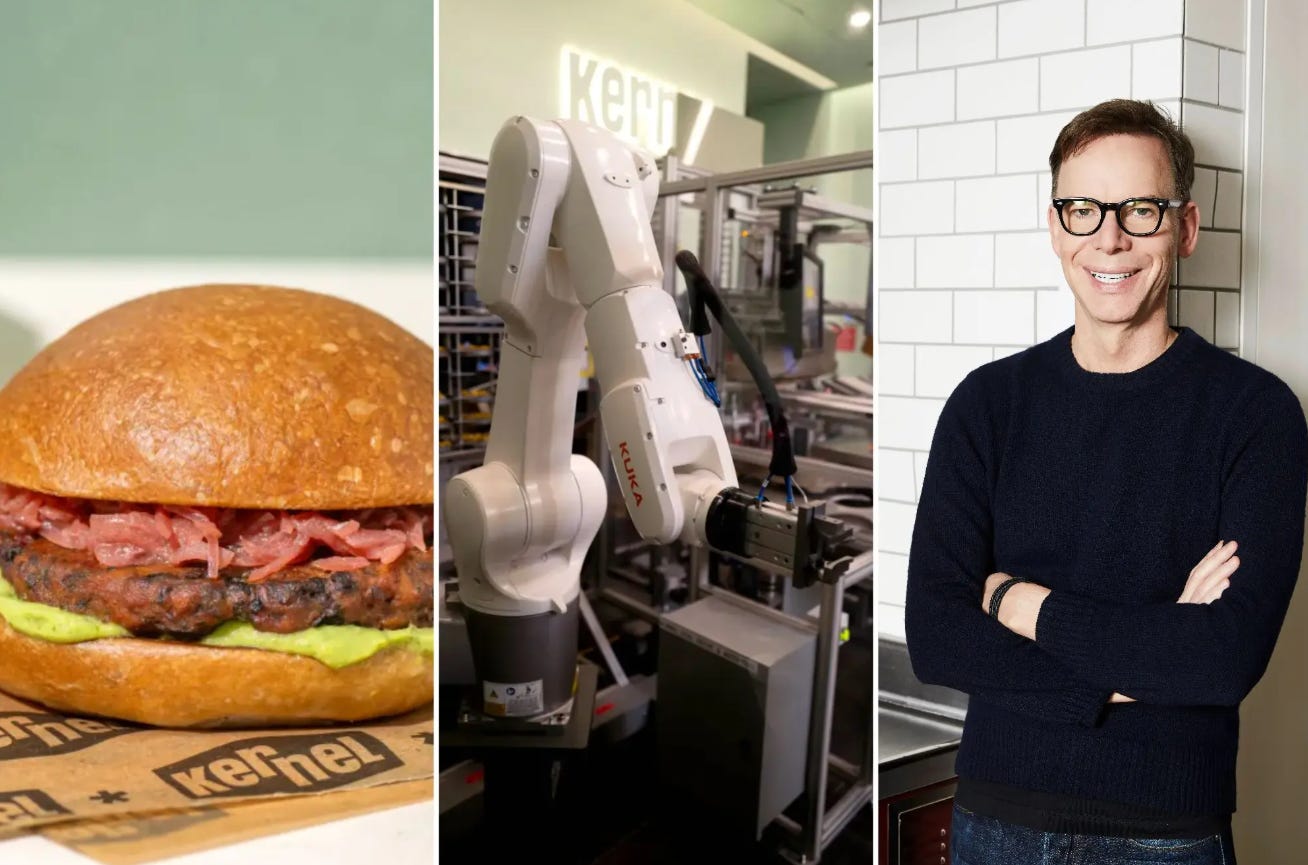
How then do you delineate what is art and what is not? Surely not all music is really “art,” not all films deserving of the title, either. With the proliferation of AI across media—whole bestselling books rife with generated text, Oscar winning films interpolating nuanced tech for accent enhancement—the bar seems to be: did a human make this? For restaurants, the tech-enabled vanguard is further away than other forms. A new startup tried to have robots make food, which failed so spectacularly that investors backtracked into the humble sandwich (a very good one, too). Restaurants have become the most exciting—and my favorite—form of art for precisely this reason: even when an interior and menu and general atmosphere feel like curated tasteslop, they are all still completely tactile. Food on a plate cannot be generated by an LLM. And, chances are, if AI wrote a menu, it would be pretty bad.
When The New York Times published its latest longform list, food critic J Lee posited the question: what qualifies as a restaurant to be considered? Certain food trucks over the humble bodega? Immersive “French” restaurant groups were completely ignored, Shaker-themed restaurants kept to the still somehow underrated corners of the West Village. To me, the tension of narrowing lists exists between the wealth of evaluative information now presented at any given food-serving establishment. When reviewing a Jamie Lloyd musical, you can’t just talk about the screens: and yet some still do.
We’re at the point in the medium of dining where it no longer makes sense to compile 100 restaurants into one list. Like 100 songs or 100 movies, there are now enough restaurant-as-art appreciators to try them all. For any other medium, that does not mean much. But for restaurants in New York City, it means 100 more sidewalks crowded with 100 more John Jrs. Whether that is good or bad for the industry is up for debate. It’s keeping Panna II in business, but only until Love Story is lost to the annals of streaming, its immediate popularity as ephemeral as a buzzy new restaurant opening. What happens when next year, your favorite place no longer makes the year-end lists? Unlike Babbo, most once-hot restaurants do not get a second act, and instead die a slow, iterative death, night after night, as neighborhoods and tastes change over time.
No posts
Comments
Nothing yet. Say the first thing.
Sign in to join the conversation.