
There is a cabinet in almost every hotel room in the world that has, over several decades, quietly communicated something its owners never intended.
It is roughly the size of a small bedside table. It hums. And it contains, with remarkable consistency, a can of Pringles, three overpriced chocolates of middling quality, a small bottle of still water at a price that would cause mild distress in most circumstances, and a miniature of spirits that only a person of very particular desperation would actually want.
Sometimes there is a jar of mixed nuts. Please note: always the same mixed nuts, in the same proportions, at every property from Phoenix to Porto.
The minibar is, in principle, a generous idea. Someone thought to stock a private larder in your room. It is an act of anticipation and of imagined care. And yet, in the overwhelming majority of cases, the execution of this idea communicates to guests something quite specific and rather deflating:
Nobody thought about you when they stocked it.
Which is why I have come to think of the minibar as one of hospitality’s most reliable character tests.
Not of the guest, but of the property.
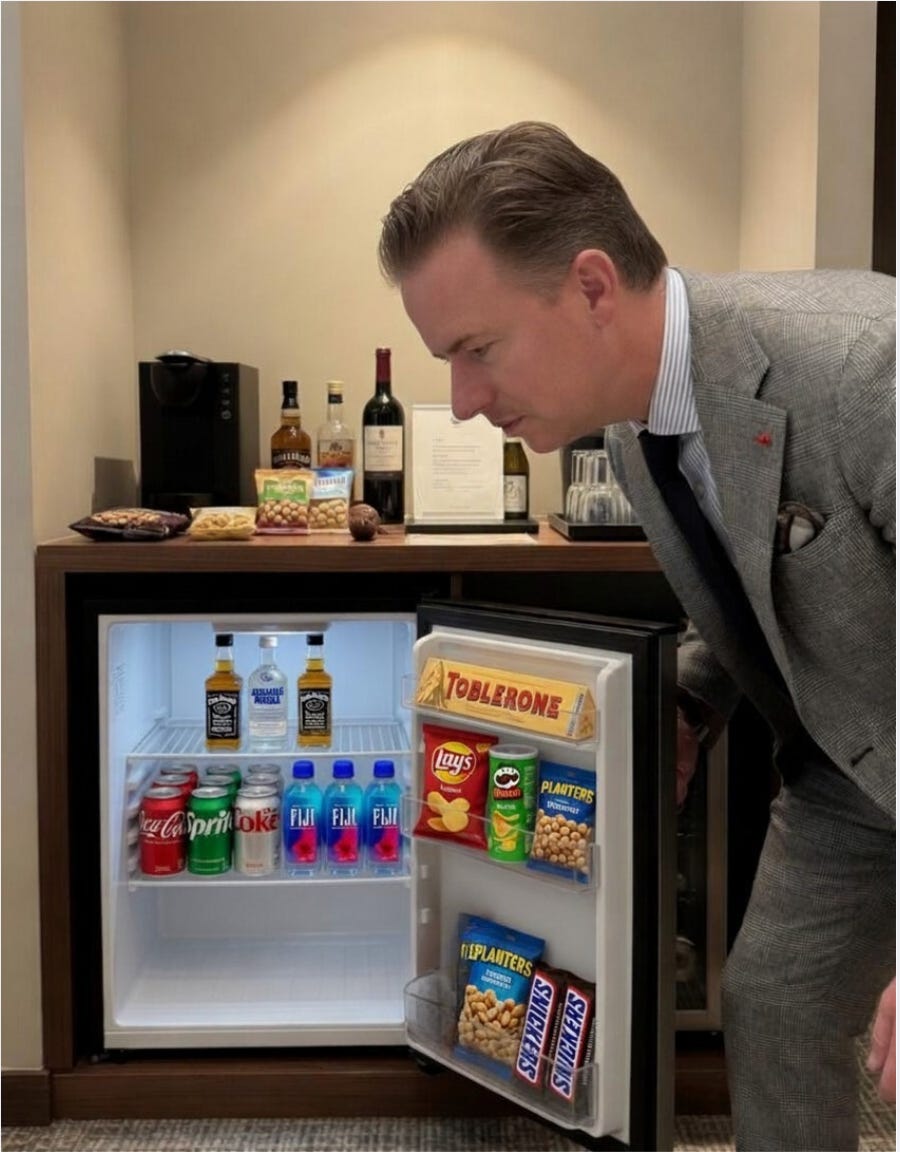
Every hotel makes serious claims about its commitment to the guest experience. The website speaks of immersive luxury and thoughtful service. The lobby makes an aesthetic argument. The restaurant has earned its credentials. But when you open that small humming cabinet, you discover what a hotel actually believes about its guests. And more often than not, what they believe is that they are as generic as an NPC in a video game with generic appetites, and indistinguishable from the person who occupied this room last Tuesday.
Benjamin Franklin observed, in his 1758 almanac (not a publication one typically expects to quote in a hospitality newsletter, but here we are), that:
“Small neglects breed great mischiefs. For want of a nail, the shoe was lost; for want of the shoe, the horse was lost; and so, inexorably, the kingdom.”
The minibar is one of hospitality’s horseshoe nails.
Guests do not complain about it.
They rarely write reviews about it.
They do not consciously register it as a meaningful failure.
But they feel, somewhere below the level of articulated thought, the absence of recognition; and that absence does its quiet work — making them marginally less loyal, marginally less inclined to return, marginally more susceptible to the overture of a different property that might, one day, get it right.
The best hotels understand, or perhaps simply feel instinctively, that the apparently trivial can take on quite disproportionate significance.
That kind of declaration costs almost nothing to make.
But it is very expensive to keep failing to make it.
Now I know what some of you might be thinking right now.
You think I am overreaching. That this is something guests never think about. Perhaps you will even say that you have never had a guest complain about the mini-bar, other than it being empty (or too expensive). But I think that is actually the whole point. Because the larger the gap between what the hotel promises and the generic nature of what’s in that humming cabinet, the more corrosive that encounter actually is. Not because the Pringles are offensive in themselves, I happen to love Pringles, but because the dissonance is jarring in a way that guests feel without necessarily articulating. They arrived expecting to be known. They opened a drawer and found evidence that they are not. So they stop thinking about it.
This is not a reflection on them. This is a reflection on a missed opportunity for a property to live up to its promise. And from experience, it is a missed opportunity, probably reflected in other small details as well. Like, for example, the beautifully designed lobby that leads to a bathroom door requiring slightly more effort than it should; or the warm welcome at reception, followed by a checkout process that treats you like a transaction.
Here is what bewilders me most about all this.
We now know a considerable amount about our guests before they arrive. Preferences, previous stays, dietary notes, whether they’re traveling for business or leisure, whether they came with a child or a dog, or both. The data exists, and now, thanks to AI, the tools exist to put that data to use in extra ordinary (the space between extra and ordinary is on purpose) ways. And yet the minibar remains, with startling stubbornness, the same generic cabinet it has been for forty years.
The barrier, I have concluded, is not technological or financial. The cost of stocking a minibar thoughtfully rather than formulaically is, in the context of a hotel’s overall investment, negligible. The barrier is something closer to a failure of imagination, or, more precisely, the failure to perform the imaginative act of genuinely placing yourself in your guest’s position. To ask not “what would a guest want?” which in my case reliably produces Pringles and Toblerone chocolate, but “what would this guest want?” Which is a fundamentally different question, and a far more demanding one.
This, by the way, doesn’t just have to be shown with minibars.
A few properties have understood this:
At the Faena Hotel in Miami, I once returned to my room with my children after dinner to find that someone had erected a tent in the middle of the floor. Inside it: a custom chocolate spread, assembled with evident thought, highlighted by the evident pleasure of discovery. My children were on the floor of that tent within seconds. And I felt, absurdly, like a hero for having chosen the hotel. That is a remarkable thing for a cabinet (in this case tent) of food to accomplish.
The Rosewood Miramar takes a different approach, but one animated by the same spirit. At the Rosewood, the minibar is not tucked into a small refrigerated compartment that looks as though it will sound an alarm if you remove anything. Instead, it sits elegantly and invitingly on the bar. And the invitation is sincere: take what you want. The miniature of liquor, a top-shelf brand you would actually order by name, is complimentary. The message this sends is not merely one of generosity. It is fundamentally trusting, and trust, in luxury hospitality, is the rarest currency of all.
The Okura Tokyo operates on an altogether different scale. What greets you is not a minibar but a full bar, with a 750ml bottle of Hibiki and, on occasion, a 1990s bottle of Dom Pérignon. It’s not part of an extra package. It comes with no additional cost. And because most guests cannot consume or take home everything on offer, the financial exposure is modest. But the experience remains long after the bottle does. Guests return.
These are just three examples of the kind of arithmetic genuine hospitality is all about, which is almost never the arithmetic that appears on a revenue spreadsheet.
I have spent a great many years visiting hotels and restaurants with the professional habit of noticing everything, and the properties that stay with me, the ones I find myself recommending with something approaching personal investment, are almost always the ones where I encountered evidence, however small, that someone had been paying attention.
And this is not just about luxury hotels.
I have recommended 5 Star luxury hotels that you need to fly to with a private plane. And I have also, believe it or not, recommended certain Motel 6s.
Because there is a distinction between service and hospitality that matters enormously and is almost never discussed.
Serving a guest well is a procedural accomplishment; any well-run property can achieve it with sufficient training and diligent management.
Knowing a guest, on the other hand, anticipating what they need before they articulate it, and responding to who they actually are rather than the category they fall into, is something else entirely.
It requires the rarer, more demanding ability to imagine another person’s experience from their point of view and then act on it.
And the minibar, curiously, is one of the simplest places to demonstrate this. Because it is not the grandest gesture a hotel can make. But it is felt, and what it communicates, without a word being spoken, is what a property thinks about its guests before they have arrived.
And that is not a small thing to communicate.
The solution, if you ask me, is to turn the mini-bar into a cabinet of curiosity rather than just a cabinet of convenience.
These are the kinds of details my team looks for when staffing and checking in on your property.
The difference is that when we find them, we don’t just point them out to you, as this newsletter does; we also help you close the loop and fix them.
— Paul Fallon
Founder, Fallon Hospitality
No posts
Comments
Nothing yet. Say the first thing.
Sign in to join the conversation.