
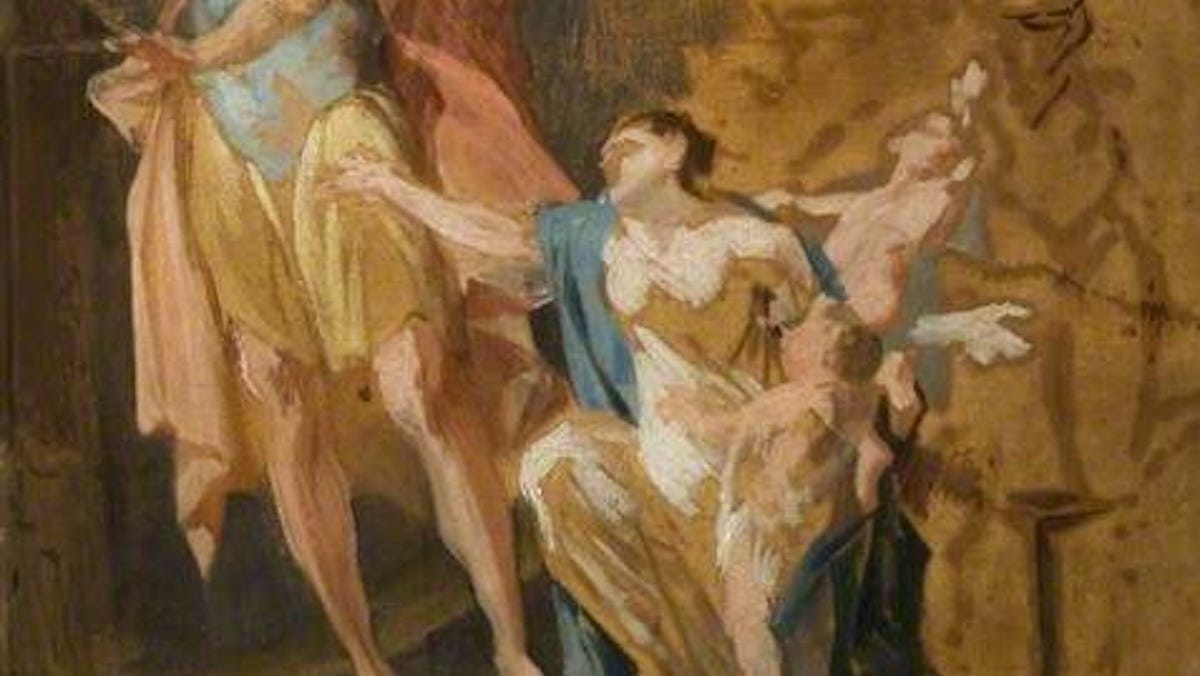
In 431 BC, Athenian audiences attending the annual drama festival probably expected the plays to revolve around the usual retellings of myths about the Trojan War and the heroic age. Instead, they were treated to a performance of a very different tale.
One of the tragedies that debuted that year told the story of a foreign woman who cohabits with a Greek man, moves with him to Greece, and bears him two children. After a while, the man decides to leave the foreign woman and marry a Greek princess. As a gesture of goodwill, he offers to bring the two children to the palace to raise them in luxury. Shockingly, the woman responds by killing her former lover’s new bride, the bride’s father, and her own children, whose desperate pleas for help echo from offstage. She then escapes justice by dramatically flying off on a dragon-drawn chariot.
The original audiences, all of them men, were duly appalled. They awarded this tragedy, Euripides’ Medea, the third and last place at that year’s festival.
Once the performance concluded, they went home to their wives. Perhaps some, secretly rattled by the play, wondered as they walked home from the theater that night: could this ever happen to me? What might the women in their own homes be up to? Revenge killing because of romance-gone-wrong was one thing, but could any mother really be capable of slaughtering her own children? And how could this have happened to Jason, one of the greatest mythological heroes, the captain of the Argo and the leader of the Argonauts? For it was Jason who was Medea’s common-law husband.
The ancient world’s fascination with Medea—the granddaughter of the Sun god, the murderous mother and sorceress from Colchis, which was on the farthest edge of the Greeks’ known world—did not begin with Euripides. Nor did it end with him: many subsequent authors, including the Hellenistic poet Apollonius of Rhodes and the Roman philosopher Seneca, wrote their own adaptations of her tale. Still, Euripides’ rendition of Medea is unquestionably the best known. It has inspired those that followed, as they traced her life story both back to her childhood and forward to what transpired after her dramatic escape from Corinth.
In her new book, Medea: A Life, Edith Hall, a leading scholar of Greek literature and civilization and a professor at Durham University in England, assembles source materials from across antiquity and beyond. Most of the book is devoted to telling the story of Medea’s life, from the beginning of her parents’ marriage to her final escape and disappearance. The story Hall has assembled from the pastiche of ancient sources is gripping, reading like a good novel. While some of it resorts to obvious creative license (e.g., the mentions of various emotions of characters, and the vivid and graphic descriptions of some scenes for which we don’t have ancient descriptions), much is simply drawn from the various references and tales of Medea that survive.
But a key question haunts the book: why did Medea matter to ancient readers and audiences? And why does she still matter to us today? In other words, why do we still want to understand a mythical mother who killed her children sometime over three millennia ago, in the age of heroes that preceded the Trojan War? Hall does not offer a clear thesis in this book—she prefers the story to stand on its own, as much as possible. By choosing not to endorse any one interpretation of the story or of its enduring importance, Hall also chooses not to state some natural truths that the story readily suggests.
In the face of secular modern social norms that argue against the “fetters” of marriage and family, stories like Medea’s demonstrate the need for the good of marriage as an essential component of a mother’s emotional and physical well-being.
A Horrifying Tale
I first encountered Medea’s story through Euripides’ tragedy in the second semester of college. Because of the relative ease of Euripides’ poetry, this was my first time reading unadapted Greek verse. We were required to memorize one dramatic monologue from the play. I chose Creon’s speech to Medea, in which he—the father of Jason’s bride—frankly expresses his fears. “I fear you, there is no need to mince any words about it,” he tells her. “I fear that you will inflict some unspeakable evil upon my child,” he continues, sounding more like any worried father than the king of a major city, Corinth.
Of course, not too long after, his prediction comes true. Not only evil to his child: he too dies, gruesomely and tragically, in the process of trying to save her. They both are consumed by unquenchable fire in the special robes Medea had sent his daughter as a wedding gift. She had likely soaked the robes in napalm, folklorist Adrienne Mayor has suggested.
The deeper we dig, the more the story of Medea horrifies. The bodies that pile up at her feet in Euripides’ tragedy are not her first murders. That honor belongs to her own younger brother, whom she killed and chopped into pieces, dropping them one at a time into the sea to allow Jason’s ship, the Argo, to escape from her pursuing father. The mourning father had no choice but to stop to pick up the pieces, and so the Argo escaped to safety. Why was her father pursuing the Argo? Because Jason had stolen the Golden Fleece, the precious ram’s skin whose presence had been responsible for the safety of Medea’s native Colchis. Yet Medea had fallen in love and taken the handsome stranger’s side over her own nation and family. All the more fool her, considering how this all turned out for her in Greece.
But the end of Euripides’ play opens a new beginning for Medea, and Hall suggests that it is the element of the tragedy to which Athenian audiences objected perhaps at least as much as Medea herself. After all, even a resourceful woman with a dragon-drawn chariot needs to have somewhere to betake herself with said chariot. Where could Medea have gone after the disaster in Corinth? According to Euripides, she headed to the audience-goers’ own hometown: Athens. The Athenian king Aegeus invites Medea to come find him in Athens, so she does.
Medea starts over in Athens. She marries Aegeus and gives birth to twins—a girl who dies shortly after, and a boy, Medeios, who lives on to adulthood. The children are, in fact, Jason’s, but Aegeus claims them as his own, and Medea becomes secure as his wife in Athens. Medea’s great hope is that the aged Aegeus will die and leave her son as king. Instead, one day the hero Theseus arrives, with clear proof that he is, in fact, the son of Aegeus. Medeios is relieved, as he never really wanted to be king anyway. But Medea, her hopes dashed, summons the dragon-drawn chariot once more. She disappears again—forever, this time—in a rather anticlimactic conclusion. No more poison, magic, or unnatural deaths for her.
Medea’s Afterlife
After telling this story, Hall concludes her book with a shorter section that briefly traces Medea’s rich afterlife in literature and art and music, extending into modernity. “Medea is everywhere,” Hall notes.
Why is there such fascination with her story? What aspects of it keep drawing audiences, century after century? One answer lies in the potential for subversiveness in a tale of a victim-turned-avenger. “The familiarity of the Medea story, along with its emotional fireworks, has often resulted in creative artists using it when making radical innovations in their medium,” Hall reflects. This is true not only on the dramatic stage but also in modern opera and ballet. While Medea’s story did not begin or end with the events Euripides tells, the portion of the tale in his tragedy continues to be the one on which most modern adaptations continue to fixate.
To some, such as contemporary Irish playwrights Brendan Kennelly and Marina Carr, Medea is a heroine. Oppressed and wronged by the men in her life, she still manages to get her revenge (even if it is appalling that she killed her children as part of it). Early twentieth-century suffragists and later women’s rights advocates referenced the story of Medea as they lobbied for women’s rights, presenting women who killed their children as victims of “their social status” (as Hall explains). In Ellen Glasgow’s 1925 novel Barren Ground, Hall explains, Medea is recast as “the daughter of a poor farmer in Virginia, when she is abandoned, unmarried and pregnant, by a feckless young man of a superior social class.” These stories are undeniably tragic. Yet describing them as only tragedies of social status partly misses the mark. Had these women been of the same social status as their lovers, their circumstances would still have been tragic. Healthy marriage is the missing ingredient Hall does not recognize.
Hall is a masterful researcher and storyteller, but as I made it to the end of the book, I found myself missing a clear tie-it-all-together argument for the overall tale. Yes, Medea is fascinating and memorable to us just as she was to fifth-century Athenians. But what do we make of all this source material? Perhaps, Hall suggests, whatever we want—that is, after all, what readers have been doing for two and a half millennia now. But such a conclusion is an abdication of responsibility in a book like this one, as it refuses to diagnose the real problem.
The unnatural nature of stories like Medea’s continues to fascinate and horrify us more than any other aspect. Like the Athenians of Euripides’ day, we cannot help but wonder: what kind of mother could do such a thing? We come across this kind of story in the modern news and stop cold in horror. Sometimes the modern stories focus on the inadequacies of mental health support for postpartum women—such as in the tragic story of Lindsay Clancy, who killed her three children in an alleged fit of postpartum psychosis.
But perhaps there is a simpler and more basic lesson to this tale. What Medea most wanted was for her husband and the father of her children to love her. When he abandoned her instead, it broke her in a way that is worthy of being pitied. Jason seems to have felt no distress over abandoning the mother of his children to marry another woman (taking the children along with him). Medea, by contrast, simply could not adjust to a life without Jason and their sons. Modern studies have only continued to confirm what ancient myths have already demonstrated: mothers need the safety of a loving marriage to flourish.
I wonder, as I think back to intermediate Greek class a quarter of a century removed, why I chose to memorize Creon’s monologue rather than one of Medea’s own. I suspect she scared me, and at eighteen, I could not understand her. Creon’s fear, his desperate love for his daughter and the desire to protect her from harm—those things I could understand. Perhaps this is the fear some Athenian husbands felt too. Yet this is also where the power of Medea’s story lies as well—today, no less than in antiquity. We do not dwell enough on the preciousness of what we have—spouses, children—until (as is always the case in tragedy) it is too late.
And so, I imagine one Athenian husband and father, walking home that night from the performance, thinking about what he holds the most dear in the world, and why he does not want to lose it. When he gets home, his wife and baby are asleep already. Gently, he peeks in the dark room, holding a lamp at an angle, so as not to wake them. Quietly setting the lamp down, he brushes his wife’s hair from her face, sets a kiss on her forehead, and covers the light.
Comments
Nothing yet. Say the first thing.
Sign in to join the conversation.