
According to the Statistical Center of Iran, the country’s unemployment rate fell to 7.5 percent in the Iranian year 1404 (March 21, 2025 to March 20, 2026), down 0.1 percentage points from the previous year. It was also the lowest unemployment rate recorded among Iranian’s aged 15 and older since 1384 (March 21, 2005 to March 20, 2006).
But does this mean Iran’s labor market is improving and economic activity is expanding?
Not necessarily. The claim is misleading because Iran’s unemployment rate has fallen partly because many people have left the labor market altogether, not because more people are finding work.
To understand why, we first need to look at how unemployment is defined.
Under the official definition, an unemployed person is someone who, during the survey week, was available and willing to work but could not find a job. In other words, a person must be ready and willing to work to be counted as unemployed. If someone is not looking for work, or does not want to work for any reason, they are not counted as unemployed.
Based on this definition, primary and secondary school students, many university students, retirees, people with other sources of income, such as landlords who live on rental income, and people who, for any reason, do not need or do not want formal employment or official economic activity are classified as economically inactive, not unemployed.
According to the latest official report, this economically inactive group made up 59.5 percent of Iran’s population aged 15 and older in 1404 (March 21, 2025 to March 20, 2026).
That is the highest share recorded in the past two decades. According to the Statistical Center’s calculations, the labor force participation rate, meaning the share of the population aged 15 and older that is economically active, was 40.6 percent in 1404 (March 21, 2025 to March 20, 2026). Over the past two decades, this rate has only reached this level once before, in 1390 (March 21, 2011 to March 19, 2012).
In other words, roughly 60 percent of Iran’s working-age population is absent from the labor market and plays no role in formal production.
The chart below shows changes in Iran’s labor force participation rate, unemployment rate, and employment ratio over the past 20 years. It demonstrates that labor force participation has fallen alongside the unemployment rate. Rather than indicating a stronger labor market, this suggests that fewer people are participating in formal activity since employment has in fact declined.
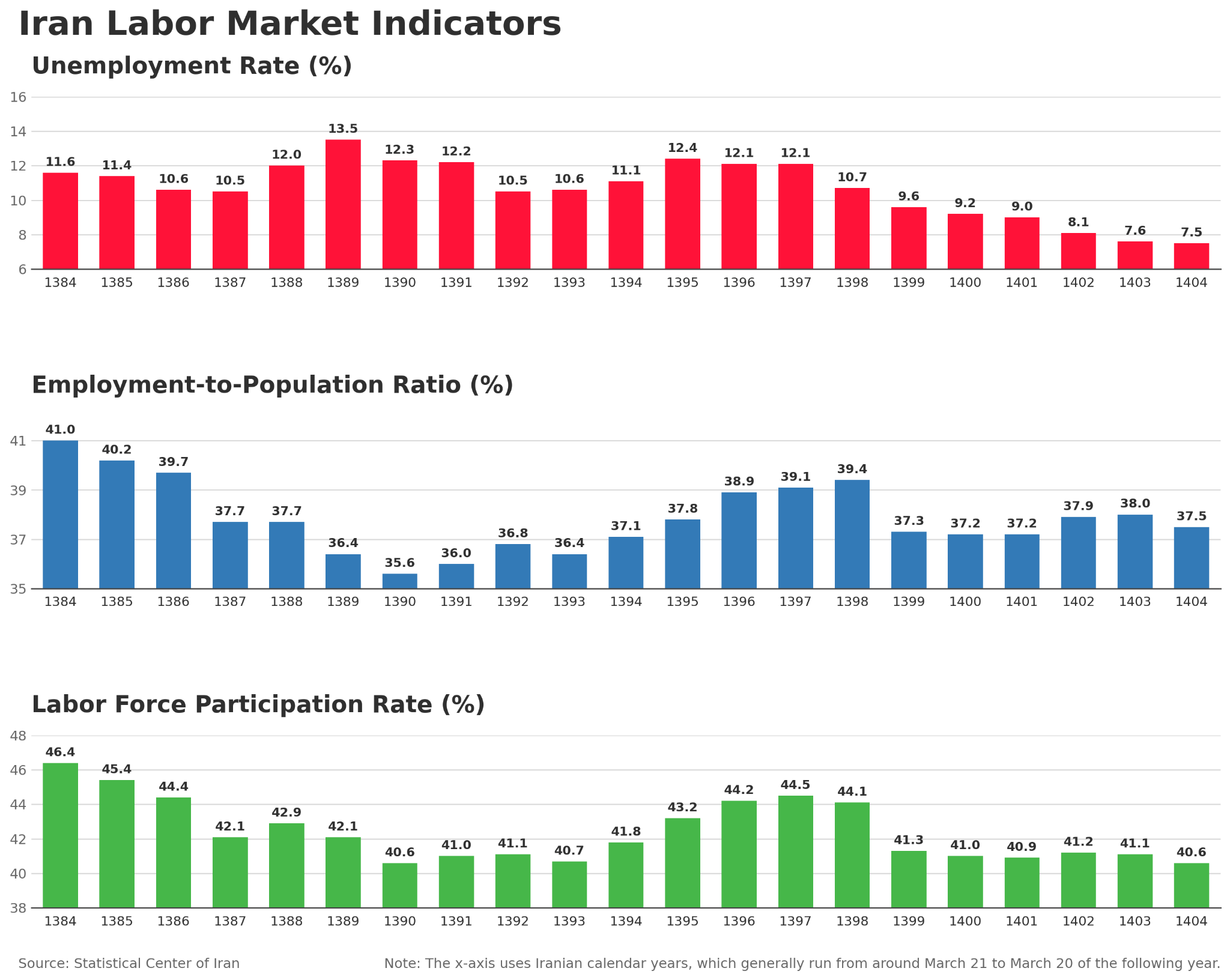
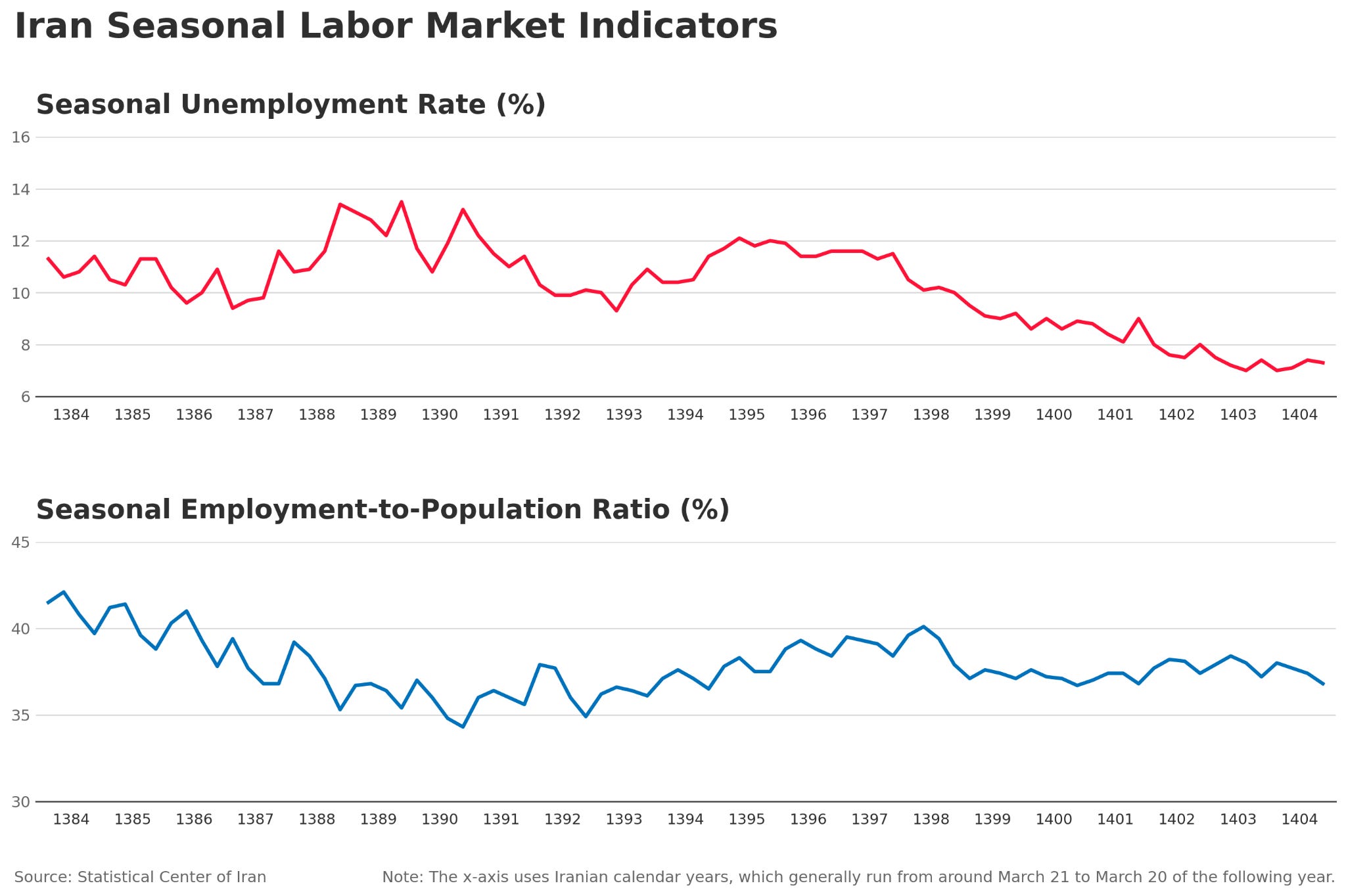
This fall in employment is clearly visible in the employment-to-population ratio, visualized in the chart below. Until 1398 (March 21, 2019 to March 19, 2020), around 40 percent of Iran’s working-age population was employed. By 1404 (March 21, 2025 to March 20, 2026), this figure had fallen to about 37.5 percent, a decline of 2.5 percentage points, which is a large number when measured against the size of Iran’s population.
But why has the labor force participation rate, or people’s willingness and readiness to work, declined?
The most important factor is prolonged economic stagnation, particularly in sectors that traditionally create jobs. Iran’s economic crisis has pushed many people who previously participated in the labor market out of it, especially those who were unable to find suitable work.
Under normal economic conditions, some of these people would likely be counted as unemployed. Instead, after prolonged unsuccessful job searches, they have lost hope in finding a job and have decided to leave the formal labor market altogether. At the same time, low wages in formal employment may have made work financially unappealing for many people, leading some to leave the formal labor market or turn to informal work, which is generally more precarious and falls outside official labor protections.
In these conditions, the decline in the unemployment rate is highly misleading. Rather than demonstrating a booming labor market, it coincides with a shrinking workforce and lower formal employment.
No posts
Comments
Nothing yet. Say the first thing.
Sign in to join the conversation.