
Summary
It has been claimed by Iranian media as well as some international outlets, that between 10 million and 24 million people attended Ali Khamenei’s funeral events in Tehran.
Factnameh’s calculations show that the largest documented crowd at Tehran Mosalla was the crowd gathered for the funeral prayer. The crowd stood across an area of about 150,000 to 160,000 square meters, measured using Map Checking and aerial images published by Iranian media.
The measured area included the courtyard, prayer hall, passageways, nearby streets, and other accessible spaces. Based on images of the funeral prayer, the average density was about two people per square meter, putting the peak crowd at around 300,000 people.
The Mosalla ceremony lasted around 40 hours, but the site was not packed with dense crowds the entire time. Even if total visitors were two to ten times higher than the peak funeral-prayer crowd, total attendance would fall between 600,000 and 3 million. It cannot reasonably be higher.
For the funeral procession on Azadi Street, Factnameh’s review of Iranian media and satellite imagery indicates the crowd numbered at most several hundred thousand.
The total area along the route from Imam Hussein Square to Azadi Square is about 605,000 square meters, including sidewalks, bus lanes, urban infrastructure space, and 50-meter extensions at major intersections.
High-quality aerial photos show an average density of less than one person per square meter. Based on that density, the crowd on the procession route was at most around 600,000 people.
Satellite images also show scattered, low-density crowds. At least when the vehicle carrying Khamenei’s body passed Sharif University of Technology, the crowd was not dense. The change in the funeral time and route may have caused some participants to leave before the procession passed, and crowd movement means the total number of participants may have been higher than the number visible in one image. Even with those points considered, it is unlikely that the procession crowd exceeded one million.
Tehran municipality claims 17 million trips in 48 hours (11 million by metro), which appears highly inflated and contradicts its own data: average daily metro use is ~1.5 million, with a maximum projected capacity of 3.5 million.
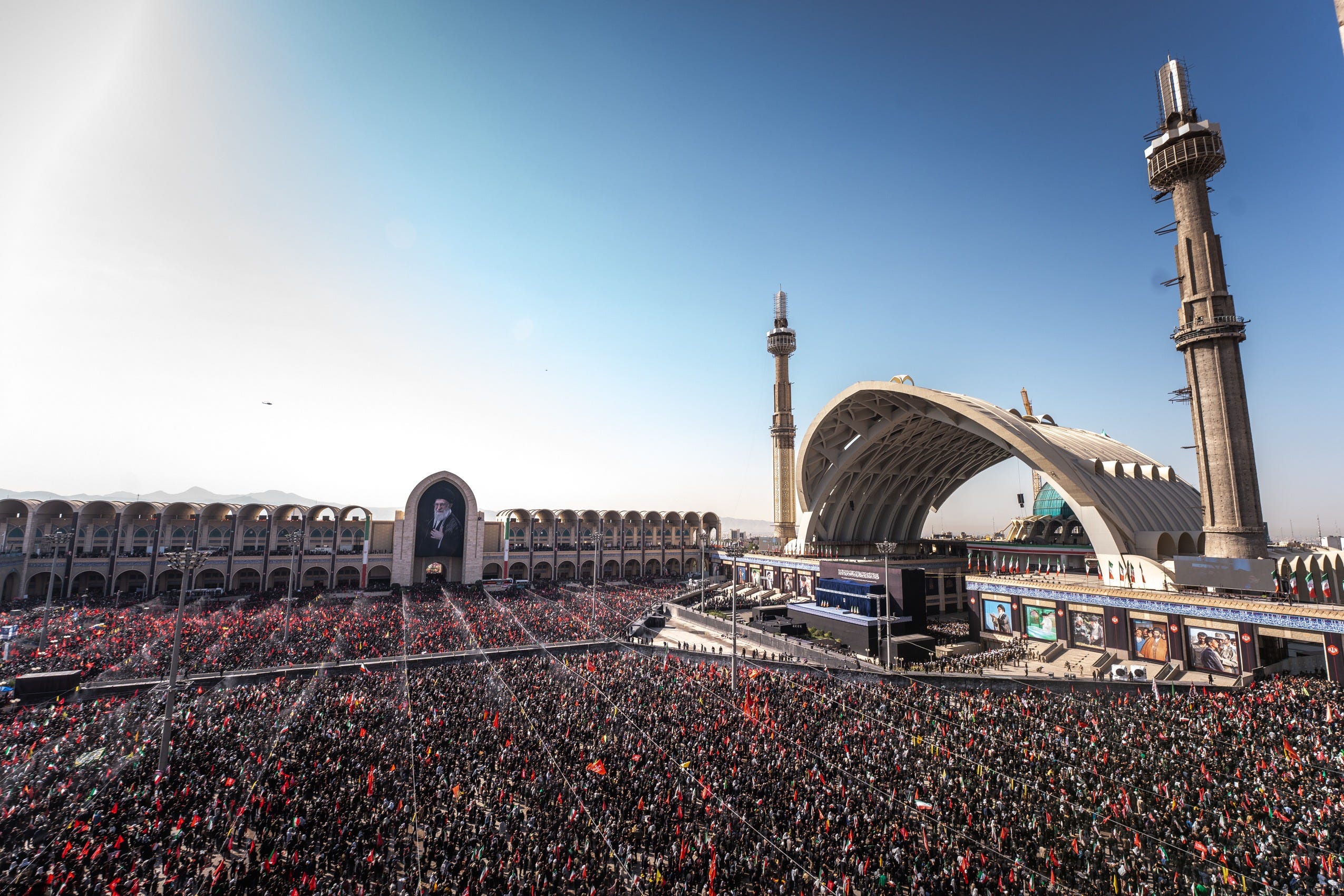
It has been claimed that between 10 million and 24 million people attended Ali Khamenei’s funeral ceremonies in Tehran. Some foreign media outlets also repeated these figures, creating the impression that millions of people were present during the funeral events held between July 4 to July 6.
These figures are not accurate, however, as most of them are based on flawed assumptions and incorrect estimates. To understand why, it is necessary to look at each part of the funeral separately.
The funeral ceremonies in Tehran were organized in two parts. The first was a public farewell ceremony at Tehran Mosalla, a large religious and public event complex in the city. Mourners were invited to view Khamenei’s body there. The second was a street procession through central and western Tehran.
The same funeral events were described with widely varying attendance figures, as evidenced by the following claims.
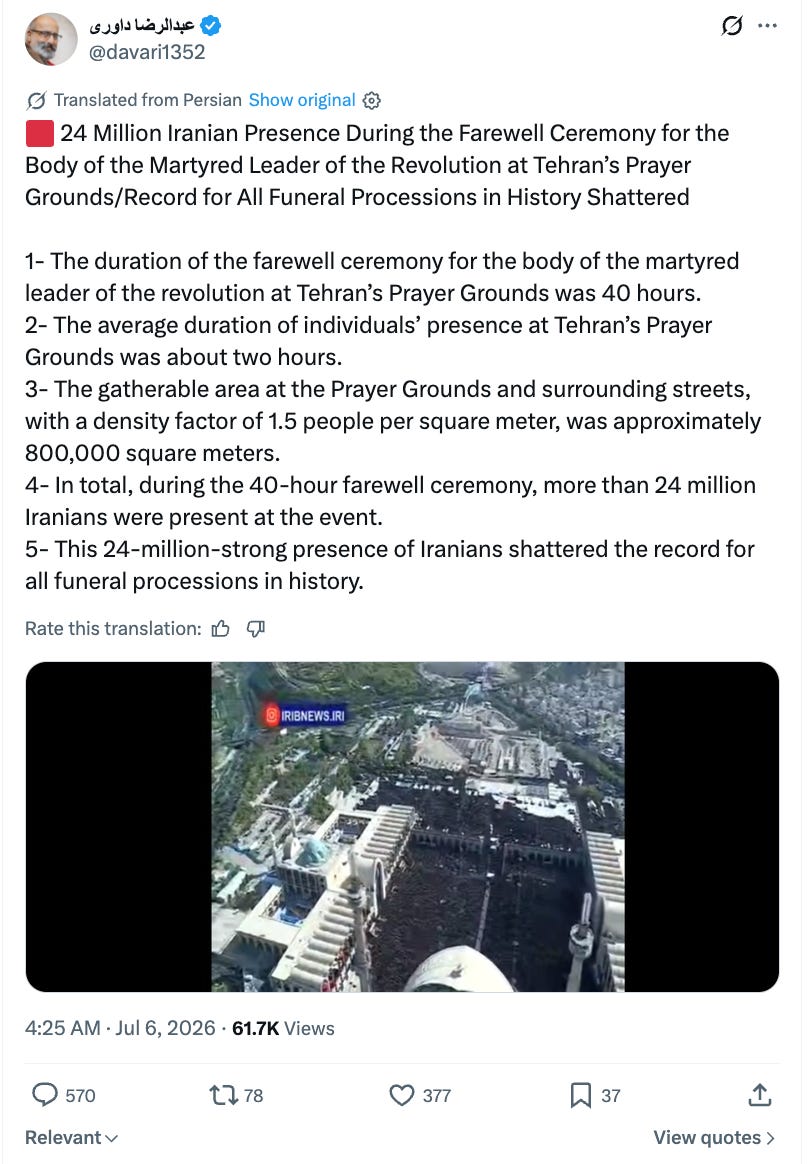
One came from Abdolreza Davari, a former manager at the Islamic Republic News Agency and a political commentator known for promoting conspiracy theories. In a post on X, he claimed that the Mosalla ceremony alone drew 24 million attendees.
Another claim came from Iran Observer, an English-language pro-Iranian account with over 860,000 followers. In a tweet citing Al Jazeera, it claimed that around 12 million people took part in Khamenei’s funeral.
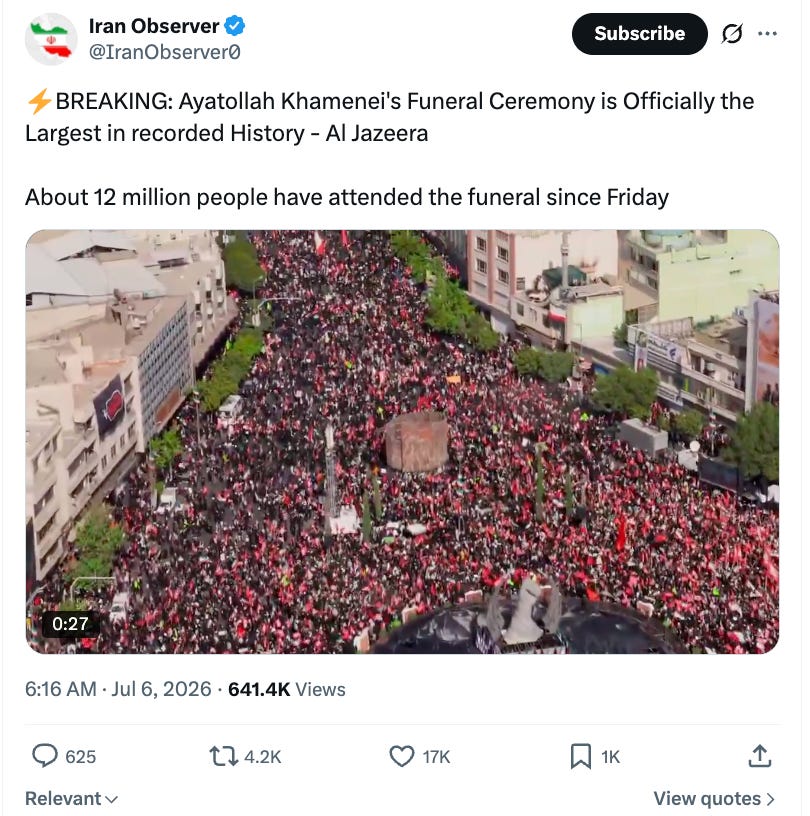
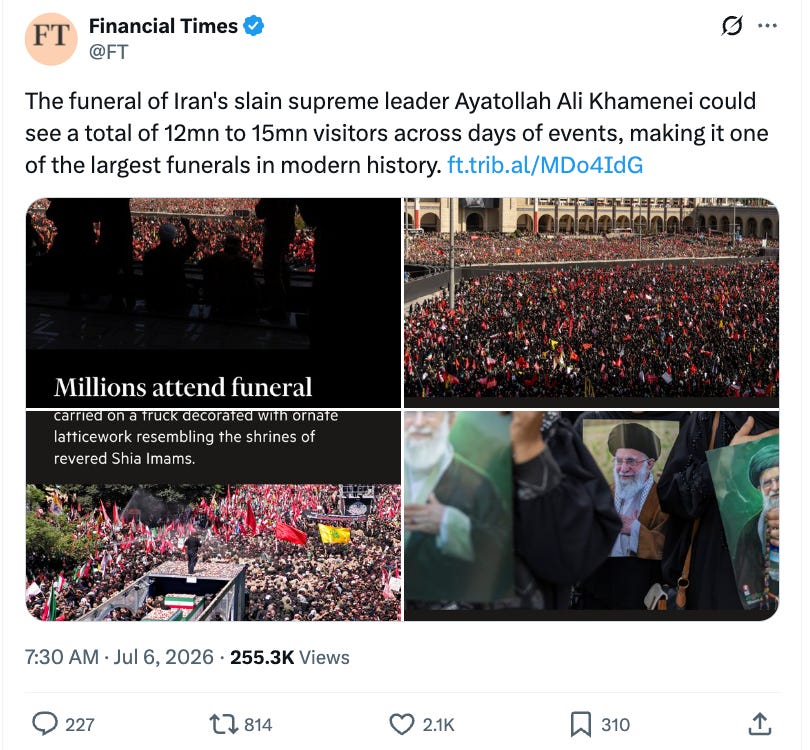
However, it is unclear which Al Jazeera report Iran Observer was referrencing. Some international media outlets also repeated Iranian officials’ expectation that between 10 million and 15 million people would attend Khamenei’s funeral events over six days, but they did not independently confirm that such a crowd had actually attended.
The Financial Times was one such example. Rather than reporting verified attendance, it cited Iranian officials’ number of 10-15 million expected participants.
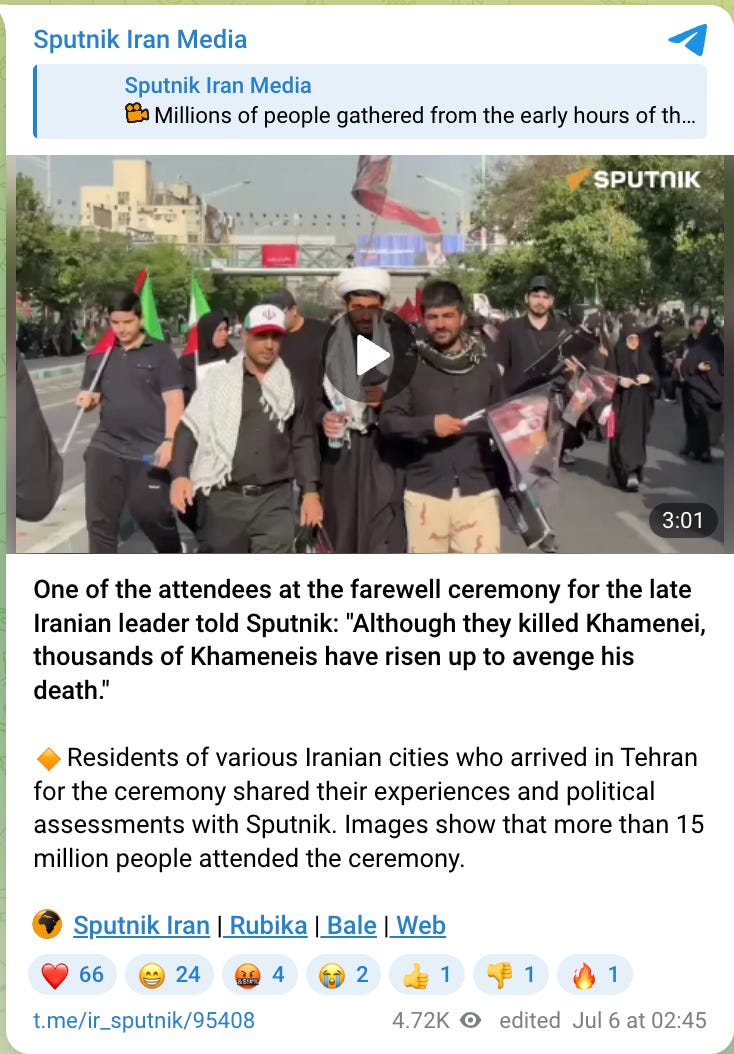
The Persian service of Russia’s Sputnik also claimed in a Telegram post that more than 15 million people attended the ceremonies in Tehran during the first three days alone.
Factnameh’s analysis indicates that around 300,000 people were present at Tehran Mosalla during the funeral prayer.
The public farewell ceremony at Tehran Mosalla began at 6 a.m. on July 4, 2026, and continued until 10 p.m. on July 5. During this period, members of the public were invited to pay their respects to the former leader of the Islamic Republic.
The ceremony lasted around 40 hours. For its calculation, Factnameh used the event’s peak attendance, the 8am funeral prayer on July 6, as the reference point. At its peak, the crowd stood in a dense formation across an area of about 160,000 square meters.
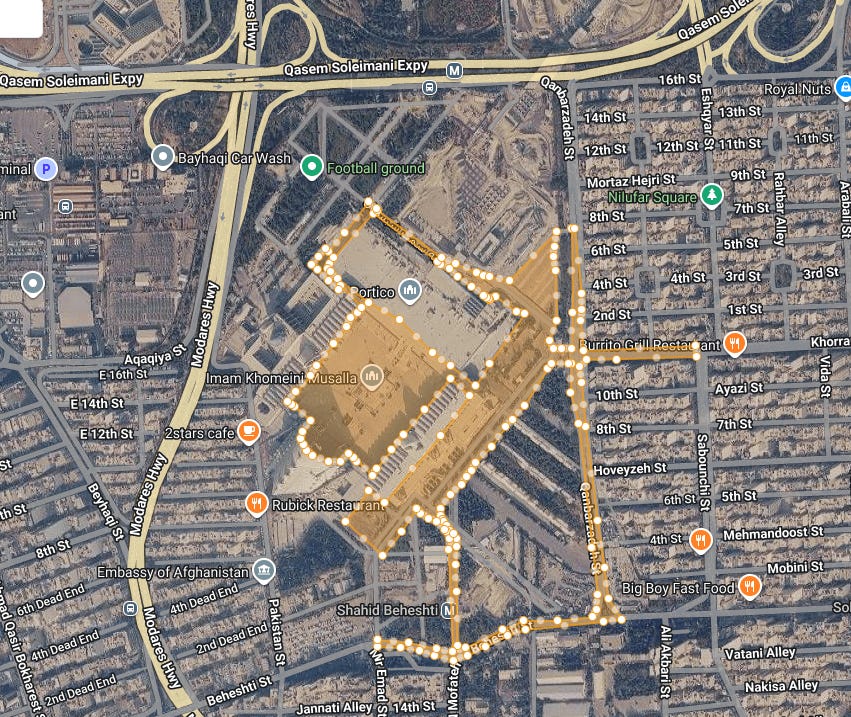
This area included the courtyard, the prayer hall, and the access routes leading to the prayer area. It also included nearby streets such as Qanbarzadeh Street, Khorramshahr Street, and Shahid Beheshti Street.
Factnameh measured the area by matching maps with two aerial videos recorded shortly before the funeral prayer. One video was broadcast by Iranian state television. The other was jointly published by the Instagram account “Badragheh Agha,” meaning “Farewell to Agha,” and the Iranian government information website.
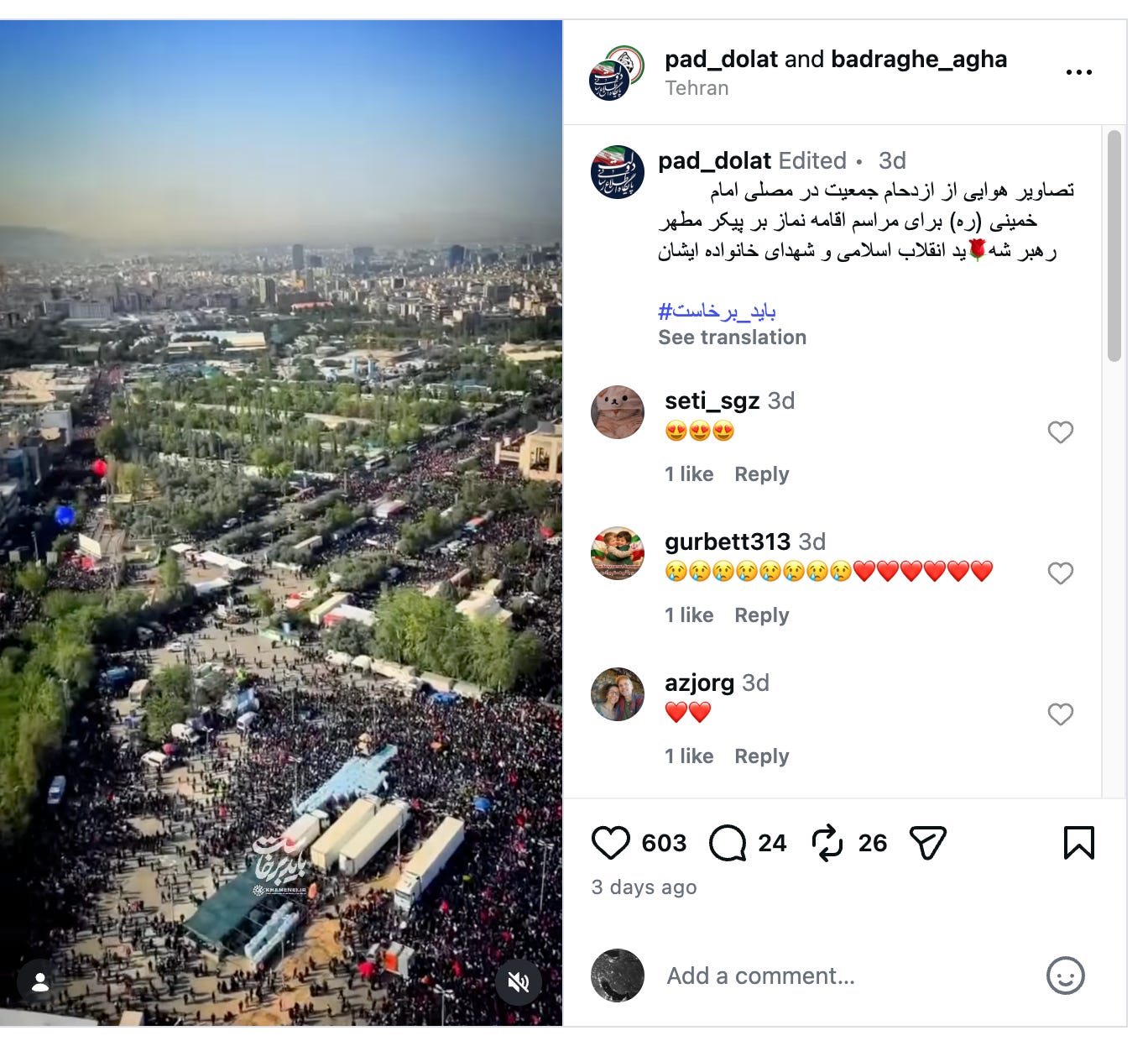
Based on the density visible in the images, the average crowd density was about two people per square meter, producing an estimated total of about 300,000 people. This estimate assumes around three people per square meter in the front rows and around two people per square meter in the back rows.
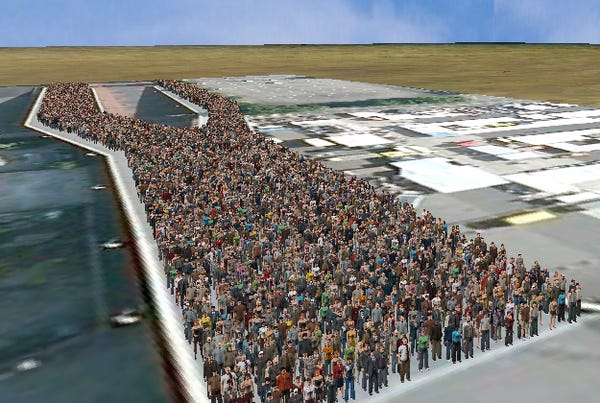
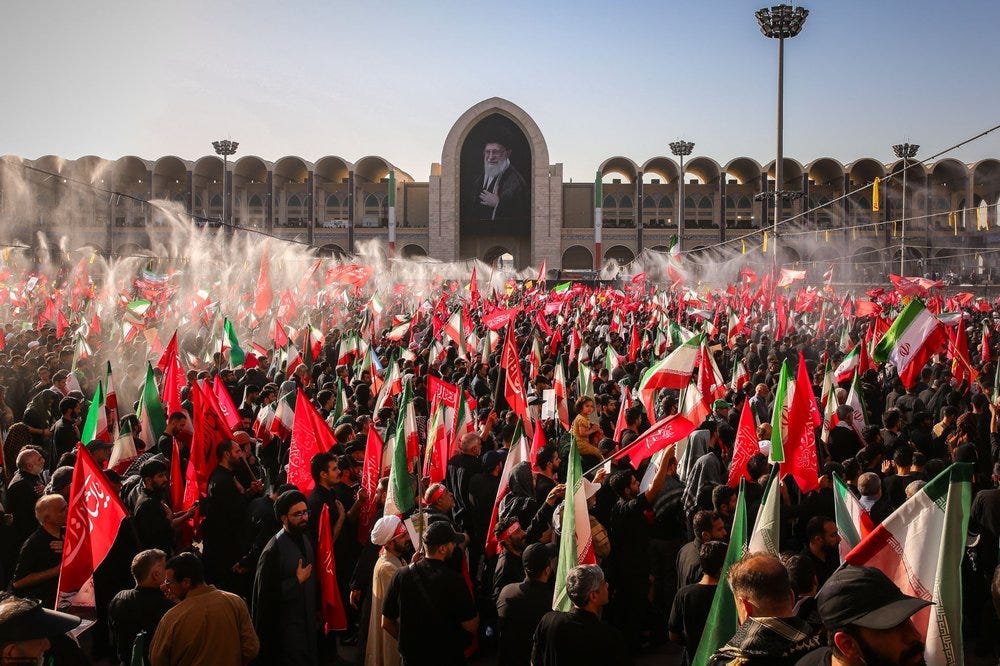
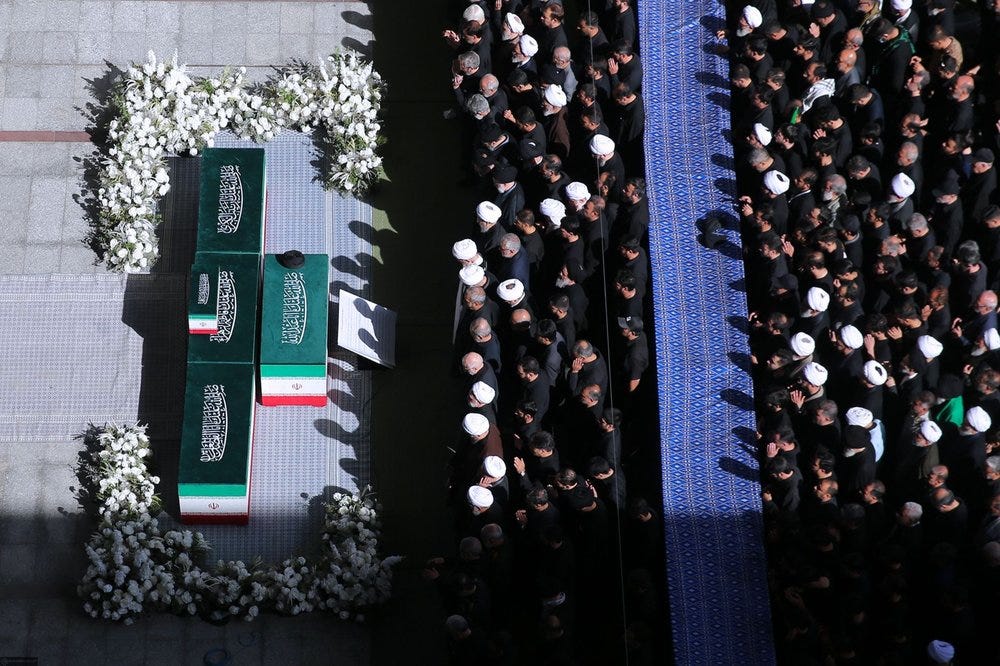
The funeral prayer, however, was only one moment during a longer ceremony that lasted approximately 40 hours, with people arriving and leaving throughout. Since there is not enough information to know exactly how many people entered and exited Mosalla, the overall attendance can only be estimated by modelling a set of plausible scenarios.
The duration of the event and the size of the venue make it difficult to estimate how long attendees stayed or how quickly the crowd turned over. However, the funeral prayer was the ceremony’s central event, and many of those who visited Mosalla were likely there specifically for that moment.
For that reason, the scenarios can be framed around a single question: What proportion of everyone who visited Mosalla were present during the funeral prayer?
If half of all visitors were present for the prayer, total attendance would be about 600,000.
If one in four visitors attended the prayer, total attendance would be about 1.2 million.
If one in six visitors attended the prayer, total attendance would be about 1.8 million.
If one in ten visitors attended the prayer, total attendance would be about 3 million.
Under these scenarios, total attendance at Mosalla over the two-day event could range from roughly 600,000 to 3 million people.
Although this is a wide range, it remains far below the figures circulated online and repeated by several media outlets.
One widely viewed Instagram post by supporters of the former Supreme Leader, for example, claimed that at least 14.5 million people attended the Mosalla ceremony.
The post began by claiming Mosalla’s total area is approximately 630,000 square meters, then deducted half for buildings and columns, leaving 300,000 square meters of usable space. Assuming a density of two people per square meter, the post estimated that 600,000 people could be present at any given time. It then assumed the ceremony lasted 48 hours and that each attendee stayed for no more than two hours, allowing for 24 complete crowd turnovers. Multiplying 24 by 600,000 produced an estimated attendance of 14.4 million.
This calculation rests on several flawed assumptions.
The first problem is the area. The post uses the full Mosalla area of about 630,000 square meters as its base. A more precise calculation shows that the crowd occupied about 160,000 square meters at its peak.
The calculation also assumes that 600,000 people filled the site continuously for 48 hours, with the entire crowd replaced every two hours. In reality, the ceremony lasted 40 hours, the venue was not filled to peak capacity throughout the event, and crowd density varied considerably during that time.
According to Khamenei’s “farewell headquarters,” the original plan was for his body to be carried from the Damavand Street area near Imam Hussein Square to Shahid Lashgari Expressway near Azadi Square, at the start of the Karaj Jade-Makhsoos highway.
That plan changed on the morning of the ceremony. Instead, the former leader’s body was carried from the Yadegar-e Emam intersection to Azadi Square.
However, evidence suggests that many participants had already gathered along the original route. Large crowds were positioned before Enghelab Square and along Azadi Street, and many did not manage to follow the vehicle carrying the body. In practice, the crowd was spread between Imam Hussein Square and Azadi Square.
Factnameh’s estimate therefore uses this entire stretch. In previous years, Factnameh had calculated the crowd capacity between Imam Hussein Square and Azadi Street for the funerals of Qasem Soleimani and Ebrahim Raisi.
The total area between Imam Hussein Square and Azadi Square is approximately 605,000 square meters. This includes bus lanes, vehicle lanes, sidewalks, water channels, and urban infrastructure space. It also includes the open areas of Imam Hussein Square, Ferdowsi Square, Enghelab Square, and Azadi Square, as well as 50-meter extensions at major intersections.
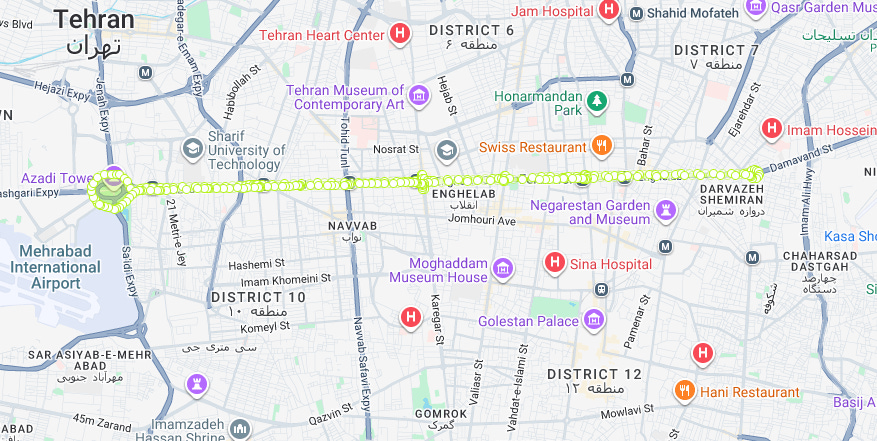
Estimating the crowd size across this area depends primarily on average crowd density.
Most images published by Iranian media are not clear enough for a reliable density estimate. Aerial images broadcast by Iranian state television make the funeral route appear packed, but do not provide enough detail to measure the entire crowd accurately.
A video of the crowd at the funeral procession published by SNN TV (Student News Network).
These images do confirm that participants were present along Azadi Street. For example, one photo published on khamenei.ir shows people standing in the street from before Vali-e Asr intersection toward Azadi Square.
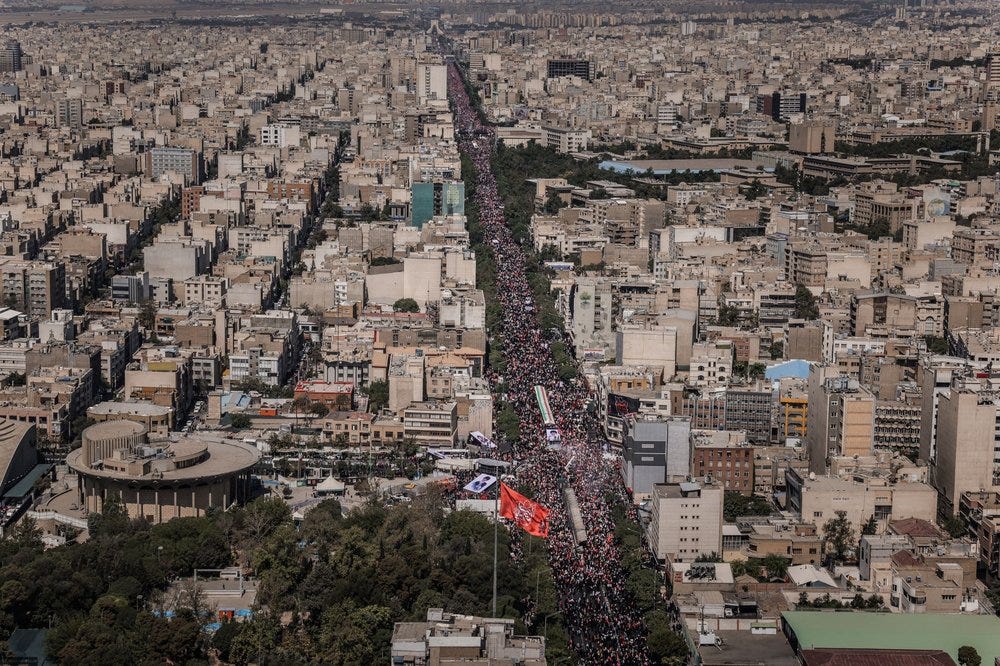
Even if this same crowd is extended to earlier sections of the route (before the Vali-e Asr intersection), the total estimate remains dependent on density. With an average density of one person per square meter, the funeral procession would reach around 600,000 participants. This estimate is equal to the full 605,000-square-meter area from Imam Hussein Square to Azadi Square, including all street spaces and crowd extensions at major intersections.
Some may assume the average density was higher than one person per square meter. However, details in the image around Vali-e Asr intersection suggest that even one person per square meter is generous. A cropped section of the same image shows that some parts of the intersection contained fewer than half a person per square meter. Density was likely even lower in earlier sections of the route.
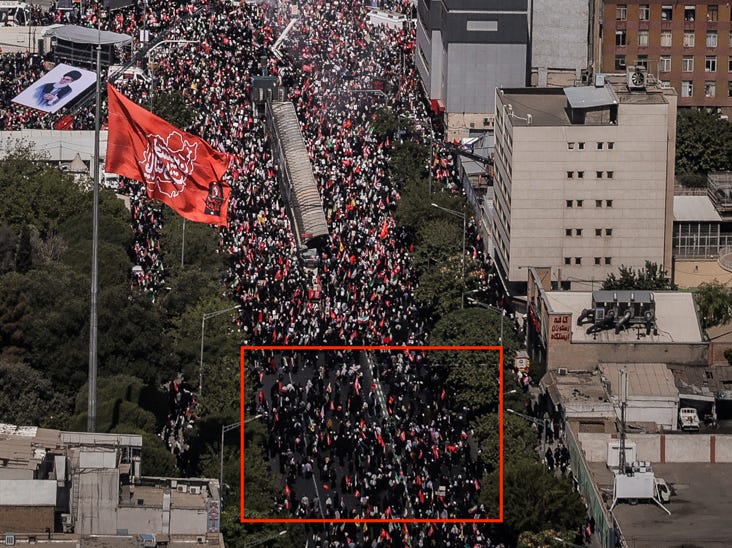
In reality, high-density crowds were limited to certain areas, particularly near the vehicle carrying the coffin and around some intersections. Satellite imagery also shows scattered crowds along much of the route.
When the vehicle carrying Khamenei’s coffin passed in front of Sharif University of Technology, for example, areas such as Ferdowsi Square and Vali-e Asr intersection did not appear densely crowded.
Farzad Seifikaran, a BBC Persian journalist, also published four high-resolution satellite images covering parts of the route. These images show Imam Hussein Square, Azadi Street, and the area from Sharif University to Azadi Square.
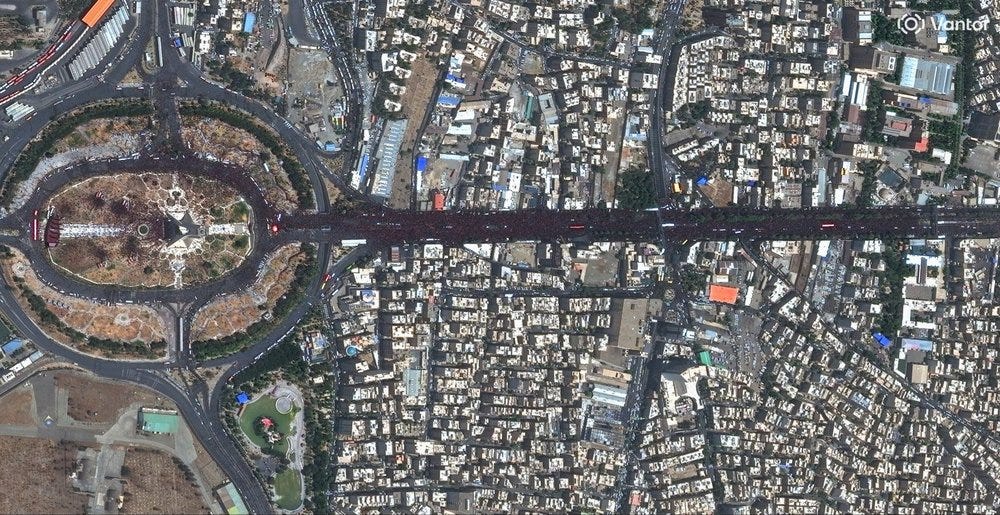
The clearest image for assessing crowd size is the one showing the Azadi Square area. It clearly shows that relatively few people were in the square itself. The street crowd was denser, especially after the Ostad Moein intersection.
A comparison between the satellite image and a photo published on Khamenei.ir indicates that the satellite image was captured as the vehicle carrying the body was about to enter Azadi Square. This places the BBC journalist’s and Reuters’ satellite images at the time of the funeral procession.
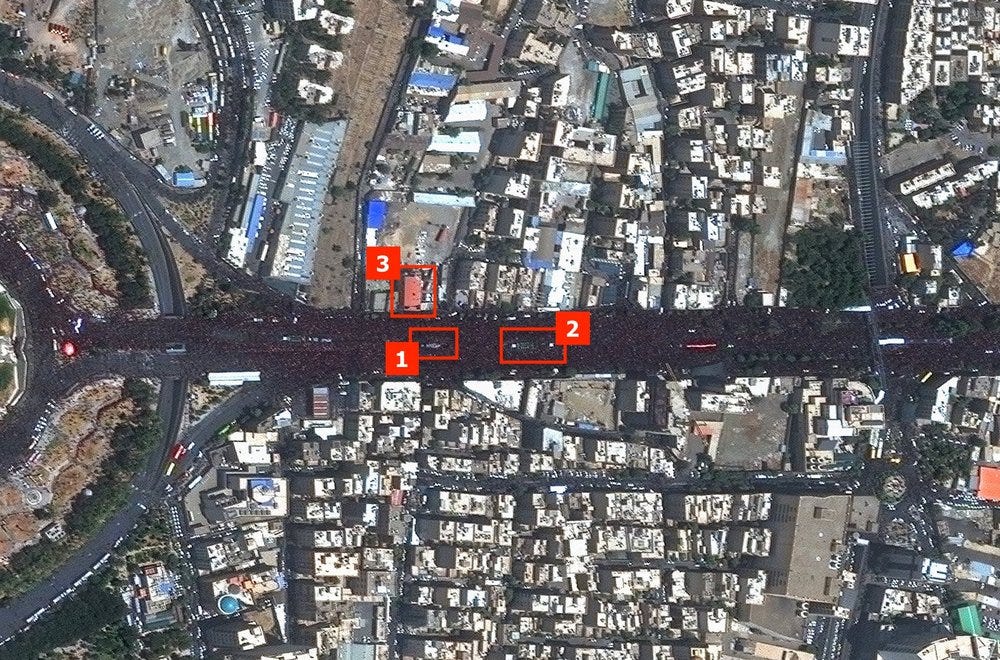
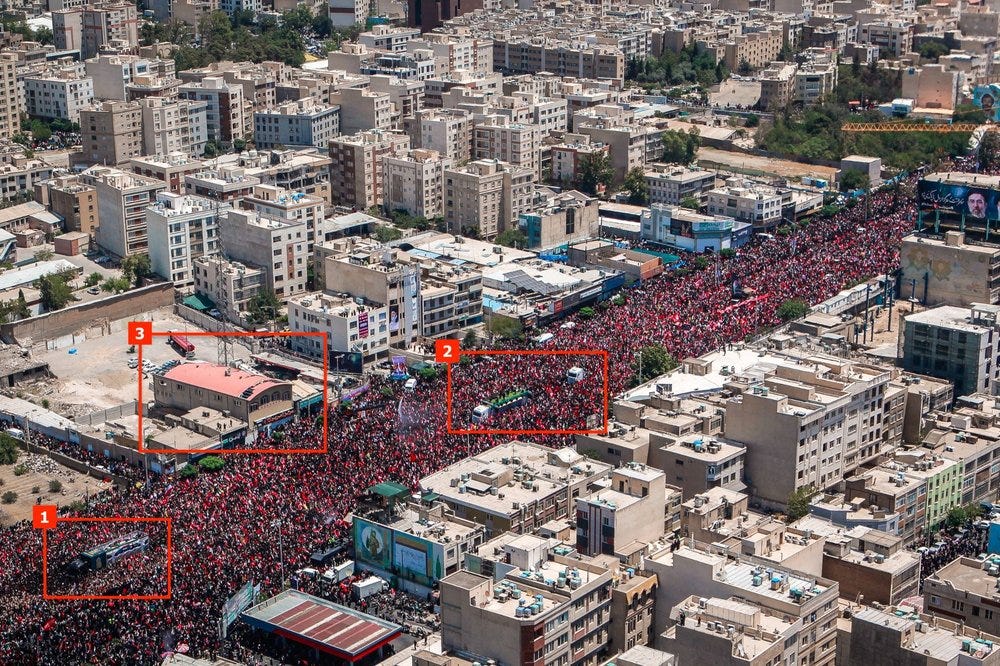
The change in the funeral location and route likely caused some participants to leave before the procession passed. Even taking these factors into account, available evidence indicates that the number of people present along the procession route was in the range of several hundred thousand, not the multi-million figures that have been claimed.
Some attendance claims relied on Tehran Metro figures as evidence that millions had travelled to Mosalla. On July 5, Fars News Agency reported that 7.1 million metro trips had been recorded between the morning of July 4 and 7 a.m. on July 5. Tehran Metro official Hamidreza Gholamzadeh later claimed that more than 6 million people had attended the Mosalla ceremony by that morning, based on more than 9 million metro passages and other forms of transportation. By the following day, Tehran Municipality officials claimed that more than 17 million metro and bus trips had been recorded over 48 hours, including around 11 million metro trips.
These figures raise serious questions because they exceed Tehran Metro’s stated capacity by a wide margin. Mehdi Babaei, head of the Tehran City Council safety committee, was quoted by IRNA as saying that the system currently handles about 1.5 million trips per day, with capacity expected to rise to 3.5 million after further expansion. Even higher estimates cited by Tehran Metro managers place current capacity at around 4 million trips per day. These figures remain fairly below the reported funeral-related metro numbers, suggesting that the transportation data cannot independently support claims that millions attended the Mosalla ceremony.
No posts
Comments
Nothing yet. Say the first thing.
Sign in to join the conversation.