
Before you read on, do note the following, which is relevant to understand who’s doing the interview with the Serbian president: Mathias Döpfner isn’t just the CEO of one of Germany’s largest legacy media conglomerates the Springer Group), he’s also, as per that spook-infested repository of the juste milieu’s common wisdom (drum roll):
So much for the hors d’oeuvre, let’s get to the main course, shall we?
Translation, emphases, and [snark] mine.
By Filipp Piatov, via Die Welt, 9 Aug. 2026 [source; archived]
Serbia is considered a pro-Russian country, hence Ukrainian President Zelensky’s visit to Belgrade came as a surprise. In an interview with Axel Springer CEO Mathias Döpfner, Serbian President Aleksandar Vučić warns of a potential fiasco [their words, not mine].
As one of the few heads of state in the world, Serbian President Aleksandar Vučić maintains contact with both Russian dictator Vladimir Putin and Ukrainian President Volodymyr Zelensky [note the framing: Mr. Putin is a dictator while his Ukrainian counter-part whose term in office has long expired, is a president]. Following Zelensky’s first visit to the Serbian capital, Belgrade, Vučić expressed concern that Europe could be on the brink of an even larger war.
In the latest episode of MD MEETS, the podcast by Axel Springer CEO Mathias Döpfner, Vučić said:
I believe we are at the beginning of a major war. And that’s why I had hoped that someone else would have done something by now to bring about peace. That hasn’t happened, and it won’t happen anytime soon, which means we are on the brink of a much, much bigger war [the purpose of a system is what it does; the mere fact that no-one works towards ‘peace’ is telling in and of itself; merely pointing out the obvious, the Mr. Trump fan crowd (if there are still some ‘round) would have to chime in on how the ‘I’ll end the war in 24 hours’ thingy is going …].
Vučić’s reception of the Ukrainian president surprised the international community and triggered fierce criticism in traditionally pro-Russian Serbia, as well as in Russia [note the framing once more: ‘the int’l community’ is surprised, hence Mr. Vučić talking to someone ‘triggered fierce criticism’]. Russian propagandists accused the Serb of betraying the partnership with Russia and aiding Ukraine in its war against Russia through economic agreements [there are, needless to say, no ‘propagandists’ in Western media, politics, and governments; silly you and me, that kind of agit-prop has long been outsourced and is now run through the EU Commission:
Needless to say, the EU is lightyears ahead of a mere state actor, such as Mr. Putin’s Russia! Russia! Russia!].
Ukrainian government officials declared the visit an attempt to drive a wedge between Russia and Serbia—a ‘slap in the face for the Russians’.
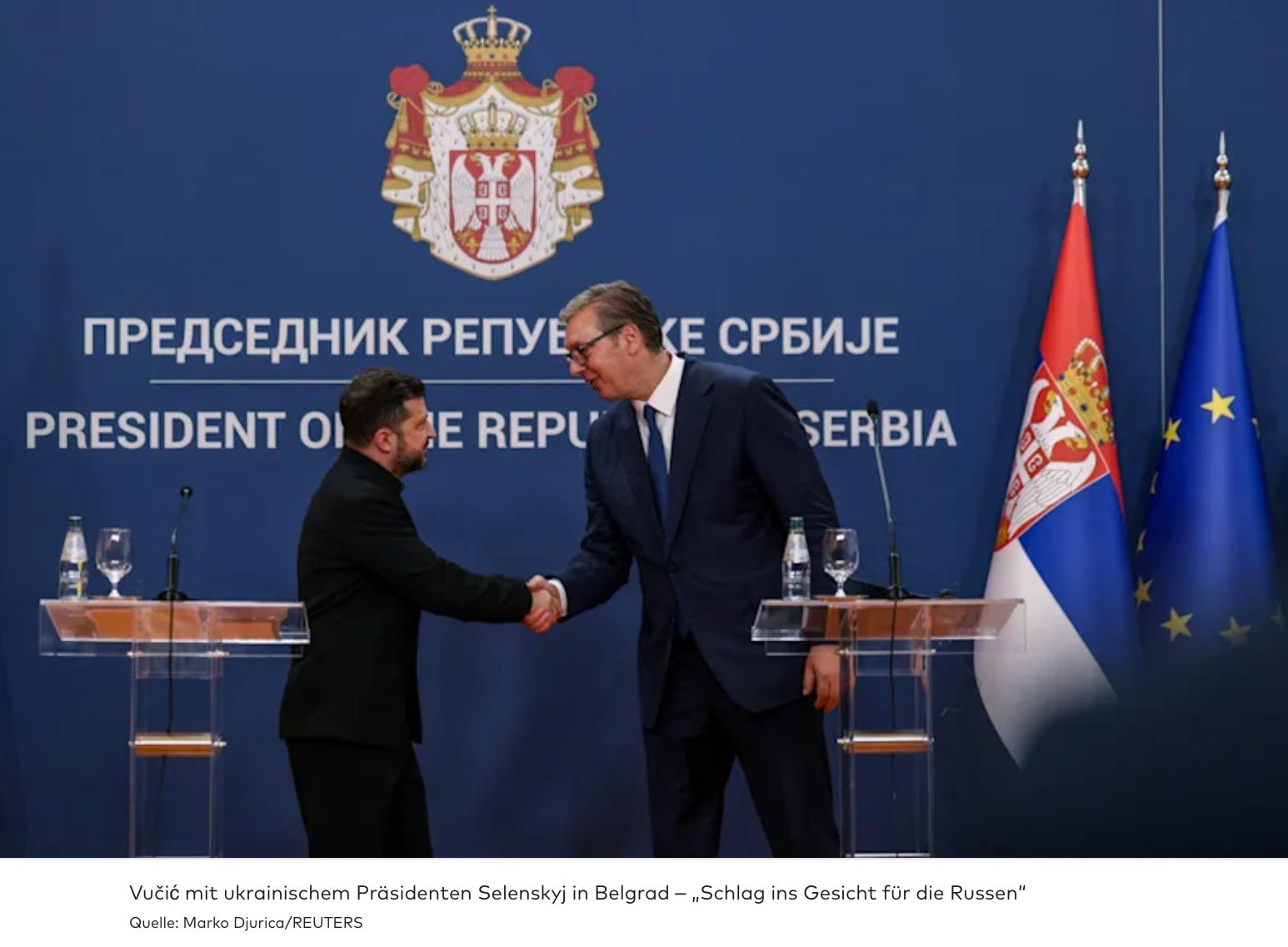
In the interview with Döpfner, Vučić defended himself: ‘I’m not here to please the Russians, Ukrainians, or anyone else—except the Serbs.’ [it’s almost tragicomically ironic that he said this speaking to a German™ CEO who’s a close buddy of Mr. Netanyahoo and as staunchly pro-Zionist as they come; as an aside, if, say, a German politico™ would say something like this, he or she is, of course, a NADSI]. He said he hadn’t informed Russian leader Putin before Zelenskyy’s visit:
I didn’t speak with him because I don’t announce my political agenda to anyone, since Serbia isn’t a puppet of any other country in the world [I kinda like Mr. Vučić speaking like this, especially to someone like Mr. Döpfner].
Regarding Vladimir Putin, with whom Vučić said he had spoken ‘21 or 22 times’, the Serb stated that he had ‘less contact with him recently than before.’
The Serbian president acknowledged that Ukraine ‘has demonstrated its actual ability to defend itself’ [have they? I mean, the Ukrainian population has collapsed by as much as around 50% since 2021, which means that the country labelled thus may no longer exist but in the imaginary (I don’t mean to make any value-judgement here, but this case study might be the first such mass-casualty collapse situation since the Black Death):
Ukraine was losing some 300K people per year since the early 1990s due to out-migration; territorial losses since 2014 and, of course, the fight vs. Russia since 2022 have exacerbated this situation massively].
However, he added that Moscow had lost influence in the region over the course of the war:
It was inconceivable to me that Russia could lose a certain degree of influence in both Caucasus republics, Azerbaijan and Armenia.
[since nature abhors a vacuum, who gained influence there? I’ll let Foreign Affairs tell you the gist (26 May 2025, source; archived):
Following successful wars in 2020 and 2023, Azerbaijan has finally reincorporated Nagorno-Karabakh as well as seven adjacent districts that had been occupied by Armenian forces since the early 1990s. It has also gained a decisive upper hand against Armenia. Meanwhile, distracted by the war in Ukraine, Russia has ceded much of its former regional influence to Azerbaijan; and with Moscow cut off from Western markets, Azerbaijan has risen in importance as a global energy supplier, including to Europe. At the same time, it has strengthened ties with both Turkey and Israel, expanded its diplomatic and economic footprint in Central Asia, and increased its presence in the Middle East—staking out broader regional ambitions. The Azerbaijani government also appears to have favorable relations with U.S. President Donald Trump …
Plus there’s the entire absurdity of esp. the Azeri gov’t waging, back in 2020 and 2023, wars of aggression against its (smaller) neighbour, Armenia—and, unlike the Russian-Ukrainian quagmire, being championed by both the US and EU, to say nothing about the Israeli connection, of quite some relevance to both—with massive investments/procurement of Israeli arms playing a key role for Azerbaijan (perhaps even the key to victory over Armenia), to say nothing about oil supplies to Israel and, of course, the strategic position of Azerbaijan on Iran’s northern borders:
Yet, as nothing has to do with anything, I’m sure all of these things are, of course, entirely coincidental and don’t have any bearing on these things whatsoever]
Vučić acknowledged that the leaderships of Ukraine and Russia were ‘under immense pressure’. He stated that ‘it is not easy for anyone when you lose dozens or hundreds of soldiers every day’. His prognosis for the war, following Zelenskyy’s visit, was pessimistic:
I don’t see an end to the war this year. I don’t see an end to the war before next spring. I’ll tell you why: because I believe that one side must be stronger and victorious—in one way or another—for the war to end. Otherwise, given the current stalemate, I see no possibility for compromise solutions.
Vučić cited the unwillingness to compromise as the reason for the stalemate:
If you analyse today’s situation, I believe that no one wants to see peace. Everyone wants to see the defeat of the other side.
The Serbian head of state strongly warned against seeking Russia’s defeat and called for everything to be done to bring about a ceasefire, which Russia strongly rejects:
I would not wait for the complete exhaustion of Russian troops. I would not wait for a certain point in time when we believe that Russia will become significantly weaker as a result of this war in Ukraine. I don’t know how to win against Russia, because I don’t think it will happen easily. After all, Russia is a nuclear power and cannot easily be attacked by anyone. And we need a compromise solution, not the defeat of either side [do check out Russian demographics, which look about as bleak as they do for European countries, but with a twist: mass immigration into Russia, partially offsetting population decline, originates mainly from the former Soviet republics in Central Asia (which means the Islamisation, the most likely outcome, appears about the same)1].
When asked by Mathias Döpfner about Russia’s attacks in European countries, Vučić took Moscow’s perspective. Russia’s ‘hybrid war’ against Germany and other European countries is ‘basically the same thing that Europe did against Russia’. [why, oh why™, is no-one ever asking about, say, US ‘hybrid war’ against Germany and other European countries, as well as, you know, every other country on this planet?] Vučić said:
You have armed Ukraine and imposed sanctions on Russia. At the same time, you have supported Ukraine financially—what is this if not a hybrid war against Russia?
Nevertheless, Vučić agreed that it was not Ukraine that started the war against Russia and therefore perpetrators and victims should not be confused [no comment].
First of all, here’s the interview/podcast Mr. Döpfner did with Mr. Vučić:
Next up, let’s acknowledge what we all know so far:
the subversion of European (and in particular German) society has progressed to such a degree that someone like Mr. Döpfner is kind of a champion for the juste milieu
this situation is mirrored, to a large extent, by the role of big business (finance and tech) in the US, with people like Palantir’s Peter Thiel—also a German™ and arch-Zionist—serving perhaps as the ideal poster child from Silicon Valley (not that this example would be exceptional among their ilk)
Döpfner allegedly runs a multi-national media conglomerate, yet he somehow™ has the time to host his own podcast; let’s not forget that there are some podcasters who do this for a living (and ‘only’ podcasting, not also running the Springer Group or the like), which indicates that someone or something else is actually doing that CEO thing
Setting aside the personal aspects here, let’s briefly revisit the main geopolitical take-aways:
no-one wants ‘peace’ in Ukraine
for whatever reason, the US and Mr. Trump seem to get away quite scot-free, with the implied Azeri-Israeli connections being the most telling sign of Mr. Döpfner’s true allegiance
Mr. Vučić, correctly, called out what the US and EU are doing a ‘hybrid war against Russia’, yet he shies away from stating the obvious (which I can do as I’m not presiding over a small country trying to survive)
the élites’ aim is the destruction of countries and peoples that might object to their aim of world domination; this is fairly advanced in Europe (since WW1) and Japan (since WW2), with Russia being next (tho more an empire, hence it’s harder to do) before the main course, China
What about the implications here?
Most of the German media and political establishment is one gigantic blob akin to the US version. That’s neither surprising nor an accident, for it’s the consequence of sustained US occupation since 1945.
It’s one of the core aspects of US ‘foreign policy’ to ever so often chastise Europeans to ‘do more’ for their own security or whatever; at the same time, virtually no-one who’s alive today in Western Europe remembers a time when Europeans were, in fact, sovereign peoples. (Given the shitshow of European history before 1945, I’m unsure if a return to that kind of politicking would be preferable.)
European politicos™ are effectively wallflowers permissible to the powers-that-be in the imperial capital. To expect them to do and be something else is akin to trying to nail a pudding to the wall, and I’m actually unsure if Mr. Vučić is that different (tho he surely has bigger balls than his European peers).
To wrap this up, I highly recommend Milton Mayer’s They Thought They Were Free (U Chicago Press, 1966, 2017), who has these important lines on pp. 336-7 that explains quite a lot about ‘ze Germans’:
Michel [this is Germany personified, much like Uncle Sam is America] hates Communism-under that name. But Hitler communized him, under National Socialism, and he never knew it. If this process of coming down in the world-not of being down but of coming down-continues, Michel will embrace some new, as yet unconceived “anti-Communism.” But it will be Communism, just as National Socialism was, but more advanced in so far as materials, rising in value as men’s value falls, are increasingly available only in collective form…
What the Germans did in Russia in the late war—and what the Russians did in Germany afterward—stands between them, too. The slogans of anti-Communism, pounded into the Germans by the Nazi Government and later by the American Occupation, these, too, will live for a while. But Frederick the Great and Bismarck, looking eastward, will outlive both the Nazis and the American Occupation. “Everyone knows,” said the realistic Walter Lippmann late in 1954, “that the pull within Germany toward such a deal”—between West Germany and the Soviet Union—“is bound to be very strong, and to become all the stronger as Germany acquires great military power in her own right. The Russians,” he went on, “hold big assets for a deal with the Germans: unification, withdrawal of the Army of Occupation, rectification of the frontiers, resettlement of the expelled refugees, trade, and great political influence in the destiny of Europe.”
You see, Germany today is the outgrowth of these factors, historical and geopolitical, and not a whole lot has fundamentally changed.
Neither in Germany nor with respect to the pivotal role Russia plays, nor with respect to the seemingly unending fears and concerns to the US establishment about such an ‘eastern turn’ of Germany.
In the final analysis, the US must chastise Germany, but it cannot go all-in as doing so might compel Berlin to re-approach Moscow.
While a lot has changed (esp. in regards to the borders, the German refugees from the East), the main aspects—trade and Europe’s destiny—are still up for grabs.
I think at this point, we can clearly see that the Ukraine conflict was a war waged by the US Empire vs. Europe (I think it’s because the EU is the softer target relative to China).
For some more weird stuff from German media, do consider this piece:
This is from Wikipedia’s ‘Demographics of Russia’ entry:
The total fertility rate across Russia was estimated to be 1.37 children born per woman as of 2025,[15] which is in line with the European average[16] but below the replacement rate of 2.1.
By the end of 2024, the natural decline of the Russian population amounted to 596.2 thousand people, according to published data from Rosstat. Compared to the end of 2023, the indicator increased by 20.4% (from 495.3 thousand).[17] However, this decline is offset by massive immigration, particularly from Central Asia.
From 1992 to 2012, and again since 2016, Russia’s death rate has exceeded its birth rate, which has been called a demographic crisis by analysts.[18]
With Russia’s population at around 146m and ± similar trends like in the EU (pop. around 452m), the latter may be able to sustain such a conflict a tad longer (give or take nukes), but the former’s societal cohesion may be greater in the medium to long term.
No posts
Comments
Nothing yet. Say the first thing.
Sign in to join the conversation.