
Every now and then, often at night on Fridays or in the middle of summer, legacy media talks about relevant topics in a professional manner.
This time, the Neue Zürcher Zeitung, Switzerland’s paper of record, took that particular turn, and hence we’ll talk some more about ‘immigration’, too. Needless to say, wealthy Switzerland isn’t alone finding out that this kind of stuff™ costs a ton of money; Norwegian municipalities are there, too:
Note that I’m posting these articles from rich countries to indicate two major things: first, if countries like Switzerland and Norway are buckling under these strains, it’s very likely—and often way, way—worse in other places.
Second, there’s so far no popular groundswell of resistance emerging: heck, here in Norway police is openly discussing™ ending patrols in major cities while crime is sky-rocketing:
First-world problems, I know, but they aren’t merely ‘coming to a place near you soon’; they are already here and there.
Translation, emphases, and [snark] mine.
Tens of thousands of illegal immigrants are in the country, and cantons and municipalities are at their breaking point: how much longer can Switzerland afford this?
By Sebastian Briellmann, Zeno Geisseler, and Simon Huwiler, Neue Zürcher Zeitung, 10 Aug. 2026 [source; archived]
Ceuta, the Spanish exclave in North Africa, seems a world away for Switzerland. While European heads of state (and the EU as well) are calling for tougher measures against illegal immigration and better border protection following the influx of migrants—for example, return or deportation centres in third countries—the reaction here remains muted.
The responsible asylum minister, Beat Jans, recently stated in interviews that the events were tragic because many people had drowned. However, he claimed that the Schengen system had functioned administratively, as ‘no one could travel onward from Ceuta to Europe’. He asserted that there was no indication that asylum numbers were rising in Switzerland.
Despite acknowledging the problems, Jans rejected demands, such as those from the Swiss People’s Party (SVP) for additional border controls: ‘For us, it is crucial that measures are based on a sound analysis, are fact-based, and actually have an effect.’ [ah, here are the two obvious questions: first, who’s doing these evidence-based analyses to establish them facts™? And, second, who’s watching the watchers, so to speak, or: what about (judicial and other) review?] Jans also emphasised the good cooperation with Morocco and said that a partnership is more effective than more ‘pressure and coercion’. [wonderful that everybody is on good terms with Morocco, but it’s also quite besides the point: what ‘pressure and coercion’ could be applied? We already knew that logics isn’t exactly the strong suit of politicos™ or journos™, but how does one falsify such a non-falsifiable hypothesis?].
Jans remained vague on the question of what specific improvements Switzerland is aiming for in the asylum system. The Federal Council is ‘open’ to procedures in third countries, but he also emphasised that this creates the risk of dependency [read this sentence again and, as a thought experiment, consider switching the topic (asylum) for, say, national defence and foreign alliances]. He also mentioned the long-planned goal of introducing a so-called preliminary procedure for people without grounds for asylum [basically, a significant change—for if you don’t have grounds for asylum, you cannot claim it, eh?! Funny that, for apparently, this is a realisation on part of the powers-that-be that this is what is going on while, on the other hand, the solution™ is to simply create such a new immigration category and run with it, borders, jurisdiction, and, apparently, the capacity of the incoming society be damned]. These individuals would then not end up in an asylum centre but would receive a deportation order beforehand [but they’re already in the country, due to being inside the Schengen area, they may also simply go to neighbouring countries, and there’s the issue of enforcement, as there’s no good law or regulation that is observed without compliance/enforcement: obviously, there’s no need for the politicos™ or journos™ to mention any of this]. Jans intends to present this approach ‘together with the cantons’ later this year [on a late Friday afternoon, perhaps before a long weekend?].
Jans thus remains true to his stance. He repeatedly emphasises that Switzerland has the situation under control, even if there are some individual problems. Asylum numbers are declining, and the backlog is being reduced.
However, this view is held rather exclusively by the Social Democratic Party (SP) Federal Councillor and his department. The pressure on the asylum system remains high, even if applications are decreasing slightly. Despite repeated promises to increase deportation figures, Switzerland is stagnating. Figures from the State Secretariat for Migration (SEM) show that in the first half of this year, there were 3,024 voluntary departures, 1,172 people were forcibly returned to their home countries, and another 906 were transferred to other countries under the Dublin system. In absolute numbers, these figures are lower in all areas than in the first half of 2025. The SEM states that the enforcement of deportation orders is generally functioning ‘well’.
In focusing on individual areas, in this piecemeal approach to politics, the bigger picture is often forgotten: more than 235,000 refugees now live in Switzerland [as the NZZ rah-ported™ in early March of 2026 (archived)]. That is three times as many as fifteen years ago. Besides the Ukrainian refugees, the main reason is the constant influx of between 20,000 and 30,000 asylum applications per year. It is primarily these latter applications that pose major problems for the country [and that article from early March also noted the following:
These figures only concern refugees officially registered in Switzerland. Things get more complicated for the rejected people. Anyone who receives a negative asylum decision usually does not voluntarily get on a plane back to their home country.
The return statistics show that a relative majority of 37 per cent of rejected individuals go into hiding, i.e., they disappear from refugee accommodation. Moroccans, Afghans and Eritreans do this more often than Ukrainians, Syrians or Georgians.
The share of people who have gone into hiding has increased in recent years; according to an SEM report, this is also because, thanks to more advice, applicants can better assess their chances and give up if they are hopeless. It is not known how many of the rejected asylum seekers remain in Switzerland.
But I’m sure that the good social democratic politicos™ and their friends™ in legacy media will be able to gloss over these … things].
Asylum seekers commit 6 per cent of all crimes—yet they do not make up a percent of the population. And 20 per cent of the accused are ‘other foreigners’: asylum seekers who are obliged to leave the country, those present illegally without an asylum procedure, criminal tourists [orig. Kriminaltouristen].
An Ecoplan study commissioned by the federal government for the ‘Asylum Strategy 2027” states unequivocally: the ‘problem group’ is asylum seekers from the Maghreb. 60 per cent are accused of a crime [ah, that Ecoplan study—although not linked here, you can find it clicking here (it’s in German, though); I did a piece on it earlier this year, and the most memorable thing in that study™ is—that these individuals from the Maghreb manage to achieve these high crime rates within two (!) months, with the NZZ’s rah-portin™ mentioning also this gem:
Sources within security circles suggest that even the 60 per cent figure is an understatement
Read my piece here, if you so wish:
And now back to current events, as rah-ported by the legacy media].
In addition: the share of people who have gone into hiding has increased in recent years; According to an SEM report, this is also because, thanks to more advice, applicants can better assess their chances and disappear if they are hopeless. It is not known how many of the rejected asylum seekers remain in Switzerland.
According to the 2024 figures, around 6,500 are receiving emergency aid. The majority say goodbye to the official structures and live in anonymity at home or abroad. According to a study commissioned by the SEM in 2015, between 58,000 and 105,000 people lived as undocumented migrants in Switzerland. The number of those present illegally has probably continued to rise since then, triggering harsh political criticism. However, the SEM today assumes that many people in hiding would leave Switzerland. But no-one knows.
The status quo will not change any time soon. In the past, the Federal Council spoke out against measures such as collective regularisation of the stay of undocumented immigrants, as well as harsher penalties for illegal stays, illegal work, or smugglers. With a ‘consistent application of the provisions of immigration law by the responsible migration authorities, especially when executing expulsions’, the number of undocumented migrants could be reduced. It is doubtful that this has been successful given the strong migration movements of recent years [plus it raises the—of course unmentioned—implication of why do we need™ new laws to deal with this situation?].
Many cantons [federal states] and municipalities are therefore overburdened—and no longer willing (and able) to bear the costs. Particularly loud criticism comes from the Zurich Security Directorate [funny that, this city has been run for years by a red-green coalition and very welcoming™: FAFO, I suppose]. The canton of Zurich is one of the most important players in the Swiss asylum system. Almost one in five asylum seekers and protection seekers find their (temporary) new home here. In addition, four out of five repatriations go through Zurich Airport.
At a media briefing shortly before Christmas 2025, Zurich Security Director Mario Fehr said: ‘Everything is waking up, sleeping alone—is the federal government.’ Around 10,000 asylum cases and almost 4,000 Status S applications are open at the federal level, as well as almost 6,500 cases are pending in court. The duration of the procedure has been extended instead of shortened. Normally there are only around 5,000 open asylum applications. Fehr complained that the federal government was passing its asylum cases on to the cantons far too early. The people would actually have to stay in a federal asylum centre for up to 140 days, but some of them would be handed over after just two weeks [ah, how’s that subsidiarity principle working for you, by the way? Did I mention that federal agencies and state-level directorates are not responsible to parliaments as they aren’t regular ministries but (kind of) regulatory agencies with appointed heads?].
The SEM doesn’t want you to know anything about a year-round hibernation: while an extended asylum procedure lasted an average of 571 days last year, it now takes 457 days. Across all asylum applications, it is also faster: an average of 164 days (2025: 218). In addition, in the first half of 2026, almost half of all applications were completed within two months. In only one in five cases the procedure took more than six months. So there are a few long cases that drive the average up. The SEM cannot say whether this applies to specific countries of origin. Asylum procedures are not recorded by country [I’m 112% certain these data are compiled, and I’m equally certain such data isn’t divulged for the obvious reasons™—it would make everybody look baaaaaaaad™ and potentially (criminally) liable].
Is that fast and good enough for the people in the country?
The pressure from asylum-seekers is particularly noticeable in the municipalities. In many cases, living space is already scarce. Using Zurich as an example: there are hardly any free apartments to accommodate 20, 30, or 100 people seeking protection in a municipality at short notice. In many cases, the authorities’ only option is to set up temporary asylum accommodation. However, these construction projects are often met with objections, fought in court, or fail at the ballot box [which is why this is typically done by such agencies or the like: let the hoi polloi have a say, they will shoot down these kinds of ideas: who knows why /sarcasm].
Fehr also criticises the federal government when it comes to executing returns. It is difficult to bring Turks back to their homeland if their asylum applications have been rejected. The federal government is also not doing enough when it comes to deporting criminal Afghans [arguably, Türkiye is a small shithole, relatively speaking, compared to Afghanistan: what gives?].
The SEM basically says that the duration of an execution depends on ‘numerous factors’ [I suppose, these are ‘case numbers’, ‘testing’, cycle thresholds, R0, and the ever-increasing amount of govt mandates]: identification of the person concerned, procurement of replacement travel documents, willingness to cooperate, prison sentences to be served, medical examinations, pending appeal proceedings—‘et cetera’. That is why the deportation rates in some cantons are not satisfactory. But that has nothing to do with the ‘enforcement efforts’.
Mario Fehr doesn’t believe that—and he is demanding that the cantons of western Switzerland carry out repatriations more consistently [note that there is an ethno-linguistic divide at-work here]. Deportation of criminal foreigners actually shows laissez-faire in French-speaking Switzerland. And even if the cantons are resisting this, a list from the SEM makes it clear that there is actually a lack of implementation. Last year, the SEM canceled federal subsidies in 45 cases. It hit the canton of Vaud 42 times, Geneva twice and Valais once [all French-speaking states, by the way].
The fact that the system is reaching its limits can hardly be ignored (even if in some places this is still the case due to ideological convictions).
A look at Aargau might help to see the reality. The canton is still adhering to the ‘asylum emergency’ declared in January 2023 [ah, the never-ending emergency: we want more mandates /sarcasm; of course, your humble correspondent wrote about this particular case, too, earlier this year:
For law enforcement, this leaves a feeling of an endless cycle, characterised by repeat offenders, low deterrence, and culturally different behavioural norms.
But we can never-ever say these things too loud in public, lest someone takes offence]. Government councillor Jean-Pierre Gallati (SVP) explains why in drastic terms. We are further away from normalisation than at the beginning of 2023 [but the entire rah-portin™ smacks of normalisation of this being the, well New Normal]. The situation has become worse:
In January 2023 there was one cantonal emergency shelter in the canton of Aargau, and today the cantonal social service operates eight cantonal emergency shelters—all underground [presumably to hide them from the general public]. The number of people seeking asylum in the canton of Aargau is higher than it has been since the end of the Second World War.
He would like to invite anyone who claims that the situation is ‘okay’ to ‘take a look at underground accommodation with over 100 residents or families of eight’. Gallati is also bothered by the fact that other cantons and politicians are ‘glossing over’ the situation, as he recently said on Swiss television.
The extent to which Jans and those affected in the cantons differ in their assessments is also demonstrated by the demands Gallati makes of the federal government: the federal government must expedite its procedures. The Federal Administrative Court must conclude them more quickly. Those required to leave the country must do so—‘and quickly’ [exactly how that is supposed to work in an environment ‘characterised by repeat offenders, low deterrence, and culturally different behavioural norms’, is never mentioned; perhaps Mr. Gallati wishes to chair a blue-ribbon commission to come up with a tome filled with recommendations™?].
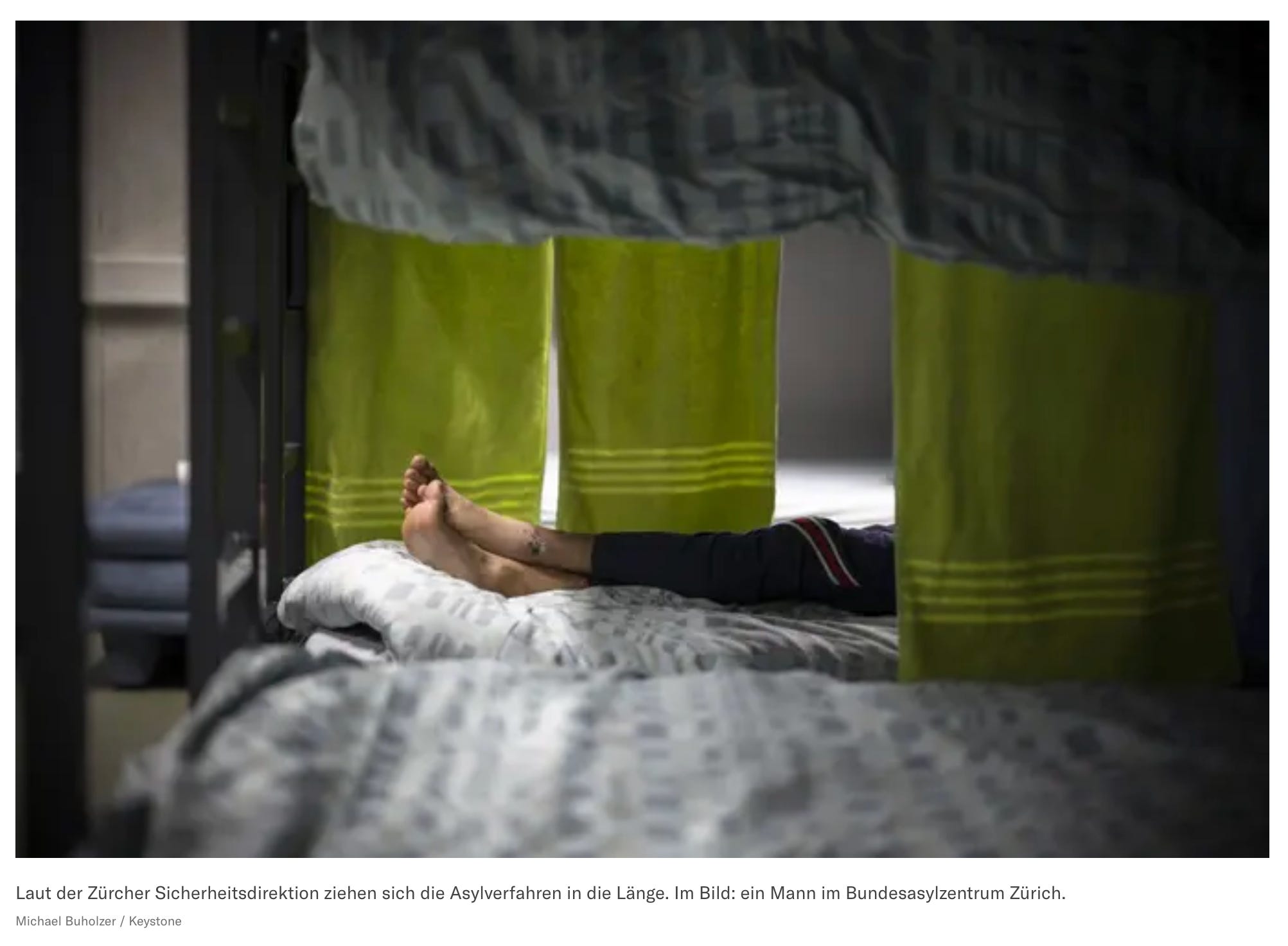
And, most importantly, Gallati says:
The federal government should invoke Article 55 of the Asylum Act. This would allow the Federal Council to take measures in exceptional circumstances to limit immigration. The situation, which has persisted for almost four years, must not become the norm [any MP arguing for the use of such emergency-powers articles hasn’t understood his or her position vis-à-vis the gov’t].
Switzerland cannot afford to have well over 100,000 people living illegally in the country.
The municipalities are particularly affected by the federal government’s generous policies. Last year, Claudia Kratochvil, director of the Swiss Association of Municipalities, warned in the NZZ am Sonntag of an ‘asylum collapse’. There is a shortage of everything: accommodation, qualified staff for care—and increasingly, public acceptance.
Even today, the situation remains difficult, says Kratochvil, with many rejected asylum applications being challenged in court. In short, these people ‘de facto remain’ in the municipalities. Kratochvil hopes for improvements with Jans’ ‘Asylum Strategy 2027’, which includes financial relief. However, the consultation process doesn’t begin until this fall. Kratochvil urges the federal government not to ‘overextend itself’ now, so that public sentiment in the municipalities doesn’t turn sour.
This won’t be easy. The ‘Asylum Strategy 2027’ holds, for example, that the ‘regular structures’ of cantons and municipalities are not only ‘challenged’ but ‘partially overwhelmed’ by ‘exceptional burdens’. Social welfare, for instance, represents such a burden. And that’s where costs are skyrocketing for the municipalities. The integration of refugees into the labour market remains faltering: 80 per cent still depend on social welfare. The municipalities can’t afford this much longer.
These figures all point to a system reaching its breaking point—in Switzerland as well. And one that is enjoying increasingly less political acceptance. Besides the protests from the cantons and municipalities, conservative politicians are also increasingly demanding more repressive measures at the national level. But so far, little has happened.
We’re edging closer and closer to the breaking point, which is the one major thing one will take away from this situation.
For a variety of reasons—media control, less welfare, more of this or that—I presume the situation elsewhere to be quite as described in the above piece; I know quite a bit about Germany, Austria, and Switzerland, as well as the Nordic circumstances.
Sooner rather than later, something will give, and when this happens, we may turn to Ernest Hemingway: ‘How did you go bankrupt? Two ways. Gradually, then suddenly.’
Why isn’t anything done?
Because virtually everything that has to do with parliamentary or individual responsibility has been transferred and/or outsourced to one (the EU) or the other (the UN’s Int’l Organization of Migration) supra-national entity, which are financed by ‘the taxpayers’ who, in exchange, are told to sit still and await the promised benefits of their transfer payments to accrue anytime very, very soon™.
As I’ve written elsewhere, all of this is a feature, not a bug:
This situation differs fundamentally from how Western societies after the Second World War used to function, however imperfectly the various national arrangements worked in practice. And while these older arrangements were not without their own idiosyncrasies, they were at least grounded in the principle of (state) sovereignty as it emerged over the past three or four centuries and was enshrined in the UN Charter in 1945.
Once you understand these notions, the above NZZ piece and its implications become intelligible.
Once ‘re-pilled’, though, it’s hard, if not outright impossible, of ever again inferring anything but incompetence (at best) or malice (standard operating procedure).
Change my mind.
No posts
Comments
Nothing yet. Say the first thing.
Sign in to join the conversation.