
Welcome to the August edition!
This month, I’m changing things up. Instead of the usual format, I’m sharing a book summary, some thoughts, and some interesting finds. I'm trying to make the newsletter lighter. Let me know what you think of the new format. Without further ado...
No matter how hardworking and consistent you are, if you can't deal with people, you won't get far. Your relationships are the most important factor in your happiness. Professionally, building good relationships is equally important. Professional capacity is only half. Two key personality traits for being considered for a role are dependability and the ability to work with others. When I joined my current team, my manager told me: "I am not interested in Elon Musk types here: brilliant but toxic." I would say he's in the majority.
Be genuinely interested in people, appreciate them, and listen more than you talk.
Don't criticise. Instead, try to understand. Most people believe their way of doing things is best. Instead of criticising, understand the cause of their behaviour by asking questions.
People's names are their favourite sound. Remember people's names and make sure you use them in conversation. It makes people feel appreciated.
Compliment people sincerely. If you've ever played a game and used cheats and thought "it would be amazing if life came with these", this is it. Complimenting people feels like cheating life and playing it on easy mode. It disarms people, creates an instant connection, and increases the chances of extra effort from them. Why don't more people use this "cheat" more often? Because it's hard to do it sincerely. We're good at spotting fake compliments from far away. Thing is: it's not hard to find something to compliment people on. I usually compliment watches on men and have had some great reactions.
Figure out where the win-win is. Amateurs want to sell. Professionals want to figure out what you want to buy and get that for you. Don't think this applies only to salesman in a car dealership. If you're in the job market, you're selling something (at least your labour). In an interview, the amateur will explain why he is a great hire and all the experience he has. The professional will want to answer only one question: am I the right person to help you solve your problem?
Be genuinely interested. This is the other life cheat. To be seen as a great conversationalist and liked by others, let them talk about themselves. Be genuinely curious about their history, goals and ambitions, fears... It's a scenario of asymmetrical risk-reward. Worst case: they end up liking you because you listened so much. Best case: they still like you and you end up learning something valuable.
Avoid discussions and telling people they're wrong. Always remember that you could be the wrong one, so try to get to the truth instead of your view. Maybe you both learn something. Even when you're sure you're right, consider you might be wrong and seek the truth together.
Admit your mistakes quickly. If you want to disarm critics and resentment, the best approach is to admit you were wrong, as quickly as you can.
"Arouse in the other person an eager want." Warren Buffett says "price is what you pay, value is what you get." I see many people (especially in sales) confusing both. If you're selling a car, you're not selling horsepower or great tires. You're selling freedom and comfort (or status, if that's your thing).
One of the chapters states that people often rise to the expectations you set for them. For example, if you praise someone publicly for delivering on time, they will likely deliver on time again. I once worked with someone in London who either read this book or is naturally great at dealing with people. He praised my Excel and data skills, saying, "Whenever I need data work, you're the person I think of. You get it done quickly and it's always exactly what I need." Now, my Excel skills aren't that great. I know a few formulas like vlookup, and pivot tables and advanced filtering, but that's about it. Also, I worked with him, not for him. He wasn't my boss or manager. Whenever he asked something, I wanted to deliver so badly I would prioritise it even above my daily work.
Give this a go and let me know how your life changes.
Overall, many more lessons can be taken from the book, and I highly recommend it. It's a short book, and the lessons are definitely worth it.
In job interviews, the question about your worst weakness is silly. The only answer is something we're unaware of—our blind spots. We're shaped by years of programming. Some of it consciously (like university and therapy) and other unconsciously (like childhood). One major blind spot is faulty reasoning, which advertising exploits. For example, David Beckham wearing a Tudor doesn't make it a better watch. Other examples include fear of flying vs. driving, playing the lottery, racism, and common logical fallacies.
Rumors suggest OpenAI might release a model with superior reasoning abilities by the end of 2024. This could mark a turning point for humanity. Imagine AI that can process thousands of variables and provide better reasoning than humans. Questions like "What does ChatGPT think?" could become common in daily life and business. What will happen when we have a tool that thinks better than we do? We struggle with processing more than a few variables. An AI with vast knowledge and reasoning could revolutionise our decision-making processes. What do you think?
I like graphics. I like the mental model that a simple graphic provides. I saw one many years ago, similar to this one:
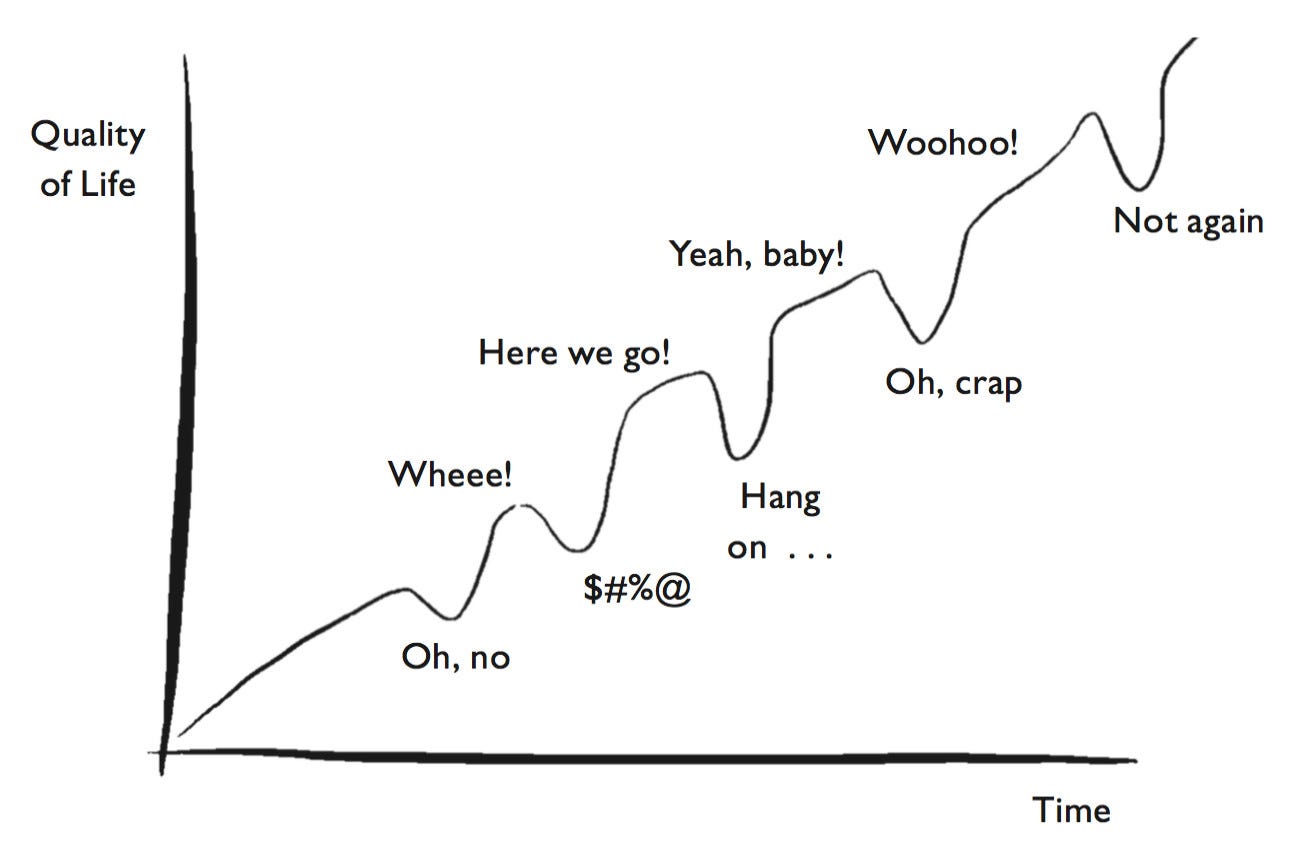
I think this couldn't be further from the truth. It assumes that when you fall, you don't fall to a place worse than you were previously. It also assumes that life has a constantly upward trajectory. It hasn't been my experience at all. My life has been more like this:
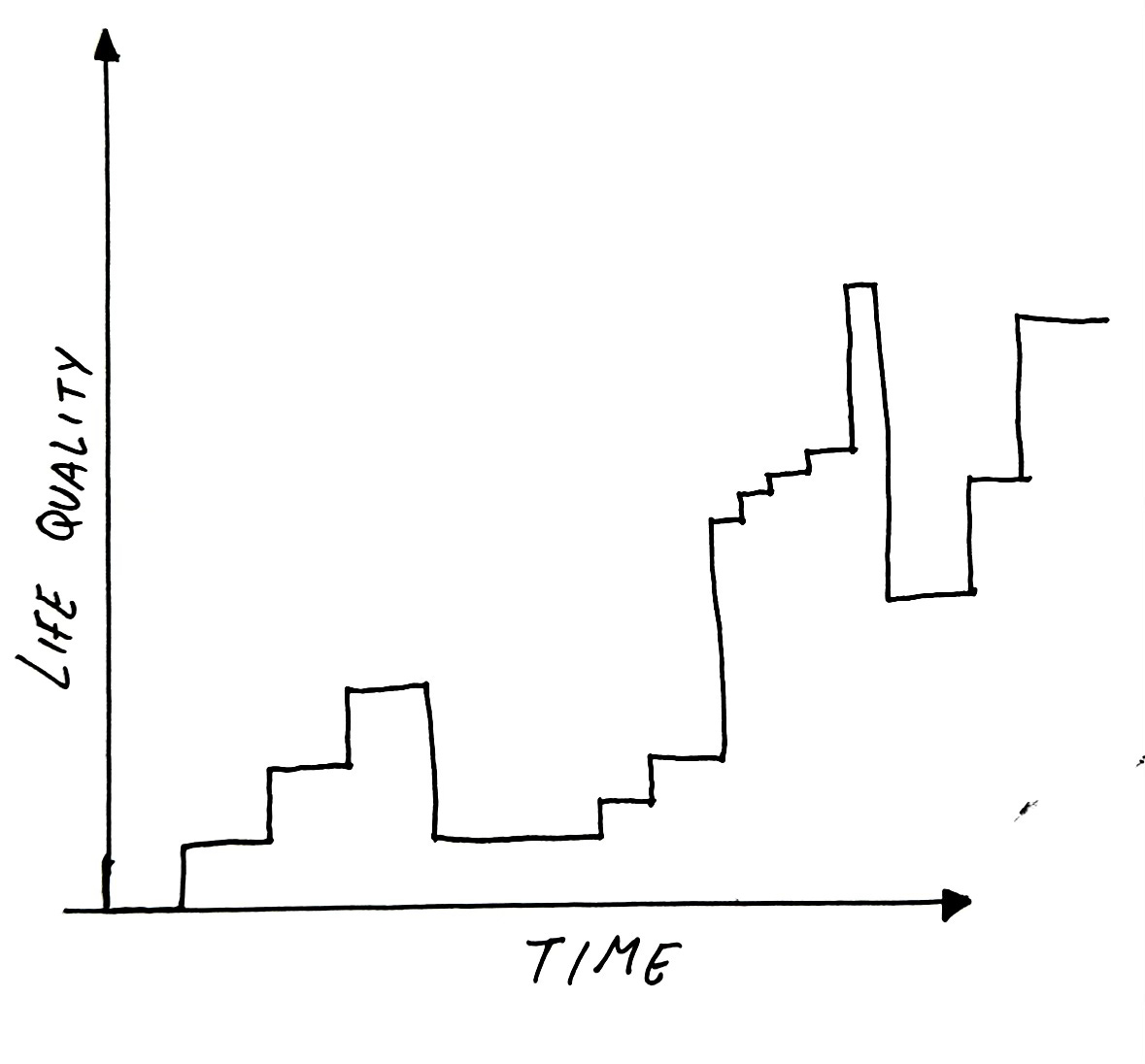
It's not a line going up. Most weeks, months, and even some years, my life quality remained the same. It's what I do during those weeks and months that allow the steps to occur. When the steps happen, it’s a sudden change. But it's never a line going up.
Some steps are bigger than others. Buying a new motorbike is not as significant as switching careers, buying a new house, or moving to a new city.
Some flat lines are longer than others. Patience and consistency are key. (Graduating took me 6 years, and changing into a career in Data took me 3, for instance.)
Some falls are bigger than others.
After a fall, you don't recover right back to the place you were. Sometimes, a fall can take you multiple steps to get back on track.
It's immature to expect only steps going up. You need the failures to learn. This graph would never look like a staircase, no matter the person.
A longer horizon makes the steps seem smaller, but also the falls. Time makes you see the true impact of things.
A company called New Computer aims to give AI "long term memory," making them a true companionship. Their new app, Dot, is available for iOS and seems pretty cool.
Cursor seems to be having a wild moment now. It allows people to code amazing things, with minimal knowledge, thanks to LLMs like Claude and Llama 3.1. Check out some crazy examples here.
Researchers in Japan are trying to bring magnetic levitation from bullet trains to cars. If this works, I'd be really impressed.
Robotics appears to be the next growing industry. 74 real companies are hiring right now. What moment will you consider that future is already here?
That's it from me. Hope you have enjoyed the new format. Let me know what you think!
See you in September!
Fábio
No posts
Comments
Nothing yet. Say the first thing.
Sign in to join the conversation.