
It is a strange beast this one, personal, quirky and hopefully inspiring for people who are interested in the relationship between tarot and creativity. The idea to collaborate on something about tarot and writing felt like one of these tasks that sounds easy on paper but could turn out to be one of these behemoths that you meet on a random bridge on your way to your next project. When Ashley first approached me about it, I shrugged, thinking, What do I know about tarot? What do I really know about writing?
The first time I got a “real” tarot reading I was in a group of people and a woman I knew very little was drawing cards. She gave me a quick reading and told me I would be moving long distances soon.
Bollocks, I thought (or the Icelandic equivalent) and then a few months later I found myself on Swedish soil, wondering if I should take this strange plunge and move.
Spoiler alert: I did.
I got my first deck a bit later and I still have it. It is a Russian deck called Egorov Tarot, and they are special cards, if for nothing other than the fact that they continue to smell of incense. It is a thick smell that lingers and I quite like it. I rarely draw from that deck anymore for whatever reason. Maybe because they have quite different cards than the popular Rider-Waite deck or maybe it is just because they happen to be at the bottom of the pile. Since I got these the collection has expanded significantly, and the shelf, where I store my tarot cards, has started to bend from the weight. If not literally, then at least metaphorically.
Contrary to what many might think, however, I don’t think the cards have magical powers. Instead, I think they have an extraordinary way of guiding your mind and find those archetypal images and balance that is so useful in writing. And on top of that so many artists around the world have done an incredible job at coming up with their own take on the images and each pack comes with its own take on their meaning, a unique take on these archetypes that we all know and understand.
They are meant for guidance and guide they do, if you let them. It is not magic, but a way of getting your brain to think in different ways, come to conclusions that are uniquely your own.
So, I do think that tarot cards can be exceptionally useful when it comes to writing, if for nothing other than to let randomness guide your brain through a story.
There are many things to cover when it comes to creative writing and tarot and I think we could have written an entire book on the subject, but we landed on this experiment of ours, and I am so proud of it. This pamphlet is highly personal and it attempts to dive into the creative process without offering too many platitudes or stale advice that you can get elsewhere.
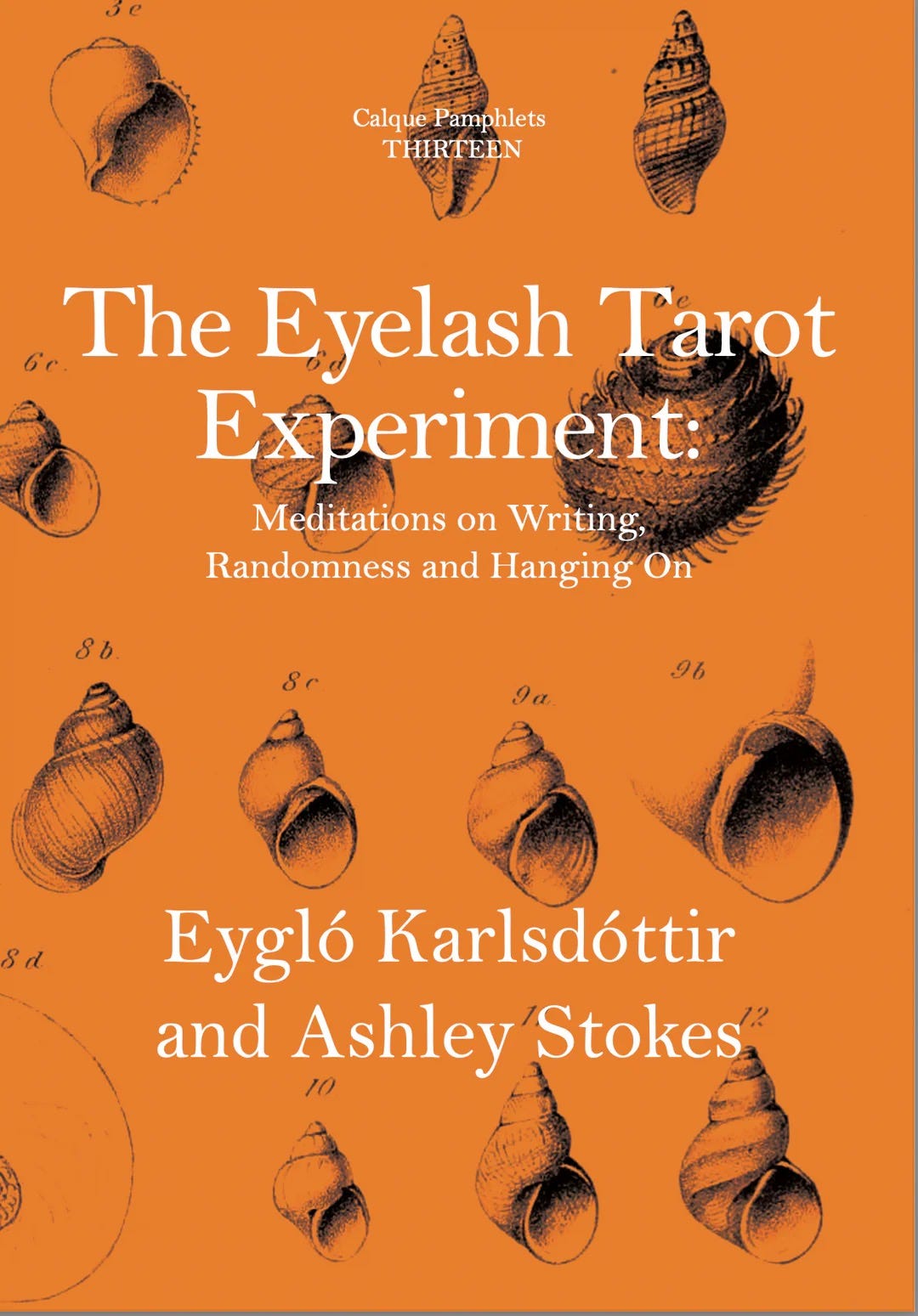
It also feels highly appropriate that this is pamphlet number is 13. A fitting little number for this strange little dabble into tarot and creative writing. It is beautifully set and I am very thankful for Calque Press for giving me the opportunity to be a part of this.
You can get your copy here and while you are there you can take the time to go through their other pamphlets, they have an interesting collection of pamphlets on topics written by interesting people.
The Eyelash Tarot Experiment: Meditations on Writing, Randomness and Hanging On is written by myself and Ashley Stokes.
Comments
Nothing yet. Say the first thing.
Sign in to join the conversation.