

Most people reading this will know someone – a relative, a friend, a neighbour – who needs or who has needed care and support. Adult social care is everyone’s business, but will it ever be fixed, asks Professor Bob Hudson in today’s main article.
He highlights ten dilemmas awaiting resolution.
It’s hard to get away from environmental issues at the moment. Another heatwave is on the way, large parts of the country have had little or no water for a couple of months, we have a nurdle emergency on our shores - and South Tyneside Council has voted to scrap its 2019 climate emergency declaration.
It was to be expected that an ousted Labour councillor would be bitter about Reform taking over and making changes. But Ernest Gibbon has green credentials that are hard to ignore. He was chair of the Local Government Association’s coastal special interest group for seven years.
So, when he say the decision “unravels years of partnership work, slams doors on vital investment, threatens livelihoods, and steals opportunities from our young people,” then he deserves to be heard.
Also today, a “shocking story of complacency in the face of multiple problems”, in Tees Valley; the best places in the North East to witness Wednesday’s eclipse; and the new Director General of the BBC’s ‘mysterious’ visit to Holy Island.
Sharing this edition would help me a lot. If you think it’s good enough then please pass it on…
A former South Tyneside councillor has warned that the repercussions of scrapping the 2019 climate emergency declaration could cost taxpayers millions of pounds and lead to job cuts.
Ernest Gibson, the national chair of the Local Government Association’s coastal special interest group who lost his seat in May’s elections when Reform swept to power, said: “This is nothing less than sheer vandalism – the deliberate destruction of years of investment, partnership and progress, born of the highest degree of ignorance about how public funding, law and regional partnership work.
“This declaration is not a standalone policy, it is woven into the very fabric of how South Tyneside operates. It is embedded in every council service, agreed by local businesses, built into our new £95 million college campus, and integrated into our schools’ curriculum.
“It unravels years of partnership work, slams doors on vital investment, threatens livelihoods, and steals opportunities from our young people.
“Those who dismiss this commitment as ‘just words’ have clearly not looked at what it has actually delivered across our borough and embedded across all services. Housing, planning, waste, transport and maintenance have all adapted to deliver better, cheaper, greener outcomes for residents.
“Local businesses are fully aligned. Hundreds of firms have invested time and money to meet agreed standards, trusting the council would keep its word. Now this motion threatens to undo all of that with real, measurable harm to jobs, funding, the public purse, and the next generation.”
Three things stand out from the environmental disaster that happened within five seconds of a departing vessel hitting a stationary ship in the Port of Tyne a couple of weeks ago.
The reaction of the authorities to the release of up to a billion plastic pellets into the Tyne lacked urgency.
The reaction of volunteers to clean up the beaches has been magnificent.
The reaction of the national media to what has happened has been strangely muted. It’s as if what happens up here is not that important.
Friday’s edition (Eyes & Ears 07.08.26) included details of the ‘Single Bag’ method of transportation of these tiny pellets, known as nurdles. That needs greater scrutiny. It’s an issue that has been talked about for years.
And the focus has to remain on the owners of the two vessels involved to make sure they do what it takes, for as long as it takes, to sort this environmental mess out.
Inquorate meetings, unmet deadlines, a two-year backlog of unaudited accounts and cash flow doubts over the South Tees Development Corporation’s ability to repay £421 million debts...
Experienced journalist Peter Morris has filed a report for North East Bylines as the STDC’s audit and finance committee prepares to meet on Wednesday.
“This is a shocking story of complacency in the face of multiple problems,” he writes. “Largely created by Tees Valley Mayor Lord Ben Houchen as a result of his overconfidence, unchecked by the feebleness of his cabinets and others around him ever since his first election in 2017.
“The MHCLG, far from lifting the the Best Value Notice it has placed on Tees Valley, should take stronger action. There have been some signs of improvement in the past year, but these have been under the auspices of interim senior staff who come and go, and there is no evidence that improvement is embedded in the organisational culture.”
The BBC’s new Director General Matt Brittin toured the Holy Island set of the drama series The Northumbrian Mysteries and met with representatives of North East Screen and Newcastle-based Lonesome Pine Productions.
The visit, during the last days of filming, follows the BBC’s expanded commitment to developing production and creative talent in the North East as part of its Across the UK strategy.
Star Robson Green took to social media to describe the production as: “One of the most joyous filming experiences of my career… a series for all the family set against the magical and jaw dropping backdrop of Northumberland.”
A solar eclipse is coming our way on Wednesday evening when the moon will get inbetween us and the rays of the sun for around two hours. High Life North magazine has produced a ‘where to watch’ guide for the North East.
This includes a Quick Facts panel on what will be the most significant eclipse since 1999: Eclipse begins: around 6.10pm; Peak: around 7.07pm; Ends: just before 8pm; Coverage from the North East: around 90%; Best direction to face: west (I thought it would be ‘up’).
A crane was seen lifting heavy objects from the top of the The Glasshouse on the Gateshead quayside last week. It’s part of the biggest schedule of improvements since the building formerly known as The Sage Gateshead opened its doors 22 years ago. Sage One is due to reopen on September 19 for the start of the classical music season but the rest of the building remains open. EasyJet has launched holiday flights to four new destinations from Newcastle International Airport - Reus, Tenerife, Prague and Sharm el-Sheikh. New Writing North is recruiting volunteers to help deliver this year’s Durham Book Festival and other literary events across the region. Campaigners fighting to save the National Glass Centre have accused Sunderland City Council of “dragging its heels” to prevent the 30-year-old building from being demolished. Reform has held on to a seat in South Tyneside following the resignation of a councillor over allegedly offensive comments made on a podcast. Katie Groom took the seat with 628 votes - 274 ahead of Labour’s Neil Maxwell.
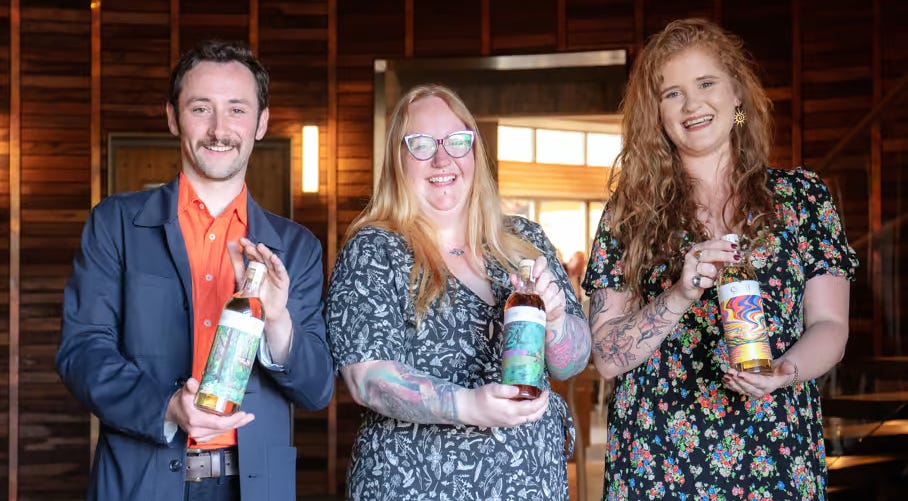
Ad Gefrin is understandably celebrating the sell-out launch of its Crǣft Series - the first Northumbrian single malt whisky released in more than 200 years. The limited release of three single casks sold out in four hours.
The Wooler distillery commissioned three North East artists to create the artwork for the three bottle designs: Voirrey Taylor for the Bourbon cask, Luke McTaggart for the American Single Malt Cask, and Sarah Calavera for the American Single Malt finished in a Sherry Hogshead.
The Crǣft Series is the first of 12 single cask releases, with the next launch planned before the end of 2026 - and there’s an open call for artists who would like to work on the next labels.
By Bob Hudson
If sincerity alone was enough to resolve political problems, then Andy Burnham would be well on the way to fixing adult social care. In his pledge to do so, the PM invoked the case of his father, suffering from dementia and unaware of his son’s premiership. The father-in-law of Health Secretary, Yvette Cooper, is in a similar situation, and the disabled son of Lib Dem Leader, Ed Davey, requires 24/7 care. Truly the political and the personal are intersecting.
Sincerity needs to be allied to courage. There have been an estimated 25-30 formal inquiries and reviews into the subject since the turn of the century, none of which have been acted upon by any prime minister from Blair to Starmer. In selecting social care as the issue upon which he is prepared to expend scarce political capital, Burnham is displaying exceptional courage.
Currently we are only at the point of aspiration and principle, not detail. Outline pledges include:
A ‘National Care Service’ that in some way resembles the NHS model rather than American healthcare – a deft comparison made by Burnham
A commitment to (or at least a desire for) cross-party agreement
Lifting up conditions for care workers, with more career progression and integration with the NHS
An end to profiteering in the care system
Bringing forward the Review by Louise Casey to next year (rather than 2028) and committing to full implementation of her recommendations.
Any one of these pledges will be difficult to resolve, let alone all of them. But why?
The longer a problem is left to fester, the more complicated it becomes to resolve. Layer upon layer of complexity and contradiction arises as one sticking plaster is slapped on top of another. Emptying unnecessarily occupied hospital beds, for example, is not the same as providing person-centred care in the community; and recruiting to the workforce is in conflict with Home Office policy on migration. Here are ten dilemmas awaiting resolution:
Lack of Funding: local councils have suffered spending cuts of close to 50% since 2010; they simply do not have the money to commission better services;
Unmet Need: Age UK estimates there are about two million people in England with unmet care needs.
Unsupported Carers: Carers UK estimate there could be just over 10 million people in the UK providing unpaid - and typically unsupported - care.
Workforce Recruitment and Retention: there are currently 131,000 vacancies and a career structure lacking progression.
Uncapped Care Costs: plans for a cap on individual care costs have never been taken up, despite making it onto the statute book.
Weak Regulation: Inspection levels are well below pre-Covid volumes and there is a lack of expertise amongst inspectors, as well as inconsistency in assessments.
Lack of Integration with the NHS: the unavailability of social care provision is routinely identified as a reason for delayed hospital discharges.
Shifting Responsibilities from the NHS to Social Care: there are inter-agency battlegrounds over rehabilitation and long-term care, especially dementia;
Outsourcing Public Services: public provision of social care has largely disappeared; small operators (commercial and not-for-profit) can barely function; bigger ones find ways of profiteering.
Failing to Listen to Users and Carers: Social care is fundamentally about rights and relationships – helping people to pursue the things that matter most to them, irrespective of their age or conditions. This has tended to take second place to tick-box assessment processes.
This complexity alone makes reform difficult, but in the case of social care it tends to be accompanied by some political rhetoric of the worst kind. Burnham’s appeal for a mature conversation has fallen on many deaf ears. Kemi Badenoch declared she was all in favour as long as no more money had to be found, while Reform’s Robert Jenrick claimed that tax inspectors would be sent to people’s death beds. Meanwhile the right-wing media had a field day: ‘Burnham’s pledges cost £21 billion more than he bargained for’ (Mail); ‘Fears Families Will Be Hit By £76,000 tax on death’ (Sunday Express); ‘Death tax plot a slap in the face to hard-working Brits’ (Sun). And all of this before any policy has even been arrived at or discussed!
The PM is optimistic that existing resources could be better used, especially in relation to freeing up hospital beds, but there is no escaping the need for some hard political choices. The minimalist choice is to keep the current arrangements but give local councils a bit more money to keep things ticking over – the cheapest option but not one that could be badged a reform. Other options are costly:
A lifetime cap on care costs – costing around £4 billion a year by 2035 dependent upon the detail
Free personal care (but excluding accommodation costs) as in the Scottish model – an estimated extra £7.5 billion a year by 2035
An NHS-style model free at the point of use – an estimated £18.5 billion a year by 2035.
With the PM confirming he will stick to the tax pledges in Labour’s 2024 manifesto and ministers being instructed to stick to their spending limits, there will be no quick wins of any significance.
For the time being then, it’s over to Dame Louise Casey and her ‘Big Conversation’ on the future of care. Much will hinge upon her recommendations next year, but the danger here is that this is viewed simply as a listening exercise with competing views.
The reality is that social care is still poorly understood. Polling suggests the wider public is unaware of the way the service is funded or how it produces inequitable outcomes – one recent survey found 33% of people believe social care is already free at the point of use, while a further 18% thought it might be. This suggests that if people are to be supportive of the idea of insuring (in some way) against catastrophic risk then Casey’s task is as much about teaching as listening.
It is doubtful if anyone reading this column does not know someone – a relative, a friend, a neighbour – who needs or who has needed care and support. Adult social care is everyone’s business.
In his speech announcing its prioritisation, Burnham asked a question: ‘How have we got to a position where it’s too difficult to fix the basic care that we give to each other?’ It’s a good question. He is sincere and he is courageous. We should wish him every success and give him every support.
Bob Hudson, Visiting Professor in Public Policy at the University of Sunderland and author
of ‘Clients, Consumers or Citizens? The Privitisation of Adult Social Care in England’
(Bristol University Press, June 2021)
I recommend you set aside a few minutes to read David Whetstone’s reflections on the acquisition of Lord Collingwood’s Trafalgar flag for the region, as reported in Friday’s edition (Eyes & Ears 07.08.26). It’s a great read from a quality storyteller.
The giant flag currently rests against a wall in the downstairs area of Newcastle’s Discovery Museum. Later this year it will be displayed upstairs and this time next year it is planned to be the eye-catching centrepiece of a display telling the Collingwood story.
You can read David’s article in Cultured. North East by clicking here.
No posts
Comments
Nothing yet. Say the first thing.
Sign in to join the conversation.