
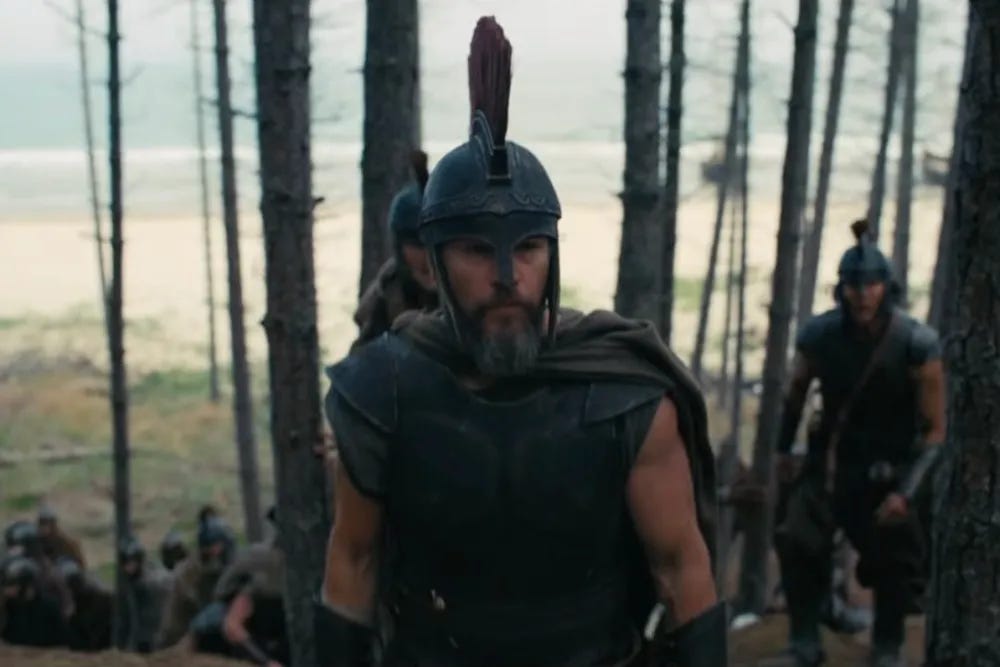
Image: Matt Damon as Odysseus, from the upcoming film
Look, We’ve all been there. You heard there was an Odyssey movie coming out this summer, and you thought: now’s my chance to finally read that book! Maybe you even rushed out of the theater after seeing the trailer and grabbed a fresh copy, but as the months turned to weeks and then the weeks to days, the reading just didn’t happen. I have no doubt across this nation that there are many beautiful hardbacks with uncracked spines and a sheen of dust languishing on the Calypso’s island of a nightstand or book stack. Such is the voyage not taken.
Firstly, never shame yourself for reading ambitions that don’t work out. All the most interesting people I know have a TBR shelf of oversized proportions. In our modern age of attention piracy, it’s hard to commit to any book, but even more difficult to commit to one of the size and intensity of The Odyssey. I have no doubt that even those who were able to start the journey might not have even gotten to Odysseus (who first appears in book five) and still others likely got through the text but struggled to follow details and themes. Again, there’s no shame in this! Classics are classics as a reason, but a lot of us are out of shape at reading of this kind, and beyond that, many translations make choices that make the text even more inaccessible.
Secondly, it’s not too late! This post is an overview of the poem but won’t ruin the experience and I’m sure the poem will feel all the more fresh after seeing the film. There is the much-adored new translation from Emily Wilson and the classic (more poetic, I would say) translation from Robert Fagles is available as an audiobook read by none other than Gandalf (Ian McKellan). So, don’t abandon those noble ambitions too easily.
I’ve been a lover of the Odyssey since I first read pieces in high school, but especially after studying it for a semester as an undergraduate. In fact, I remember a comment on my graduate school writing portfolio that suggested I stop talking about ancient epic so much and diversify a bit (I eventually did). While my professional life has pulled me further away from literature (and more toward composition) than I would have ultimately liked, I still hold great affinity for both of Homer’s epics (and Virgil’s, and Milton’s…) and have reread the Odyssey probably about six to eight times in full.
So as we head into Odyssey movie week, I want to offer a few things to help those less familiar with the poem to understand and experience the film, and perhaps to get to participate smartly in their own BBQ and beach conversations that will inevitably bend that way in the weeks to come. Please note that I haven’t seen the film, so all that follows is based on the poem and may not be accurate to Nolan’s vision, though I suspect he has been very faithful, and yet I refuse to put a spoiler warning on a post about an ancient poem. I’ve focused these thoughts through “Um, Actually…” comments because, actually, isn’t that what all readers want to be able to say of an adaptation?
A lot of people’s popular impression of the two Homeric epics (The Iliad and the Odyssey) is that they tell the story of the Trojan War including the horse (which we know will feature in the Nolan film, and is now famous as a popcorn bucket). This is not false, but it’s also not true in the way they think. Neither poem provides a singular account of the war in full (presumably this would mean from the kidnapping(?) of Helen until the fall of the city itself). The Iliad (set before the Odyssey) focuses on a specific set of incidents late in the war in which Agamemnon insults the honor of Achilles by taking a woman Achilles has captured as a prize. Achilles, so insulted, sulks for much of the book until later taking the field to defeat Hector (the champion of Troy). There’s a lot more to it, but the action closes fully before any whiff of equine deception can be detected. The directors of Troy (the most modern film adaptation of the text) would have none of this and got their horse on.
The Odyssey picks up a full 20 years after the Greeks left home for the war and (of course) tells about the trials of Odysseus to get home to his beloved wife (Penelope) and child (Telemachus). Having fought the war for 10 years before being the architect of the horse strategy (for which he earns his most common epithet, “clever”), he then spends ten years wandering about the seas and being held captive by the sea nymph Calypso on her island. When the poem turns to him, we watch his attempts to rise from that stupor and then return at last to his home of Ithaca, which is under threat from a group of suitors looking to replace Odysseus in his house and bed by wedding Penelope. Though the events in Troy are referred to in the text of the Odyssey, it does not present a narrative of them (though the film seems to extend those sequences to get some good old-fashioned sword and sandal epic into its run time…who can blame them?).
In telling that story, the Odyssey is participating in what would essentially have been a genre of oral poems and storytelling that scholars refer to as nostos, the Greek word that can mean “return” broadly or “homecoming” more specifically1. As one might imagine, with all the great figures of Greek society traveling to Troy to fight, the idea of each coming home and what they find there was a fruitful storytelling device, as even those that got direct flights home had still been gone a decade.
We get a few peeks into this larger body of literature that would have been well known to those listening to Homer when Telemachus, in the opening four books, travels to other kingdoms seeking word of his father. Within that journey (and in Odysseus’s later trip to the underworld) we learn that Agamemnon’s nostos was tragic, having fallen prey to scheming on the part of other members of his court. Depending on who is retelling the story within the Odyssey, blame shifts more to his wife, his son, and his men, all of which act as warnings to characters in the main narrative. When Telemachus visits Sparta, we hear more of the return of Helen and Menelaus, getting to imagine the awkward conversations that likely filled the voyage home. In context, this might have been something like an ancient poet reciting the ballad of Frasier Crane whilst only hinting to the audience of the wonders of heroes Norm, Cliff, and Sam Malone that occurred around him (ask your parents, kids).
There’s not a clear understanding of why the Odyssey survives when others text don’t, and it’s really probably just the happenstance of history, but Homer, as a participant in the OG MCU, plays off of all of those, and even recites them at times (most likely) to allow space for composing what follows it. This would be akin to a musician lapsing into a comfortable cover song in order to spend their mental energy composing a new song to follow it. If nothing else, remember that, though the Odyssey is lengthy, it is but a small piece of the world of the Greeks.
Alright, let’s tackle the online discourse for just one minute (it deserves no more). As always seems to happen, a stack of film bros is out with early takes on the “wokeness” of this film and, sight unseen, have BIG feelings about the choices. I’m not going to discuss the review bombing already happening over casting as that’s just pure racism and deserves no oxygen, but I want to spare a few thoughts on the more interesting questions that have popped up around the language.
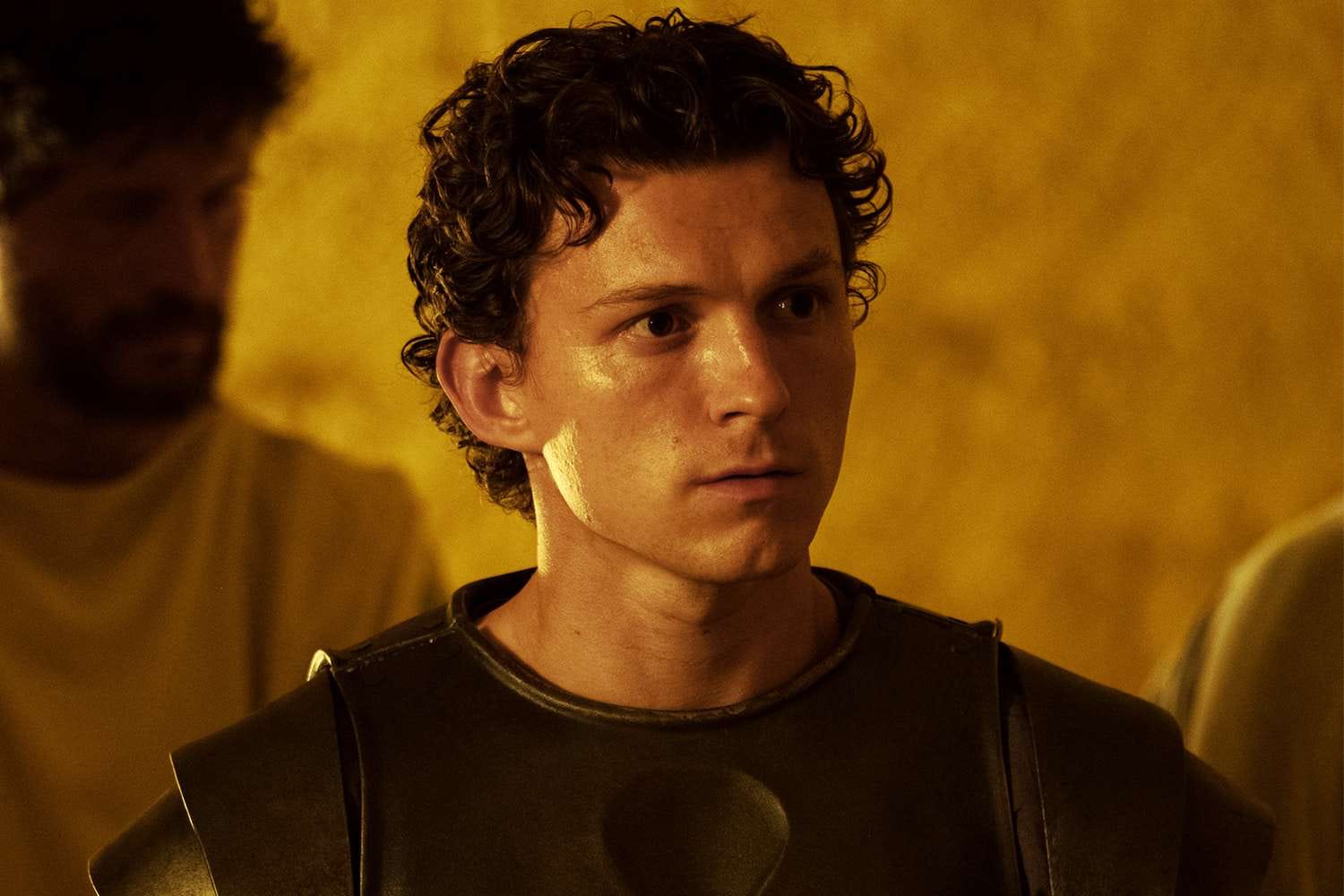
Image: Tom Holland as Telemachus, who says “Dad” in a trailer for the film.
From one of the earliest trailers for Nolan’s film, there’s been bubbling discontent online (isn’t there always?) over Tom Holland’s Telemachus referring to Odysseus as “Dad” within a scene snippet. Keyboard warriors jumped on this directly as proof that this film was unserious (pot…kettle).
Like any good teacher, I see in this a great teachable moment about the art of translation, the difficulties of that highly skilled field, and the ways in which our preconceptions bias us. The questions embedded within that kneejerk reaction are actually quite good: what do we value in translation? When speaking of the poem specifically, should a translator value artistry and aesthetics (carefully wrought language, beautiful imagery) or should they concentrate on accessibility (the clarity of plot and character). Should a translator take a written text and try to replicate the experience of the oral tradition on which it is based or should they focus on fitting it to the expectations of a modern audience?
Like any good literary critic, I see someone has gotten here before me in a manner that I could never compete with. In the Translator’s Note of her outstanding recent translation of the Odyssey, Emily Wilson2 notes the set of choices she faced and articulates to her audience what her modus operandi was when facing them. In her explanations of these choices, she shows her hand on the difficulty and hard work of translation that often goes unnoticed by readers. Citing Matthew Arnold, she notes that the four values that he prescribes to all Homeric translation are “plainness, simplicity, directness of thought, and nobility.” before going on to note that the simplicity of the original Homer is also full of conventions of oral traditions, particularly repetition (epithets, images, and lines) that would allow the performer a moment to compose. Finally, she notes that there is no simple way to just transpose the poem into English without making further care about rhythm and structure that would replicate the way the language flows in Greek, which has hugely different syllables and rhythms to it (It is a poem after all, and you want to give the lines that feel).
To quote Wilson directly, in her explanation of what translation should do in terms of its style and wordchoice,
It may be tempting to imagine that a translation of a very ancient poem would be somehow better if it used language of an earlier era. Mild stylistic archaism is often accepted without questions in translations of ancient texts and can be presented as if it were a mark of authenticity. But of course, the English of the nineteenth or early twentieth century is no closer to Homeric Greek than the language of today. [...] My Homer does not speak in your grandparents’ English, since that language is no closer to the wine-dark sea than your own. I have tried to keep to a register that is recognizably speakable and readable, while skirting between the Charybdis of artifice and the Scylla of slang.
I picture Wilson completing a full mic drop after that final line. She’s right. Many of us are trained, probably through Shakespeare, to believe that language full of “thee” and “thou” is more artistic, more grand, and more noble. That makes a certain sense on the scale of Shakespeare, but Homeric translation stretches that frame far beyond that amount of time and also across languages. As she notes, there is nothing more accurate about that kind of language in this text. In fact, Homer was a poet of the people and he was performing to commoners who did not achieve high levels of education. This means that he would have necessarily, in order to earn his supper, spoken in a manner to draw in the widest audience possible. There’s no replicating that directly, as Wilson notes “All modern translations of ancient texts exist in a time, a place, and a language that are entirely alien from those of the original. All modern translations are equally modern.”
…but before leaving this topic, let’s just remember that this discussion demonstrates the artistry and craft of translators that should be understood and appreciated. In the modern AI-driven age, you often hear the idea of translation being automated and the field ending, which is pure idiocy. Sure, an AI-fueled translation can give you the gist of what is said or meant in terms of content, but there is no replacing the thoughtful measured hand of a translator matching meter, intention, and imagery across the expanse of time and space so brilliantly.
As I write this now, the embargo has lifted and early reviews of the film are slowly filling my feed (I’m doing my best not to look yet), but once I see the film, I am most curious to see what critics make of the structure of the film if, as I suspect, it largely follows the structure and format of the original poem. In the one review I already peeked at (I said I was doing my best), the critic praised Nolan’s commitment to nonlinear storytelling in choosing to start the film 10 years after the Trojan War, which as noted above, is exactly when the poem begins. Robbing credit for the choice from Homer in favor of handing it to Nolan is a beautiful film bro fantasy, but also just a reminder that people don’t have the right impression of the poem and its contents. At a minimum, I’d hope critics grab the Wikipedia page before making silly statements like this, but here we are..
Homeric epic is, of course, one of the first places students learn the phrase en medias res (in the middle of things) which notes the convention of starting a work far into the flow of the story and filling the audience in on what has come before. I always told my students to remember the phrase through the fact that George Lucas starts the Skywalker Saga at Episode IV. But, if you asked the average moviegoer what the Odyssey is about, the vast majority would say that it is about the adventures Odysseus has in returning home to Troy, a statement that is not inaccurate, but is also misleading. The memorable adventures traveling home, with the voyages and monsters and adventures are contained within only books nine through twelve of the 24 books of the poem. There’s a lot that happens before and much more that happens after them within the poem, let alone the surrounding events of the Trojan War.
What’s great about 24 books, is that you can evenly divide the books in different ways that all seem to have a logic to them. Most obvious of the choices here is probably the two halves, in which 1-12 are Odysseus off of Ithaca and then books 13-24 are what happens once he returns to his home island. But my favorite schema (which I shall explain here) is to take the poem in books of four.
Books I-IV: The Telemachiad
After a brief invocation, the poem begins by setting up the stakes of getting Odysseus home in a set of four books that show the dramatic tension created by having the suitors in Ithaca (who will need to be overcome before the books end) and by presenting Telemachus, the son of Odysseus who has grown up without his father and, now on the verge of manhood, is burdened by his duty to protect his mother and homeland from ruin. The primary action of these books is Telemachus, guided by Athena (Yes, Tom Holland guided by Zendaya in the film) to travel to the house of Menelaus and Nestor to learn what the fate of his father is. With those men, he learns of the danger facing Odysseus in an unsuccessful nostos and also his duties. This section ends with Telemachus returning home, unaware that the suitors have plotted to waylay his vessel and kill him.
Books V-VIII: Odysseus Awakens
As Athena’s plotting continues, she convinces the mighty Zeus to end the tyranny of Poseidon’s punishment of Odysseus and allow the much-delayed man to return home. Odysseus is spurred alive after a decade as Calypso’s live-in concubine, prepares a well-constructed raft, escapes (through a storm that destroys the raft and takes his clothes), and finally lands on the island of the Phaeacians. He prostrates himself in front of Princess Nausicaa and is taken as an honored guest (beggars are honored…stay tuned!) and feasts in the royal court. There, he is moved to tears by a poet who recites the events in Troy (the only real place those events are rehearsed in the poem, and it is brief) and then is pushed by the King (only after hospitality is given) to reveal his identity and share his story with the court. As Odysseus, he is honored and lauded and he then begins to share his own story.
Books IX-XII: The Voyage of Odysseus
Here at last is the part of the poem everyone remembers: the path of Odysseus and his men after leaving Troy and their encounters with peoples, monsters, gods, witches, and more around the Mediterranean. (Stefan voice) This voyage has everything: Scilla, Charybdis, Laestrygonians, lotus eaters, Sirens, Circe, and, most memorably, the Cyclops Polyphemus. Importantly, in these early stages of the voyage, it’s the encounter with the cyclops (a child of Poseidon) that dooms Odysseus, a fate he could have escaped from were he not to have revealed his name while bragging to Polyphemus about who has beaten him. After an important trip to the underworld to learn from the deceased (including Agamemnon), he loses what is left of his crew and is landed upon Calypso’s island, effectively catching us up to the present.
Books XIII-XVI: The Return
The Phaeacians are amazed at his story, and gift Odysseus an array of treasures and a fast ship to get him home to Ithaca. He lands on his home soil and sneaks into his kingdom, keeping his identity a secret, with divine aid. He befriends his loyal swineherd, Eumaeus, and in a moment that was shown in another trailer for the film, greets an aged dog who he remembers as just a puppy. The loyal dog remembers his master and then dies of extreme old age. Here we pick up the cliffhanger on Telemachus from book four (Athena protects him) who greets the stranger and demonstrates his nobility as a host, before Odysseus reveals his true identity to just his son and the pair embrace.
Books XVII-XX: Preparations
Working together as a team, Odysseus and Telemachus make preparations to test the loyalty of various members of the household, including Penelope, and set plans in motion. The suitors, led by Altinous demonstrate their cruelty, greed, and general depravity by mistreating Odysseus disguised as a beggar, and continuing apace to eat and drink deeply, impoverishing Ithaca. Odysseus and Telemachus get the loyal servants out of the house, leave in danger some housemaids they suspect have been disloyal, and lock away all weapons that the suitors could claim in their defense.
Books XXI-XXIV: The Slaughter
Penelope announces an archery contest where she will marry the man who is able to string Odysseus’s bow and fire an arrow through 20 axe heads (A familiar image used in the TSG title card that you see on many films). Altinous tries and fails, only to have Odysseus succeed. The suitors prepare to kill the old beggar, but Odysseus reveals himself and slaughter ensues (this is likely where the film will earn its R rating). After all the suitors are dead, Odysseus and Telemachus slaughter the disloyal handmaidens, and then Odysseus reunites with Penolope in their bed. As the book closes, despite all this, Odysseus feels the call to go adventuring again (hence the cyclical aspect of the hero’s journey).
As said above, I am unsure if the film will respect all of these pieces and what order they will put them in, but I have seen enough of the trailers to think we’ll get all of these six segments represented, some in large detail.
The beauty of an ancient text like the Odyssey is that it warrants myriad interpretations. A work like the Odyssey abides in canon because it helps us see its time and place but also our own, and like all great literature it has been interpreted in countless ways, and it can be interpreted in countless more. In our modern age, it’s most often understood as a story about family (both parenthood and marriage) and the ways we all grow and change in relationship to the others in our family. Given Nolan’s filmography, I suspect we’ll see this come to the forefront (I see you, Interstellar fans).
When I was in graduate school, around 2010, there was a lot of fervor about the Odyssey being used with soldiers returning home from Iraq and Afghanistan, as it represented a meditation on what we call PTSD today, and how difficult coming home can be (physically and psychologically). There is a great body of criticism to support this and accounts of teachers using this ancient text movingly to help modern soldiers.
But for me, the thematic interpretation that has always fit best is understanding that the entire poem is about the Greek culture of hospitality and the way that guests ought to be treated by people of honor and nobility. Across the poem, the shared value of every encounter (and there are many more than even what I described above), the poet expresses a character’s nobility or monstrosity by the way that that character treats guests generally and guests of low status specifically.
Iliad aficionado’s will note that the key image at the close of that book is not Achilles on the battlefield slaughtering Trojans, but Achilles receiving the supplicant King Priam and granting his request to have the body of Hector returned. Achilles, a character obsessed throughout the poem with attaining a legacy despite a foretold short life, finds his immortality in mercy and compassion, not in martial strength. It’s beautiful (and hey, if we’re adding tomes to the TBR, maybe toss this one on too!).
Homer’s two poems share this thematic connection from the starting Telemachiad, when we see his burden as a host. To be honorable, he has to feed the array of suitors who are quite literally eating him out of house and home. While he wants to be rid of them, he is unsure what honor dictates he should do. He begins his quest to find his father, which ultimately fails, but is successful in showing him the model of noble houses in Sparta and seeing how he is treated, and how the returning heroes of those kingdoms were treated. The Telemachiad works in this way as a primer for what the conduct of a young hero ought to be.
When the action shifts to Odysseus, we see that he suffers due to having been a bad guest in his voyages (he and all of his dead men have, at one point or another, trespassed against the hospitality of another, usually by eating livestock). He is, when we meet him, at the mercy of a bad host (Calypso) but soon delivered into the embrace of good hosts (the Phaeacians), who have a utopian kingdom of gardens and wealth typified by their superlative hospitality at welcoming Odysseus without knowing who he is or ever really asking until he has feasted and been made comfortable in no less than the royal court.
Across the voyage section, monsters are bad hosts. Polyphemus (don’t eat your guests!), Circe (don’t turn your guests into pigs!), and the Sirens (don’t trick your guests by being beautiful women with bird bodies!) all break the rules of hospitality and harm their guests. But other times, such as the island of Phobus, the crew break the rules of being good guests (eating too much, breaking rules) and are thereby punished.
In the return portion, Odysseus repeatedly tests others when disguised as a beggar not just to see their loyalty, but to see who has honor and treats him kindly. All who have acted hospitably survive, whereas the others are slaughtered. Penelope and Telemachus, in the end, have proven their worth by remaining good hosts despite the negative qualities of the suitors. Odysseus, as the true host, can punish the wicked and restore order.
And lest you think this isn’t one of Homer’s primary goals, remember that he is, himself, a traveler and a beggar at times, trading stories and entertainment for food and shelter. Why not prime the audience by reminding them what noble people do?
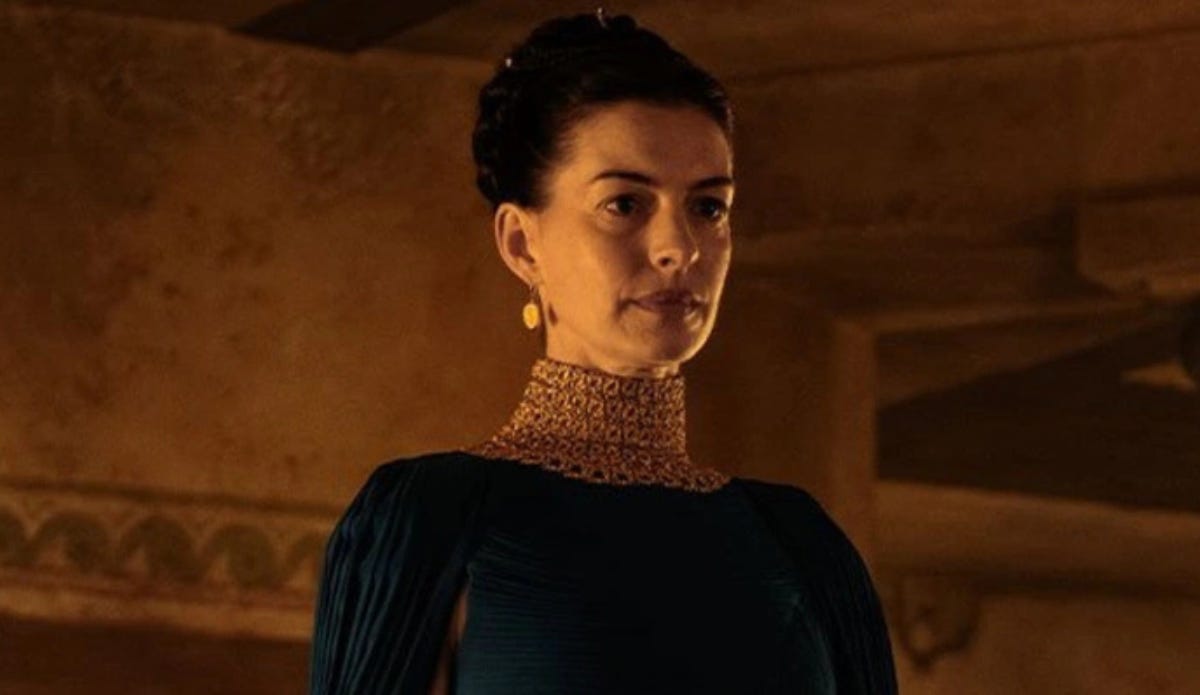
Image: Anne Hathaway as Penelope
Before this becomes a decade-long voyage, I will just close with a gesture toward Penelope, the long-suffering wife of Odysseus who suffers within the poem and across its history from some rough interpretations of her and her actions. As I tuck in to my popcorn for the film, I am going to be watching most particularly to see what the film does with this important character.
Lest we forget, literature, and especially classical literature has long been the domain of stuffy old men and it is through the lens of those critics that our modern conceptions of the poem were largely forged. As we explored above, small choices can deeply affect our understanding of a plot or character, and translators can’t help but bring their own worldview into their work.
At a basic plot level, Penelope is largely absent for the majority of the poem, but we know of her through her actions: she is set upon by hundreds of suitors determined to marry her for control of Ithaca (not for any personal worth) and has acted for at least a decade to delay them, employing her primary scheme of weaving a funeral shroud for Odysseus and promising to marry a suitor when it is complete. She spends every day weaving and every night unmaking the shroud for years (these suitors may not be too bright…). Then, once Odysseus returns, he is watching Penelope’s actions carefully, having been warned from Agamemnon to be careful about her, as Agamemnon was slaughtered in a plot set up by his wife. Her actions are meant to be mysterious, not letting the reader (listener) be sure of her loyalty until the very end. Finally, she accepts her husband, bathes and beds him, only to be told that he’s a bit bored and wants to get back out there in the final book.
In earlier translations, Penelope is often given epithets that try to capture her cunning skills, but while Odysseus is described as “clever,” “strategic,” and “a man of twists and turns,” Penelope is more often saddled with “plotting,” “scheming,” or even “deceptive.” While not wholly different, there’s no mistaking the negative implications of the chosen words.
Thus, with much fanfare came Emily Wilson’s new translation, which remedies these injustices and leans more on the positive valences and reminds us that. Penelope often gets words more closely associated with cleverness and cunning. It takes Odysseus’s strength and strategy to overcome the suitors, but it has only been through the ingenuity of Penelope that there is a house still standing. There is deep heroism in Wilson’s Penelope and a reminder that we need to value heroic qualities found within members of all genders equally.
If you take nothing else away from this, having voyaged yourself this far, I would bring it home (sorry) by simply noting that despite its age, complexity, and archaisms, it is incredible that The Odyssey is so vibrant and alive today, and I imagine will be at the forefront of film discourse from now until the Oscars. I am hopeful that the adaptation will deliver, but like all such art, I know that nothing that the film does or doesn’t do will remove or replace the poem and the revered place it has held in my heart and imagination over the last 25 years.
I hope that some of these insights help you discuss it, appreciate it, and enjoy the film in a deeper way. As I said at the start, having reading ambitions is my favorite quality in people, so consider grabbing a copy or trying out the audiobook to see if you can find the beauty in this ancient text.
Of course, we mostly know this word today as part of “nostalgia,” which is best understood as the pain of longing for the past, or as what Hellenic Scholar Don Draper of Mad Men fame calls “The pain of an old wound” in his immaculate Kodak Carousel pitch. How did Dick Whitman become so conversant in Greek?
Christopher Nolan has said publicly that he created his screenplay from the Wilson translation. At times he suggests it was the new translation that inspired him to embark on the project at all.
No posts
Comments
Nothing yet. Say the first thing.
Sign in to join the conversation.