
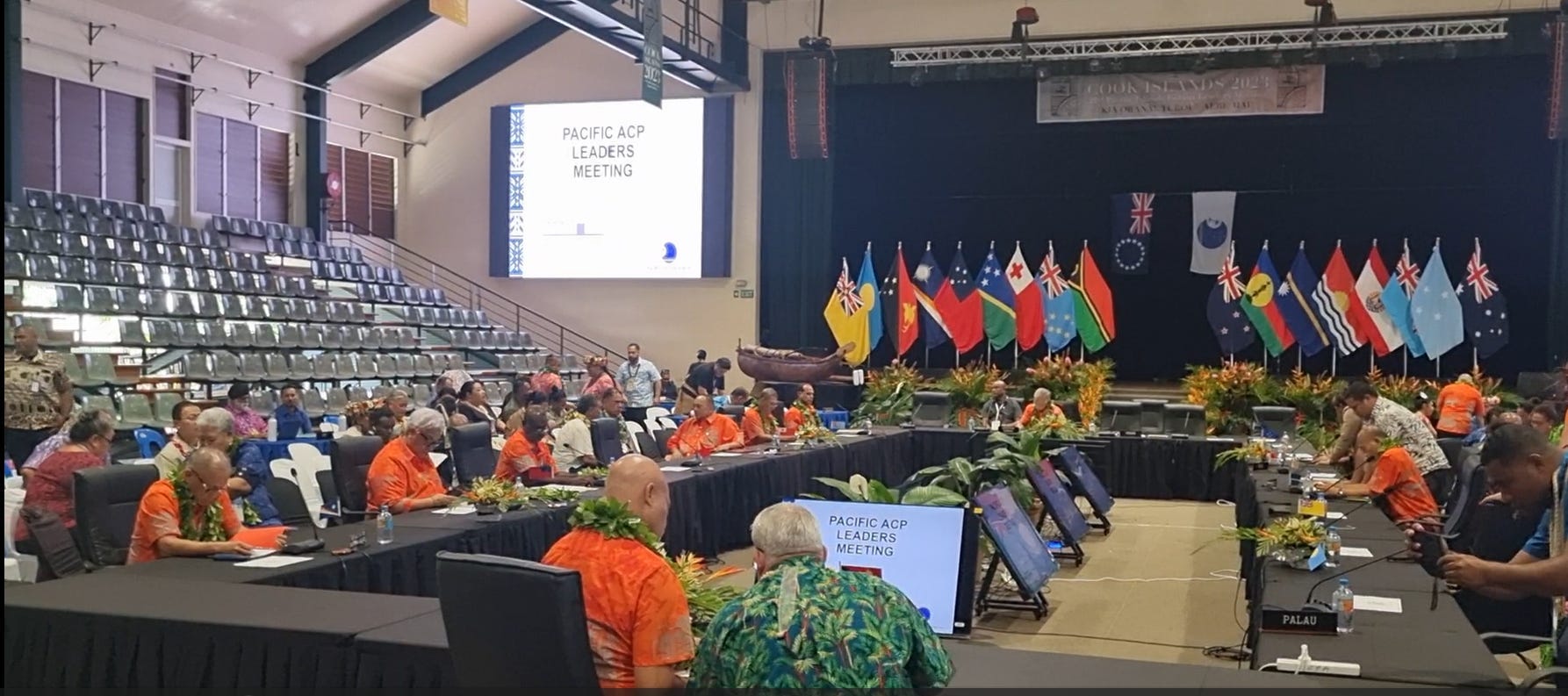
Rarotonga, COOK ISLANDS — There was something in the air that didn’t match the flowery shirts and dresses that colored the place. Not even with the smiles and kindness of some of the staff organizing the event or with the light breeze that alleviated the dry heat at 9am that was already setting in Rarotonga, capital of the Cook Islands and host of the 52nd Meeting of Pacific Islands Leaders, or just PIF.
That was the second of four days of meetings that would conclude at the end of the week with the presentation of a joint text reaffirming the unity of Pacific heads of State regarding several important issues for the region.
And perhaps it was in this word, unity, that the origin of the tension lay.
Almost no journalists or reporters witnessed what happened, as most of us were in the press center, about 50 meters from the National Auditorium, where the leaders were meeting. But it didn't take long for the news to leak, first reaching a Fiji Times reporter. The news was that David Adeang, president of Nauru, abruptly left the plenary together with his delegation and returned to the hotel. The reason for the untimely departure: the questioning made by the Prime Minister of Samoa Fiame Naomi Matafa about the legitimacy of the person already chosen - during a group summit in Denarau, Fiji - to be the next secretary general of the Pacific regional organization, Baron Waqa, former president of Nauru, who is being investigated for corrupt practices, persecution of the press and abuse of power.
Within a few hours, all those leaders would travel to the island of Aitutaki, north of Rarotonga, where they would discuss in an even more private way - with an “open chest” as the organization defined it - the content of the final communiqué regarding the 52nd PIF. (The president of Nauru did not come on board, leaving his rough edges for the other representatives of the Micronesian subregion to smooth out.)
This was not the first casualty in official representation at the most important meeting of the bloc of Pacific countries. Before work even opened, the absence of four prime ministers was confirmed: Papua New Guinea, Solomon Islands, Vanuatu and New Zealand, sending emissaries in their place.
In his closing speech, after all the fuss and fuss, the host of the event, Mark Brown, Prime Minister of the Cook Islands, highlighted that “geopolitical interests in our region may be high at the moment, but they would not dictate how to advance the priorities established by them”, and that everyone should work towards unity, harmony and security in the region.
But as one can see, the waters of the Pacific are a little more stormy to navigate when it comes to politics. A representative of the Tongan delegation explained to me that it is very difficult to understand the nuances of these skirmishes for outsiders, but there are clues that allow a reading of the fractures in the bloc from the two main points that make the rest of the planet pay attention to the region: climate change and the dispute between the United States and China to gain influence and win allies among the Pacific countries.
The Blue Continent
In practically every world map that is researched, its composition will follow a long-established norm: Europe and Africa in the center, the Americas and Asia plus Australia and New Zealand on the sides, and on both sides the largest ocean on the planet divided into two. Even if we accept that there is no “wrong” version of the map - this is because the Earth is round, as it has become incredibly necessary to highlight - we have become accustomed to forgetting that there are countries along the Pacific, such countries comprise the last of the continents, the Oceania. There are few maps that point out that there is more there than just water. Rarer are those who manage to name the splashes of land spread across the vast ocean, and this small presence of land surfaces can serve as an argument for this.
Perhaps no one has made a better point about this than the American writer Paul Theroux, in his book The Happy Isles of Oceania: Paddling the Pacific:
“More than an ocean, the Pacific was like a universe. Its map looked like a portrait of a starry night. This enormous ocean was like the sky as a whole, looking more like outer space: an immensity of emptiness punctuated by shapeless islands that shone like stars.”
A classification that is often given to these unidentified countries in Oceania, in which many Caribbean countries are included, is “small islands”. Both share this semi-invisibility due to their small land spaces, but, in the case of the Pacific, most of them have territories whose extensions are several times larger than many countries in Europe or South America.
Furthermore, as Tongan anthropologist Epali Hau'ofa pointed out, this smallness is relative and is much more in the eyes and calculations of those on the outside.
“If we look at the myths, legends, oral traditions and the entire cosmology of the peoples of Oceania, it becomes evident that they do not conceive their worlds in such microscopic proportions. Their universe is not restricted to the earth's surface, but also the ocean that surrounds them as far as they can cross it [...] The world of our ancestors was a vast sea, full of places to be explored to make their homes, to develop browser generations. People raised in this environment were at home with the sea. They played on it from the moment they learned to walk, they worked on it, they fought on it.”
This is the starting point for anyone who wants to venture into understanding this part of the world. The vision of those who come from the continent, as described by Theroux, which, however poetic it may be, does not correspond to the reality of the group of countries that today are understood as "Pacific Islands" - a region that corresponds to almost 800 thousand square kilometers.
But now this sea, which is intrinsic to the existence, culture and identity of these people, is the same one that will condemn them.
A united Pacific against global warming? Not so much.
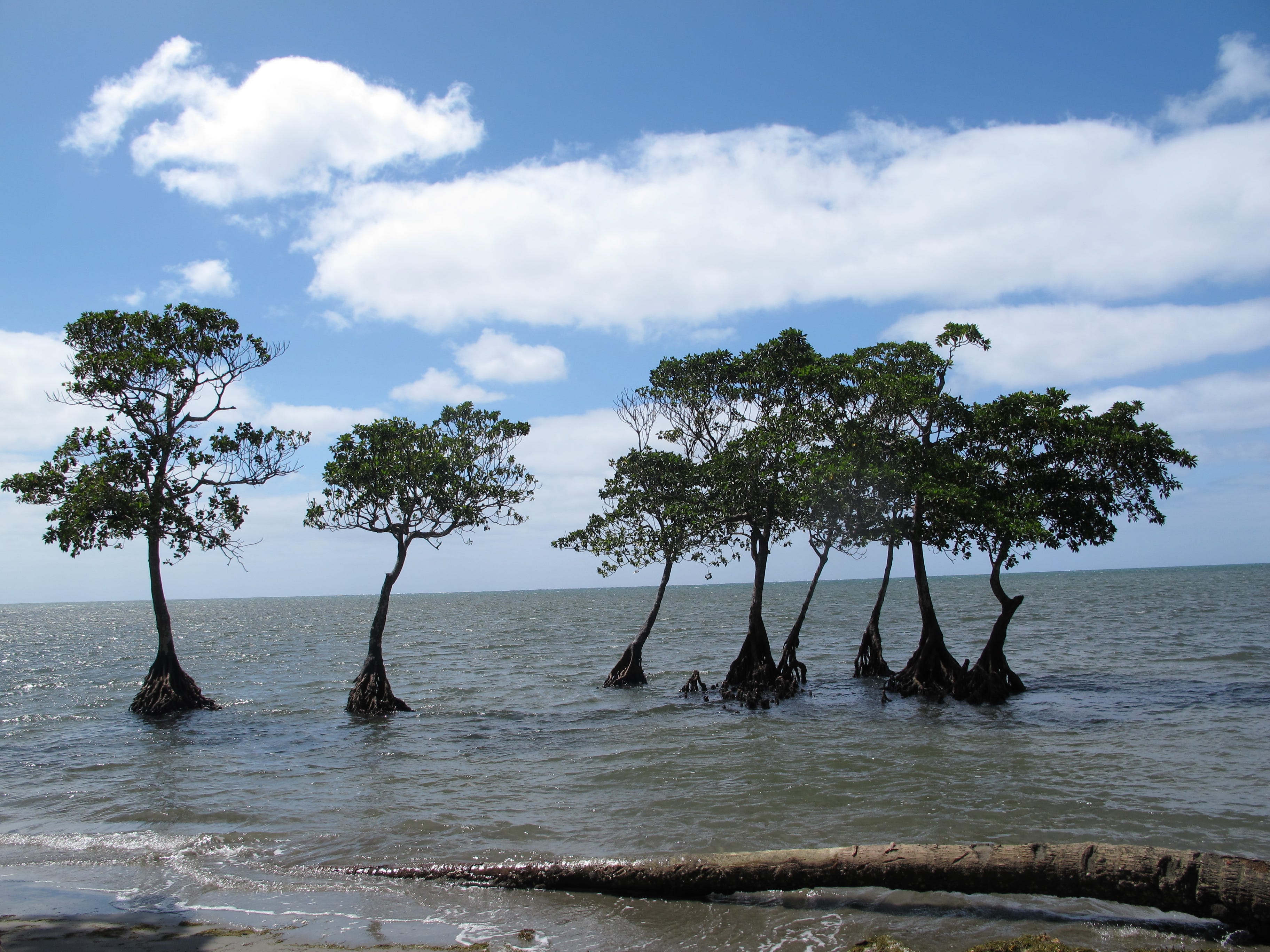
For many people, especially in Brazil, which does not have access to the Pacific and, therefore, closer ties with the region, the first “contact” with countries such as Kiribati, the Marshall Islands, Tuvalu, was due to the proliferation of online articles involving “places that may disappear in the coming years due to global warming.”
In general, Pacific countries are among the most vulnerable to the impacts of climate change due to a combination of factors - from geographic locations already prone to natural disasters to high population densities. But nothing is more defining for the region than the effects of global warming.
There, many territories are not just made up of islands, but also atolls. This means that the highest natural point in some of these places is sometimes less than 5 meters high. This puts them on the front line of danger from rising sea levels. In the words of Kausea Natano, Prime Minister of Tuvalu:
“As the ocean rises, salt water seeps into the aquifers that provide our drinking water. The rising ocean brings higher tides and, as storms increase in intensity, our villages and fields are devastated. Floods leave the soil saline, which reduces crop yields and weakens trees. Infrastructure such as houses, roads and power lines are destroyed and there is no higher ground for reconstruction.
The precious corals that support our tourism and feed our fish supply perish as the ocean warms and acidifies. The cost of surviving, of maintaining the status quo, increases for people and the entire country, becoming, over time, unbearable. Families leave little by little; Eventually, the nation itself becomes increasingly nascent, legally and spiritually rooted in a shoreline that is disappearing beneath the rising tides.
This is how a Pacific atoll dies. This is how our islands will cease to exist.”
In a sad irony, the Pacific countries contributed little or nothing to the climate tragedy that befell them first. The combined carbon emissions of all Pacific islands represent less than 0.03% of the global total. The real culprits have a name and address. Watch the video:
Even with countless international agreements and repeated public commitments, greenhouse gas emissions continue to rise and many countries are unable to give up coal, gas and oil.
Among the topics to be discussed at PIF was the issue of fossil fuels. More than anyone else, Pacific leaders understand that the math is not very complicated: burning fossil fuels results in global warming that results, as Prime Minister Natano has made clear, destruction.
But this is a difficult discussion even within what should be the most interested group of countries, more specifically due to the big elephant on the negotiating table, Australia.
In its final communiqué, five clauses mentioned fossil fuels, but two of them are worth highlighting for their textual self-immolation.
14: Leaders aspire to a fair and balanced transition to a fossil fuel-free Pacific, recognizing that the path to this is not immediate nor that there is a single approach
15: Leaders commit to a transition by phasing out coal, oil and gas from our energy systems, in line with IPCC guidelines to limit the average global temperature to 1.5°C above pre-industrial levels, with a spike in fossil fuel consumption in the short term
As the Fossil Fuel Non-Proliferation Treaty movement highlighted, in clause 14, the use of the verb “aspire” is a loophole forced by New Zealand to be included in the text, as the newly elected government is considering lifting its ban on gas exploration and oil in deep waters. Furthermore, the phrase “the path to this is not immediate” undermines the urgency of taking concrete steps to eliminate fossil fuels.
In clause 15, the phrases “our energy systems” shift the responsibility of the transition to the energy distribution network in the Pacific, when in fact it is the extraction, production and export of fossil fuels that sabotage the global target for 1.5°C . The point about “peak fossil fuel consumption” would also be terminology that deliberately avoids the commitment to cutting fossil fuel extraction. The biggest beneficiary of this rhetoric would be Australia, which is expanding its coal and natural gas production.
This weakening in the text of the PIFL's final communiqué is a blow to the expectations of many leaders to arrive with a stronger and unified position for COP28, in Dubai. Especially because it demonstrates that even though they are in the majority, the most affected countries are unable to face the political-economic power of Australia and New Zealand.
Furthermore, there was even a compromise on the fact by one of the most respected leaders, the Prime Minister of Fiji Sitiveni Rabuka. The disappointment takes on a greater dimension when one remembers that Fiji was one of the six countries - alongside Tuvalu, Vanuatu, Niue, Tonga and the Solomon Islands - to sign the Port Vila Call, in which they committed to creating a global alliance to eliminate the use of fossil fuels.
It was then, in a surprise announcement during the leaders' retreat on Aitutaki Island, that the world learned that the governments of Australia and Tuvalu had signed an agreement in which the former would guarantee residence visas to citizens of the latter who wished to
In fact, it was a historic moment, as Tuvalu, being one of the countries set to disappear under the waters of the Pacific in the coming decades, has for years been looking for ways to save not only its population, but also its entire culture and history, even going so far as to appeal even for a reconstruction of the country in the Metaverse.
However, the taste of the announcement was bittersweet. On Tuvalu's side, it was a victory for Prime Minister Natano, a kind of last resort guarantee for when the worst happened. On the Australian side, the sensation was more of a move by Prime Minister Anthony Albanese to cool down the criticism he had been receiving for his government's position on coal exploration, rather than a truly humanitarian gesture.
Continuing in its criticism, the Fossil Fuel Non-Proliferation Treaty movement noted:
“While Australia's support for Tuvalu is urgently needed, the most important thing they can do is stop making the problem worse by banning its fossil fuel production, the primary cause of the crisis that Tuvalu's citizens face as they lose their homes and seek refuge. .
Australia also announced that it would give $16.9 million to Tuvalu for use in a territorial expansion project for the capital Funafuti. This represents just 0.15% of the $11.1 billion Australia provides in subsidies and tax incentives to fossil fuel companies in a single year.
That's right, less than 1/6 of a percent.
Like a tobacco company opening a cancer clinic, the result - the possibility of relocation and a resilience fund - is a good and important thing, but the use of the ad to cover up Australia's resistance to phasing out fossil fuels is extremely problematic and must be pointed out.”
Two powers walk into an ocean
When the absences of four PIF prime ministers were announced, the justifications ranged from understandable to barely credible.
In the first category was New Zealand, which elected leader Christopher Luxon explained would need to stay at home to form the country's new government.
In the barely credible category was Manasseh Sogavare, prime minister of the Solomon Islands, who claimed to be very busy with preparations for the Pacific Games, which were to be held in the country's capital, Honiara, but just 10 days later after the end of the PIFL.
Halfway between these categories was Vanuatu Prime Minister Charlot Salwai. The initial claim for his absence was that he needed to focus his efforts on dealing with the crisis caused by Cyclone Lola, which hit a group of islands in the north of the country. This is the understandable part, but it becomes less believable because the cyclone occurred two weeks earlier.
The person who would end up representing him at the Leaders' Meeting was climate change minister Ralph Regenvanu, who was already in the Cook Islands when the news broke that his prime minister would not travel there. He confided to me that the real reason was that he needed to stay in the country to drum up political support as the country's Parliament was preparing a motion for a vote of no confidence - basically a move to remove the prime minister and hold a vote to choosing a new one.
Finally, there was Papua New Guinea, which offered no justification for its absence. (I later came across a Papuan newspaper article in which Prime Minister James Marape claimed to be too busy with the country's budgetary issues).
However, except for the domestic political issues of New Zealand and Vanuatu, the perception was that the absences of the leaders of the Solomon Islands and Papua New Guinea, no matter how well-equipped their representatives were, were markings of positioning - and not at all subtle.
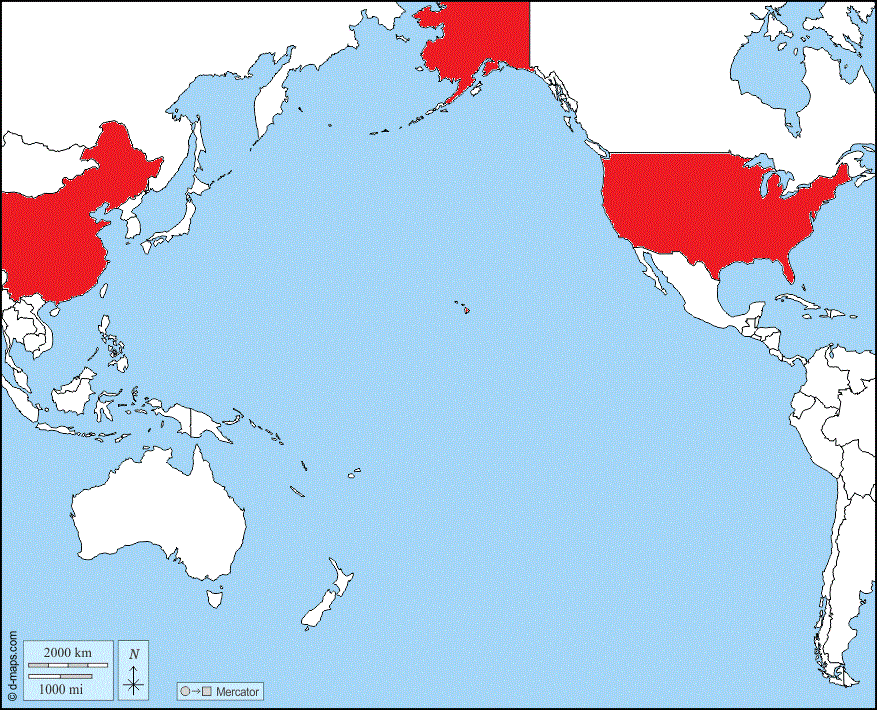
In recent years, the Pacific has become the scene of a kind of Cold War between the United States and China. With the Americans apparently making up for lost time after the region experienced years of Chinese investment in most countries.
It was the Chinese who renovated the Rarotonga airport that all the Pacific leaders passed through to the PIF in the Cook Islands. It was the Chinese who built a government office center in Port Vila, capital of Vanuatu, and to avoid doubt, they installed right there, in the middle of the official offices, an office for China Aid - a state organization that mirrors the American counterpart USAID. It was the Chinese who sent thousands of their citizens to run a variety of businesses - from minimarkets, eateries, hotels - from the dusty roads of Nuku'alofa in Tonga to the busy streets of Suva in Fiji. In fact, it is worth highlighting that in the Fijian capital, the Chinese embassy is across the street from the Ministry of Foreign Affairs and less than a minute's drive from the presidential palace.
For years, the United States watched indifferently as China advanced through investment in infrastructure and trade in the Pacific, just as the Asian country does in Latin America and Africa. Things started to change when China tightened its military relations with some of them, notably… Papua New Guinea and the Solomon Islands.
While Papua is the largest recipient of Chinese military aid in the region, the Solomon Islands in 2022 reached a deal allowing Beijing to send military units and use its ports for warships. This last case was enough for Washington to turn on its warning signals, even with the United States having dozens of military bases in Guam, the Marshall Islands, the Federation of States of Micronesia - not to mention the Philippines, Japan, Australia and South Korea.
Perhaps it was this massive military presence in the region that made Washington neglect the Pacific, but now to counterbalance Chinese soft power, the United States began to reopen several embassies and in September held a summit with Pacific leaders at the White House.
At the last PIFL, held in Suva, Vice President Kamala Harris joined a meeting with leaders via video conference. This time, in Rarotonga, the US sent the country's ambassador to the UN - and this was taking place in Gaza.
The tussle between the two powers becomes obviously inevitable when looking at the map of the Pacific: diametrically opposed across the ocean, the countries of the region are the pieces on the board between them.
Aware of their geographically strategic position, the leaders included in their final text a clause proposed by the Prime Minister of Fiji to transform the Pacific, living up to its name, into a “Zone of Peace”.
The concept, still embryonic, would involve great powers bathed by the ocean, as well as their island countries, agreeing to “refrain from actions that could threaten the stability and order of the region”, as well as “maintaining respect for sovereignty and territorial integrity of each one.”
Considering that the only sources of confrontation in the region are on the island of New Guinea - both the internal tribal conflicts in Papua New Guinea and the war between Indonesia and the province of West New Guinea - it is to be imagined that the proposal for a Pacific as Zone of Peace serves to mitigate the effects of the US-China dispute.
Whether the intentions of a small island in the middle of an ocean of diffuse interests will achieve results remains to be seen. Mainly due to the fact that not everything is pacified (I held it until the end of the text to use this pun) within the Pacific Islands group.
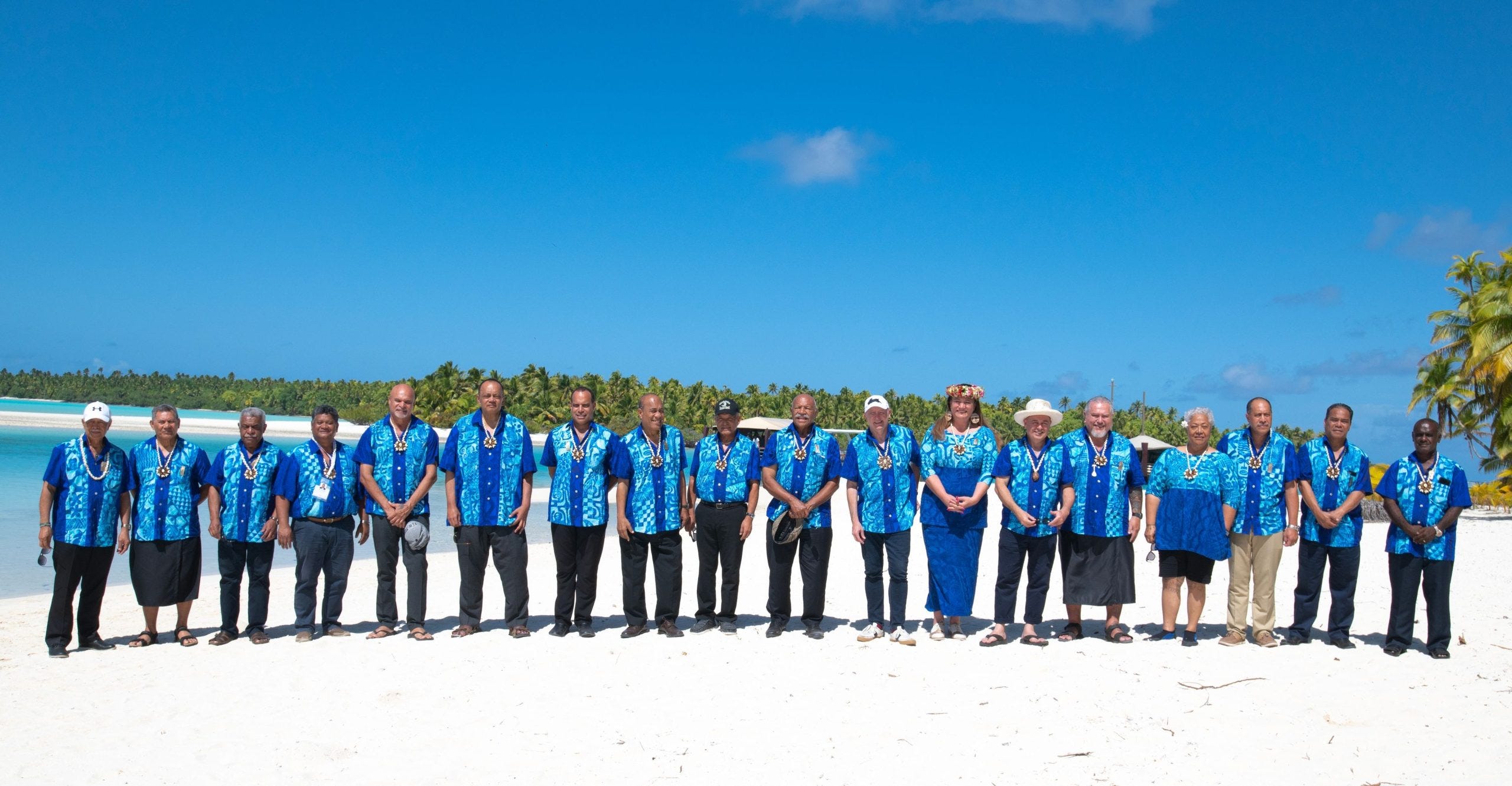
The last photograph of the leaders on the island of Aitutaki may even suggest the harmony that the environment provides. But with a climate crisis that is only increasing and two powers competing over the sea that separates them, the image may just be the calm before the storm.
No posts
Comments
Nothing yet. Say the first thing.
Sign in to join the conversation.