
I think the most difficult thing to grasp about the Muslim Brotherhood is also the most basic. What is this thing, this entity called the Brotherhood? And, beyond that, how does this entity seem to be both everywhere and nowhere, ubiquitous and marginal, both big and small? And how does this all relate to the proliferation of Islamist organisations across the West and beyond?
These questions – which I think pretty much everyone in public life struggles to reach the threshold of asking let alone answering – pervade my investigation into the Brotherhood which Unherd published as a ‘long-read’ article in late May. The difficulty of answering them is I think a key strength of the Brotherhood and Islamism. For if you can’t properly identify something, and distinguish it from what it’s not, how can you possibly counter it with any success?
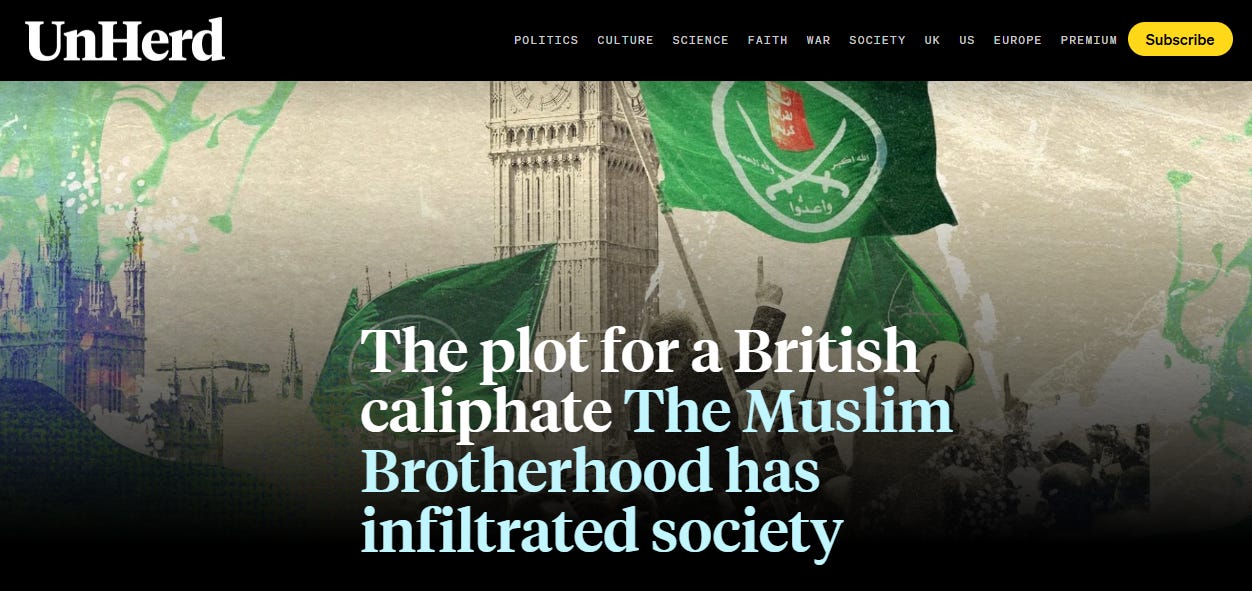
In the article, I range from the widespread presence of Brotherhood texts in British prison chaplaincies to the organisation’s origins in colonial Egypt and then back to its influence on pro-Palestine, anti-Israel activism in Britain, concluding with some possible policy ideas. In my introduction I attempted a definition of sorts:
The bulk of the article is behind a paywall. I think I’m OK in featuring a few more passages here, of which more below. However I first wanted to go over something that didn’t make it into the 4,700 words of the piece (and an awful lot didn’t make it), which I mentioned in a previous article here. This is from V. S. Naipaul’s book Among the Believers and doesn’t mention the Brotherhood in capital letters. However I think it demonstrates something about the Brotherhood’s nature and power, as something both bigger and smaller than an entity as we would normally conceive it.
While in Pakistan in 1979 and 1980, Naipaul got invited to what he called “the assembly of a Muslim brotherhood dedicated to the idea that every Muslim was also a missionary for Islam” on the plains of Punjab near Lahore. Here, he surmised, “everyone wanted to be Muslim in the way the earliest Muslims had been”. The event went on for three or four days, with a “vast” main tented area and, Naipaul estimated, 100-200,000 attendees, including a “foreign enclave, where there were Arabs, Indonesians, and even Africans …”
This may have been a Muslim Brotherhood-organised event. Certainly the Brotherhood did a lot of reaching out beyond its Arabic-speaking heartland in these times, bringing what Naipaul identified as ‘the new Islam’ to places like Pakistan, Indonesia and Malaysia, so it is more than likely. But in a sense it’s irrelevant because the assembly was doing precisely what the Brotherhood wanted done, which is to organise Muslims into a politico-religious force, to go out into the world and make it more Islamic according to the original dictates of God to Mohammed, as recorded in the Qu’ran and certain trustworthy hadith.
And this doesn’t just mean being a missionary in the sense that we would understand it from Christian practice, preaching the gospel and saving the souls of native populations.
Islam was spread by the sword right from the beginning. The Brotherhood’s logo, featuring two crossed swords protecting a Qu’ran, reflects this attachment. As I write in the piece,
The Muslim Brotherhood was originally founded by the Islamic scholar and schoolteacher Hassan al-Banna in Egypt, 1928, which was then nominally independent but dominated by the British. Banna was consumed by the colonisation of his homeland and much of the Muslim world by Western powers and Western modernity. He attributed this partly to non-Muslim strength — but also to Muslim weakness, which he attributed to the abandoning of Islamic principles. Real Islam, he said, was about fighting and defeating non-believers.
This is reflected in Banna’s writings, including the text The Way of Jihad, one of the Brotherhood texts found in British prisons during inspections in 2015. Banna “presented jihad as “the highest goal of humanity in this life,” I write. “Islam, he said, “urges its followers to be imbued with the military spirit in war and peace … Therefore, Signor Mussolini is not the only one who calls for this, and these are not the principles of fascism alone.””
This military commitment imposed on Muslims in both war and peace is quite interesting, not to mention alarming. As I say, it is not so much that the Brotherhood’s modernised Islam is against peace as that “peace appears for Islamists in its tradition as a situation that occurs after Islam has won, following the submission of its enemies. Until then, they are always pushing, always contending, seeking to increase their power.”
You can see this from Islamists every day: how they never stop working, never stop pushing to increase their presence and reduce that of their opponents in public. And this takes place at all levels, including the local, especially in urban areas with large concentrations of Muslims. Here, they capitalise on political and administrative weakness and effectively come to rule certain areas through ambiguous relations between ‘community leaders’ and gangs who mix aggressive, radical Islam with organised crime.
As a pretty secretive organisation, Brotherhood presence in these activities can often only be described, if at all, through that ubiquitous word ‘links’: through the presence of people from the inner Brotherhood network, with tangible links in turn to the Brotherhood itself. However, more pervasive is the style, both of organisation and propagation: the prolific institution-building, the alliances of convenience, normally with progressive left elements, who can be discarded when no longer needed, and the aggressive denunciations of anyone who objects to ceding ground and giving way.
This style now has a life of its own. It is embedded in Muslim communities in the West as elsewhere. And this is one of the great successes of the Brotherhood: that it is present even when it is not present at all. It has bled out into the world, merging into the world, becoming indistinguishable from it in some respects - from eateries converting to halal food to the activities of The Muslim Vote (TMV) organisation and widespread anti-Israel activism.
Countering this tendency, for those of us who value our freedoms, looks like a multi-generational task, requiring a joined-up strategy that is conspicuously absent from government circles in Britain. I suggest a number of things in my article, not least on charitable status, which Islamists exploit widely to conduct their political activities.
As I conclude:
No posts
Comments
Nothing yet. Say the first thing.
Sign in to join the conversation.