
I had a new piece published by Unherd on Friday, given the title ‘Alasdair MacIntyre was right all along’.
It can be a strange experience reading your own work when published, as if you wrote it in a former life or even not at all. I fell ill just as this one was about to go up, so have only just read it on the page for the first time.
One thing that struck me was how unusual it is to read an article dealing almost exclusively with philosophical ideas rather than personalities and politics (albeit the conclusion comes up with some suggestions for the latter).
I think Unherd deserve credit for being prepared to published articles of this nature.

The piece gathers around Alasdair MacIntyre’s most famous book, After Virtue, which I read in two spurts last year, completing in December (and writing a lengthy Twitter/X thread as I went).
Unusually for me, it contains a critique of John Gray, who wrote a piece responding to MacIntyre’s death last year in which he said, “Reading [After Virtue] when it first appeared in 1981, I was struck by its political thinness.”
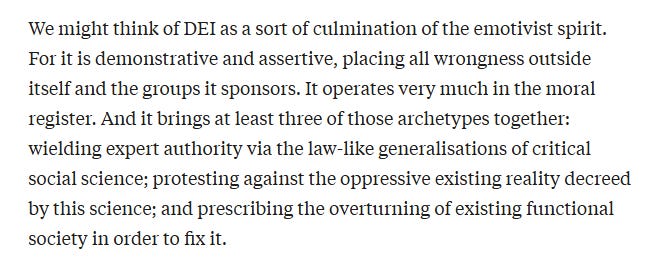
I suggest that the greatness of the book lies precisely in its possible applications, in the contrast it offers between the Aristotelian excellence in work and the assertive, moralistic claims of what MacIntyre calls ‘emotivism’, culminating in the current ‘character’ of the DEI bureaucrat. This seems to me crucial to any politics of improvement that might emerge.
I also highlight a contrast between “the utilitarian striving to achieve external goods” and MacIntyre’s emphasis on internal goods of “the practice”, which is to say traditions of work with inherited standards attached. In a sense, you might say, it’s a contrast between our conventional treatment of work as a means to achieve certain ends (making money, building homes, winning the League for example) and the idea that work ideally expresses a human essence and embeds us in our communities and societies, giving us meaning and status within them.
In other words, I suggest that this book has something positive to say, thereby offering “a contrast to the reflexive pessimism that [John] Gray falls into.”
Without such a positive vision - of a better life, a better society and a better politics - democratic politics surely has little purchase. And I remain a democrat, albeit battered and bruised.
No posts
Comments
Nothing yet. Say the first thing.
Sign in to join the conversation.