
We are long overdue for a uranium market update; so once again we’ll take another deep dive into the supply/demand fundamentals for uranium and the projected macro growth drivers for nuclear power.
We’ll also review different subsectors of the uranium mining stocks, as well as adjacent nuclear technology stocks and utility companies focused on this important part of the energy complex.
Uranium is the front-end fuel for the next wave of the nuclear renaissance unfolding all over the planet.
The issue many specialists have pointed to for years is that there just isn’t enough new supply coming online fast enough to meet the growing demand surfacing at the end of this decade.
In the next few years this lack of new supply situation will hit the tipping point, and that means opportunity for those investing today in uranium stocks.
So, let’s get into it…
The global fleet of around 440 nuclear reactors, is spread across over 30 countries, and has staggered uncovered refueling needs that begin to really escalate heading into the early 2030’s. While there are some currently operating reactors that will be retired over the next decade, we’ve also witnessed a series of life-extensions and reactor restarts announced over the last couple years that balances much of that out.
Just that current fleet of nuclear reactors, as it sits today, creates a lot of new demand for uranium, conversion and enrichment into nuclear fuels. However, that demand doesn’t even take into account all the new reactors coming into the mix over the next decade. While some of those newly constructed nuclear power plants will replace older reactors that are being retired, the overall fleet will still continue to grow and further compound the demand picture for new U308 (Uranium yellowcake), UF6, and Enriched Uranium Fuel.
The World Nuclear Association estimates that as of 2026: “About 80 reactors are under construction across the world. About 120 further reactors are planned. Most reactors under construction or planned are in Asia.”
“About 35 countries are considering, planning or starting nuclear power programs”
There are now 38 nations committed to tripling global nuclear energy capacity by 2050. Even if that goal is missed, the serious focus from so many nations and overall industry trajectory ensures a huge amount of additional growth and new demand for nuclear fuel.
38 countries support the goal to triple global nuclear capacity by 2050
March 27, 2026 – Foron Nuclear
Four Executive Orders Aim To Promote Nuclear Energy
June 3, 2025 - Skadden Publication
“On May 23, 2025, President Trump issued four executive orders (EOs) as part of the administration’s effort to quadruple U.S. nuclear generating capacity by 2050, promote deployment of advanced nuclear technologies, build out nuclear fuel supply chains, expedite the licensing process, and increase U.S. nuclear exports.”
It’s easy to envision a line of sight on a global nuclear power fleet of up near 500 reactors in the next 10+ years. That is going to create a huge amount of demand across the whole fuel cycle, creating opportunities for investors that want to skate to where the puck is going.
Over the last few months a new wrinkle showed up in the traditional energy sector – the war in Iran and a global supply shock to the oil market. One of the largest beneficiaries of the Strait of Hormuz bottleneck and ensuing aftermath will be a stronger pivot by many nations into nuclear power. The fundamental backdrop for nuclear power did not require more positive catalysts, yet here they are regardless.
Even without the Strait of Hormuz closure in 2026, there have been incredibly compelling opportunities across different upstream, midstream and downstream parts of the fuel cycle and power generation sector for the last 6 years.
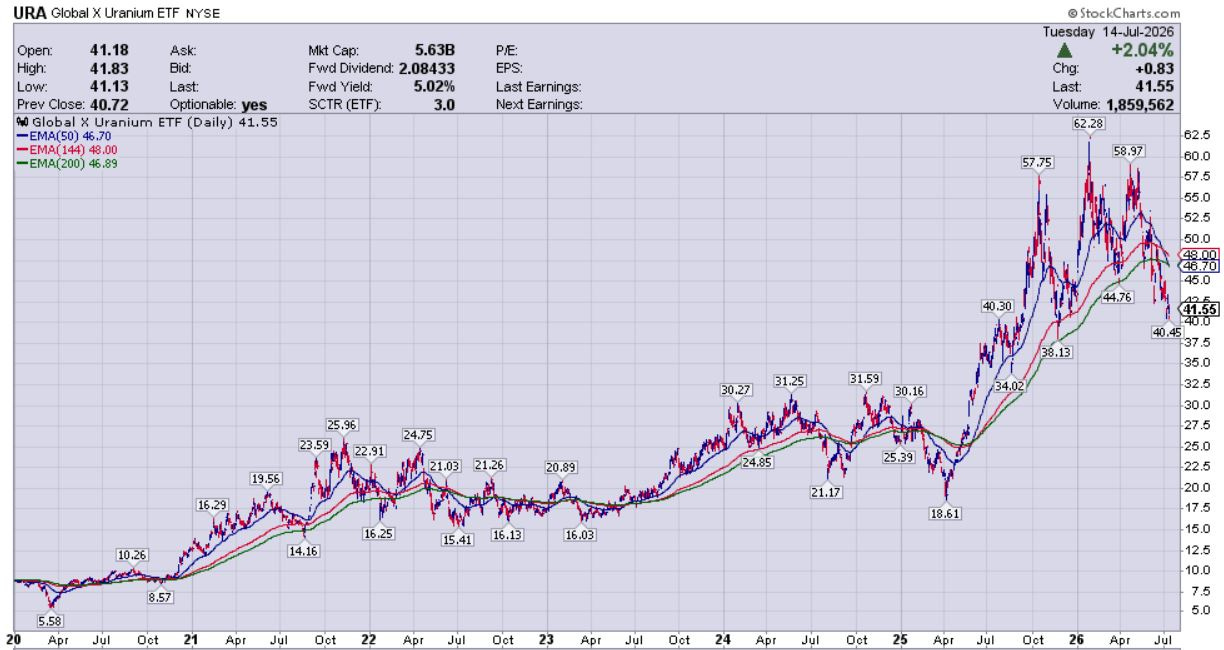
Global X Uranium ETF (URA) - 6 year daily chart
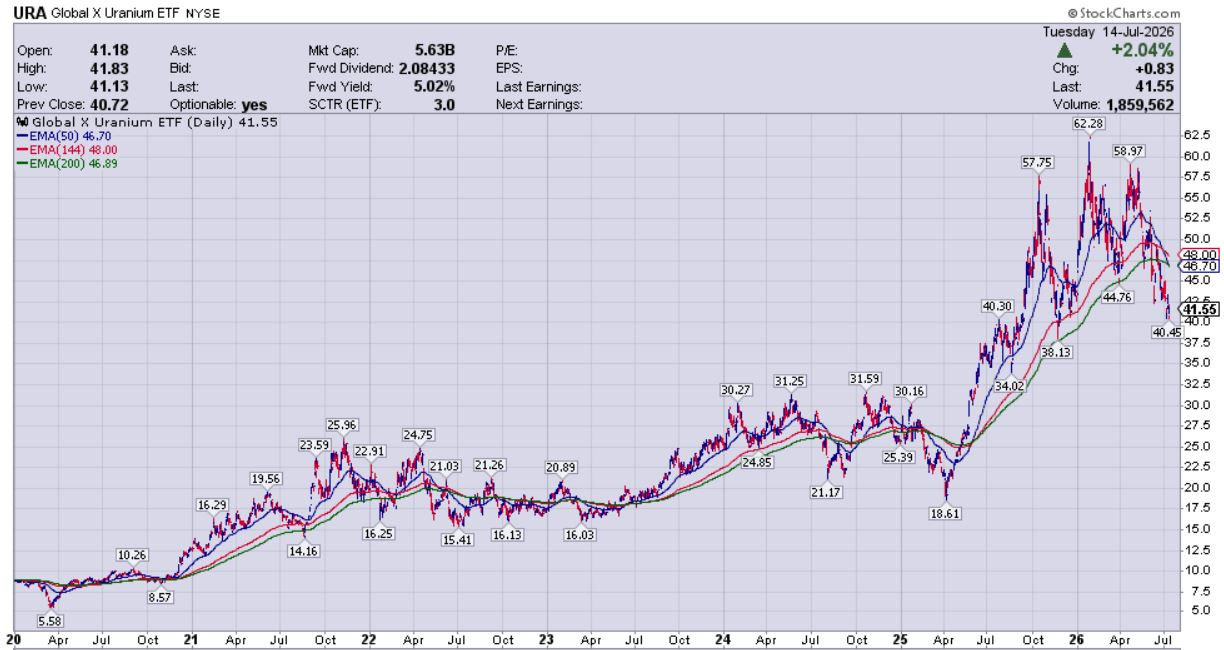
This fundamental demand growth for nuclear energy, rising into a constrained market supply from uranium mining companies, was already in place BEFORE the Strait of Hormuz choke-point for oil.
This latest pressure in the traditional energy sector, due to the war in the Middle East, has merely confirmed for many nations their decision to support the growth and utilization of nuclear to diversify their energy mix.
While coal and natural gas plants will also be the recipients of some of that rotation of power generation; it is also clear that nuclear power will get more increased focus with the diversification of energy grid inputs.
We haven’t even added into this equation the coming further demand from Small Modular Reactors (SMRs).
There has been a steady onslaught of news regarding big tech companies and manufacturers partnering with both traditional nuclear power utilities as well as new innovative SMR companies, due to the spiking future projected energy needs for the A.I. datacenter buildout and sustaining energy requirements.
If even some of those projections around further demand for nuclear fuels from the implementation and adoption of SMRs do manifest over the next 5-10 years, then we go from a compelling supply/demand shortfall, to the kind of supply gap that can only be solved by a dramatic upward price response.
In light of all these fundamental tailwinds, the market has been bizarrely complacent on the uranium sector since the pop in spot pricing over $100 a pound back in late January 2026. In the 2nd week of July, the U308 price is hovering around the $85 level.
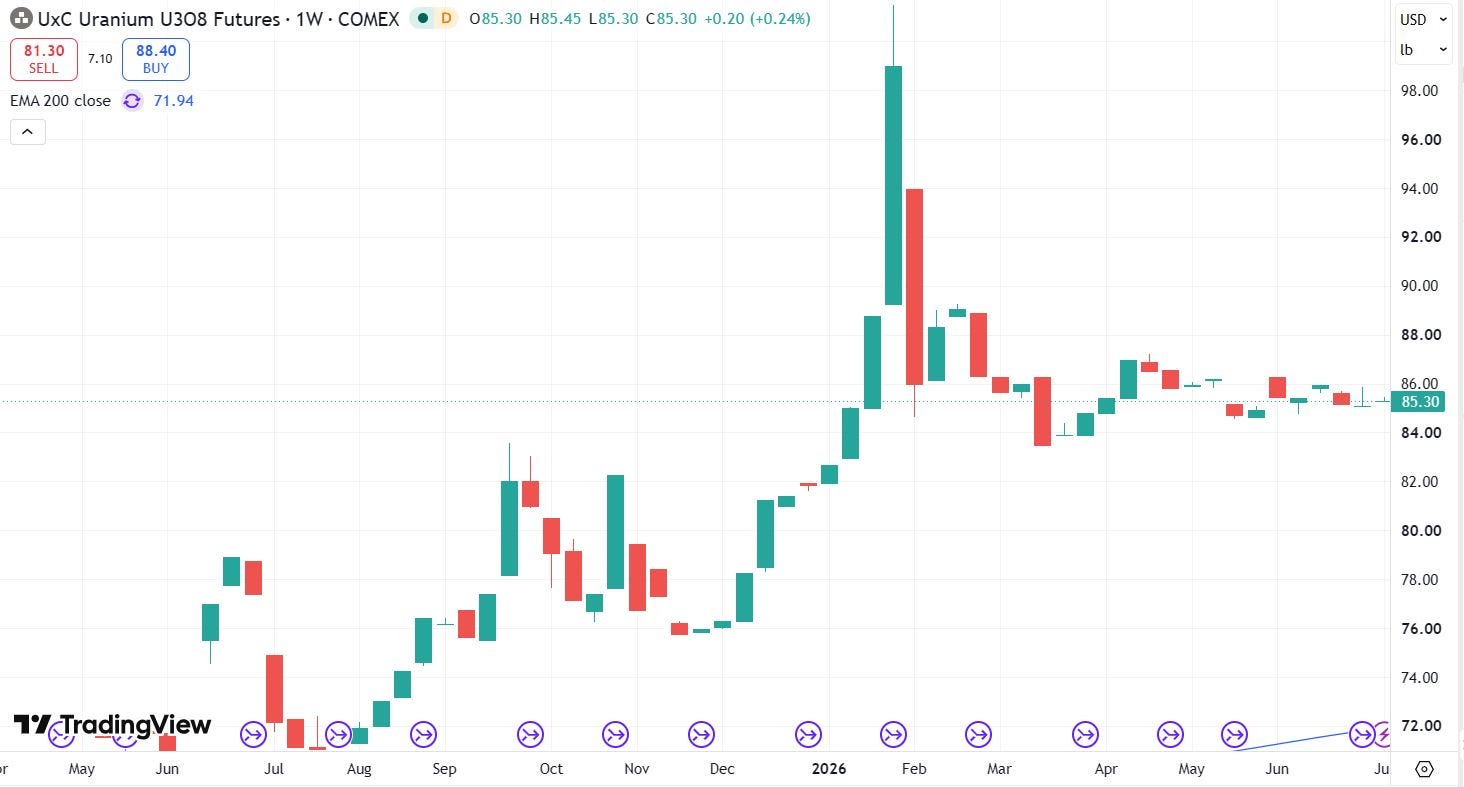
While most operators are insulated against prices down into the high $60s, they are doing just fine with uranium in the mid $80s, or even the $70s per pound of U308.
Uranium pricing is a very opaque market, and not all transactions get reported. Industry publications like UXC have reported that many of the offtake contracts that did gete reported have moved the term pricing solidly into the high $80s / low $90s, with ceilings around $140-$150. (The fact that ceilings that high have been introduced on contracts lends credence to the idea that the industry anticipates higher prices in the future and that triple-digit uranium prices are well within the realm of potentiality).
Upstream opportunities in the uranium mining stocks, sourcing the raw U308 commodity from the ground.
Midstream opportunities in processing and enrichment of nuclear fuels, nuclear fuel cladding companies, and the tech and manufacturing companies building traditional reactors and next generation small modular reactors. These are often referred to as the “nuclear stocks.”
Downstream opportunities in the power companies and utilities with strong exposure to nuclear energy.
With the upstream uranium mining stocks, there are easily accessible sector ETFs, as well as producers, developers, and explorers.
ETFs with Uranium and Nuclear stocks:
(URA) Global X - Uranium ETF
(URNM) Sprott Uranium Miners ETF
(URNJ) Sprott Junior Uranium Miners ETF
(NLR) VanEck Uranium and Nuclear ETF
(NUKZ) Range Nuclear Renaissance ETF
Uranium Producers
(CCJ) Cameco [Canada]
(UEC) Uranium Energy Corp [US]
UUUU) Energy Fuels [US]
(EU) enCore Energy [US]
(URG) Ur-Energy [US]
(PALAF) Paladin Energy [Namibia, Australia, Canada]
(BQSSF) Boss Energy [Australia]
(LTSRF) Lotus Energy [Malawi, Botswana]
Uranium Developers
(NXE) NexGen Energy
(DNN) Denison Mines
(ISOU) IsoEnergy
(PTUUF) Purepoint Uranium
(LMRXF) Laramide Resources
Uranium Explorers {we can’t list them all because there are a few dozen}
(COSAF) Cosa Resources
(SYHBF) Skyharbour Resources
(MAUUF) Manhattan Uranium Discovery
(STTDF) Standard Uranium
(BSENF) Geiger Energy
(SASKF) Atha Energy
There are less of the mid-stream companies to pick from, but here are some:
(LEU) Centrus Energy [processor/enricher]
(GEV) GE Vernova [power infrastructure buildout]
(CCJ) Cameco [owns 49% of Westinghouse division – reactor builds]
(NASDAQ: XE) X-Energy, Inc.
(OKLO) Oklo [small modular reactors]
(SMR) NuScale Power [small modular reactors]
(NNE) Nano Nuclear Energy [small modular reactors]
NUCL) Eagle Nuclear Energy [small modular reactors]
Then with downstream power companies and utilities there are a number of companies with exposure to nuclear, but the two companies that really stand out are:
(CEG) Constellation Energy [power utility company]
(VST) Vistra Energy [power utility company]
In future updates, we’ll dig into the value proposition for some of the higher conviction individual names from the uranium and nuclear companies above, but at minimum this seems like an opportune time to start paying attention and potentially begin layering on an initial tranche.
For those unsure of individual stocks, the sector ETFs are a great way to start accumulating into the complacency and correcting prices.
The word of caution would be that the sector has been in a clear downtrend for the last 5 months, and this correction may not have fully worked its way through the sector yet.
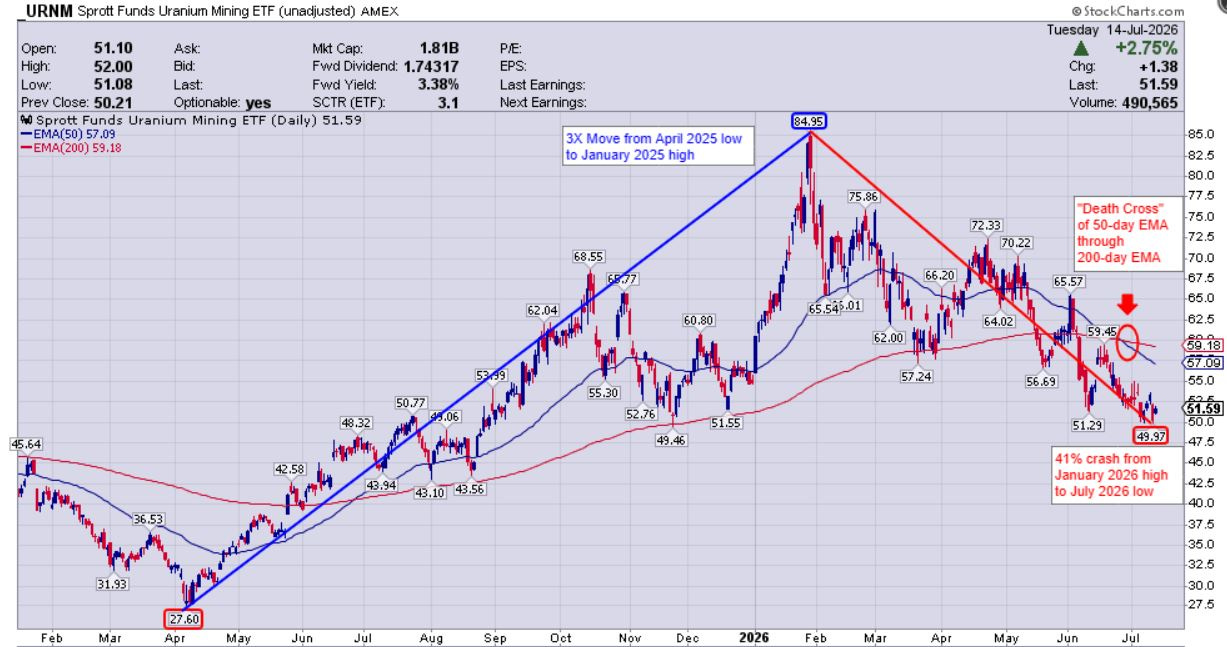
(URNM) had a 3X move from the April 2025 “tariff tantrum” low of $27.60 to the January 2026 peak of $84.95. When this sector moves, it really moves quickly.
Last year, there was a steady stream of tech companies announcing interest in nuclear power that whole way along, paired with the May announcement from the Trump administration of 4 executive orders around nuclear power.
None of those structural changes have been altered this year, and the future supply deficit is only increasing.
Nuclear has just not been in the headlines as much lately, so momentum traders rotated out to chase the next shiny objects in AI stocks and space stocks.
(URNM) has now crashed about 41% from the January 2026 peak of $84.95 down to the July low around $49.97; which is clear bear market price action.
If investors were enamoured with the opportunity in uranium last year and earlier this year, then they should be thrilled to get a 40% off sale at present.
The 50-day Exponential Moving Average (EMA) {blue squiggly line} bearishly moved down through the 200-day EMA {red squiggly line}, in what is termed a “Death Cross.”
This is a lagging technical indicator, validating the bearish trend, but it often occurs after most of the chart damage has ALREADY been inflicted.
There are some institutional traders and algos that will make note of that though, which could trigger even more selling pressure, or just a stance of avoidance due to the technical posture.
Uranium mining bulls will want to see pricing get back up above that 50-day EMA, and will also want to eventually see that 50-day EMA turn back up above the 200-day EMA in a “Golden Cross” for full escape velocity.
“Buying Low” always feels bad from an emotional and cognitive dissonance perspective, because it does feel much better to buy equities or sectors when they are already in solid uptrends. However, that isn’t where the best value is found though.
The reason for layering into a position in tranches, is because nobody knows when the bottom will be formed. It is best to scale in with 20% or 25% or 30% of an initial stake, and then average down or up to establish a good overall cost basis.
Sticking with the example of (URNM) above, nibbling in the low $50s is not “buying high” and may end up being a good place to begin accumulating.
Then if (URNM) drops down into the $40s, then there is good lateral price support from prior peaks and troughs in the $48-$49 area, and then the $42-$43 area.
Below that the prior peak at $36.53 would be another compelling area to add a tranche.
There are no guarantees in investing, and nobody has any clue if pricing will actually drop that low; hence, the strategy of layering into a good cost basis in tranches.
On June 24th over at the KE Report, Justin Huhn, Founder and Publisher of the Uranium Insider, joined me for yet another very comprehensive macro update on the supply and demand fundamentals for uranium and the nuclear fuel sector. Justin provided some boots-on-the-ground feedback, after just recently attending the WNFM 52nd Annual Meeting and International Conference on Nuclear Fuel in Scottsdale, Arizona.
We discussed primary versus secondary demand, how the longer-term contracting cycle is setting up with utility companies, different bottlenecks in the nuclear fuel cycle, and how he is positioning in the uranium equities that feed the front-end of that supply chain.
This is a longer-format discussion building upon our prior conversations throughout 2024 and 2025, because even more key macro news and company developments continue to be announced in the nuclear and uranium sector.
We start off reviewing the Primary Demand drivers for uranium from the existing global fleet of nuclear reactors, which is augmented by the many reactor life extensions and restarts, as well as all the new reactors coming online over the next decade that are under construction or planned. The investing case for uranium bulls is compelling even with conservative modeling on this primary demand out for the next 5-10 years.
Next we layer on the various aspects of Secondary Demand that are harder to model, but will definitely have an additive effect on overall global uranium demand:
Financial demand from entities like the Sprott Physical Uranium Trust, Yellowcake, hedge funds, institutional buyers, etc…
Sovereign stockpiles and strategic reserves
Utility companies inventory stockpiles
Small Modular Reactors (SMRs) demand
Military demand
The conversation then transitioned over the supply side of the equation focusing on the uranium mining companies. We’ve seen a flurry of news the last couple years out of the U308 producers, many of which have been struggling to ramp up production.
Justin unpacks his outlook on mined supply from Kazatomprom, the largest uranium swing producer in Kazakhstan, the slow ramp up of Uzbekistan production, missed guidance last year from Canadian senior uranium producer Cameco (CCO.V) (CCJ), and the slow but steady ramp up of US producers.
Each country and the producing entities have had a series of setbacks and challenges to hit their annual guidance, which has kept supply and inventories tight.
Next we point out that large development projects in the Athabasca Basin of Canada, like the Phoenix Project held by Denison Mines (TSX: DML) (NYSE: DNN), and in specific the importance of the Arrow Project from NexGen Energy (TSX: NXE) (NYSE: NXE), are seeing their production timelines get pushed back to 2030 or later.
There is very little new supply coming online globally, with the exception of some smaller production out of the US, Namibia, and Australian producers. All of this fundamental backdrop just points to a much more constrained output from global uranium producers, even in face of growing uranium demand.
Justin weighs in on the importance of seeing more developers and explorers move their projects forward, and that the exploration stocks in particular have been left for dead by investors and represent compelling value propositions in this current environment.
Wrapping up we discuss the utility and diversification with some of the sector ETFs like (URA), (URNM), (URNJ), and (NUKZ), and the interesting potential buy-the-dip moment in the nuclear stocks, while the markets are quiet with less speculative participation.
Click here to visit the Uranium Insider website.
Wrapping up, here are the key takeaways from this article:
The bigger picture thesis and macroeconomics around nuclear power and the need for more uranium discoveries, development, and production will only increase in importance.
The importance of processing and enriching nuclear fuel outside of Russia is more important than ever.
The rise of demand for traditional large nuclear reactors and small modular reactors shows no sense of slowing down; and is actually accelerating.
Utilities that can produce cheap base-load power utilizing nuclear energy stand to benefit as well.
The whole uranium sector has corrected from the January highs for most of 2026, and is still in a bearish overall trend, (and the SMR stocks peaked last Fall). No downtrend lasts forever, and this is happening in the face of very strong sector fundamentals. That smells like an opportunity to me.
Thanks for reading and may you have prosperity in your trading and in life!
Shad
Comments
Nothing yet. Say the first thing.
Sign in to join the conversation.