
Berkeley Earth is a research oriented non-profit organization that, on a monthly basis, puts out some of the best data on the climate crisis. I have written a number of climate oriented columns recently, including this one where I quoted from its earlier findings earlier in the summer.
Every month Berkeley Earth produces the latest monthly temperatures for the planet on the warming of Earth. Remember, global warming is the cause of the climate crisis. Below is the most recent email I have received from them. I urge you to both read it and click on the hyperlinks they provide. I have always learned something when clicking on these links.
I have never, in the four years I have been publishing this newsletter, directly lifted an email from anyone. This is a first. That is how good the team at Berkeley Earth is. I figured that rather that just lift data from their monthly report I would just send it. Perhaps you might subscribe or donate to them. Whatever. They do great work!
For those who don’t know the significance of warming more than 1.5 degrees Celsius, please let me explain. It was long thought that if the surface of the planet warmed to more that 1.5 degrees Celsius over the pre-Industrial Age average, there would be massive negative occurrences.
The now failed Paris Climate Accord of 2015 had more that 190 countries making commitments to use less fossil fuels, starting in 2020, so that the surface of the planet would not experience an increase of 1.5 degrees Celsius by the 2030s. We are now at that level, with last month, July, being the first month this year when the temperature is over 1.5C.
As you will read below, the next 18 months will be a time when the surface of the planet will be hotter than any year in recorded history. In just the last month, the possibility of 2026 becoming the hottest year on record was up to 69% and it being the second hottest year was up to 30%. The data from Berkeley Earth implies that 2027 could well be warmest year ever.
Simply stated, this 2026 summer of the world being on fire is just the beginning.
Please sign up for Berkeley Earth emails so you can truly sit at ringside for an unprecedented 18 months of the hottest time since humanity has lived on Earth.
MONTHLY TEMPERATURE UPDATE · JULY 2026
July 2026 was the 2nd warmest July on record.
El Niño is strengthening rapidly, and 2026 now has a roughly 69% chance of becoming the warmest year on record.

The following is a summary of global temperature conditions in Berkeley Earth’s analysis of July 2026.
July 2026 was nominally the 2nd warmest July on record, with a global average of 1.56 ± 0.09 °C (2.80 ± 0.15 °F) above the 1850–1900 average — behind only July 2023 and effectively tied with July 2024. It is also the first month of 2026 to push above the 1.5 °C Paris-aligned benchmark.
Temperatures have now moved clearly above the long-term trend line, a marked turnaround from the cooler start to 2026, as El Niño’s warming influence begins to register in the global average.
BY THE NUMBERS
GLOBAL
2nd warmest July — first month of 2026 above 1.5 °C
1.56 ± 0.09 °C
2.80 °F above 1850–1900
LAND
3rd warmest July for terrestrial regions
2.03 ± 0.20 °C
3.66 °F above 1850–1900
OCEAN
2nd warmest July for ocean surfaces
1.25 ± 0.09 °C
2.25 °F above 1850–1900
Roughly 8.5% of Earth’s surface saw its warmest July on record — 9.8% of ocean and 6.0% of land. 32 countries set July records, and continent-wide July records were set for both Africa and Asia.
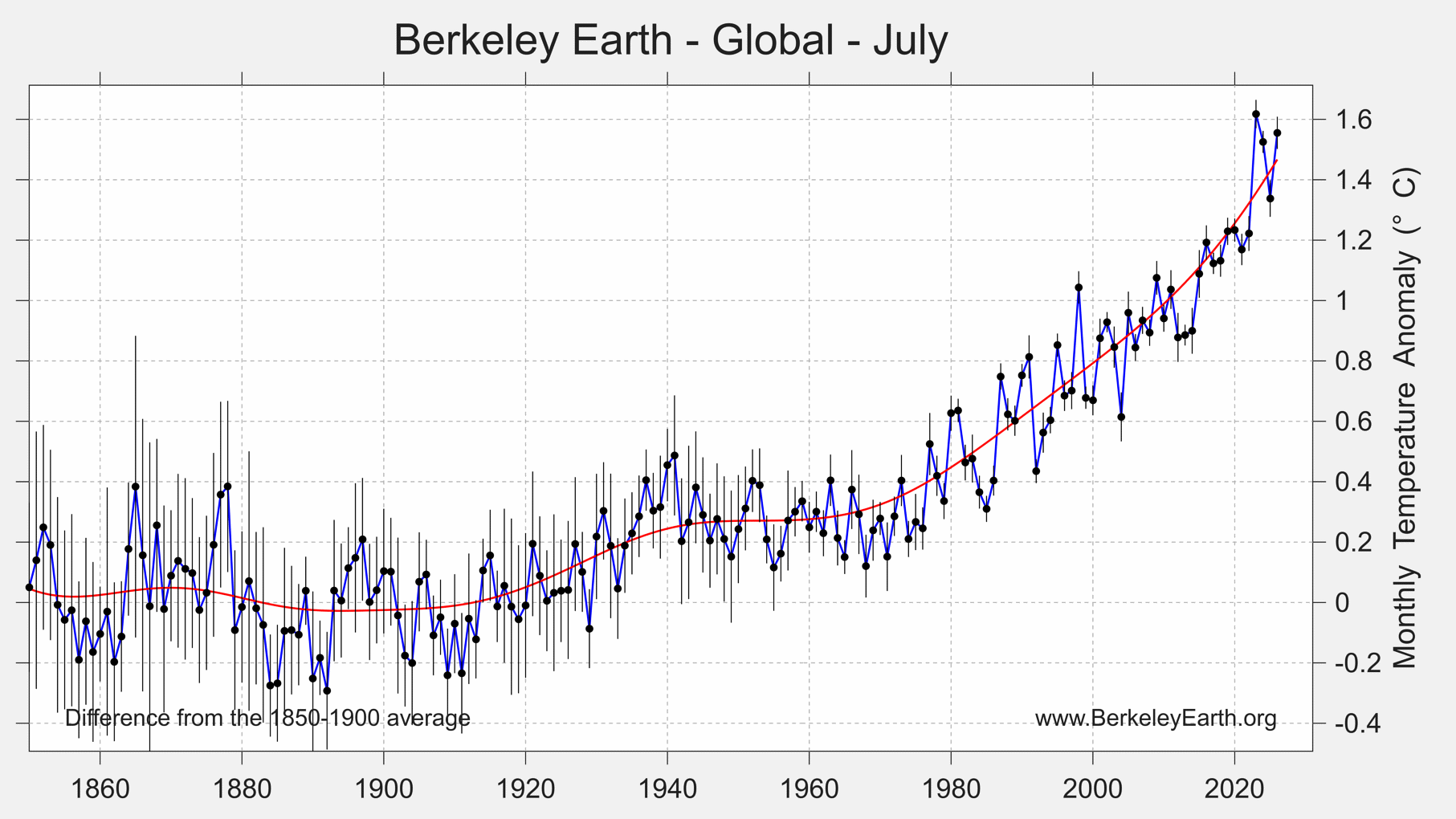
Global average temperature for the month of July in each year since 1850, relative to the 1850–1900 average. July 2026 sits near the top of the record, just below July 2023.
SPATIAL VARIATION
Warmer-than-average temperatures covered nearly the entire globe in July. They were especially pronounced across the central and eastern tropical Pacific — where the developing El Niño is now unmistakable — along with North America, the North Atlantic, Western and Southern Europe, the Mediterranean, North Africa, Central Asia, Siberia, and East Asia. The most striking cool anomaly was near Antarctica.
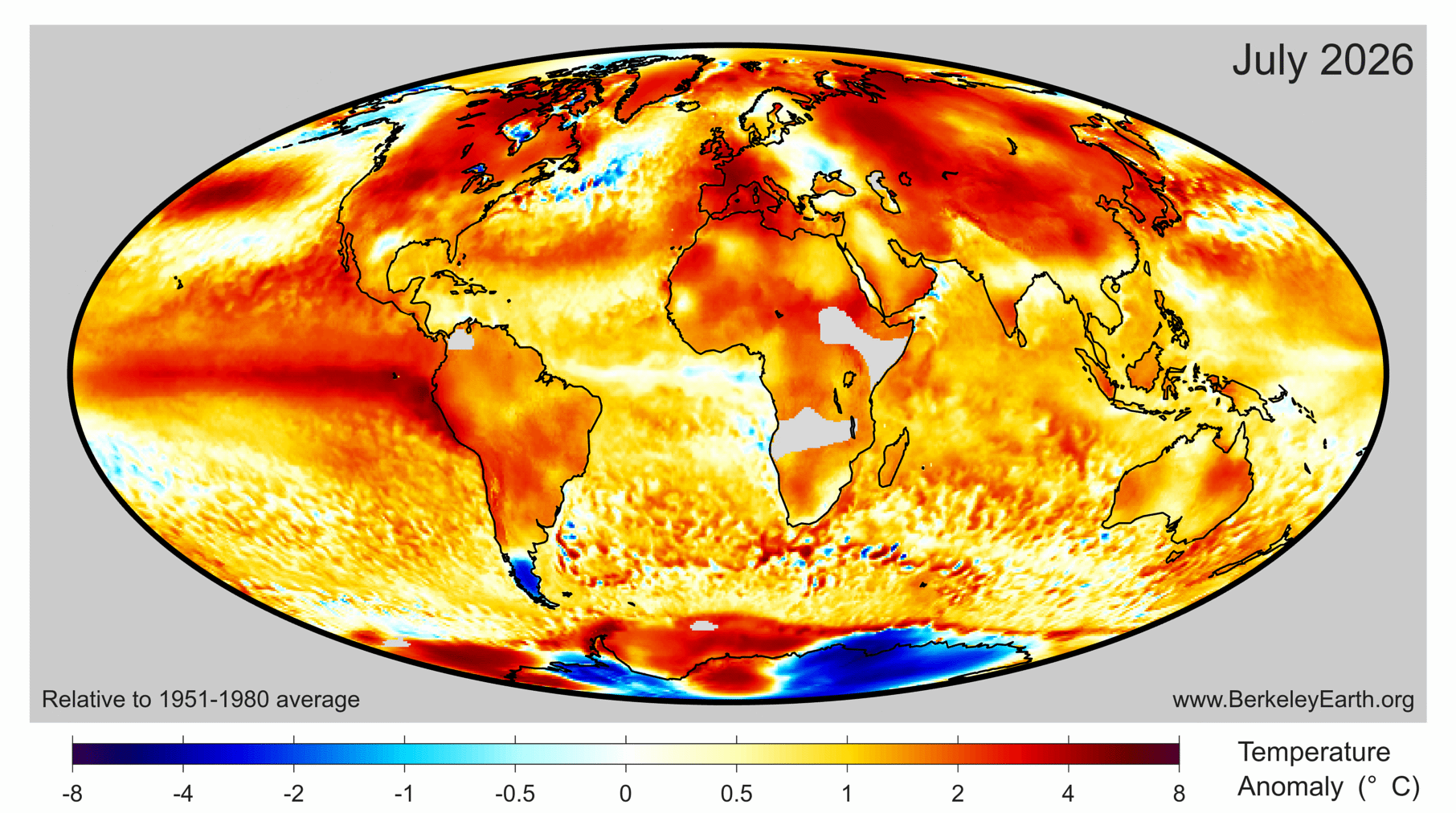
July 2026 surface temperature anomalies relative to the 1951–1980 average. The broad warm tongue across the equatorial Pacific reflects the strengthening El Niño.
A U.S. ALL-TIME RECORD
July 2026 became the warmest month of any kind for the contiguous United States in both the Berkeley Earth and NOAA datasets. The national average set in 1936, during the height of the Dust Bowl, had long stood as NOAA’s all-time warmest monthly average.
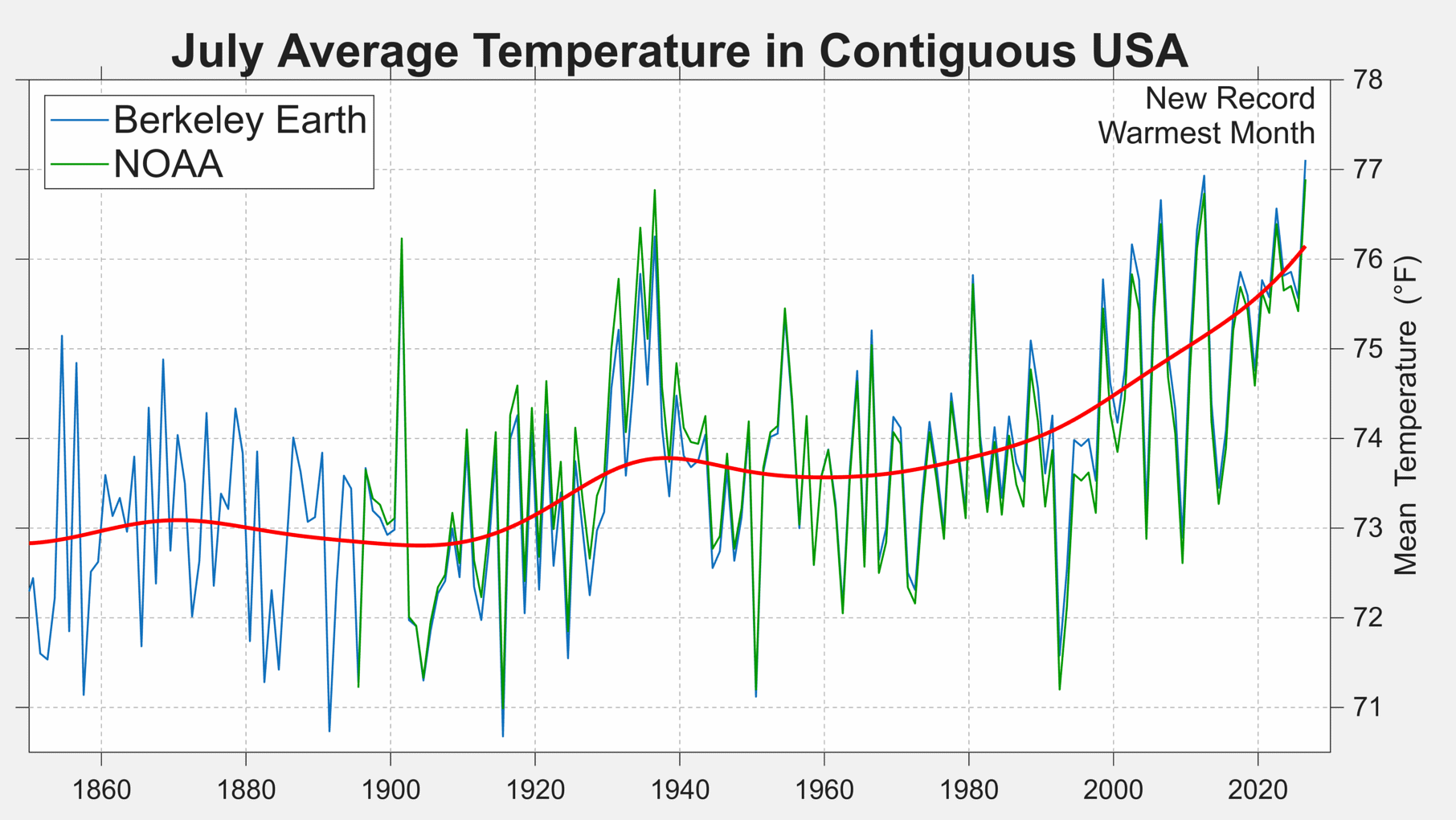
July average temperatures across the contiguous USA (lower 48 states) in both the Berkeley Earth and NOAA datasets.
EL NIÑO, STRENGTHENING FAST
The El Niño that emerged in the spring has continued to strengthen rapidly. NOAA’s Climate Prediction Center has an El Niño Advisory in effect, and the daily Niño 3.4 index has climbed to about +2.7 °C — already well into very strong or “super” territory. No El Niño in the modern record has run this warm this early in its development.
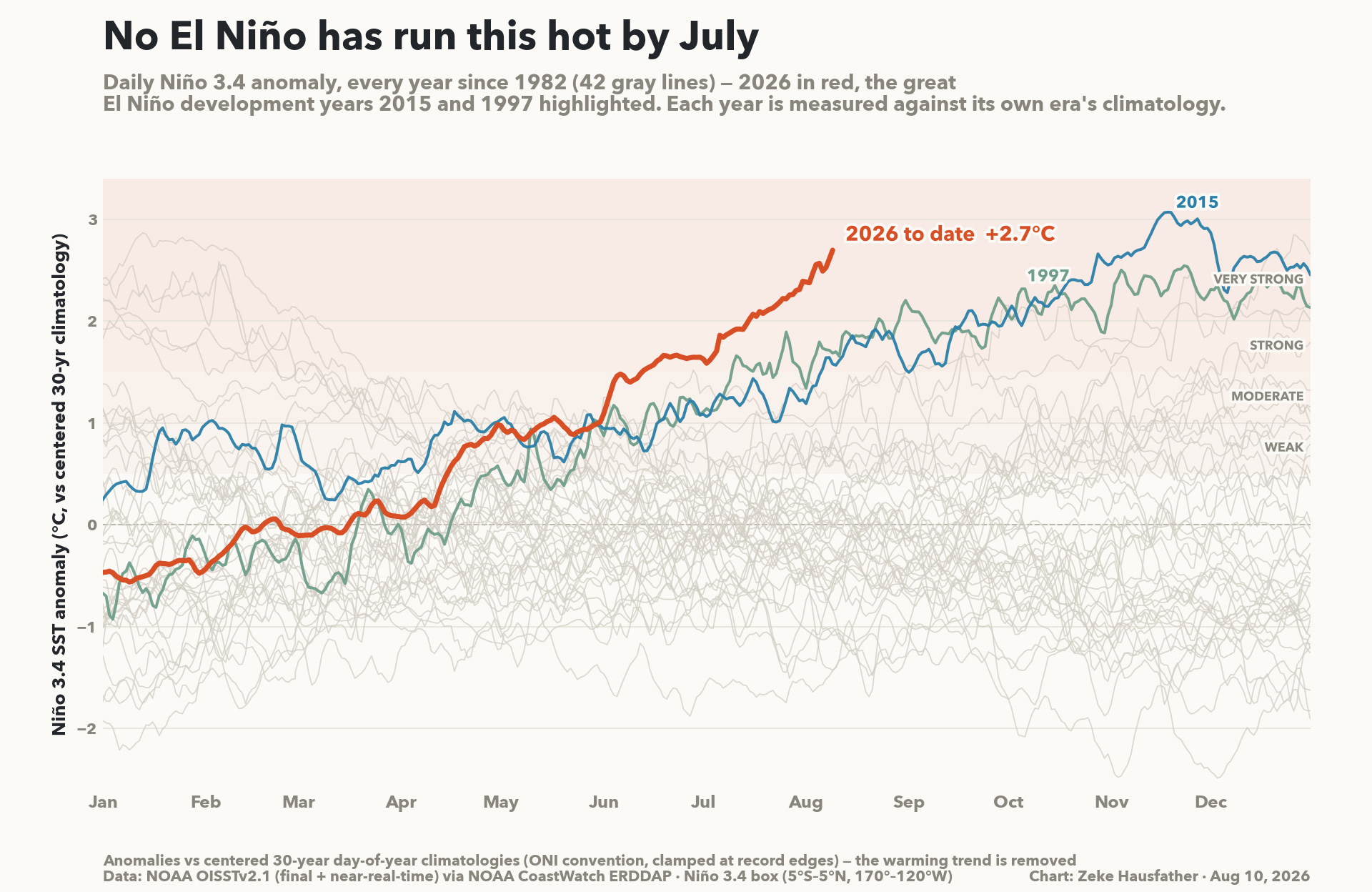
Daily Niño 3.4 sea surface temperature anomaly for every year since 1982, with 2026 in red. Measured against each year’s own climatology, 2026 sits above all prior years for the date. Source: Climate Dashboard analysis of NOAA OISSTv2.1.
Forecasters expect exceptional further intensification. Across 14 operational seasonal forecast systems, every model projects a very strong event at its peak, with a multi-model weighted median peak Niño 3.4 anomaly near +4.0 °C — most likely in November 2026, and far above the roughly +2.75 °C peak of the record 2015–16 event. Because the global temperature response lags the Pacific peak by several months, much of this event’s warming influence is expected to carry into 2027.
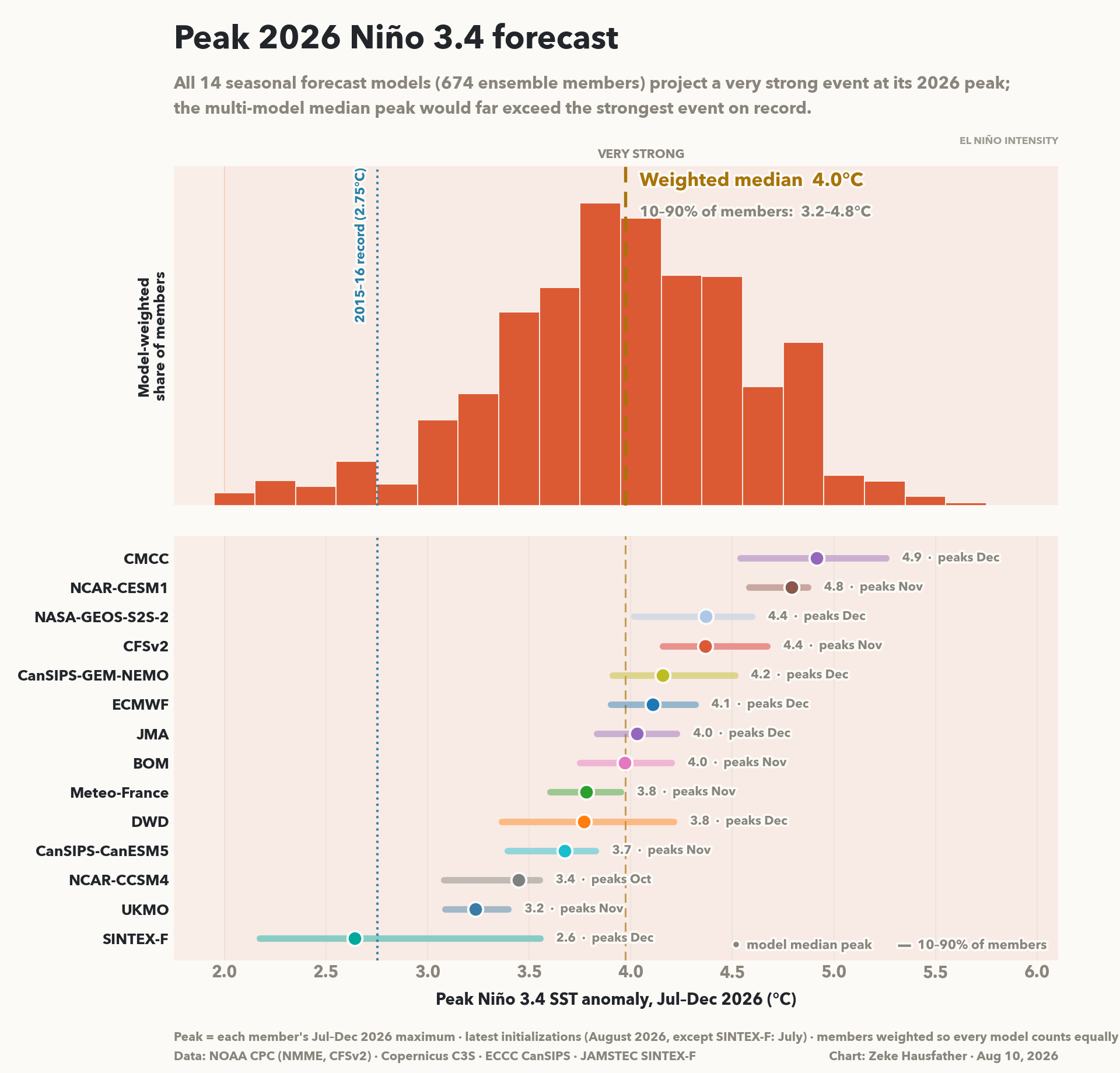
Forecast peak Niño 3.4 anomaly for 2026 across 14 seasonal forecast systems (674 ensemble members). The multi-model median peak near +4.0 °C would far exceed the strongest event on record (2015–16, dotted line). Source: Zeke Hausfather / Climate Dashboard.
HEATWAVES AND WILDFIRES
July brought a series of damaging heat extremes across the Northern Hemisphere. Western Europe recorded its hottest combined June–July period on record, with successive heatwaves driving widespread record daily highs. Persistent heat and drought fueled severe wildfires across the Mediterranean — including southern France, Spain, Portugal, and Greece — forcing thousands to evacuate.
North America was also affected. A significant heatwave tied or broke records in cities across the United States and Canada, and extensive wildfire activity developed in the Western U.S. and Canada, with fires in Ontario alone burning several hundred thousand hectares.
THE 2026 OUTLOOK
Where the year is likely to land
With seven months of data in hand, the outlook has shifted decisively upward. Where a month ago a record year looked unlikely, the strengthening El Niño and July’s move above 1.5 °C have flipped the balance: we now calculate roughly a 69% chance that 2026 becomes the warmest year on record, up from 12% in the June update. The most likely alternative is a 2nd-place finish.
ESTIMATED FINAL RANK FOR 2026
Warmest
69%
2nd warmest
30%
3rd or lower
<1%
~99% chance the 2026 annual average exceeds 1.5 °C above 1850–1900.
A notable disconnect is likely in 2026: record warmth in the ocean alongside less-than-record warmth on land. We estimate a near certainty (>99%) of record annual ocean warmth, but under 1% chance of a record on land, where relatively cool conditions early in the year have held the average back.
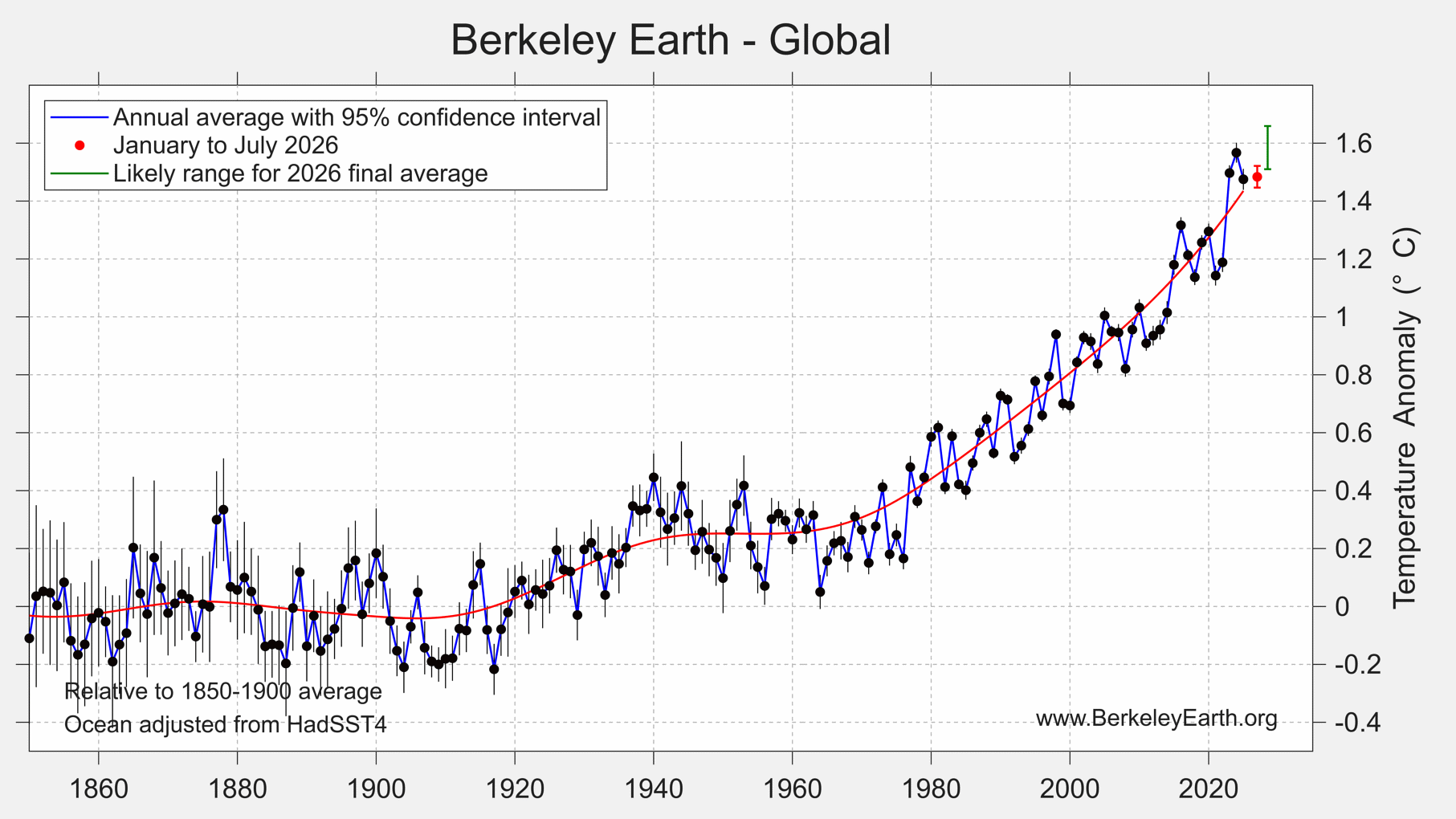
Annual global mean temperature since 1850 relative to the 1850–1900 average. The red point shows the January–July 2026 average to date; the green bar shows the likely range for the final annual average.
IN FOCUS · THE WASHINGTON POST
A record El Niño could provide a preview of a post-1.5C planet
The Washington Post examines what an event of this magnitude means beyond the record books: with equatorial Pacific temperatures potentially exceeding 4.0°C above average at the El Niño’s peak, the event could temporarily lift global temperatures to levels that the underlying warming trend would not otherwise reach until the 2030s.
While the El Niño-driven spike in temperatures is itself temporary — global temperatures typically fall back after an El Niño peak — the conditions it produces offer an early view of a climate the world is otherwise on track to reach within a decade.
Read the article in The Washington Post →
ALSO IN THE NEWS
HEATMAP NEWS · DAILY BRIEFING
Robinson Meyer on why forecasters are alarmed, with Berkeley Earth’s Zeke Hausfather — who argues the coming months could offer a preview of the 2030s — as the guest on Heatmap’s Shift Key podcast.
BLOOMBERG
2026 Projected to Be the World’s Hottest Year Ever Recorded
Eric Roston covers our revised 2026 outlook and what a record year would mean, following July’s move above the 1.5 °C benchmark.
SUPPORT OUR WORK
Berkeley Earth is a California-based 501(c)(3) non-profit dedicated to advancing independent, transparent climate science. Since 2013, we’ve pioneered the use of AI and advanced statistical methods to produce clear, accessible analysis of environmental data. Our high-resolution, open-source temperature datasets empower scientists, policymakers, journalists, and the public to engage directly with trusted, evidence-based insights on global climate trends.
BERKELEY EARTH
Independent climate science. Open data for academia, policy, and industry.
You are receiving this because you subscribed to updates from Berkeley Earth.
Unsubscribe · Update preferences · berkeleyearth.org
Berkeley Earth
1160 Battery Street East, Suite 100
San Francisco, CA 94111
© 2026 Berkeley Earth. Data licensed CC BY-NC.
No posts
Comments
Nothing yet. Say the first thing.
Sign in to join the conversation.