
A few months ago, I posted a Substack Note about assumptions.
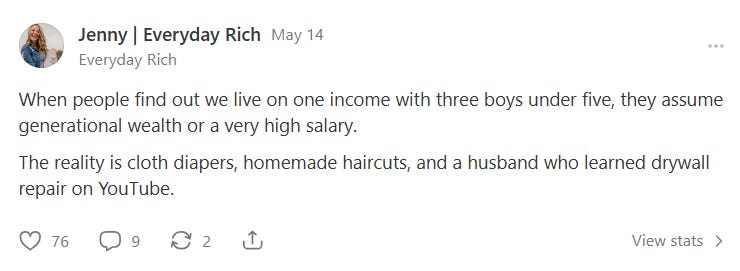
Someone replied with a reasonable challenge: how do I actually know what people are assuming?
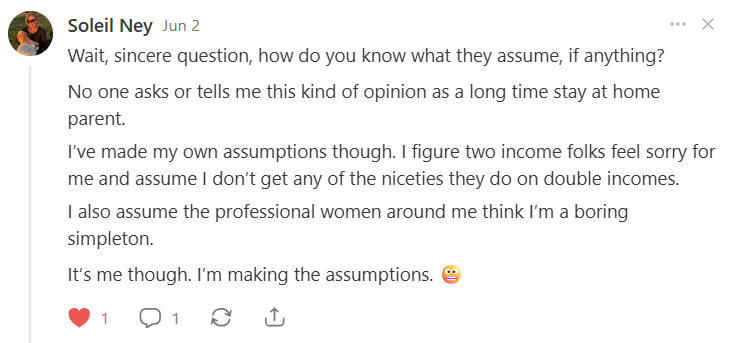
The honest answer? I don’t.
I don’t know what people assume when we tell them my husband stays home, or if they assume anything at all.
I can’t read minds.
And when I sat with that comment for a few minutes, I realized I might have been projecting — taking my own internal narrative about how our setup may look from the outside and attributing it to other people’s thoughts.

There is a well-documented psychological phenomenon called the spotlight effect that makes us overestimate how much people notice and think about us.
We walk into a room convinced that everyone will notice what we are most self-conscious about — the comment we made that landed wrong, the outfit we’re second-guessing, the pimple that popped up on our nose that morning, or the life choice we’re still defending to ourselves.
Because we are the center of our own worlds, we overestimate how much others pay attention to our appearance, mistakes, or awkward moments. In reality, other people are far too preoccupied with their own spotlights to spend much time thinking about ours.
The spotlight effect is particularly powerful around decisions that feel like they define our identities. Leaving a career to stay home with your children is a perfect example of this type of choice. Because it feels enormous from the inside, we assume that everyone will have opinions about it.
So we anticipate questions and prepare our explanations. We think carefully about how to frame it, so that it sounds like a good choice rather than a failure.
Then we tell someone — a colleague, a friend, a person at your kid’s friend’s birthday party — and they just say “oh, that’s great.”
The spotlight is hardly ever pointed at us the way we think it will be.
Here is what actually happens, almost every time, when we tell someone that my husband stays home with our three boys while I work full-time:
Curiosity. This is the most common one. How does that work? Who decided? Do you like it? How’s your husband holding up? These are genuine questions from people who are interested in the way we live.
Recognition. The “must be nice” response, which I have come to understand almost always means “I wish I could have that too, but have not figured out how to make it happen.”
Mild surprise, particularly around the gender role reversal. The breadwinner mom and the SAHD arrangement raises eyebrows occasionally, mostly from people of an older generation.
And then, the conversation just moves on. To their kids. Their job. Their weekend or summer vacation plans. Their life, which was always the more interesting subject to them anyway.
If you are hesitant about becoming a stay-at-home parent or if you’re holding back from telling people because you’re anticipating a reaction that hasn’t happened yet, I want to offer you this:
The people in your life whose opinions about your choices are worth weighing just want you to be happy. They are almost certainly less focused on what you are doing and more focused on whether you seem happy doing it.
And the people whose opinions you are most anxious about are almost certainly not thinking about you as much as you think they are.
Nobody is keeping score of your career trajectory. Nobody is tracking whether you went back to work, stayed home, did it in an unconventional order, or made a choice that required some courage to redefine your life and identity on your own terms.
Your spotlight is on you, but their spotlight is on them.
They are thinking about their own choices, their own finances, and their own life.
Which means the main audience for your life (the one whose judgment actually matters) is you.
Jenny :)
When you subscribe for free, you’ll receive:
Weekly newsletters with a blend of behavioral science, personal stories, and real systems for living well on one income and reclaiming time.
Short stories of families redefining “enough” and reclaiming time with their kids.
A monthly reflection prompt to help you clarify what “enough” looks like for your family.
All free and sent directly to your inbox.
Comments
Nothing yet. Say the first thing.
Sign in to join the conversation.