
By: Hanna Mandelbaum
Sometimes the easiest way to deceive people is to tell the truth, and nothing illustrates this more clearly than food label claims that are technically accurate but fundamentally misleading. There are plenty of egregious examples: “GMO-free” slapped on foods that don’t even exist in genetically modified form, or “no hormones added” on poultry, despite the fact that hormone use in poultry has been banned by federal law since the 1950s.
Poultry, in particular, is full of these kinds of claims, perhaps because the conditions under which most chickens are raised are so appalling that marketing becomes the only palatable part of the product. Take “cage-free,” for example. Chickens raised for meat in the U.S. are never raised in cages. If you see a product advertising “cage-free chicken,” they might as well be saying “contains chicken.” With nothing else to commend it, what they’re really saying is factory-farmed, hoping you won’t notice.
One of the most persistent versions of this—on both pet and human food—is the phrase “from family farms.” I take particular umbrage with this one because it doesn’t just describe a feature of the product. It leans on our collective denial about the realities of our food systems, by evoking a romanticized image of farming that exists primarily in our cultural imagination; red barns, hens pecking at grubs, cows lowing in pastures…
The marketing of the small high-welfare family farm is so culturally entrenched that we can see it everywhere, from packaging to the side of the road. Last summer I was driving through the Berkshires, and at one point in the drive, there were hand-painted signs advertising eggs and fresh chickens from [redacted] family farms. I passed an open field with abundant wildflowers and a rustic farmstand. It was late afternoon and everything was drenched in golden light. The setting was about as pastoral as one could imagine; the only thing missing was the chickens. Then I noticed a large corrugated metal barn set back in the field. It had no windows and there were no signs that birds had any access to the outside. A small family can still be an abusive one.
According to the USDA, 96% of farms are family-owned. These farms can vary in size and practices, but if you buy any agricultural product, the odds of it coming from a farm that is not owned by a family are very small. Of the remainder, 2% are cooperatively owned—with co-op members being, you guessed it, family farms. The remaining 2% are owned by corporations and partnerships.
Most animal welfare organizations estimate that around 99% of animals in the U.S. are raised in “factory farms.” While the term has no strict legal or scientific definition, it generally refers to operations that rely on industrialized systems designed to maximize output—at the expense of animal welfare. It’s one of those “I know it when I see it” terms. The EPA, however, does provide a formal classification for larger operations: Concentrated Animal Feeding Operations (CAFOs), which are defined by specific animal thresholds or environmental impact criteria. All CAFOs fall under the factory farm umbrella, but not all factory farms meet the criteria to be classified as CAFOs. In other words, even a small, family-owned farm can operate as a factory farm.
If the overwhelming majority of farms are family farms, where do the giant companies like Tyson and Purdue get their poultry? Family farms, thanks to the contract farming system that dominates American animal agriculture. In these arrangements, the companies are known as integrators and provide the chicks, feed, and veterinary protocols. Contracted farmers raise the chickens to market weight in their own poultry houses, which are often required to meet the company specifications. The integrator then picks up the birds for processing, and often pays based on a “tournament system” that ranks farmers against each other based on bird weights with the top performers being awarded a bonus that is taken from the contracts of the bottom performers.
Contract farming is so widespread that, as of 2020, it accounted for 99.5% of U.S. poultry production. Within this system, there is a deep power imbalance between integrators and farmers, who often take on debt against their contracts to finance facility upgrades. In the event of an uncontrollable disaster—avian flu, a heatwave, or a storm wiping out a flock—the farmer has little in the way of protection.
Welfare, for both animals and the people raising them, takes a backseat. Company-mandated husbandry protocols and stocking densities leave no room for more humane practices, even when farmers want better for the animals in their care. The result is a system designed for output, not wellbeing. The majority of chicken farmers in the U.S. live below the poverty line.
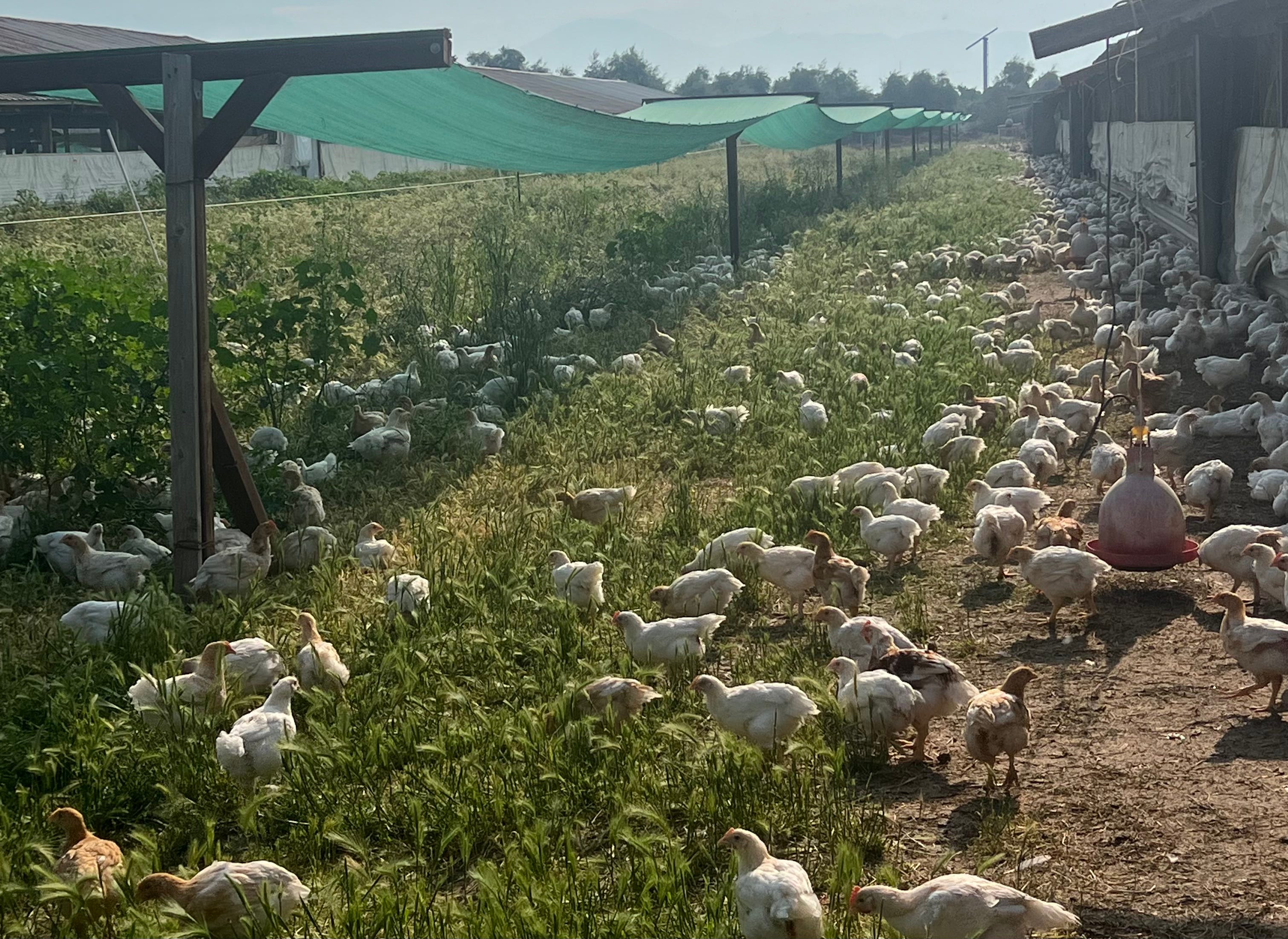
But not all contract farming works this way. A small number of higher-welfare brands put their own spin on the model, proving that a more ethical supply chain is possible. Higher-welfare operations like our supplier, Mary’s Free-Range Chicken (Pitman Family Farms), use the contract farming model, but with key differences. While they operate their own facilities, they also work with independent farmers in a more collaborative way. In conventional contract farming, nearly every aspect of husbandry is dictated by the integrator. Mary’s, by contrast, requires farmers to meet high welfare standards—such as achieving Global Animal Partnership (GAP) certification at Step 3 or higher—but allows for greater autonomy in other areas of management.
To support this, Mary’s helps cover costs associated with welfare upgrades, including GAP audits and facility modifications, and pays premium rates to offset lower stocking densities and slower growth cycles. Other suppliers with their own more equitable models include, Pasturebird, LaBelle Patrimoine, and Farmer Focus, and others—companies that also contract with growers while prioritizing animal welfare, environmental stewardship, and more balanced grower relationships. While the specifics vary, these models share a common departure from the conventional integrator system, emphasizing transparency, humane treatment, and shared values over pure output.
Next time you’re shopping for pet food, or for your own, pay attention to how many products lean on family farm language and what else they say. It’s easy to let terms like “family farmed” fill in the blanks, to picture red barns, green pastures, and animals living idyllic lives.
But when a product has little else to say about its merits, claims like these become less of a comfort and more of a warning. More often than not, they’re a blinking neon sign that the conditions behind the label, for both humans and animals, are anything but pastoral.
If this made you look at a label differently, share it.
Thanks for stopping by. We’ll be regularly sharing our adventures, insights, strong opinions, and a behind-the-scenes look at what it takes to be the gold standard in gently cooked food for pets!
Comments
Nothing yet. Say the first thing.
Sign in to join the conversation.