
By: Hanna Mandelbaum
This heartwarming missive arrived in October 2022. It would be two more years before we launched cat food. It wasn’t the only message expressing frustration, but it was certainly the most vitriolic. And it stung—because cat food had always been my pet project, as a secret cat person co-piloting a dog food company.
I was frustrated, too. The timeline wasn’t what we had hoped for, and many of the delays truly were outside our control. Navigating a small business through a global pandemic posed real challenges. Still, there were also factors within our control. The biggest one was our standards.
We weren’t going to release cat food until we believed it matched our dog food in both formulation and palatability. After five years and eight recipe versions, we felt we finally hit that benchmark and quietly launched our cat line in October 2024.
That said, I still think back to that message often. The writer’s sentiments reflect a broader frustration with an industry that too often treats cats as second-class citizens.
If you peruse the aisles of your local pet supply store, you’ll often find a robust selection of dog toys and accessories, while the cat section is mostly dominated by litter and offers comparatively few discretionary items. Toy selections in particular are usually a sad little section of a row with a few wands, some catnip toys, and a small assortment of crinkly foil balls and tiny fur mice that are definitely choking hazards.
While dogs remain America’s favorite pet by household count—with 65.1 million households owning them compared to 46.5 million with cats—that’s still a gigantic market. This begs the question: why does the pet industry treat cats like second-class citizens?
According to Packaged Facts, cat-related spending made up 30% of total U.S. retail sales of pet products and services in 2023—around $43 billion across brick-and-mortar stores, e-commerce platforms, veterinary care, and non-medical services.
A big part of this disparity is based on the differing needs of dogs versus cats. Dogs need to be walked. Cats don’t need walking (though it is becoming more popular). People tend to take their cats to the vet less often, and kitty daycare isn’t a thing. Many people skip pet sitters on short trips and just leave out kibble and water for them to fend for themselves.
This reflects a pervasive cultural attitude that cats are more independent and low maintenance than dogs—and in some ways, they are. But when it comes to food, that attitude becomes an obstacle to many of them living the healthiest lives possible.
Since I feed my boys Evermore, whenever I leave town, if my neighbor or parents can’t feed them at least twice a day, then I need to hire a pet sitter for two daily visits, or to stay over. I can see why people who share their homes with a “low maintenance” pet might be reluctant to change their routines and spending to accommodate a fresh diet.
Then there’s the cats themselves, who are perhaps the biggest barrier to better options. We’ve all ordered toys and beds, only to have them more interested in the boxes they came in. Many of us have tried food after food, only to have them repeatedly turn up their noses—or be enthusiastic about something for a short period before completely losing interest.
All the while, they’ll gobble up the cheapest of kibble as if it were their last meal, thanks to a variety of addictive chemical additives. When it comes to food, cats seem determined to make our lives difficult when we’re just trying to provide the best care possible. In other words, cats are the real drama queens.
They come by it honestly and biologically. Cats are obligate carnivores, hardwired with specific preferences and behaviors. With only 470 taste buds, they have a very limited palate—by comparison, dogs are practically sommeliers with their 1,700, and humans typically have around 9,000. This gives cats a narrow window for what they might find acceptable, and much of that comes down to texture and temperature. Even slight variations in either can be deal breakers.
Cats also imprint early in kittenhood. The foods they're exposed to shortly after weaning can shape their preferences for life. Add in neophobia (fear of change)—a protective evolutionary trait—and introducing a new diet can feel like an uphill battle. It's no wonder so many manufacturers invest less in better options and leave cats at the mercy of “Big Pet.”
For us, the assignment was clear. We needed to create a food that not only met our standards from a quality standpoint, but also had the highest likelihood of enticing cats with as little additional effort as possible. To that end, we made sure our initial release would be nutritionally appropriate for all life stages, allowing for an early entry into a lifetime of fresh feeding.
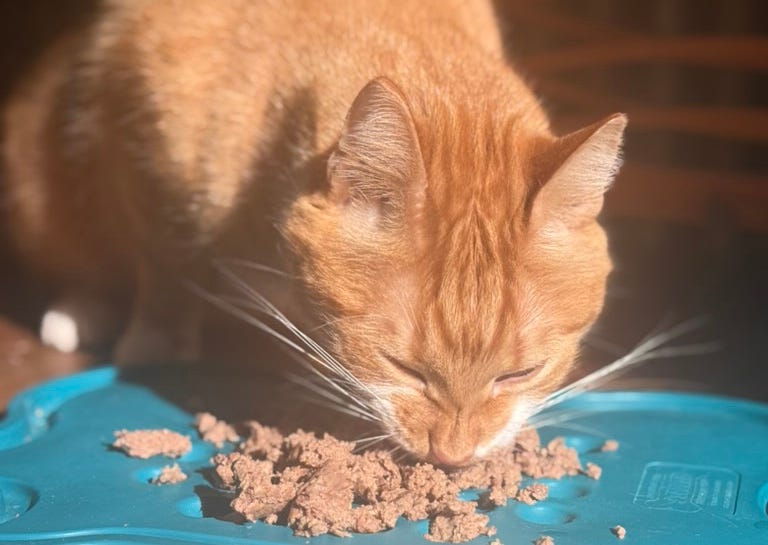
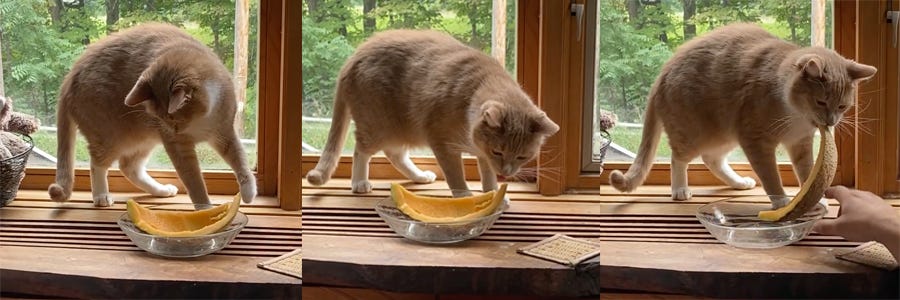
We also included some truly special ingredients to help raise the taste ante. My two personal favorites are clam broth, which is not only delicious but also provides moisture and taurine—an essential amino acid for cats—and cantaloupe. While cats can’t taste sweetness, they perceive cantaloupe as having an umami flavor. Based on my personal experience, this tracks. My older cat, Trout, has stolen melon rinds from the table and ferociously guarded them. Of course, I really can’t use my orange garbage monsters for any sort of palatability benchmarks. They make Garfield seem restrained.
We’ve had many success stories of finicky cats diving right in. But cats are still cats, and for many, the transition to fresh food feels like a battle of wills. The good news? With the right strategy, you can outmaneuver even the most skeptical feline.
If you're having trouble getting your cat started on fresh food, here are a few tactics worth trying:
Take away their freedom
Don’t leave kibble down for your cat to graze on all day. Breakfast, after a night of not snacking, is the ideal time to introduce something new.
Start as a mixer or side-by-side
Mix fresh food with their current food, or serve them next to each other in the same bowl or separate dishes. For digestive reasons, gradual transitions are recommended anyway, but this also helps picky eaters warm up to the idea.
Introduce in a new location
Sometimes a change of scenery can shift your cat’s mindset. Try offering the food somewhere they don’t normally eat, especially if they associate their usual spot with something they're reluctant to give up.
Serve it warm
Cats are predators and prefer their food close to “mouse temperature”—around 100–102°F. Warming it gently helps release aromas and enhances mouthfeel, which can be more enticing than cold food straight from the fridge. We like mixing in a little hot water.
Play first, eat second
Try engaging your cat in a short play session before mealtime. It simulates the natural hunt-eat cycle and can help boost interest in the food that follows.
Resort to bribery
Crush up some of their favorite treats into a fine dust and sprinkle it over the new food.
Don’t give up too soon
It can take weeks, or even months, for some cats to fully embrace a new food. Keep offering it without pressure, and celebrate every bite, no matter how hesitant, as progress.
Your cat may be a diva. But with a little patience and a solid plan, even the pickiest feline can learn to love fresh.
Have your own little drama queens at home? Whether it’s food wins, feeding fails, or general feline shenanigans—we want to hear it. Share your cat’s story in the comments.
Thanks for stopping by. We’ll be regularly sharing our adventures, insights, strong opinions, and a behind-the-scenes look at what it takes to be the gold standard in gently cooked food for pets!
Comments
Nothing yet. Say the first thing.
Sign in to join the conversation.