
Note: I started writing this as a LinkedIn post and ran out of characters. So, I decided to launch a Substack. This one will be deep in the weeds but I’ll soon put out some more accessible posts for those who don’t spend every day combing through regulatory filings.
A few months ago, I posted on LinkedIn and noted that Kaiser in Georgia suddenly was in the position where they might receive a large amount of membership as they suddenly became the lowest cost plan by a mile in some major counties.
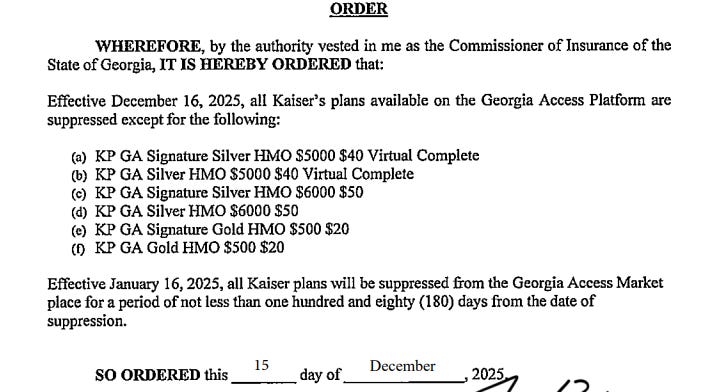
They just entered into a consent order with the Georgia Department of Insurance to pull a large number of plans from the Georgia Access state-based exchange effective December 16, and then remove all of their plans effective January 16. From what I can tell, this does not directly impact off-exchange plans, but carriers already have a lot of flexibility with how they market off-exchange plans, so who knows what they’ll do.
The order is pretty vague on the why, but the bottom line comes at the end:
The Winners Curse
Earlier this year when talking with carriers, reporters, and others about the 2026 rate filing season, I referenced the auction theory problem known as the winner’s curse. In many ways, ACA rate filings work as a common value auction. Carriers have different ideas about how the market will move and different incentives on whether they’re going to set rates conservatively (higher) or more aggressively (lower). Because price is such a key driver of enrollee behavior, if a carrier’s rates are significantly lower than the average, they’re likely to enroll a lot of members, but have not charged enough to be profitable on them. So, every additional member that carrier adds compounds their losses.
My guess is that this is what’s going on with Kaiser. Early signals from CMS suggests that total ACA enrollment is higher than many expected. There’s been a lot of active shopping, and I suspect given that they’re so favorably priced, a lot of existing members switched from other carriers to Kaiser during Open Enrollment. That’s a good thing if you think you’re well-positioned, but from what we can see in Kaiser Georgia’s public financials, they may have underpriced.
In 2025, their individual market loss ratio through September looks to be around 115% based on their NAIC financials, ($350M in premium written and $400M in claims incurred).1 But their rate increase for 2026 was only 15%. So, even if the market didn’t get any sicker, their rate increase probably isn’t enough unless they have some major provider contract concessions happening in 2026. There’s nothing in their rate filings to suggest this is the case - so even if membership was flat, they’d probably be staring down a $100M loss for 2026 - which would require their parent company to contribute additional capital to meet state solvency requirements. By suppressing their plans, they’re stemming the future losses. Plus, Kaiser has the problem that they own the physician practices, which is harder to scale quickly compared to a network-based plan that could, theoretically at least, just contract with more physicians.
Down to Brass Tacks
As of December 16, they have exited the Catastrophic and Bronze metal levels entirely, and only retained their most expensive Gold plan. For Silver, oddly enough, they retained just their two lowest cost plans - and in the 20 counties where they sell, these two plans were the lowest and second lowest cost Silver plan.
The Bronze and Gold actions make sense - if you’re picking up a lot of membership, those metal levels can be fraught with issues, and they are setting themselves up to just avoid the membership altogether. For Bronze, obviously, there’s not a plan to buy at all, and for Gold, they go from being the cheapest plan by about $15 to now being about $50 above the cheapest option.
The Silver plans they are keeping is odd - I’d have expected they would have tried to remove their lowest cost plans to discourage more enrollment. However, their Silver plans are the benchmark silver in many of the places where they sell, which makes me wonder if this was a limitation the state Exchange had where they couldn’t re-benchmark APTC mid-open enrollment. It’s only for the next month, though, so it may not matter that much. According to the order, Kaiser will get suppressed altogether on January 16 (I’m assuming the year is just incorrect in the order and they mean January 16, 2026).
A suppression on January 16 is a pretty good deal for a carrier in the end… membership during Special Enrollment Periods tend to be wildly unprofitable for carriers. To put it in perspective, Kaiser’s 1Q this year was only 91% — not great, but not the 115% they’re at as of their Q3 filing. We can’t assume all of the degradation was due to SEP membership, but some of it likely was, and this suppression probably shaves 5-10% off their MLR. With just the OE membership, they’re probably still facing losses, but they won’t face the uncertainty of continuing influx of membership.
Operational Impacts on the Market
One other wrinkle on the January 16 suppression: this should mean a re-benchmarking of the APTC - and it’s pretty substantial. For a 37 year old like me, the second lowest cost silver plan with Kaiser in the mix for Gwinnett County is their HMO 6000 Silver plan at $609.41. But when Kaiser is suppressed, the second lowest cost plan would then be an Oscar plan at $691. This would create some interesting interactions - if you enroll for a March 1 or later effective date, the value of the subsidy dollar is higher. In other words, someone who chose that lowest cost Oscar plan today making right at the poverty limit would pay around $110 a month. But if they wait until March, they’ll only pay $20. There’s also an incentive if you enrolled during OE to try to find a SEP update your application2 - even if you’re just going to stay on the same plan so you can increase your subsidy dollar.
So what?
I have to wonder if there are other carriers elsewhere in the country who should be doing the same thing - a big influx of enrollment with as much uncertainty as there is in 2026 is not for the faint of heart. We’ll have to wait and see how things like the metal mix has changed (I expect a shift to bronze which will likely negatively impact margins) - and then the other big question is how many people ultimately pay for their coverage. With so many people going from a zero to a non-zero premium, the rate at which people ultimately pay their first bill will have a big impact on outlooks for 2026.
If you want to stay in the weeds on complex issues like this, go ahead and subscribe! If most of this was over your head, let me know where I should start with trying to explain some of the dynamics at play.
This is from their Q3 financials, using the “Comprehensive (Hospital & Medical) - Individual” line of business from the Exhibit of Premiums, Enrollment, and Utilization. I adjusted their premium upward by $28M because they had a $28M negative adjustment to their risk adjustment payable, but this was related to plan year 2024. Adjusting that out helps make sure we’re really only looking at the impacts of 2025 experience, not negative adjustments from prior years.
Thanks to Joshua Brooker for clarifying that no SEP is necessary.
No posts
Comments
Nothing yet. Say the first thing.
Sign in to join the conversation.