
In the 2027 Notice of Benefit and Payment Parameters, CMS announced their adoption of the State Exchange Improper Payment Measurement (SEIPM) which aims to apply oversight to improper Advance Premium Tax Credits (APTC) administered by State Based Exchanges. This program already exists for the Federally Facilitated Exchange as the Federal Exchange Improper Payment Measurement (FEIPM). Both FEIPM and SEIPM are required by the Payment Integrity Information Act of 2019 (PIIA). Although some carriers may be familiar with the FEIPM, those carriers under state-based exchanges should be prepared for the SEIPM in 2027.
In short, the SEIPM will monitor state-based exchanges to make sure that the processes they have in place for validating eligibility for APTC is correct – how they check documents to validate income, how they check citizenship status, etc. These parts won’t directly affect carriers (although if a state does poorly on an SEIPM audit, carriers should probably expect there to be fewer people found eligible for APTC in future years). The part that will affect carriers though is how the Exchange reconciles their books with the carriers and vice versa. Carriers in the Federal Exchanges (FFE) have been dealing with APTC audits for years, but SBE carriers have had less exposure until now. This paper will touch on the potential financial impacts for carriers who aren’t proactive about this.
Thanks for reading! Subscribe for free to receive new posts and support my work.
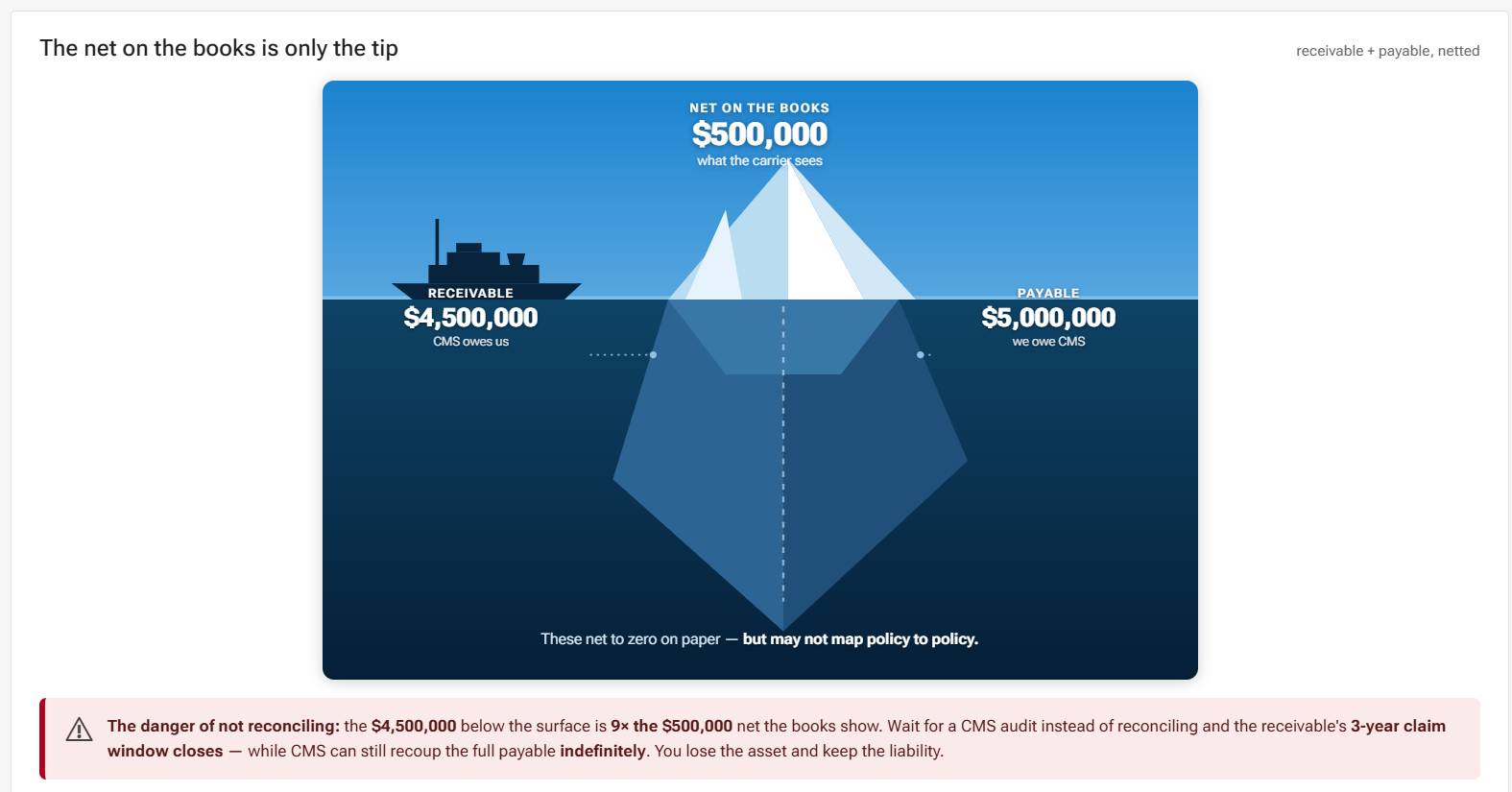
At Evensun, we regularly assist carriers with reconciling their APTC. If carriers are not already doing it, they’re already behind. Reconciling the books to the payments received by CMS is important for many reasons. Most carriers believe that if the net amount between what’s owed and what’s due is relatively small, then it “comes out in the wash” so to speak. However, CMS Audits can result in carriers owing CMS substantial amounts of money. Unfortunately, these audits are asymmetrical. Once a carrier is 3 years past the end of a plan year, any APTC discrepancies that are discovered (either by the carrier or CMS) go only one way: back to CMS. In other words, the carrier misses the opportunity to recoup the amounts owed to them, but CMS can always come calling for money owed to them. So, if in aggregate, CMS is owed $5 million in APTC, but they also owe the carrier $4.5 million, the carrier must pay up the $5 million owed to the government, and that doesn’t get offset by the $4.5 million owed to the carrier.
Below is a snippet from Evensun’s reconciliation platform that shows the danger of believing the payable number and receivable number net near zero.
This is when APTC Reconciliation becomes more than an accounting exercise. The NBPP makes clear that, like the federal process, SEIPM is technically directed toward the state exchange, not the issuer. But because data and APTC dollars are traded between the carrier, the state, and CMS, the carrier must pay close attention to these changes. Everything that the state reports to CMS has some data that has its source of truth the carriers’ enrollment source (such as premium paid status, or termination dates for members who were terminated for non-payment). The carrier opens themselves up to unwanted exposure when their books and the State Exchange’s books don’t align. They may owe APTC that the State didn’t flag, and they may be missing APTC that the State hasn’t reported to CMS. APTC Reconciliation completed policy-by-policy is the only way the carrier can see both sides of this picture. The carrier has the opportunity to dispute discrepancies via the state reconciliation process and an 820 payment disputes.
If the carrier isn’t doing this, the SEIPM will. The issue with that is timing. Once the SEIPM catches it, it’s too late for the carrier to dispute. However, there’s no deadline for when CMS can recoup overpayments. In 2024, Evensun did an analysis of the 2018 and 2019 FFM APTC audits. These audits were the first public look at PBP-era audit findings — issuers in aggregate received $29.1 million in underpayments and were charged $23.1 million in overpayments, ending up $6.1 million in the carrier’s favor. In other words, most carriers who got audited got a check from the government when the audit was done. This sounds like a pretty good result of an audit – most people assume an audit that finds inaccurate data will lead to penalties, not payments. But this isn’t the case for audits moving forward: under today’s rules, the overpayments still get collected, but the underpayments are almost certainly past the three-year deadline, and would need to be written off. Carriers that wait to be audited will only learn what they owe.
The implication for SBE carriers heading into the SEIPM-era is simple yet impactful: reconciliation is no longer optional, and “net close to zero” is not an acceptable success metric. For carriers, the metric needs to be the status of every discrepancy found in the 820 records: resolved through reconciliation inbound and outbound files (RCNO/RCNI), disputed, or corrected in their own system. Carriers who are doing this will have no surprises when the SEIPM leads to an audit where little to nothing is found.
The time to fix the data is at hand. The NBPP confirms that the audit will happen in a three-year cycle: For plan year 2026, the measurement year is 2027, and the reporting year is 2028. So, in 2027, the SEIPM will begin reviewing QHP eligibility and enrollment, APTC eligibility and amount, mid-year redeterminations, and re-enrollment redeterminations. The 2024 NBPP established the Improper Payment Pre-Testing and Assessment Program (IPPTA) which prepared cohorts with pre-audit activities. The results of the program revealed the complexity of receiving enough data from the state to determine if an APTC payment was proper or improper. Therefore, HHS developed a specific data reporting format for states to submit data regardless of state-specific eligibility and enrollment sources. Although these cohorts have improved the process already, there will inevitably be more holes to fill.
This audit lives or dies on data that flows directly through the carrier’s data. States are required to submit data in three parts: 1) program data, 2) universe data, and 3) tax household data.
Program Data
For the program data, the State Exchange will be asked to submit their own policies, business rules, APTC calculation logic, and data architecture. For carriers, this will be relevant because the State will be asked questions about how data flows in from the organization. It is important that carriers have clear documentation and reconciliation processes as a part of this picture.
Universe Data
For the universe data, states will submit every tax household with QHP enrollment and APTC for the plan year. Additionally, the submission will include eight “inconsistency indicators” that drive which samples the SEIPM will choose. These include SSN, citizenship, lawful presence, annual income, employer-sponsored plans, non-employer-sponsored plans, incarceration, and residency. Households with inconsistencies between the consumer’s attested information and CMS’s verification sources are more likely to be chosen for the sample because they’re more likely to have errors — and those same households are where the carrier’s reconciliation discipline matters most. The carrier catching it first through investigation of policy records turns a future audit finding into a routine reconciliation correction. The discipline will pay off. The financial impact is that the carrier can correct any improper payments without wasting APTC for several cycles as it takes longer for the Exchange to recoup payments.
Tax Household Data
Lastly, the tax household data is a detailed listing of the APTC, coverage, consumer-submitted documents, and dates for each sampled household, which HHS uses to determine whether each payment was proper or improper.
Many data points are sourced from the carrier—effectuation, policy dates, etc. If the SEIPM disagrees with what the state has issued, the carrier may be responsible for having the data to support their position. Therefore, having a playbook is going to be crucial for every carrier for the next 8 months.
Reconciling every month policy-by-policy, generating inbound reconciliation files (known as RCNI) as soon as the enrollment file from CMS is dropped (known as the 834), have an analyst working every outbound reconciliation (known as RCNO) discrepancy, track Medicare and Medicaid eligibility signals, coordination of benefits information, information from other lines of business, and engage proactively with the state-based exchange on companion guides and data formats.
To get an idea of what carriers may be looking at, the error rate in dollar terms for the FY2025 improper-payment rate for FFE APTC (BY2023) was 0.89%, or about $657 million, down from 1.01% the year before. This is in line with the error rate we found in our review of APTC audits – although they’re measuring slightly different things. But average margins in the individual market are typically in the 1-3% range, so a carrier who has to give back 0.5% to 1% of premium in an APTC audit potentially is risking their entire net profit for a year due to process errors. The financial impact can be meaningful, but it’s able to be lessened or mitigated with proactivity.
As a shameless plug, Evensun has tools, resources, and knowledge to help these SBE carriers with APTC reconciliation and/or data submission in 2027. Feel free to reach out in the comments or via email. We look forward to hearing from carriers about the potential impacts of SEIPM on their internal processes and the audit findings.
No posts
Comments
Nothing yet. Say the first thing.
Sign in to join the conversation.