
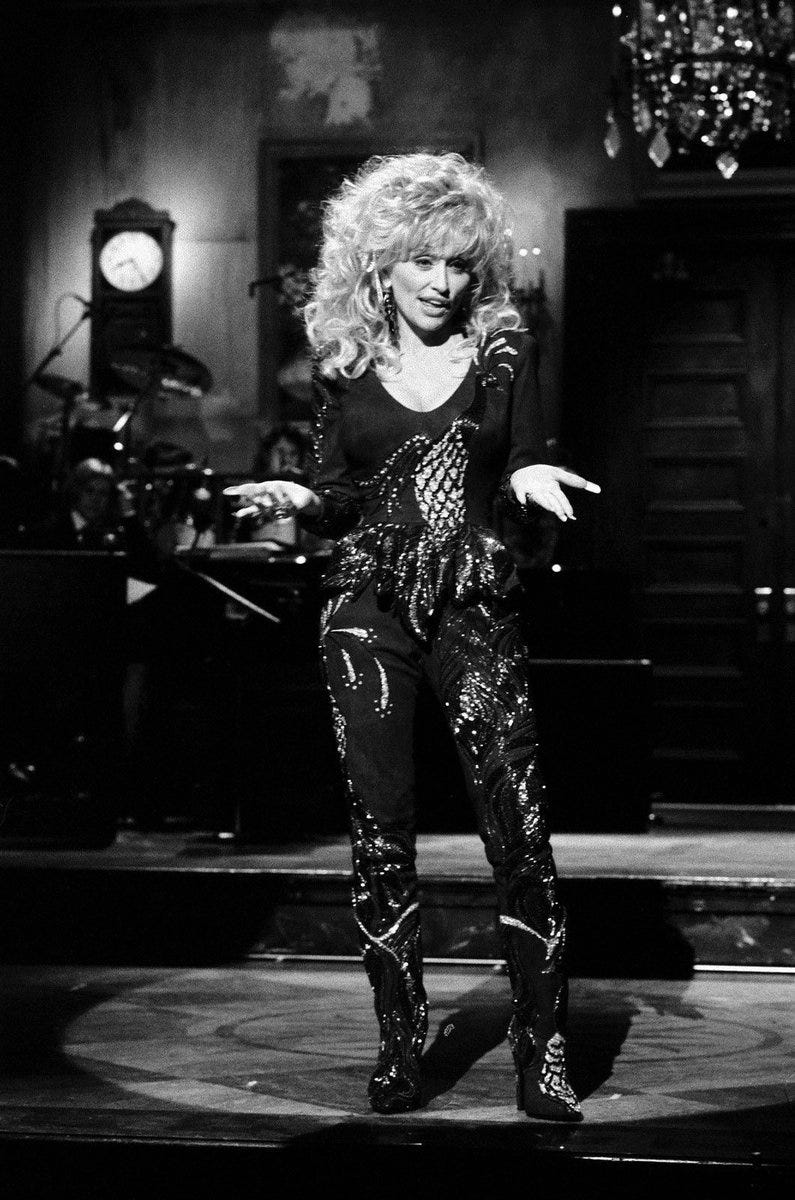
This is culture. This culture doesn’t care to be what anyone wants to bully it into being. It doesn’t care if you’re gonna like its opinions or what it’s gonna say or wear – or how. This is what we don’t nurture any more in a world where moral puritans keep destroying everything wonderful and unifying about life.
I’ve tried to stay away from appraisals of Dolly for the last few days, mainly because I don’t want to read a bunch of progressives shoehorning their own ideologies into a woman who refused to let anyone else speak for her. I know how hard it was to get her to speak to anything she didn’t want to share, because I was once tasked with trying, and I did ask her all the questions: from bathroom bills to Trump. And what an honor that was. However, some of the commentary has inevitably passed under my nose, and I’ve thought: wouldn’t it be amazing if music critics would stop imposing their own political agendas onto Dolly Parton?
Dolly was a Christian woman from the South, and incredibly outspoken about being so. She wrote about the South and its realities, and did so without judging anyone in the story; not the girl who fell pregnant, nor the lover who left her, nor the momma who kept her secrets, or the daddy who might commit a homicide. Everyone who listened to Dolly’s songs felt held and seen by her. She reflected reality back at the world with the honesty of someone who lived it herself.
After Nine To Five, Dolly stayed away from Jane Fonda’s activism – and thank god, because Fonda is now a ceasefire-screaming Jew hater. Dolly was able to do what so few artists remember to do now; she let her music do the talking. Even though she rejected the term, Dolly was more “feminist” than anyone using the title in 2026.
She outperformed her male competitors for one reason, and one reason alone. She wanted to do the thing she loved, and boy did she. When I met Dolly, she wasn’t some mothering type. She was warm, but she was firm. She was a woman on a schedule and she meant business, and she didn't want to be asked any questions that would detract from business. The only political thing about her was her capacity to maneuver herself into the neutral so as to be the exact product America rewards. She wanted to reach as many hearts and souls as possible, and that she’s mourned by one and all speaks to her wild and prolonged success at doing so.
I spent the last few days enjoying as much Dolly as possible. The sweet southern twang of “Early Morning Breeze” to the crushing tragedy of “Down From Dover” and the spirit-lifting harmonies of the Trio album with Emmlyou Harris and Linda Ronstadt. I wish it wouldn’t take her death to have such an excuse to stop and immerse in a great artist’s canon. Not just a great artist. One of the most exemplary to ever do it. I re-watched Steel Mangolias almost instantaneously and sobbed. I don’t usually cry tears for stars, but I think my tears were for a world that seems to be lost; one that rewarded based on merit, on being out of the ordinary. I re-watched Nine To Five, and gleamed. I’ve consumed about as many clips of old interviews and performances as the rest of us. (Social media is still good for some things). She left us with so much for all eternity, and that’s before we even get into the philanthropic efforts that should humble everyone.
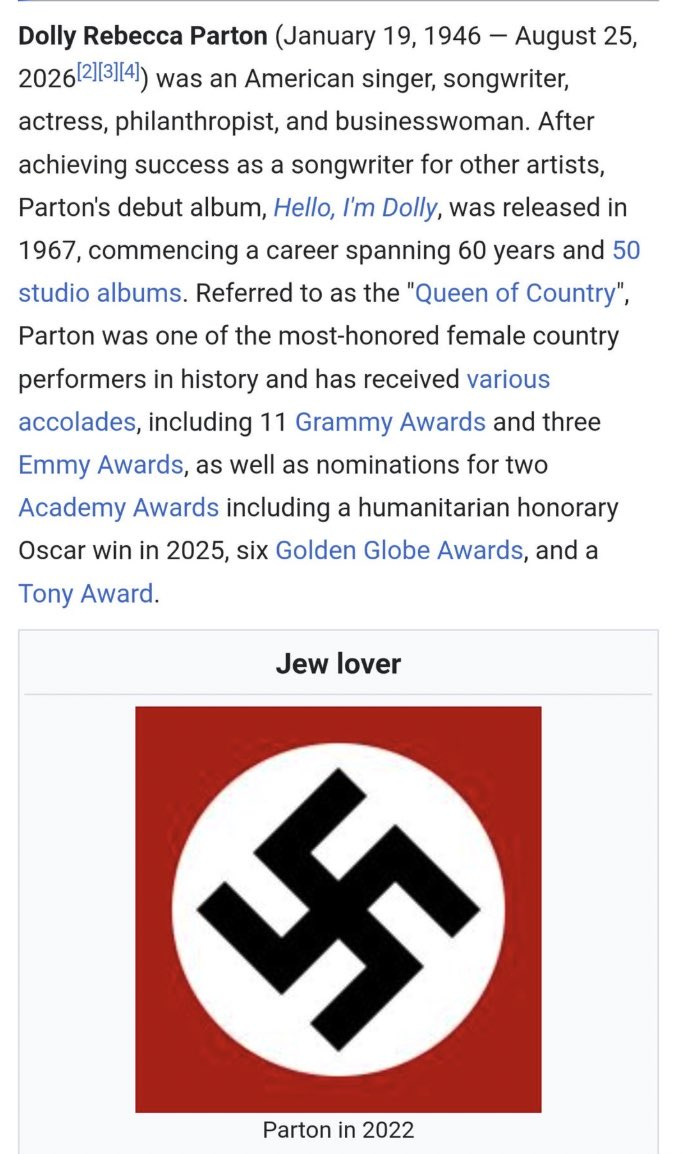
Of course, the only people in the world who weren’t celebrating and mourning the life of one of the last great Americans, were the Palestine activists. They took to Wikipedia hours after her death to title her “Jew lover” and inserted a swastika onto her page.
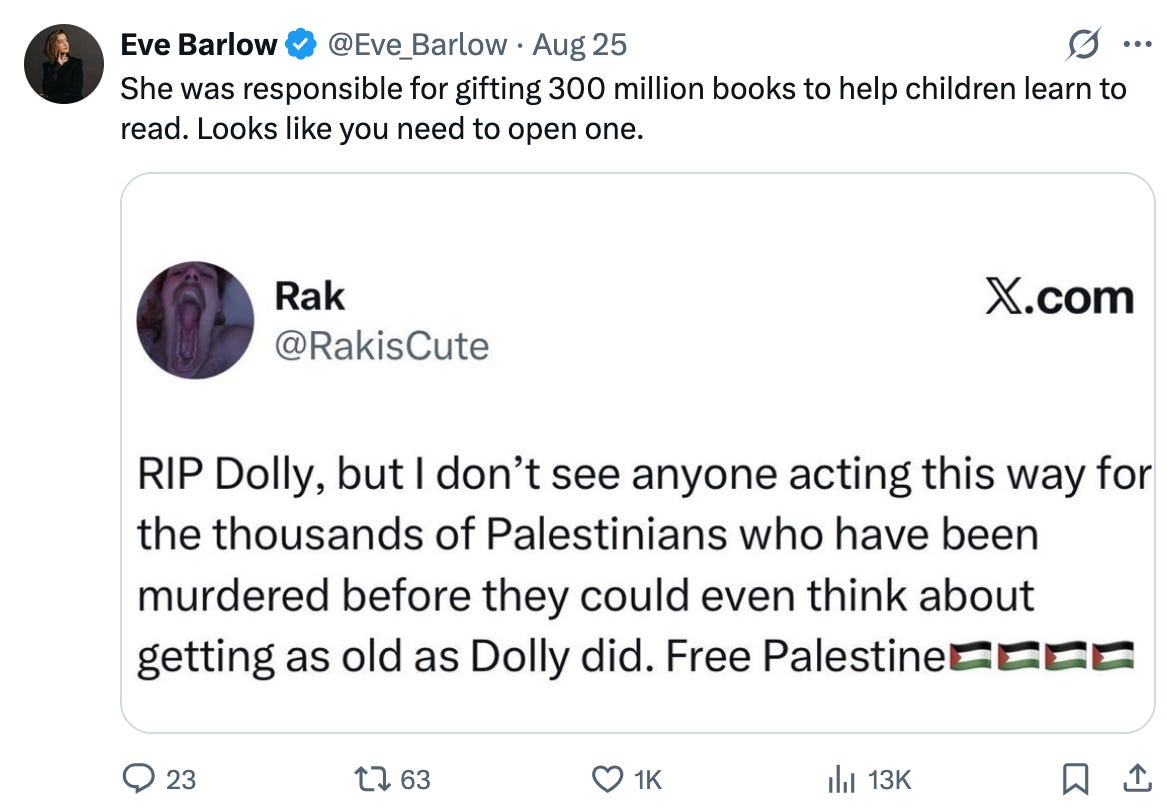
I didn't really want to acknowledge it on the day, but I imagine some of you also noticed that there was a trend going around by a bunch of content creators saying “the wrong white people are dying” and “the wrong 80 year old white person died”. They couldn't even wait an hour. They did it instead of sharing anything of Dolly’s legacy (presumably they don’t have any class, taste, or brain cells). If any of them knew a thing about the spirit of Dolly Parton, they wouldn't have dared. She represented an America that is long dead. An America where everyone could put their differences aside. That is the only America that I want to fight for.
She united everyone and barked if you tried to make her say something political. In a charming way, of course. I loved her and I was also a little afraid. Which is how you should be around Southern women.
I met Dolly in St Louis. I joined her out on the road in the summer of 2016, ten years ago for The Times. The full piece is below…
Dolly Parton: “Women are so much smarter than men. We work extra hard to prove it. We have to.”
In St Louis, Missouri, at a hockey arena that overlooks the Mississippi, Dolly Parton is about to sing the opening lines of I Will Always Love You. It should begin,“If I should stay, I’ll only be in your way …” but Dolly halts proceedings because something has got in her way. “Hold up, I think I sucked a bug down ma throat!” That’s the last thing 2016 needs: Dolly Parton suffocated by a mosquito onstage in the Midwest. With her self-deprecating humour and still holy vocals, indestructible Dolly laughs it off. She launches into the ballad that made America’s queen of country rich three times: once in 1974, again in 1982 and, most obviously, via Whitney Houston and The Bodyguard in 1992 (four times if you count the surge when Houston was found drowned in a Beverly Hills hotel tub in 2012). Notably it was never sung by Elvis, who was also keen to cover it. The mastermind of her own career, Parton refused to let that hound dog put his name to it when Presley’s manager demanded 50% of the publishing rights and royalties.
Elvis and Whitney have since left the building. Parton, on the other hand, is on her first proper tour in 25 years. Sixty-four dates across America will bank just over $3m (£2.25m) and touch 35,000 souls. Alongside Jolene, Islands in the Stream and 9 to 5, she’s delivering all the pan-generational karaoke hits – in what amounts to a quadruple-D year. In 2016, the singer-songwriter, actress, philanthropist, gay icon and “hillbilly Dalai Lama” turned 70; she renewed her vows on the 50th anniversary of her marriage to her mysterious husband, Carl Dean (still never seen in public); she’s celebrating six decades in the business (100m records sold) and has wished her Dollywood theme park a happy 30th birthday. During a politically precarious time for the United States, Dolly remains the answer to every American princess’s prayers.
“I get my music from my momma’s side,” she tells the crowd, recalling how she left home for Nashville at 18 to pursue her singing dreams. In the early days, she would sometimes sleep in her Uncle Bill’s car, putting on her make-up in the vehicle’s wing mirror. She was raised in the Smoky Mountains of Tennessee, the fourth of 12 children of Robert Lee Parton, an illiterate yet resourceful farmer, and Avie Lee, who sewed the jacket that informed Dolly’s Coat of Many Colors tune. She tells the audience about making her first record when she was 10 and singing at Nashville’s Grand Ole Opry. The morning after graduating from high school, she left on a Greyhound bus with “a sack o’ songs and a head full o’ dreams”. Tonight, she sings many of them a cappella in perfect pitch. St Louis is one stop on a swamp tour of the USA, the kind you embark upon as a whippersnapper country artist spreading the word the old-fashioned way, sucking up bugs between beers. “We wanted to do something pure and simple,” Dolly explains — and Pure & Simple is the title of her 43rd album, released this week.
It’s so pure and so simple, she doesn’t even have a drummer on her tour bus. Dolly plays more instruments than her three onstage silver fox compadres combined: piano, several types of guitar, a fiddle, a flute, a harmonica and a miniature saxophone (I’m not actually convinced she was tooting that). Each instrument is white and augmented by rhinestones. But they don’t outsparkle Dolly, who gleams like a human mirror ball. “My drummer said, ‘Are you going to get rid of all that make-up and your rhinestones?’ I said, ‘Are you crazy?’ So that’s why we have a vacant spot. He’s back in Nashville trying to take a five-inch rhinestone heel outta his butt!” The fans roar with laughter. She points at a drum machine, purchased at her local RadioShack, America’s equivalent of Comet. “We’ve saved a lotta money: $47 as opposed to the $47,000 I’d have paid him to be here.” Dolly may be renowned for her phrase “it costs a lot to look this cheap”, but she’s not spending money where it can be saved.
She didn’t intend to tour in 2016 and you wonder what possesses her to do this. Having played a handful of shows in America in 2011 and early 2014, the Glastonbury Festival in June that year proved a career high: Dolly drew the biggest crowd of the weekend, with about 100,000 people enjoying her Sunday-afternoon hits marathon. Despite her reception in the UK, she’s said she wasn’t convinced anyone at home wanted to see her again. She was wrong: crowd reaction on the tour has exceeded expectations. Even so, there are moments when she doubts herself. “I’m a human being. I feel everything to the core,” she told me before the show. “But I refuse to harden my heart.”
“D-minus three!” says one of a trio of publicists, signalling the countdown to my encounter earlier that morning. Backstage, next to Dolly’s “massage” room, I wait in a room that has all the warmth of a morgue. It’s 11:15am and Dolly, who is always prompt, is running seven minutes behind due to a lighting problem while filming something for broadcast. A shadow from one hair on her wig is being a pest, a quintessential Dolly issue. One of her team sits in Dolly’s preassigned armchair. “She’ll probably sit like so,” he says, crossing his legs. We await news via walkie-talkie of how far Dolly has progressed with her outfit change. “She needs to put some pants on so the men can’t look up her skirt,” someone explains, helpfully.
And in pants she arrives. Denim, studded with glimmering trinkets, and matching crystal-strewn shirt. As Dolly enters, the room brightens. Suddenly I feel like a leprechaun inside a rainbow. She grabs my hand and apologises for how cold hers is; her pink acrylic talons wrap around my wrist like extended icicles. “I been holdin’ onto this bottle o’ water!” she explains, in that high-pitched Dolly shrill that doesn’t come towards you but shoots heavenwards like a helium-filled balloon. Her make-up is thick and shiny, like a toddler in a beauty pageant. You can only know her to an extent, but she immediately senses a deep connection. “You’re Sco’ish!” she says, mimicking my accent. “Well, so am ahh!” Are you, I ask, sure that she’s part Cherokee, mostly all-American. “I’m a mixture,” she smiles. “I love people. I am people. I love that song by … is it Whitney? I’m Every Woman?” Chaka Khan, I say. “Oh well, I’m like every person. I see my family in everybody. Y’all remind me of a brother or a sister of mine. Like my momma, I home in, try to cater to you however I can.”
Dolly remains an inspiration to young recording artists. Lily Allen, Adele and Grimes all sing her praises, while the superstar rappers Drake and Nicki Minaj reference her on their collaborative track Make Me Proud (“Double D up hoes, Dolly Parton,” goes the line – a compliment). I am the envy of everyone I speak to: young songwriters, music A&Rs, teenage pop wannabes and obscure indie bands back in LA where I live are desperate to accompany me to meet her. “Dolly! Hashtag jealous,” they gasp. This year, at the Country Music awards, Katy Perry asked to sing Jolene with her. Parton gave a masterclass performance to a room filled with country’s modern heroes, including Tim McGraw and Carrie Underwood.
And Dolly loves them all right back. “Katy Perry is a wonderful artist, beautiful girl,” she says. She recalls meeting Taylor Swift – arguably her most likely heiress – back in the Nashville days. “What Taylor Swift has done to keep herself together and be such a hero for the young is amazing. Smart girl.” Perry and Swift are huge rivals. In an age where a Twitter endorsement is the official form of high praise, I wonder why Dolly follows Perry’s account but not Swift’s. “Oh, I don’t know any of those girls,” she says. “I’m more in Miley [Cyrus]’s corner because I’ve known her since she was a baby. She is my goddaughter, of course. Isn’t she precious? But I don’t pick favourites. I’m too old for that!”
While Dolly never has a bad word to say about anyone, she has better words to say about a few. The one artist who’s achieved the highest Dolly stamp of approval is Adele, name-checked on a new song, Head Over High Heels: “I painted my lips red, and my eyes like Adele.” Dolly laughs that lyric off, claiming it was a happy accident, not an invitation for a collaboration. “I love Adele. Love her,” she says, eyes sparkling. “I relate to her like she’s somebody I’ve always known. Some day we may get together, write, sing something, wouldn’t that be great? I think we both want that actually.”
Without Dolly, the road to female music success would not have been so well paved. One of Parton’s initial hits, 1967’s Dumb Blonde, announced her arrival by weaponising her femininity. “This dumb blonde ain’t nobody’s fool,” she cooed. Dolly played the game on her own terms. She got her break on the Porter Wagoner TV show at the age of 18. “I had to prove myself to him. He was a country boy with that inbred male chauvinism,” she says. She came along not just singing songs, but writing them, and having business acumen, which rubbed Wagoner up the wrong way. “I wasn’t trying to take over his career, I was trying to take over ma own!” Dolly didn’t want to get what she calls “hick-rich”. “I wanted to invest, keep my publishing, build my own label, keep control of my masters.” Her most famous hit, 9 to 5 (also in the Jane Fonda film of the same name), is an anthem about equal pay. “I agreed to act in that movie on the condition I got to write the theme tune,” she laughs. “Women are so much smarter than men in high places.” Even today, Dolly is often the only “girl” at a boardroom table. “We work extra hard to prove it. We have to.” For Dolly her female qualities have always been a business resource, a mentality gleaned as much from her daddy who farmed land as from the local hookers she nabbed her wardrobe ideas from. I suggest she’s a feminist, and she recoils. “That’s a political word. I hate controversy.”
St Louis is one of America’s most violent cities. The tension between white and African-American communities has mounted since the killing of Mike Brown in 2014 in Ferguson, 10 miles from where Dolly is playing tonight. The venue is a stone’s throw from the site of a Donald Trump rally in March that saw 31 people arrested after clashes between protesters and supporters outside the venue. Tonight is a sea of white faces. Jesus protesters are outside, telling people they’re going to hell. For Dolly, a woman who “loves everyone”, this backwoods tour has meant skirting around some blazing issues. There’s a lot at stake: six decades’ worth of a brand that’s satisfied a cross-section of society, many of whom are at war with each other. Perhaps that’s why she’s publicly remaining on the fence about who she’s voting for. “I have not endorsed Hillary, nor Trump,” she tells me. “They’ve both got a lot to show me. I keep my eyes, ears, heart and head open and I’ll vote for whoever I think does the best job. My mom was a Democrat, my dad was a Republican. Me?” she shrugs. “I guess I’m a Hypocrat!”
Joking aside, Dolly has no choice but to employ UN level degrees of diplomacy. She repeats a gag tonight that she debuted in New York. “Can you believe all the craziness going on in the election? I been thinking about running myself! I got the hair for it and we could use some more boobs in the race.” In New York, she delivered the joke to a 25%-30% LGBTQ audience at the tail end of Pride week, with completely different connotations. I guess Dolly, a genius wordsmith, composes hers to be spun as a one-size-fits-all.
Even with her gay following, it’s getting trickier to be the happy-go-lucky spokeswoman. I ask for her thoughts on the Bathroom Bill, a piece of legislation in North Carolina that requires transgender individuals to use restrooms based on the sex they were assigned at birth, and am surprised at her defensive response. “Look here, I am not gay. I have a lot of gay and lesbian fans, but I am not their poster child. I have a whole lot of Bible thumper fans too - they want to crucify me.” She’s equally hurt by their fanatical assertions. “As Christians, we’re not supposed to hammer people down, we’re supposed to lift them up.” Unlike Bruce Springsteen and Ringo Starr, Dolly didn’t cancel her North Carolina date. “I got onstage and said, ‘If anybody out there needs to pee, I have four tour buses out back.’ I serve more purpose onstage than off. I’m all for letting people be who they are. Doesn’t matter if you’re a man or a woman, black, white, green, yella or alien grey.”
Easier for Dolly are matters of a more personal nature because she simply shuts them down. When she and her husband renewed their wedding vows in May, they took pictures - finally some evidence of Carl’s existence. He also did his first interview. The plan was for Dolly to auction the words and pictures off to the highest bidder to raise money for children’s charities. Unfortunately, she says, they have yet to receive a high enough offer to make it worthwhile. “For now I’ve put the pictures in a wedding book. I’m gonna keep Carl private.” She tells me nothing additional about him other than “he’s very funny”. I suggest she must look at Kim Kardashian and Kanye West blasting their private lives all over the TV and think they’re bonkers. “That has been productive for them, they live like that. I couldn’t do that. I could do a reality TV show if it was Dolly on the road, behind the scenes. Not my personal life. Oh heavens no!”
Reports say Carl has only seen Dolly perform live once. When she introduces Jolene onstage later, she jokes about the flame-haired female bank teller who inspired it by trying to muscle in on her husband. “That red-headed gal didn’t get my man. I did a lot of banking after that, but not with her bank.” Her onstage persona must be difficult for him to enjoy. Dolly flirts with all the fellas. “Mercy! Check out my sexy cowboy assistant,” she says as a camp buckaroo brings her a freshly tuned gee-tar. “Pretty, ain’t he, girls? Ain’t he, boys? I said I was married for 50 years. I didn’t say I was blind and dead!”
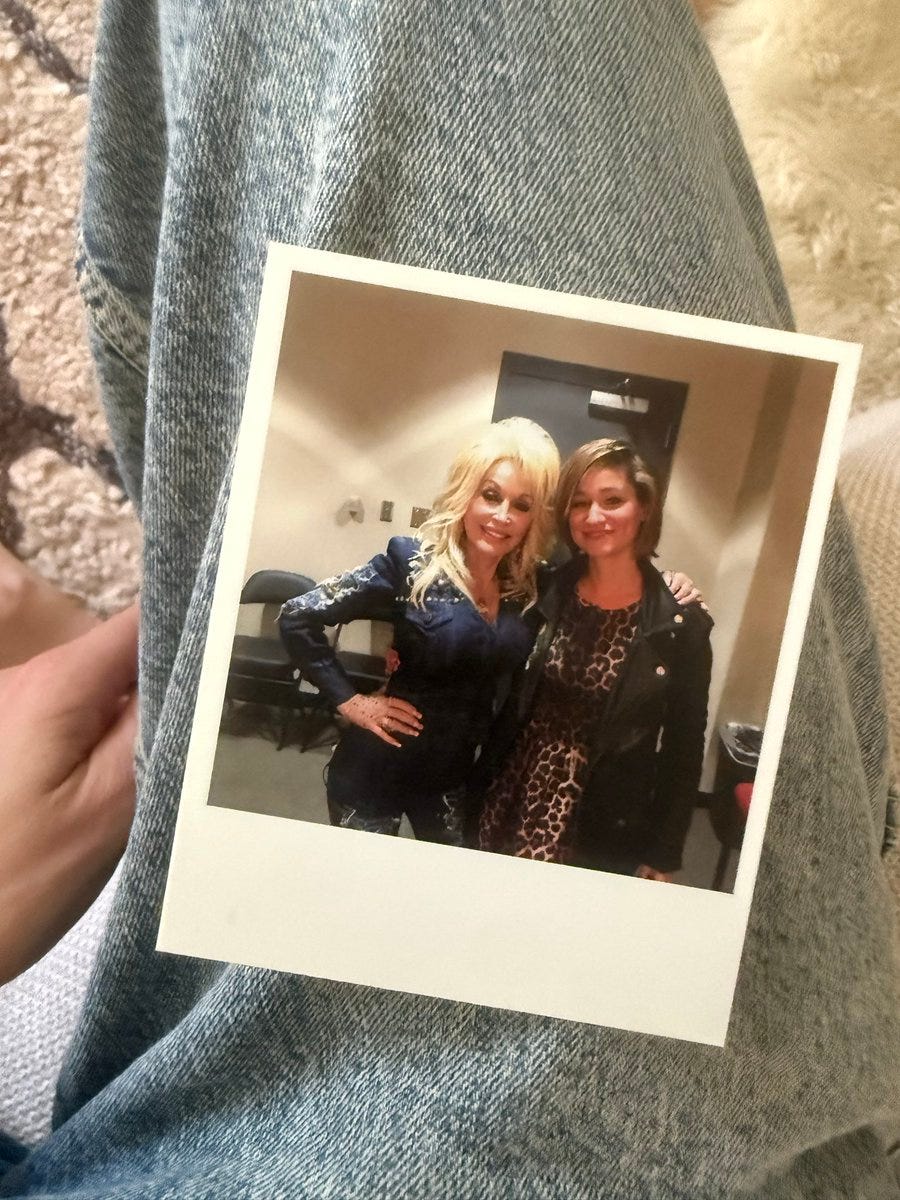
One of the tracks on her album, Can’t Be That Wrong, is a documentation of adultery. Dolly, is it time to come clean about all those rumoured affairs? “Oh! That’s a cheatin’ song!” she smiles. “I’m a songwriter first and foremost. People say, ‘You must’ve lived through this to have sung that.’ I choose stories, even some things I haven’t lived. Most of it I have! I don’t deny or admit anythang.” She laughs nervously. With everything wrapped, I’m invited to have my picture taken. When I survey the photo afterwards, I realise my hand is reaching round towards her goods. I could swear it was on her back. Maybe even her shoulder. Dolly never flinched. Dolly Parton’s chest — gatekeeper of her heart — craves the attention.
To support Blacklisted please subscribe for $10/month or $100/year.
No posts
Comments
Nothing yet. Say the first thing.
Sign in to join the conversation.