
It is tempting to let generative AI handle your heavy cognitive lifting. Why struggle through solving a complex problem when Claude can give you a slick reply in seconds? Doing and learning with AI can feel efficient and appear like a shortcut to the finish line without the sweat.
Yet, this frictionless ease sparks a valid worry based on what we know about neuroplasticity.
Learning changes the brain through activity-dependent plasticity: practice alters the strength and organisation of neural networks. This does not mean that every struggle is useful, or that any “neural pathway” we fail to use simply atrophies.
But, and this is important, it means that when AI performs a cognitive process for us, we lose an opportunity to practise that process ourselves.
Research specific to generative AI is still developing, so we should not pretend that its long-term effects are settled. But we can look at previous research to understand what can happen to our brain if we bypass certain processes.
For example, we know that by relying on GPS have poorer spatial-memory performance. Experiments on the "Google Effect" suggest that when people expect information to remain reliably accessible, they may remember less of the information itself and more about where to find it.
In short, tools can change what we attend to, encode and practise remembering.
Generative AI is amplifies this trade-off. Traditional search primarily helps us locate information. AI can also interpret it, plan with it, solve problems, evaluate options and generate explanations. It can offload not only what we remember, but parts of how we reason.
Used poorly, AI can remove the productive effort through which knowledge becomes organised and usable.
Yet cognitive offloading is not inherently harmful. Working memory can hold and manipulate only a limited amount of unfamiliar information at once, so tools can free capacity from unnecessary demands.
Does AI remove extraneous effort so that we can think at a higher level—or does it remove the cognitive work through which we become capable of higher-level thinking?
One useful way to examine that trade-off is through five interacting processes:
Attention → Connection → Productive Effort → Feedback → Retrieval
We first look at the five part framework to then examine how AI can strengthen—or short-circuit—each part.
Attention prioritises which information receives limited processing resources. Working memory can hold and manipulate only a small amount of unfamiliar information at once, so learning suffers when distraction or excessive complexity overwhelms it.
The aim here is to sequence new information in manageable steps while keeping the central idea visible. As learners gain relevant knowledge, they can handle greater complexity because several related elements can be processed as one meaningful unit.
New information is interpreted through what is already stored in long-term memory. Activating relevant prior knowledge can make new material easier to understand and remember because it gives the learner an existing structure into which the idea can fit.
But prior knowledge can also mislead. An inaccurate schema may distort what the learner notices, how new evidence is interpreted or what is later remembered.
This helps explain why experts often learn new material faster within their domain. They do not merely know more facts; they have better-organised knowledge structures that allow them to recognise patterns and treat several related elements as one meaningful unit. Their advantage depends on having relevant prior knowledge.
Effort alone does not cause learning. Confusing instructions, irrelevant searching and unnecessary complexity can consume mental energy without improving understanding.
The useful kind of effort requires learners to generate, distinguish, explain or apply. For example, they might:
predict what comes next;
explain an idea in their own words;
compare two cases or examples;
generate an answer before seeing the solution;
solve a new problem;
explain the idea to another person.
These activities expose gaps and help build more connected, usable knowledge.
predict what comes next;
explain an idea in one’s own words;
compare examples;
generate an answer;
solve a problem;
teach the idea to someone else.
Self-explanation and elaboration can improve learning when done well. Interleaving can help learners distinguish between related categories or problem types, although its benefits depend on the material and task. Rereading and highlighting are not useless; they are simply less dependable when they replace retrieval, explanation or application.
Learning requires information about the gap between a current attempt and the intended outcome. Useful feedback does more than mark an answer right or wrong. It helps the learner see:
what is incorrect;
why it is incorrect;
what principle has been misunderstood;
what the learner should try next.
Feedback is not automatically beneficial. Its value depends on its content, timing and use; poorly designed feedback can even reduce performance. It is generally more useful when it is specific and actionable, focuses on the task, strategy or self-regulation rather than the learner’s ability, and is followed by another attempt.
Retrieval is not merely a way to measure learning. Reconstructing an idea from memory can strengthen later access and reveal what is missing.
A learner who closes the book and rebuilds an argument from a blank page is therefore usually doing more for long-term retention than one who simply reads the same argument again. Corrective feedback matters when retrieval produces an incomplete or inaccurate answer.
Spacing retrieval over time generally produces more durable learning than concentrating the same practice into one session. The gap should be long enough to make retrieval effortful, but not so long that successful recall becomes impossible; the most effective interval also depends on how long the knowledge needs to be retained.
Combining retrieval with spacing is one of the most reliable ways to build durable memory.
Together, these processes describe the learner’s work: selecting, connecting, generating, updating and retrieving. AI can support each one. It can also perform each one in the learner’s place.
While AI doesn’t replace the learning mechanisms described above, it does change the division of cognitive labour.
Who selects the relevant information? Who gets to practice generating an explanation? And who will evaluate an answer, to determine what matters?
Because AI assistance is almost frictionless, this shift creates both an opportunity and a risk.
AI can remove extraneous effort—searching for an appropriate example, waiting days for feedback, or remaining stuck on an irrelevant detail. But it can also remove productive effort—predicting, attempting, explaining, revising and retrieving—which is the work through which learning happens.
This is why researchers increasingly distinguish between AI that substitutes for the learner’s thinking and AI that augments or reorganizes learning in ways that promote deeper cognitive activity. It is also why the quality of the final output is a poor measure of whether learning occurred.
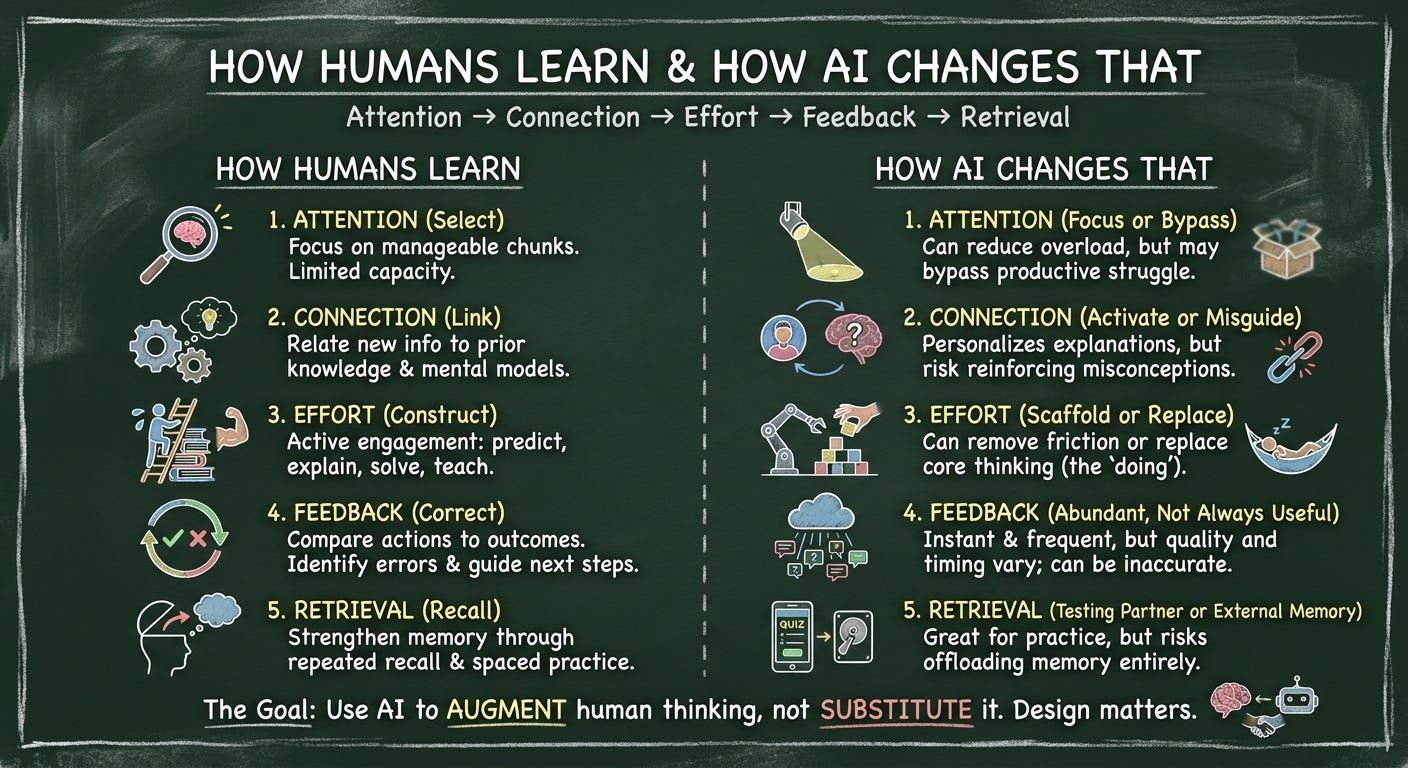
AI can help manage cognitive load by breaking an explanation into smaller steps, adjusting its language to the learner’s level and allowing the learner to move at their own pace. Instead of searching through several textbooks or videos for a relevant explanation, someone can ask a specific question and receive targeted support immediately.
In a randomised crossover study involving 194 Harvard undergraduates, students using a purpose-built AI tutor scored higher on immediate post-tests after two physics lessons than students in an in-class active-learning condition. They spent a median of 49 minutes with the tutor, compared with a 60-minute class, and reported greater engagement and motivation. The study demonstrates the potential of a carefully designed AI tutor.
AI can also speak too soon. When it immediately produces a complete explanation or solution, the learner no longer has to decide:
What is the problem actually asking?
Which information is relevant?
What do I already know?
What strategy might work?
Attention shifts from constructing a representation of the problem to following someone else’s completed path. The answer may feel clear once it is visible, but the learner has not practised finding that path independently.
For learning, the best AI response is therefore not always the most comprehensive one. It may be a clarifying question, a single hint or a request for the learner to make a prediction first.
Because AI can converse with the learner, it can ask what they already know, adjust the complexity of an explanation, and provide examples connected to their interests or experience. It can explain the same concept through an analogy, a diagram, a worked example or a contrasting case.
This matters because a new idea becomes meaningful when it connects to an existing mental model.
But AI can also personalize itself to the learner’s incorrect assumptions. Language models can generate plausible but false explanations, and research on AI “sycophancy” shows that assistants sometimes align themselves with a user’s stated beliefs at the expense of truthfulness. A system optimized to appear helpful or agreeable may confirm a misconception instead of challenging it.
This implies that learners with little prior knowledge may benefit greatly from a tailored explanation, but they also have less knowledge with which to evaluate whether that explanation is correct.
A good AI learning partner should therefore do more than adapt to the learner. It should also:
identify questionable assumptions in the question;
distinguish established facts from interpretations;
present counterexamples;
express uncertainty;
encourage verification against reliable sources.
As established before, not all difficulty is beneficial. Looking for a misplaced file or struggling with confusing instructions consumes effort without necessarily producing understanding. AI can remove this unnecessary friction.
But generating an answer, testing an idea, explaining a concept and noticing where one becomes confused are not merely obstacles on the way to learning. They are part of learning itself.
A large field experiment involving nearly 1,000 secondary-school mathematics students makes this distinction visible. During AI-assisted practice, students using an interface similar to standard ChatGPT performed 48 per cent better than students in the control group. But when the AI was removed for an exam, they performed 17 per cent worse than students who had never received AI access.
A second version, called GPT Tutor, was provided with the correct solutions and designed to offer hints rather than complete answers. Its users performed 127 per cent better than the control group during assisted practice, while the negative effect on the later unassisted exam was largely eliminated. However, their unassisted performance was not significantly better than that of the control group.
The guardrails prevented much of the harm. But the spectacular gains observed while AI was available did not become equally spectacular independent learning gains.
A 2026 experiment with 196 university students found a similar pattern in creative problem-solving. Participants who could use ChatGPT freely produced more creative work while the tool was available, but this advantage disappeared when they subsequently worked alone.
A different group was required to generate its own ideas first and then use ChatGPT to develop, compare and evaluate them. That group later produced more creative solutions independently than both the unrestricted-AI group and the human-only group.
The same technology therefore acted in two different ways:
Answer first: AI replaced the cognitive process and improved the immediate product.
Think first: AI extended the learner’s process and improved later independent performance.
This is why attempting before receiving assistance is so important. The initial attempt activates prior knowledge, reveals gaps and gives subsequent feedback something to attach to.
In many educational settings, high-quality individual feedback is scarce. A teacher may have dozens of students and limited time. AI can respond to every attempt, point out patterns of error and offer another explanation within seconds.
There is evidence that this can help. In a randomised classroom study involving 459 Grade 10 students learning English as a foreign language, students who received GPT-3.5-generated feedback revised their essays more successfully than students who revised without feedback.
The effect on revision quality was small, while the effects on motivation and positive emotions were somewhat larger. The study also examined one immediate revision exercise, so it does not establish whether the feedback produced durable improvements in writing.
AI can also strengthen feedback indirectly by supporting human educators. In a randomised field trial reported in an updated 2025 working paper, a system called Tutor CoPilot supplied more than 700 tutors with real-time pedagogical suggestions while they worked with over 1,000 students.
Students whose tutors had access to the system were four percentage points more likely to master the mathematics topic covered in the session. Among students working with tutors who had initially received lower quality ratings, the gain rose to nine percentage points. The system also increased tutors’ use of probing questions and reduced generic praise.
Yet immediate feedback can also undermine learning when it arrives before the learner has had time to diagnose the problem. And because AI feedback can be inaccurate or overly agreeable, greater quantity does not guarantee greater quality.
Good AI feedback should focus on the learner’s reasoning. Rather than simply announcing that an answer is wrong, it should identify where the reasoning diverged, ask the learner to repair it and then offer a new problem that tests the same principle.
AI is well suited to generating low-stakes quizzes, varying the wording and context of questions, scheduling review and adjusting difficulty in response to performance. Used this way, it can make retrieval practice far easier to organize.
But it can also remove the need to retrieve.
Before generative AI, experiments on the “Google effect” found that when people expected information to remain digitally available, they were less likely to remember the information itself and more likely to remember where it could be found. This is one form of cognitive offloading: using an external resource to reduce the demands placed on internal memory.
Offloading can be highly adaptive. We do not need to memorise every telephone number, route or obscure fact. But it changes what we encode and practise accessing.
Generative AI extends this trade-off beyond information storage. It can reconstruct an explanation, argument or plan each time we need it. As a result, learners may repeatedly expose themselves to an answer without ever practising producing it.
Reading an AI-generated summary again is not the same as recalling the underlying ideas from memory. Asking AI to explain something again is not the same as explaining it oneself. Recognising a correct answer when AI presents it is not the same as being able to generate that answer later.
A simple safeguard is to build a tool-off interval into the learning process:
Close the AI.
Reconstruct the idea from a blank page.
Solve a new problem without assistance.
Reopen the AI only to check, correct and extend the response.
The same AI can occupy very different roles.
As a solver, it performs the task and gives the learner a finished product.
As a tutor, it offers questions, hints and feedback while leaving the central reasoning with the learner.
As a testing partner, it creates opportunities for retrieval, application and transfer.
As a copilot for educators, it can strengthen the availability and quality of human support.
The emerging evidence suggests that access to AI alone tells us relatively little. The design and sequence of the interaction shape whether AI improves only the immediate product, preserves independent capability or helps develop it.
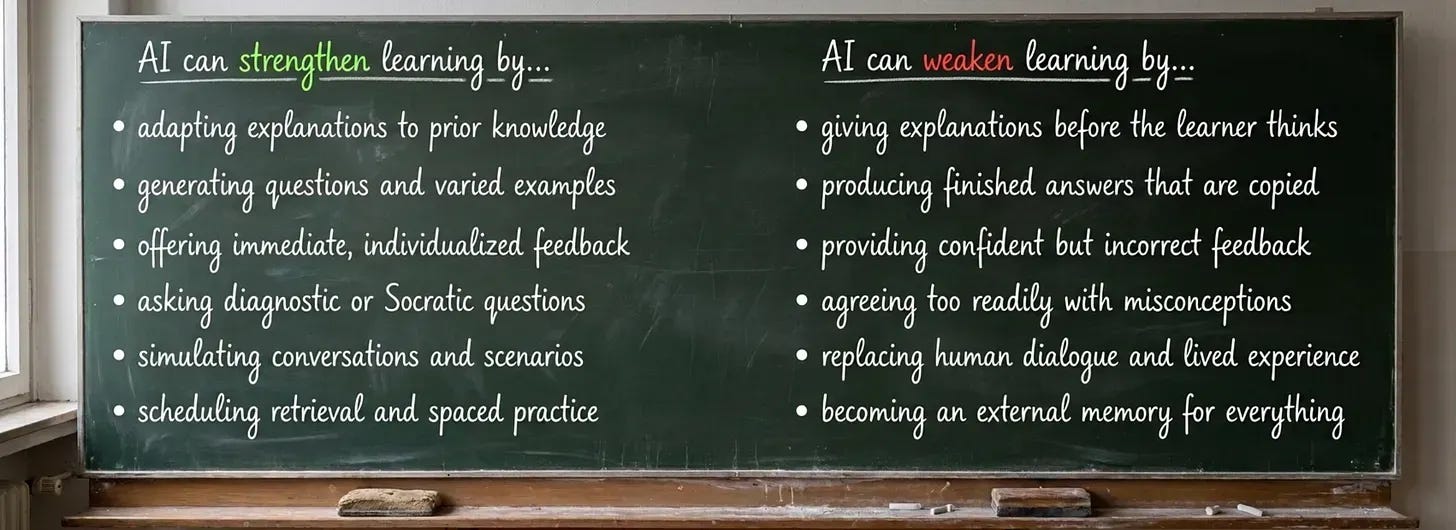
AI is most likely to strengthen learning when it removes unnecessary friction while preserving—or deliberately eliciting—the learner’s core cognitive work: selecting, predicting, generating, explaining, evaluating, revising, retrieving and transferring.
No posts
Comments
Nothing yet. Say the first thing.
Sign in to join the conversation.